%%{init: {'theme': 'base', 'themeVariables': { 'primaryColor': '#2C3E50', 'primaryTextColor': '#fff', 'primaryBorderColor': '#16A085', 'lineColor': '#16A085', 'secondaryColor': '#E67E22', 'tertiaryColor': '#ECF0F1'}}}%%
flowchart TB
    subgraph Physical["1. Physical Domain"]
        PHYS[Physical Phenomenon<br/>Temperature, Light, Motion]
    end

    subgraph Sensor["2. Sensor Transduction"]
        TRANS[Transducer<br/>Convert to Electrical]
        ANALOG[Analog Signal<br/>0-3.3V or 4-20mA]
    end

    subgraph Conditioning["3. Signal Conditioning"]
        AMP[Amplification<br/>Op-Amp Gain Circuit]
        FILTER[Filtering<br/>RC Low-Pass Filter]
        LEVEL[Level Shifting<br/>Voltage Divider]
    end

    subgraph Conversion["4. Analog-to-Digital"]
        ADC[ADC Conversion<br/>12-bit: 0-4095 counts]
        CALIB[Calibration<br/>Apply correction factors]
    end

    subgraph Processing["5. Digital Processing"]
        AVG[Software Averaging<br/>Reduce noise]
        SCALE[Scaling/Mapping<br/>Convert to real units]
        THRESH[Thresholding<br/>Decision logic]
    end

    subgraph Output["6. Output/Action"]
        DISP[Display<br/>Show reading]
        ACT[Actuator Control<br/>Relay, motor, LED]
        NET[Network Transmission<br/>MQTT, HTTP]
    end

    PHYS --> TRANS
    TRANS --> ANALOG
    ANALOG --> AMP
    AMP --> FILTER
    FILTER --> LEVEL
    LEVEL --> ADC
    ADC --> CALIB
    CALIB --> AVG
    AVG --> SCALE
    SCALE --> THRESH
    THRESH --> DISP
    THRESH --> ACT
    THRESH --> NET

    style Physical fill:#E67E22,stroke:#2C3E50,color:#fff
    style Sensor fill:#16A085,stroke:#2C3E50,color:#fff
    style Conditioning fill:#16A085,stroke:#2C3E50,color:#fff
    style Conversion fill:#2C3E50,stroke:#16A085,color:#fff
    style Processing fill:#2C3E50,stroke:#16A085,color:#fff
    style Output fill:#7F8C8D,stroke:#2C3E50,color:#fff
526 Signal Conditioning for Sensors
526.1 Learning Objectives
By the end of this chapter, you will be able to:
- Design Signal Conditioning Chains: Create complete pipelines from raw sensor output to ADC-ready signals
- Calculate Amplifier Gain: Determine required gain to utilize full ADC range for maximum resolution
- Implement Wheatstone Bridges: Use bridge circuits for precision resistance measurements
- Apply Worked Examples: Follow step-by-step calculations for real thermistor and strain gauge interfaces
- Select Appropriate Components: Choose instrumentation amplifiers and filter components for specific applications
526.2 Introduction
Raw sensor outputs are rarely suitable for direct connection to microcontroller ADCs. Signals may be too weak (millivolts from thermocouples), too noisy (interference from motors), or at the wrong voltage level (5V sensors on 3.3V MCUs). Signal conditioning transforms these problematic signals into clean, properly scaled inputs for accurate digital conversion.
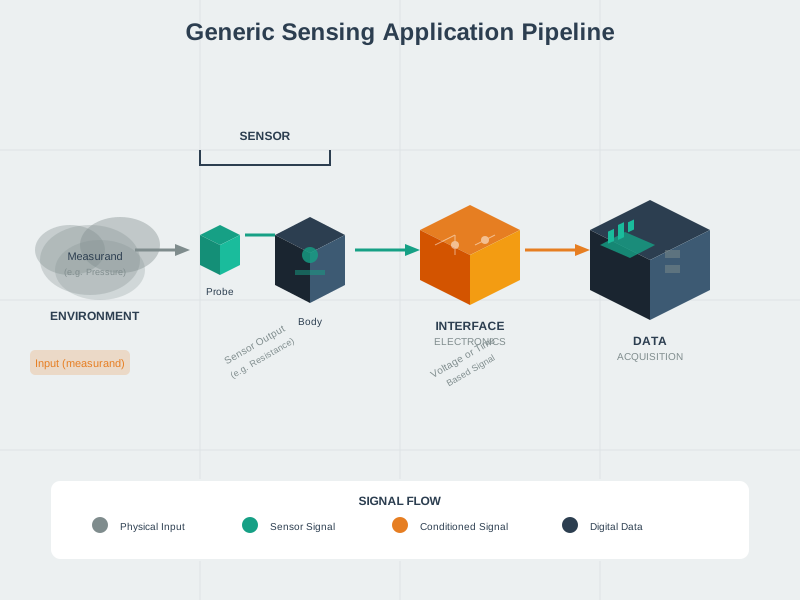
526.3 Signal Processing Pipeline Overview
Before designing individual circuits, understand the complete signal path:
{fig-alt=“Complete sensor signal processing pipeline showing six stages: (1) Physical domain capturing phenomena like temperature and light, (2) Sensor transduction converting to electrical signals (0-3.3V or 4-20mA current loops), (3) Signal conditioning with op-amp amplification, RC low-pass filtering, and voltage divider level shifting, (4) Analog-to-digital conversion using 12-bit ADC (0-4095 counts) with calibration correction factors, (5) Digital processing including software averaging for noise reduction, scaling to real-world units, and thresholding for decision logic, (6) Output stage distributing data to display, actuator control (relay/motor/LED), and network transmission via MQTT/HTTP protocols. Each stage flows sequentially from physical measurement to IoT action.”}
Key Pipeline Stages:
| Stage | Purpose | Example Components | Typical Issues |
|---|---|---|---|
| 1. Physical | Measure real-world phenomenon | Temperature, light, pressure | Environmental interference |
| 2. Transduction | Convert to electrical signal | Thermistor, LDR, piezo sensor | Sensor drift, non-linearity |
| 3. Conditioning | Prepare signal for ADC | Op-amps, RC filters, dividers | Insufficient gain, wrong cutoff |
| 4. ADC Conversion | Digitize analog signal | ESP32 12-bit ADC, ADS1115 | Noise, quantization error |
| 5. Digital Processing | Extract meaningful data | Averaging, Kalman filter | Algorithm complexity, latency |
| 6. Output/Action | Use the data | Display, relay, MQTT | Communication failures, delays |
Design Considerations:
%%{init: {'theme': 'base', 'themeVariables': { 'primaryColor': '#2C3E50', 'primaryTextColor': '#fff', 'primaryBorderColor': '#16A085', 'lineColor': '#16A085', 'secondaryColor': '#E67E22', 'tertiaryColor': '#ECF0F1'}}}%%
flowchart LR
    subgraph Decision["Design Trade-offs"]
        COST[Cost<br/>vs<br/>Performance]
        POWER[Power<br/>vs<br/>Accuracy]
        SPEED[Speed<br/>vs<br/>Noise]
        COMPLEX[Simplicity<br/>vs<br/>Features]
    end

    subgraph Solutions["Common Solutions"]
        S1[Hardware filtering<br/>$0.50 parts]
        S2[Low-power modes<br/>Duty cycling]
        S3[Software averaging<br/>64 samples]
        S4[Modular design<br/>Reusable blocks]
    end

    COST --> S1
    POWER --> S2
    SPEED --> S3
    COMPLEX --> S4

    style Decision fill:#E67E22,stroke:#2C3E50,color:#fff
    style Solutions fill:#16A085,stroke:#2C3E50,color:#fff
{fig-alt=“Design trade-offs flowchart showing four common sensor circuit design decisions and their practical solutions: Cost versus Performance solved with inexpensive hardware filtering using $0.50 resistor-capacitor components, Power versus Accuracy addressed through low-power duty cycling operating modes, Speed versus Noise managed with 64-sample software averaging to reduce signal variance, Simplicity versus Features balanced using modular reusable design blocks. Each trade-off decision links directly to its engineering solution approach.”}
526.4 Wheatstone Bridge
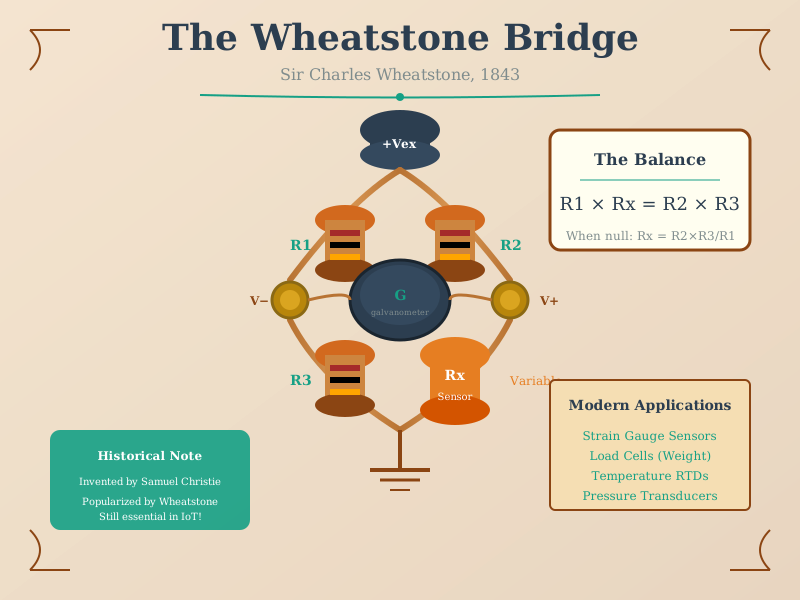
The Wheatstone bridge is a precision measurement circuit used with strain gauges, load cells, and other resistive sensors requiring high accuracy. It detects small resistance changes by comparing two voltage dividers.
Key Properties:
- Balanced condition: When R1/R2 = R3/Rx, output voltage = 0V
- Sensitivity: Small changes in Rx produce measurable differential voltage
- Applications: Strain gauges (weight scales), pressure sensors, temperature measurement
- Advantage: Common-mode rejection eliminates temperature drift and supply noise
526.5 Signal Conditioning Chain
Complete signal conditioning transforms raw sensor signals into clean, properly scaled inputs for ADC conversion.
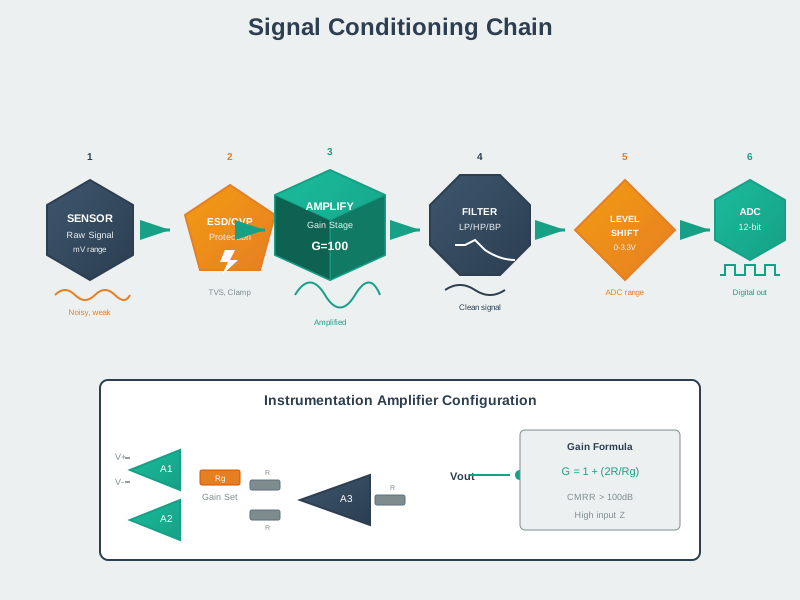
Each stage addresses specific signal quality issues:
| Stage | Function | Typical Components |
|---|---|---|
| Amplification | Boost weak signals to full ADC range | Instrumentation amplifier (INA219) |
| Filtering | Remove noise above Nyquist frequency | RC low-pass, active filters |
| Level Shifting | Match sensor output to ADC input range | Voltage divider, op-amp buffer |
| Buffering | Provide high-impedance input isolation | Unity-gain op-amp |
526.6 Worked Example: Thermistor Signal Conditioning
NoteWorked Example: Thermistor Signal Conditioning for HVAC Monitoring
Scenario: You need to measure room temperature (15-35C) using an NTC thermistor for a smart HVAC system. The thermistor output is only 20mV at 25C, but your ESP32 ADC needs 0-3.3V input.
Given: - NTC thermistor output: 10mV at 35C, 30mV at 15C (20mV range) - ESP32 ADC: 12-bit, 0-3.3V input range - Target: Use full ADC range for maximum resolution - Noise environment: Office with fluorescent lights (60Hz interference)
Steps:
Calculate required gain: To map 20mV range to 3.3V range: \[\text{Gain} = \frac{V_{ADC\_range}}{V_{sensor\_range}} = \frac{3.3V}{0.020V} = 165\] Use standard gain of 150 (close match with common resistor values)
Design instrumentation amplifier: Using INA128 with gain set by single resistor: \[R_G = \frac{50k\Omega}{G - 1} = \frac{50k\Omega}{149} = 335\Omega\] Use 332 ohm standard resistor (gives G = 151.6)
Design anti-aliasing filter: For 60Hz noise rejection and 1Hz temperature sampling: \[f_c = 10 \text{Hz (well below 60Hz noise)}\] \[RC = \frac{1}{2\pi f_c} = \frac{1}{2\pi \times 10} = 15.9 \text{ms}\] Use R = 16k ohm, C = 1uF (gives fc = 10Hz)
Level shift for offset: Since thermistor outputs 10-30mV, after 150x gain we get 1.5-4.5V. Add voltage divider to shift into 0-3V range.
Result: - Amplified signal: 1.5V (at 35C) to 4.5V (at 15C) - After level shifting: 0V to 3.0V (fits ADC range) - 12-bit ADC resolution: 3.0V / 4096 = 0.73mV per step - Temperature resolution: 0.73mV / (150 x 1mV/C) = 0.005C per ADC step
Key Insight: By using full ADC range through proper amplification, we achieve 200x better resolution than connecting the thermistor directly (which would use only 20mV of the 3.3V range).
526.7 Worked Example: Strain Gauge Bridge Amplification
NoteWorked Example: Strain Gauge Bridge Amplification for Load Cell
Scenario: A load cell for a beehive monitoring system uses a Wheatstone bridge with strain gauges. The bridge outputs only 2mV/V at full scale (50kg). You need to interface this with an Arduino Uno’s 10-bit ADC.
Given: - Load cell sensitivity: 2mV/V (with 5V excitation = 10mV full scale at 50kg) - Bridge output at 0kg: 0mV (ideally balanced) - Arduino ADC: 10-bit, 5V reference - Required accuracy: Better than 100g resolution
Steps:
- Calculate signal range:
- At 50kg: 2mV/V x 5V = 10mV
- At 0kg: 0mV
- Signal range: 0-10mV
- Determine minimum required gain:
- Arduino LSB: 5V / 1024 = 4.88mV
- To detect 100g (0.2% of 50kg): need 0.002 x 10mV = 0.02mV resolution
- Required gain to make 0.02mV visible: 4.88mV / 0.02mV = 244x minimum
- Use gain of 500x for safety margin
- Select instrumentation amplifier: HX711 (dedicated load cell amplifier)
- Built-in 128x gain option
- 24-bit ADC (much better than Arduino’s 10-bit)
- Includes filtering and offset compensation
- Calculate expected resolution with HX711:
- Full scale output: 10mV x 128 = 1.28V (within 0-2.5V input range)
- 24-bit ADC: 2^24 = 16,777,216 levels
- Weight per LSB: 50kg / 16,777,216 = 0.003g per step
Result: Using HX711 provides 0.003g resolution, far exceeding the 100g requirement. Practical accuracy limited by load cell drift and noise, typically achieving 1-5g repeatability.
Key Insight: For precision measurements like load cells, dedicated signal conditioning ICs (HX711, ADS1231) outperform general-purpose solutions. They combine optimized gain, filtering, and high-resolution ADC in a single chip designed for the specific application.
526.8 Signal Conditioning Images
526.9 Noise Sources and Mitigation
Understanding where noise enters the signal path helps design effective mitigation strategies.
%%{init: {'theme': 'base', 'themeVariables': { 'primaryColor': '#2C3E50', 'primaryTextColor': '#fff', 'primaryBorderColor': '#16A085', 'lineColor': '#16A085', 'secondaryColor': '#E67E22', 'tertiaryColor': '#ECF0F1', 'fontSize': '10px'}}}%%
flowchart TB
    subgraph SENSOR["SENSOR"]
        S1["Clean signal<br/>33mV"]
    end

    subgraph NOISE1["EMI from Motors/Wi-Fi"]
        N1["+ High-freq noise<br/>±5mV @ 50-100kHz"]
        M1["Mitigation:<br/>Shielded cables<br/>Twisted pairs"]
    end

    subgraph NOISE2["Ground Loops"]
        N2["+ 50/60Hz hum<br/>±10mV"]
        M2["Mitigation:<br/>Single-point ground<br/>Isolation"]
    end

    subgraph NOISE3["Thermal Noise"]
        N3["+ Random noise<br/>±0.1mV"]
        M3["Mitigation:<br/>Averaging<br/>Low-pass filter"]
    end

    subgraph FILTER["Signal Conditioning"]
        F1["RC Low-pass filter<br/>Removes >1kHz"]
        F2["Software averaging<br/>16-64 samples"]
    end

    subgraph RESULT["Clean Result"]
        R1["33mV ± 0.5mV<br/>Good enough for ADC"]
    end

    S1 --> N1
    N1 --> N2
    N2 --> N3
    N3 --> F1
    F1 --> F2
    F2 --> R1

    style SENSOR fill:#16A085,stroke:#2C3E50
    style NOISE1 fill:#E67E22,stroke:#2C3E50
    style NOISE2 fill:#E67E22,stroke:#2C3E50
    style NOISE3 fill:#7F8C8D,stroke:#2C3E50
    style FILTER fill:#2C3E50,stroke:#16A085
    style RESULT fill:#16A085,stroke:#2C3E50
TipMinimum Viable Understanding: Noise Sources in Sensor Circuits
Core Concept: Sensor signals are corrupted by three main noise sources - EMI (high-frequency interference from motors/radios), ground loops (50/60Hz hum from multiple ground connections), and thermal noise (random fluctuations inherent to all electronic components). Why It Matters: In industrial IoT deployments, unmitigated noise can produce ADC reading variations of 5-15% of full scale, causing false alarms, missed events, and unreliable control loops that waste energy or create safety hazards. Key Takeaway: Apply a two-stage defense - use hardware filtering (RC low-pass with cutoff above your signal frequency but below noise) to remove high-frequency EMI, then apply software median filtering to reject impulse spikes before averaging for thermal noise reduction.
526.10 Analog vs Digital Sensor Tradeoff
TipTradeoff: Analog Signal Chain vs Digital Sensor
Decision context: When selecting sensors for a new IoT design, choosing between raw analog sensors with custom signal conditioning versus integrated digital sensors with built-in ADC.
| Factor | Analog Signal Chain | Digital Sensor (I2C/SPI) |
|---|---|---|
| Power | Lower sensor power; conditioning circuit adds 1-10mA | Higher sensor power (built-in ADC, processor); 0.1-5mA typical |
| Cost | Lower sensor cost ($0.10-$5); conditioning adds $1-$10 | Higher sensor cost ($2-$30); minimal external components |
| Accuracy | Customizable; can optimize for specific application | Fixed by manufacturer; often excellent out-of-box |
| Flexibility | Full control over gain, filtering, sampling rate | Limited to manufacturer’s configuration options |
| Development Time | Longer (circuit design, PCB layout, calibration) | Shorter (library exists, drop-in replacement) |
| Noise Immunity | Susceptible to EMI on analog traces | Digital signals resistant to noise; shielded internal ADC |
| Board Space | Larger (op-amps, capacitors, resistors) | Smaller (single IC, minimal passives) |
Choose Analog Signal Chain when:
- You need maximum flexibility in signal conditioning (custom filters, gains)
- Lowest component cost is critical at high volumes (10,000+ units)
- You require non-standard sampling rates or resolutions
- The sensor type is only available as analog output (legacy, specialized)
Choose Digital Sensor when:
- Development speed is prioritized over ultimate optimization
- You need reliable, calibrated measurements without sensor expertise
- PCB space is limited (wearables, miniaturized designs)
- EMI/noise environment is challenging (industrial, motor-heavy)
- Multiple sensors needed (I2C bus simplifies wiring)
Default recommendation: Digital sensors (I2C/SPI) for most IoT projects unless you have specific signal conditioning requirements that cannot be met by available digital sensors, or you are optimizing BOM cost at scale.
526.11 Ground Loop Pitfall
CautionPitfall: Ground Loop Noise in Multi-Sensor Systems
The Mistake: Running separate ground wires from each sensor back to the microcontroller, creating ground loops that inject 50/60Hz mains hum and motor noise into sensor readings.
Why It Happens: It seems logical to connect each sensor’s ground directly to the MCU ground pin. In reality, small voltage differences between ground points create circulating currents that couple noise into sensitive analog measurements.
The Fix: Implement star-ground topology:
- Single ground point: All sensor grounds connect to ONE central point near the ADC
- Ground plane: Use a copper pour on PCB as low-impedance ground reference
- Twisted pairs: Run signal and ground wires twisted together (3-4 twists per inch)
- Differential measurement: Use instrumentation amplifiers (INA128, AD620) for long cable runs
Specific values: - Ground loop voltage can reach 10-100mV in industrial environments - On 12-bit ADC (0.8mV/step), this adds +/-125 counts of noise - Twisted pair reduces magnetic pickup by 20-40dB - Adding 100nF ceramic capacitor from signal to ground at ADC input provides additional filtering
526.12 Visual Reference Gallery
TipSignal Conditioning Chain (Modern Style)
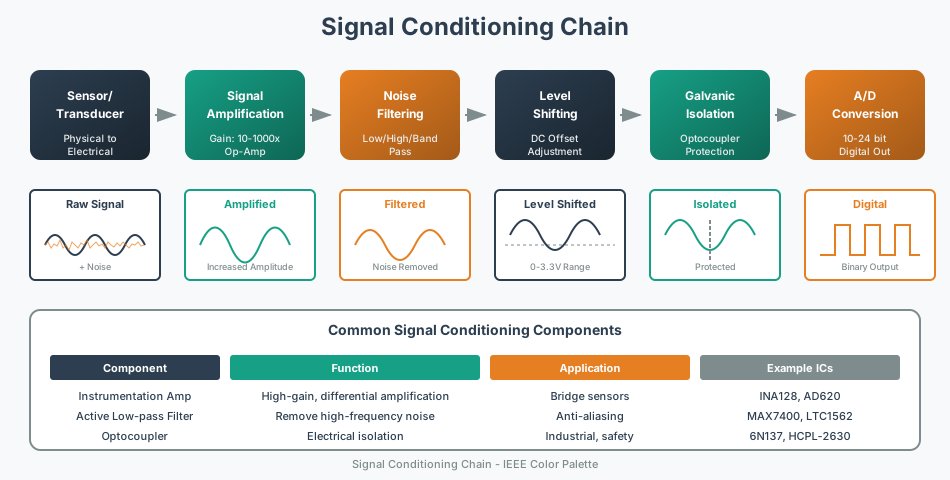
AI-generated modern visualization of the complete signal conditioning path for analog sensors.
TipVoltage Divider and Wheatstone Bridge (Geometric Style)
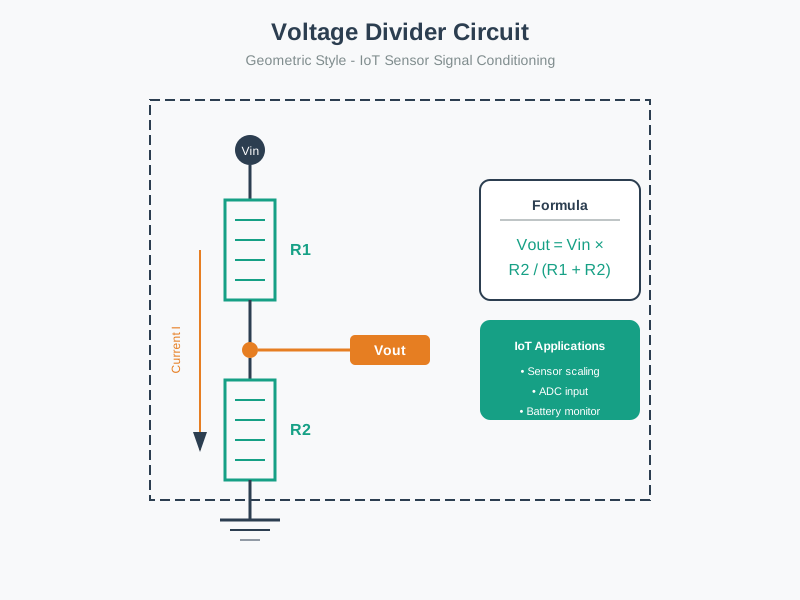
AI-generated geometric visualization of fundamental resistive sensor interface circuits.
526.13 Summary
This chapter covered signal conditioning essentials:
- Signal Processing Pipeline: Six stages from physical phenomenon to digital output
- Wheatstone Bridge: Precision measurement of small resistance changes using differential voltage
- Gain Calculation: Match sensor output range to ADC input range for maximum resolution
- Instrumentation Amplifiers: High CMRR, adjustable gain, designed for bridge circuits
- Noise Mitigation: Hardware filtering, grounding practices, and software averaging
- Design Tradeoffs: Analog flexibility vs digital simplicity based on project requirements
526.14 What’s Next
The next chapter, ADC and Noise Reduction, dives deeper into analog-to-digital conversion challenges, including resolution vs noise tradeoffs, common pitfalls like aliasing, and advanced filtering techniques.
NoteRelated Chapters
Prerequisites: - Sensor Circuit Fundamentals - Basic circuits - Electronics Fundamentals - Op-amp basics
Next Steps: - ADC and Noise Reduction - Conversion challenges - Sensor Types - Specific sensor interfaces - Sensor Interfacing - Communication protocols