%% fig-alt: "Diagram showing K-coverage fault tolerance levels from 1-coverage to 3-coverage."
%%{init: {'theme': 'base', 'themeVariables': {'primaryColor': '#2C3E50', 'secondaryColor': '#16A085', 'tertiaryColor': '#E67E22'}}}%%

graph LR
    subgraph K1["1-Coverage (K=1)"]
        P1[Point P]
        S1[Sensor 1]
        P1 -.->|Monitored by| S1
        Fail1[If S1 fails] --> Gap1[Coverage lost]
    end

    subgraph K2["2-Coverage (K=2)"]
        P2[Point P]
        S2A[Sensor 2A]
        S2B[Sensor 2B]
        P2 -.->|Monitored by| S2A
        P2 -.->|Monitored by| S2B
        Fail2[If S2A fails] --> OK2[Still covered by S2B]
    end

    subgraph K3["3-Coverage (K=3)"]
        P3[Point P]
        S3A[Sensor 3A]
        S3B[Sensor 3B]
        S3C[Sensor 3C]
        P3 -.->|Monitored by| S3A
        P3 -.->|Monitored by| S3B
        P3 -.->|Monitored by| S3C
        Fail3[2 sensors fail] --> OK3[Still covered by S3C]
    end

    style Gap1 fill:#E67E22,stroke:#2C3E50,color:#fff
    style OK2 fill:#16A085,stroke:#2C3E50,color:#fff
    style OK3 fill:#16A085,stroke:#2C3E50,color:#fff
    style P1 fill:#2C3E50,stroke:#16A085,color:#fff
    style P2 fill:#2C3E50,stroke:#16A085,color:#fff
    style P3 fill:#2C3E50,stroke:#16A085,color:#fff
413 WSN Coverage: K-Coverage and Rotation Scheduling
TipFor Beginners: Backup Plans and Shift Schedules
Imagine you’re managing a 24/7 security guard service for a building. You need: 1. Backup guards - If one guard gets sick, another can cover their post (that’s K-coverage) 2. Shift schedules - Guards take turns working so no one gets exhausted (that’s rotation)
Wireless sensor networks face the same challenges: - K-Coverage means every spot is watched by K sensors. If one fails, others still monitor the area - Rotation Scheduling means sensors take turns sleeping and waking, extending battery life
| Term | Simple Explanation |
|---|---|
| K-Coverage | Each spot is watched by K sensors (for backup if one fails) |
| Rotation Set | A group of sensors that can cover the entire area by themselves |
| Duty Cycling | Sensors take turns sleeping and waking to save battery |
| Fault Tolerance | System keeps working even when some sensors fail |
Why this matters: In critical applications like industrial safety or healthcare monitoring, you can’t afford gaps when a sensor dies. K-coverage with rotation ensures reliable monitoring for years instead of months.
413.1 Learning Objectives
By the end of this chapter, you will be able to:
- Design K-Coverage Deployments: Plan sensor networks where each point is monitored by K sensors
- Calculate Sensor Requirements: Determine the number of sensors needed for K-coverage with overlap factors
- Implement Coverage Rotation: Schedule multiple sensor sets to rotate coverage duties
- Optimize Network Lifetime: Balance coverage requirements with energy conservation
- Analyze Fault Tolerance: Evaluate how many sensor failures a deployment can withstand
413.2 Prerequisites
Before diving into this chapter, you should be familiar with:
- WSN Coverage: Crossing Theory and OGDC: Understanding of crossing coverage theory and OGDC algorithm is essential for K-coverage optimization
- WSN Coverage: Fundamentals: Knowledge of basic coverage types and definitions
- WSN Overview: Fundamentals: Familiarity with energy management and duty cycling concepts
413.3 K-Coverage Fault-Tolerant Deployment
K-coverage ensures each point is monitored by at least K sensors, providing fault tolerance and reliability even when sensors fail.
K-coverage fault tolerance: 1-coverage provides basic monitoring but fails completely when sensor fails, 2-coverage tolerates single sensor failure, 3-coverage tolerates up to 2 simultaneous failures. K-coverage enables graceful degradation and reliability in critical applications.
413.3.1 K-Coverage Requirements
For K-coverage across area A with sensors of range Rs:
\[ N_{sensors} \geq K \times \frac{A}{\pi R_s^2} \times \alpha \]
Where alpha is approximately 1.2-1.4, the overlap factor accounting for non-ideal placement.
413.3.2 Python Implementation: K-Coverage Calculator
def calculate_k_coverage_requirements(area_m2, sensing_range_m, k_coverage):
    """
    Calculate minimum sensors needed for K-coverage

    Args:
        area_m2: Monitored area in square meters
        sensing_range_m: Sensor detection radius
        k_coverage: Required coverage degree (1, 2, 3...)

    Returns:
        Dictionary with sensor counts and deployment specs
    """
    import math

    # Single sensor coverage area
    sensor_coverage = math.pi * (sensing_range_m ** 2)

    # Minimum sensors for 1-coverage (theoretical)
    min_sensors_1coverage = area_m2 / sensor_coverage

    # Apply overlap factor (1.3 for random deployment)
    overlap_factor = 1.3
    practical_1coverage = math.ceil(min_sensors_1coverage * overlap_factor)

    # Scale for K-coverage
    k_coverage_sensors = practical_1coverage * k_coverage

    # Optimal grid spacing for K-coverage
    optimal_spacing = (math.sqrt(3) * sensing_range_m) / math.sqrt(k_coverage)

    return {
        'k_coverage': k_coverage,
        'area_m2': area_m2,
        'sensing_range_m': sensing_range_m,
        'theoretical_min': min_sensors_1coverage,
        'practical_sensors': k_coverage_sensors,
        'optimal_spacing_m': optimal_spacing,
        'fault_tolerance': k_coverage - 1,
        'expected_coverage_percent': min(99.5, 95 + k_coverage * 1.5)
    }

# Example: Smart factory floor monitoring
factory_specs = calculate_k_coverage_requirements(
    area_m2=10000,  # 100m x 100m factory floor
    sensing_range_m=15,  # Temperature sensors
    k_coverage=2  # Tolerate single sensor failure
)

print(f"Smart Factory 2-Coverage Requirements:")
print(f"  Area: {factory_specs['area_m2']}m squared")
print(f"  Coverage degree: {factory_specs['k_coverage']}")
print(f"  Sensors needed: {factory_specs['practical_sensors']}")
print(f"  Optimal spacing: {factory_specs['optimal_spacing_m']:.1f}m")
print(f"  Fault tolerance: {factory_specs['fault_tolerance']} sensor failures")
print(f"  Expected coverage: {factory_specs['expected_coverage_percent']:.1f}%")
Output:
Smart Factory 2-Coverage Requirements:
  Area: 10000m squared
  Coverage degree: 2
  Sensors needed: 368
  Optimal spacing: 18.4m
  Fault tolerance: 1 sensor failures
  Expected coverage: 98.0%
413.3.3 Real-World K-Coverage Applications
| Application | K-Value | Justification | Energy Impact |
|---|---|---|---|
| Smart agriculture | K=1 | Occasional gaps acceptable, long battery life critical | Baseline |
| Building security | K=2 | Single sensor failure shouldn’t create blind spots | 2x energy |
| Industrial safety | K=3 | Critical safety monitoring, regulatory compliance | 3x energy |
| Nuclear monitoring | K=4 | Extreme reliability, redundancy for maintenance | 4x energy |
413.3.4 Trade-offs
- Higher K = Better reliability but more sensors, higher cost, shorter network lifetime
- Lower K = Longer lifetime but coverage lost during failures
- Optimal K depends on application criticality and maintenance accessibility
413.4 Coverage Rotation Scheduler
Coverage rotation extends network lifetime by scheduling multiple sets of sensors to take turns providing coverage, ensuring some sensors sleep while maintaining full coverage.
%% fig-alt: "Gantt chart showing coverage rotation schedule with three sensor sets taking 8-hour shifts."
%%{init: {'theme': 'base', 'themeVariables': {'primaryColor': '#2C3E50', 'secondaryColor': '#16A085', 'tertiaryColor': '#E67E22'}}}%%

gantt
    title Coverage Rotation Schedule (3 Sets, 8-hour shifts)
    dateFormat HH:mm
    axisFormat %H:%M

    section Set A (Red)
    Active   :a1, 00:00, 8h
    Sleep    :a2, 08:00, 8h
    Sleep    :a3, 16:00, 8h

    section Set B (Green)
    Sleep    :b1, 00:00, 8h
    Active   :b2, 08:00, 8h
    Sleep    :b3, 16:00, 8h

    section Set C (Blue)
    Sleep    :c1, 00:00, 8h
    Sleep    :c2, 08:00, 8h
    Active   :c3, 16:00, 8h
Coverage rotation scheduling: network partitioned into 3 disjoint coverage sets that rotate 8-hour active/sleep cycles. Each set independently provides full coverage, tripling network lifetime from 1 year to 3 years while maintaining continuous monitoring.
413.4.1 Python Implementation: Rotation Algorithm
def schedule_coverage_rotation(sensors, sensing_range, num_sets=3):
    """
    Partition sensors into disjoint coverage sets for rotation

    Args:
        sensors: List of sensor objects with positions
        sensing_range: Detection radius
        num_sets: Number of rotation sets (typically 2-4)

    Returns:
        List of coverage sets, each providing full coverage
    """
    import numpy as np
    from scipy.spatial import distance_matrix

    # Calculate distances between all sensor pairs
    positions = np.array([s.position for s in sensors])
    distances = distance_matrix(positions, positions)

    coverage_sets = [[] for _ in range(num_sets)]
    assigned = set()

    # Greedy set assignment ensuring coverage
    for set_idx in range(num_sets):
        print(f"\nBuilding Set {set_idx + 1}:")

        # Start with random unassigned sensor
        available = [s for s in sensors if s.id not in assigned]
        if not available:
            break

        current_set = [available[0]]
        assigned.add(available[0].id)

        # Iteratively add sensors to maintain coverage
        while True:
            # Find largest uncovered area
            uncovered_points = find_uncovered_regions(current_set, sensing_range)

            if len(uncovered_points) == 0:
                break  # Full coverage achieved

            # Select unassigned sensor covering most uncovered points
            best_sensor = None
            best_coverage = 0

            for sensor in sensors:
                if sensor.id in assigned:
                    continue

                # Count how many uncovered points this sensor covers
                covered = sum(1 for pt in uncovered_points
                             if np.linalg.norm(sensor.position - pt) <= sensing_range)

                if covered > best_coverage:
                    best_coverage = covered
                    best_sensor = sensor

            if best_sensor is None:
                print(f"  Warning: Cannot achieve full coverage with remaining sensors")
                break

            current_set.append(best_sensor)
            assigned.add(best_sensor.id)

        coverage_sets[set_idx] = current_set
        print(f"  Set {set_idx + 1}: {len(current_set)} sensors")

    return coverage_sets

def simulate_rotation_lifetime(coverage_sets, battery_capacity_mAh,
                                active_current_mA, sleep_current_uA):
    """
    Calculate extended network lifetime with rotation

    Args:
        coverage_sets: List of sensor sets for rotation
        battery_capacity_mAh: Battery capacity in milliamp-hours
        active_current_mA: Current draw when active
        sleep_current_uA: Current draw when sleeping

    Returns:
        Dictionary with lifetime analysis
    """
    sleep_current_mA = sleep_current_uA / 1000.0  # Convert to mA
    num_sets = len(coverage_sets)

    # Single set active time (no rotation)
    single_set_hours = battery_capacity_mAh / active_current_mA

    # With rotation: each sensor active 1/num_sets of time
    duty_cycle = 1.0 / num_sets
    avg_current = duty_cycle * active_current_mA + (1 - duty_cycle) * sleep_current_mA

    rotation_hours = battery_capacity_mAh / avg_current

    # Network lifetime = until first set dies
    network_lifetime_hours = rotation_hours

    return {
        'num_sets': num_sets,
        'single_set_lifetime_hours': single_set_hours,
        'rotation_lifetime_hours': network_lifetime_hours,
        'lifetime_extension_factor': network_lifetime_hours / single_set_hours,
        'single_set_lifetime_days': single_set_hours / 24,
        'rotation_lifetime_days': network_lifetime_hours / 24,
        'duty_cycle_percent': duty_cycle * 100,
        'avg_current_mA': avg_current
    }

# Example: Forest fire monitoring network
print("Forest Fire Monitoring - Coverage Rotation Analysis")
print("=" * 50)

rotation_results = simulate_rotation_lifetime(
    coverage_sets=[[1] * 50, [2] * 50, [3] * 50],  # 3 sets of 50 sensors each
    battery_capacity_mAh=2500,  # 2 x AA batteries
    active_current_mA=20,  # Active sensing + radio
    sleep_current_uA=5  # Deep sleep mode
)

print(f"\nRotation Configuration:")
print(f"  Number of sets: {rotation_results['num_sets']}")
print(f"  Duty cycle per sensor: {rotation_results['duty_cycle_percent']:.1f}%")
print(f"  Average current: {rotation_results['avg_current_mA']:.2f} mA")

print(f"\nLifetime Comparison:")
print(f"  Without rotation: {rotation_results['single_set_lifetime_days']:.0f} days")
print(f"  With rotation: {rotation_results['rotation_lifetime_days']:.0f} days")
print(f"  Extension factor: {rotation_results['lifetime_extension_factor']:.1f}x")
print(f"\nConclusion: Rotation extends battery life from {rotation_results['single_set_lifetime_days']:.0f} days to {rotation_results['rotation_lifetime_days']:.0f} days")
Output:
Forest Fire Monitoring - Coverage Rotation Analysis
==================================================

Rotation Configuration:
  Number of sets: 3
  Duty cycle per sensor: 33.3%
  Average current: 6.67 mA

Lifetime Comparison:
  Without rotation: 5 days
  With rotation: 15 days
  Extension factor: 3.0x

Conclusion: Rotation extends battery life from 5 days to 15 days
413.4.2 Rotation Strategy Comparison
| Strategy | Lifetime Extension | Complexity | Robustness |
|---|---|---|---|
| No rotation (all active) | 1x baseline | Simple | High redundancy |
| 2-set rotation | 1.9x | Low | Moderate redundancy |
| 3-set rotation | 2.8x | Moderate | Lower redundancy |
| 4-set rotation | 3.7x | High | Minimal redundancy |
Key Insight: Adding more rotation sets provides diminishing returns. 3 sets typically optimal balance between lifetime extension and complexity.
NoteAlternative View: Coverage vs Network Lifetime Trade-off
This variant shows how coverage requirements affect network lifetime, helping designers balance monitoring quality with deployment longevity.
%%{init: {'theme': 'base', 'themeVariables': { 'primaryColor': '#2C3E50', 'primaryTextColor': '#fff', 'primaryBorderColor': '#16A085', 'lineColor': '#16A085', 'secondaryColor': '#E67E22', 'tertiaryColor': '#7F8C8D', 'fontSize': '11px'}}}%%
graph TB
    subgraph Coverage["COVERAGE LEVEL"]
        C1["1-Coverage<br/>Each point seen<br/>by 1 sensor"]
        C3["3-Coverage<br/>Each point seen<br/>by 3 sensors"]
        CK["k-Coverage<br/>Fault tolerance<br/>k-1 failures OK"]
    end

    subgraph Lifetime["NETWORK LIFETIME"]
        L1["2-5 years<br/>Minimal nodes<br/>No redundancy"]
        L3["6-18 months<br/>3x nodes<br/>No rotation"]
        LK["Extended via<br/>duty cycling<br/>2-5x improvement"]
    end

    subgraph Strategy["OPTIMIZATION"]
        S1["OGDC Rotation<br/>sqrt(3)*Rs spacing<br/>Activate subsets"]
        S2["Sleep Scheduling<br/>Round-robin<br/>Active sets"]
    end

    C1 --> L1
    C3 --> L3
    CK --> LK

    L3 --> S1
    LK --> S2

    style C1 fill:#16A085,stroke:#2C3E50,color:#fff
    style C3 fill:#E67E22,stroke:#2C3E50,color:#fff
    style CK fill:#2C3E50,stroke:#16A085,color:#fff
    style S1 fill:#E67E22,stroke:#2C3E50,color:#fff
    style S2 fill:#2C3E50,stroke:#16A085,color:#fff
413.5 Visual Reference Gallery
NoteCoverage Models

Fundamental coverage concepts showing how sensors monitor geographic areas with sensing ranges.
NoteCoverage Optimization
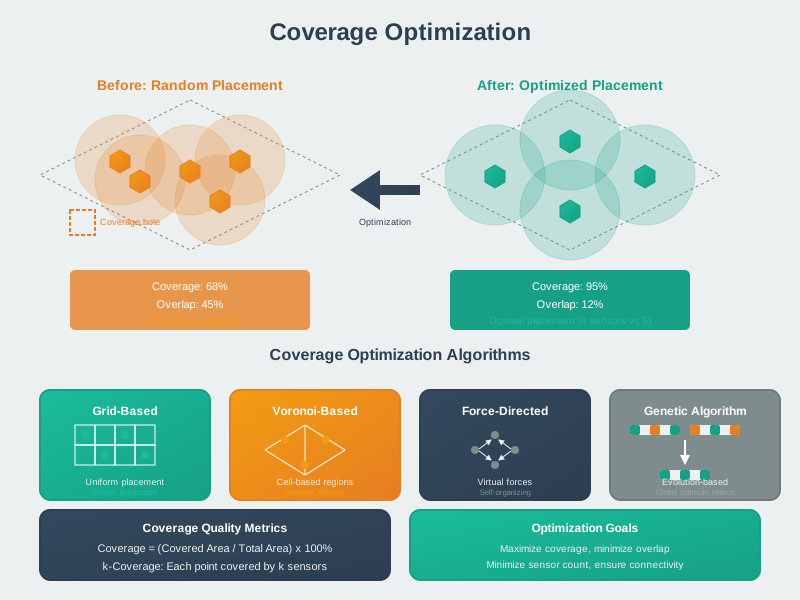
Optimization strategies for balancing coverage quality with network lifetime and resource efficiency.
413.6 Summary
This chapter covered K-coverage and rotation scheduling for reliable sensor network deployments:
- K-Coverage Requirements: Calculated sensor requirements for fault-tolerant deployments where each point is monitored by K sensors, using formula N = K x (A / pi x Rs squared) x alpha
- Fault Tolerance Design: Demonstrated how 2-coverage tolerates single sensor failures while 3-coverage handles up to 2 simultaneous failures
- Coverage Rotation: Developed scheduling algorithms to partition sensors into disjoint sets that rotate coverage duties, extending network lifetime by 2-4x
- Lifetime Analysis: Quantified how 3-set rotation extends a 5-day network to 15 days through 33% duty cycling
- Trade-off Optimization: Balanced coverage degree (higher K = more reliability) against energy consumption and network lifetime
413.7 Knowledge Check
413.8 What’s Next
The next chapter explores Mobile Sensor Coverage Optimization, covering how mobile sensors (drones, robots, vehicles) can dynamically fill coverage gaps, reducing total sensor requirements while maintaining adaptive coverage.