TipFor Beginners: How Do You Actually Make Money with IoT?
Selling a smart device is just the beginning—the real money comes after.
This chapter is about the practical “how” of IoT revenue. While business models describe the structure, monetization is about the actual dollars and cents.
Three main ways to monetize IoT:
Strategy
How It Works
Example
Hardware Sales
Sell the device
Smart thermostat for $250
Subscriptions
Monthly/annual fees
$10/month for cloud storage
Outcome-Based
Pay for results
30% of energy savings achieved
The math that matters:
Key Formula:  LTV > 3 × CAC

LTV = Lifetime Value (total money from one customer)
CAC = Customer Acquisition Cost (marketing + sales to get them)

Example:
- You spend $50 to acquire a customer (ads, sales)
- They pay $10/month for 3 years = $360 LTV
- LTV:CAC ratio = 360:50 = 7.2:1 ✅ Healthy business!
Key insight: The most successful IoT companies think beyond the initial sale. They design products that create ongoing value (and revenue) through services, analytics, and ecosystem integration.
143.2 Hardware Revenue
⏱️ ~10 min | ⭐⭐ Intermediate | 📋 P03.C05.U01
Direct monetization involves generating revenue directly from IoT products and services sold to customers.
NoteVideo: Smart Shopping and Retail IoT
Discover how retailers use IoT to create new revenue streams and improve customer experiences.
Flowchart diagram
Figure 143.1
Alternative View:
Decision tree flowchart for selecting IoT hardware revenue strategy. Starting question asks about target market price sensitivity. Low sensitivity path leads to Premium Pricing (40-60% markup) with examples like Nest Thermostat. High sensitivity path asks about long-term customer value. High LTV leads to Subsidized Hardware (sell below cost) with examples like Amazon Echo. Medium LTV leads to Bundled Solutions (Hardware plus Service) with examples like ADT Security. Each path shows business outcomes: Premium yields high margin per unit, Bundle yields contract lock-in, Subsidy yields ecosystem dominance.
Figure 143.2: Decision tree for selecting hardware revenue strategy based on market price sensitivity and customer lifetime value. Premium pricing suits low price sensitivity markets with clear ROI justification. Bundled solutions work for medium LTV customers seeking total solutions. Subsidized hardware enables ecosystem lock-in for high LTV recurring customers.
Three real-world hardware revenue strategy examples. Premium Pricing example (orange, Nest Thermostat): $249 vs $50 basic, Energy savings ROI, 400% markup justified. Bundle example (teal, ADT Security): $0-99 equipment, $30-50/month monitoring, 3-year contract lock-in. Subsidy example (navy, Amazon Echo): $25-50 device at cost, Prime subs plus shopping, Alexa ecosystem lock-in.
Figure 143.3: Alternative view: Real Company Examples - This diagram shows concrete companies implementing each hardware strategy. Premium pricing: Nest Thermostat at $249 vs $50 basic thermostats - 400% markup justified by energy savings ROI. Bundled solutions: ADT Security offers $0-99 equipment with $30-50/month monitoring under 3-year contracts. Subsidized hardware: Amazon Echo sold at cost ($25-50) to drive Prime subscriptions and Alexa ecosystem adoption. Students can map strategies to familiar products.
Premium Pricing: Charge higher prices for advanced IoT capabilities. Smart features justify price premiums over traditional products (e.g., smart refrigerators priced 40-60% higher than conventional models). The value proposition must clearly demonstrate ROI.
Bundled Solutions: Package hardware with services, reducing price sensitivity by focusing on total solution value (e.g., security systems bundled with 24/7 monitoring). This creates switching costs and customer lock-in.
Subsidized Hardware: Reduce upfront costs to increase adoption. Hardware sold at cost or below cost, with revenue recouped through service subscriptions (e.g., Amazon Echo devices priced aggressively to drive Alexa ecosystem adoption).
Show code
{const container =document.getElementById('kc-monetize-1');if (container &&typeof InlineKnowledgeCheck !=='undefined') { container.innerHTML=''; container.appendChild(InlineKnowledgeCheck.create({question:"A startup is launching a smart home security camera with manufacturing cost of $80. Their target market is price-sensitive consumers, but they expect strong demand for cloud storage subscriptions ($8/month). Which hardware pricing strategy should they prioritize?",options: [ {text:"Premium pricing at $200 to maximize hardware margins",correct:false,feedback:"Incorrect. Premium pricing targets low price-sensitivity markets with clear ROI justification. Price-sensitive consumers will reject $200 pricing, limiting adoption and subscription potential."}, {text:"Cost-plus pricing at $120 (50% margin) for balanced approach",correct:false,feedback:"Partially reasonable but suboptimal. Cost-plus ignores the subscription opportunity. With $8/month recurring revenue, prioritizing hardware margins limits ecosystem growth."}, {text:"Subsidized pricing at $60-80 to maximize subscription adoption",correct:true,feedback:"Correct! With strong subscription potential ($8/month = $96/year), subsidizing hardware drives adoption. Even selling at cost ($80), each customer generates $288 subscription revenue over 3 years. Amazon, Ring, and Peloton all use this strategy."}, {text:"Bundled pricing at $180 including 1-year subscription",correct:false,feedback:"Bundles can work but don't address price sensitivity. The upfront cost remains high ($180), limiting adoption. Subsidized hardware with optional subscription typically outperforms bundles in price-sensitive markets."} ],difficulty:"medium",topic:"iot-monetization" })); }}
143.3 Software and Service Revenue
Flowchart diagram
Figure 143.4
Three software revenue model comparison showing real company examples and revenue patterns. Subscription (Ring Protect, teal): $3-20/month, Recurring predictable, 72% gross margin, creates Steady revenue. Freemium (Fitbit, orange): Free basic tracking, $10/month premium, 15% conversion rate, creates Growth revenue. Feature Unlock (Tesla, navy): $3K-15K one-time, FSD and Acceleration, 100% software margin, creates Lumpy revenue. All three flow to central Revenue Patterns node.
Figure 143.5: Alternative view: Revenue Pattern Comparison - This diagram contrasts three software monetization approaches with real metrics. Subscription (Ring Protect): $3-20/month with 72% gross margin provides steady, predictable revenue. Freemium (Fitbit): Free basic tier with $10/month premium and 15% conversion enables growth-focused acquisition. Feature unlock (Tesla): $3K-15K one-time payments for FSD/Acceleration with 100% software margin produces lumpy but high-profit revenue. Each creates different financial characteristics.
Subscription Models: Recurring monthly or annual fees with tiered pricing based on features, usage, or capacity. This provides predictable revenue streams for financial planning.
Freemium Approach: Basic features free, premium features paid. This maximizes user acquisition and converts a percentage of free users to paid subscribers.
Feature Unlocking: One-time payments to enable capabilities. Hardware ships with latent features that users pay to activate (e.g., Tesla’s acceleration boost or full self-driving capability unlocks).
Show code
{const container =document.getElementById('kc-monetize-2');if (container &&typeof InlineKnowledgeCheck !=='undefined') { container.innerHTML=''; container.appendChild(InlineKnowledgeCheck.create({question:"A fitness wearable company has 50,000 users on their free tier (basic step counting, heart rate). They want to launch a premium tier with sleep analysis and workout recommendations at $12/month. Industry benchmarks show 5-12% freemium conversion rates. What is a realistic first-year subscription revenue projection?",options: [ {text:"$7.2M assuming 100% conversion (50,000 × $12 × 12)",correct:false,feedback:"Incorrect. 100% conversion is unrealistic for freemium models. Most users never convert. This projection overestimates by 10-20×, leading to poor business planning."}, {text:"$360K-$720K using 5-10% conversion (2,500-5,000 × $12 × 12)",correct:true,feedback:"Correct! Using industry benchmarks: 5% conversion = 2,500 subscribers × $12 × 12 months = $360K. 10% conversion = 5,000 × $12 × 12 = $720K. Realistic projections prevent over-investment in infrastructure and marketing."}, {text:"$1.8M assuming 25% conversion of engaged users",correct:false,feedback:"Incorrect. 25% conversion dramatically exceeds industry norms (5-12%). Even 'engaged' user segments rarely exceed 15% conversion. Overestimating conversion leads to cash flow problems."}, {text:"$60K assuming only 1% conversion due to competition",correct:false,feedback:"Too conservative. While 1% is possible for poorly differentiated products, industry benchmarks of 5-12% apply when premium features deliver clear value. Underestimating limits investment in growth."} ],difficulty:"medium",topic:"iot-monetization" })); }}
143.4 Outcome-Based Pricing
Performance Contracts: Payment tied to measurable results, aligning vendor and customer incentives (e.g., energy management systems paid based on verified energy savings).
Pay-Per-Use Models: Charge based on actual consumption, providing fair pricing that scales with value delivered (e.g., industrial equipment charged per hour of operation or per unit produced).
Shared Savings: Revenue split based on value created, particularly effective in B2B contexts (e.g., predictive maintenance systems sharing percentage of downtime costs avoided).
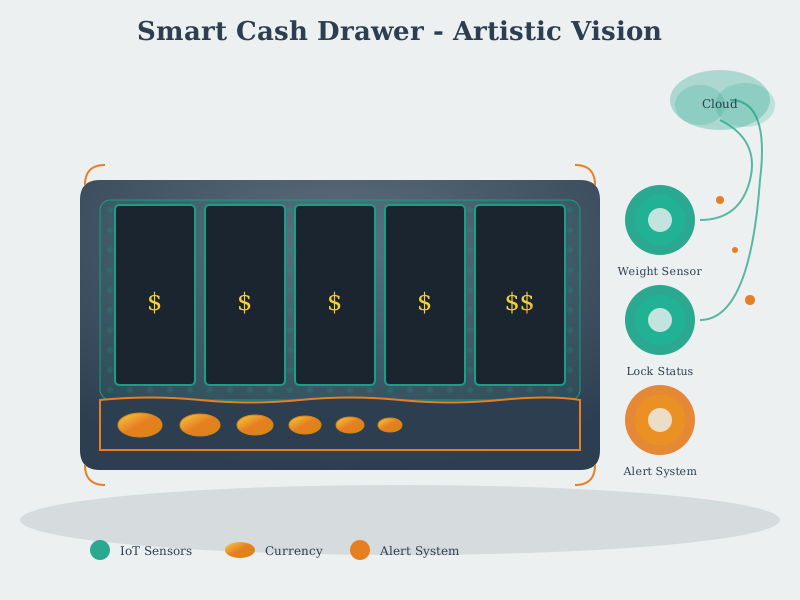
Cash drawer with IoT integration
Smart cash management systems reduce shrinkage and improve operational efficiency in retail environments. Real-time monitoring and automatic reconciliation save labor costs while providing the visibility needed for loss prevention programs.
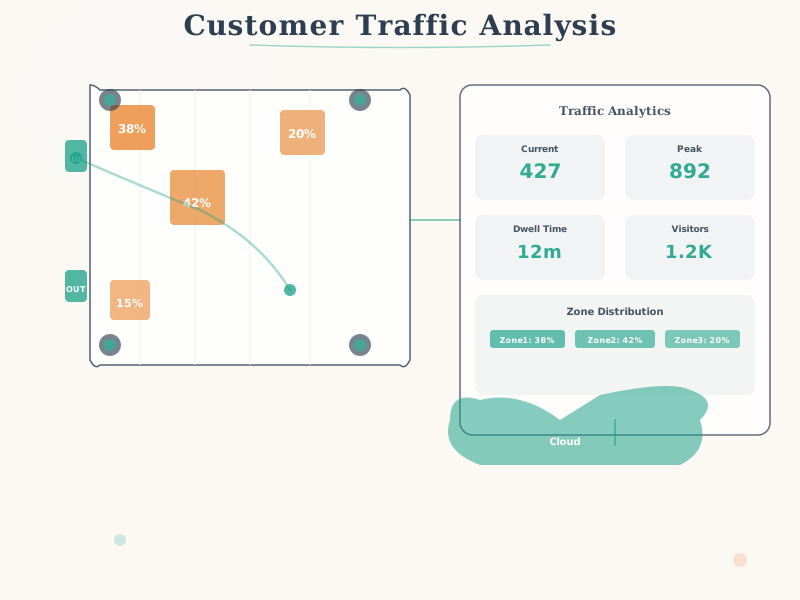
Customer traffic analytics at store entrance
Customer traffic analytics enable retailers to calculate true conversion rates and optimize staffing schedules. Understanding hourly, daily, and seasonal traffic patterns drives data-informed decisions about marketing campaigns and store operations.
143.4.1 Retail and Hospitality IoT Monetization
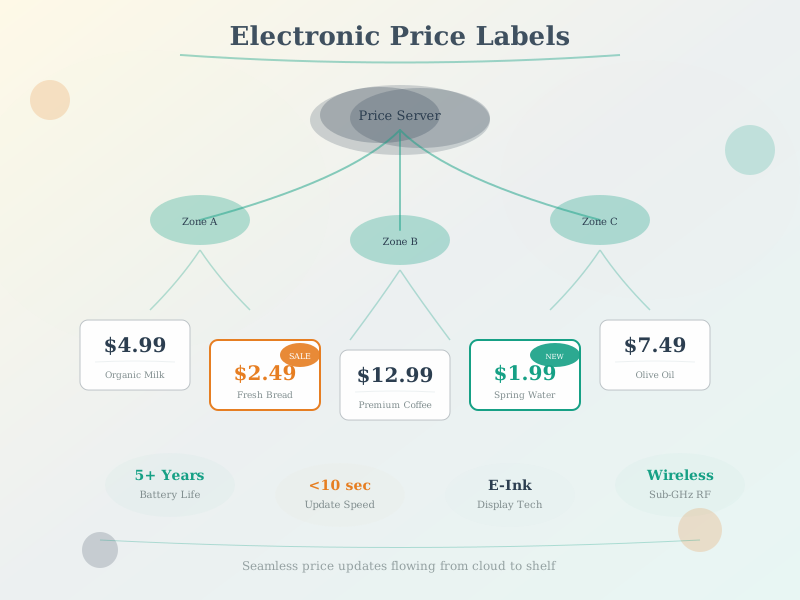
Electronic price tag display system
Electronic shelf labels transform retail pricing from a labor-intensive manual process to a dynamic, real-time capability. Beyond labor savings, these systems enable surge pricing during peak demand, markdown optimization for expiring products, and seamless omnichannel price consistency.
Hotel guest check-in kiosk
Self-service hospitality kiosks reduce labor costs while improving guest experience through faster check-in processes. IoT connectivity enables real-time room assignment optimization and integration with loyalty programs.
Sports venue fan engagement system
Fan engagement platforms transform stadiums into connected environments that enhance the spectator experience while creating new revenue streams through mobile ordering, location-based offers, and premium content delivery.
Show code
{const container =document.getElementById('kc-monetize-3');if (container &&typeof InlineKnowledgeCheck !=='undefined') { container.innerHTML=''; container.appendChild(InlineKnowledgeCheck.create({question:"An industrial IoT company offers predictive maintenance for manufacturing equipment. They propose an outcome-based contract: 30% of documented downtime savings. A manufacturer has $500K annual downtime costs. If the system prevents 60% of downtime, what is the vendor's annual revenue and what is the customer's net benefit?",options: [ {text:"Vendor: $150K, Customer: $150K net savings (50/50 split of prevented downtime)",correct:false,feedback:"Incorrect calculation. The 30% share applies to savings, not total downtime. Savings = $500K × 60% = $300K prevented. Vendor share = 30% × $300K = $90K, not $150K."}, {text:"Vendor: $90K, Customer: $210K net savings (30/70 split of $300K savings)",correct:true,feedback:"Correct! Savings calculation: $500K downtime × 60% prevented = $300K savings. Vendor revenue: $300K × 30% = $90K. Customer net benefit: $300K - $90K = $210K. This 30/70 split aligns incentives while giving customers 70% of value created."}, {text:"Vendor: $180K, Customer: $120K net savings (60% share of prevented)",correct:false,feedback:"Incorrect. The contract specifies 30% revenue share, not 60%. You've reversed the formula. At 60% vendor share, customers would reject the contract as unfair."}, {text:"Vendor: $50K, Customer: $250K net savings (based on 10% industry standard)",correct:false,feedback:"Incorrect. The scenario specifies 30% revenue share, not 10%. While 10-20% shares exist in some industries, outcome-based IoT contracts typically range 20-35% depending on vendor value contribution."} ],difficulty:"hard",topic:"iot-monetization" })); }}
143.5 Interactive: IoT Pricing and ROI Calculator
Use this calculator to explore how hardware pricing, subscriptions, costs, and customer-acquisition spend combine into lifetime value (LTV), CAC, and payback period for a typical IoT product.
Show code
viewof model = Inputs.select( [ { id:"device_plus_subscription",label:"Device + Subscription" }, { id:"subscription_only",label:"Subscription Only (no upfront device revenue)" } ], {label:"Monetization pattern",value: d => d.id==="device_plus_subscription" })viewof hardware_price = Inputs.number(200, {label:"Hardware price per device ($)",step:10,min:0})viewof hardware_cost = Inputs.number(120, {label:"Hardware cost per device ($)",step:10,min:0})viewof subscription_price = Inputs.number(10, {label:"Subscription price per month ($)",step:1,min:0})viewof service_cost = Inputs.number(3, {label:"Service cost per subscriber per month ($)",step:0.5,min:0})viewof lifetime_months = Inputs.number(36, {label:"Average paid lifetime (months)",step:1,min:1})viewof cac = Inputs.number(50, {label:"Customer acquisition cost (CAC, $)",step:5,min:0})
Show code
has_device_sale = model.id==="device_plus_subscription"hardware_revenue = has_device_sale ? hardware_price :0hardware_margin = has_device_sale ?Math.max(0, hardware_price - hardware_cost) :0subscription_revenue = subscription_price * lifetime_monthssubscription_cost = service_cost * lifetime_monthssubscription_margin = subscription_revenue - subscription_cost// Lifetime value (LTV) is total gross margin from one customerltv = hardware_margin + subscription_margintotal_revenue = hardware_revenue + subscription_revenueltv_cac_ratio = cac >0? ltv / cac :nullmonthly_margin = subscription_price - service_costpayback_months = monthly_margin <=0?null:Math.max(0, (cac - hardware_margin) / monthly_margin)md`### Results| Metric | Value | Rule of Thumb ||--------|-------|---------------|| Customer lifetime revenue | **$${total_revenue.toFixed(0)}** | Hardware + subscription revenue || Customer lifetime gross margin (LTV) | **$${ltv.toFixed(0)}** | Should be comfortably above CAC || LTV:CAC ratio | **${ltv_cac_ratio ? ltv_cac_ratio.toFixed(1) +":1":"–"}** | Target **≥ 3:1** || Payback period | **${payback_months ? payback_months.toFixed(1) +" months":"N/A"}** | Aim for **< 18 months** |`
NoteReading the Calculator
Lifetime revenue combines any one-off device sale with subscription income.
Lifetime gross margin (LTV) subtracts hardware and service delivery costs; this is what you have available to cover CAC, overheads, and profit.
LTV:CAC shows how efficiently you turn marketing spend into long-term value—IoT SaaS businesses typically target 3:1 or higher.
Payback period estimates how many months it takes to recover CAC after the initial sale and subscription margin; investors usually look for < 18 months.
Try comparing: - Pure hardware sales (set subscription price to $0) versus hardware + subscription. - High-CAC consumer plays versus lower-CAC industrial deployments.
TipHands-On: Explore Business Scenarios
Use the calculator to plug in numbers from your own IoT concept (device price, subscription tiers, CAC).
You can also launch this tool from the Simulation Playground under IoT Business ROI Calculator to keep it alongside the technical calculators.
143.6 Summary
This chapter covered the three primary direct monetization strategies for IoT products:
Hardware Revenue Models: Premium pricing (40-60% markup) for clear ROI products, bundled solutions for total value positioning, and subsidized hardware for ecosystem-focused strategies
Software/Service Revenue: Subscription models providing predictable recurring revenue, freemium approaches achieving 5-12% conversion, and feature unlocking for one-time capability purchases