%%{init: {'theme': 'base', 'themeVariables': { 'primaryColor': '#2C3E50', 'primaryTextColor': '#fff', 'primaryBorderColor': '#16A085', 'lineColor': '#16A085', 'secondaryColor': '#E67E22', 'tertiaryColor': '#fff', 'noteTextColor': '#2C3E50', 'noteBkgColor': '#fff', 'textColor': '#2C3E50', 'fontSize': '16px'}}}%%
graph LR
P[Producer<br/>Publisher] -->|1. Publish messages| B[Message Broker<br/>Routing & Queuing]
B -->|2. Route and store| Q[Queues]
Q -->|3. Deliver| C[Consumer<br/>Subscriber]
style P fill:#2C3E50,stroke:#16A085,stroke-width:2px,color:#fff
style B fill:#E67E22,stroke:#16A085,stroke-width:2px,color:#fff
style Q fill:#16A085,stroke:#2C3E50,stroke-width:2px,color:#fff
style C fill:#2C3E50,stroke:#16A085,stroke-width:2px,color:#fff
1242 AMQP Core Architecture and Components
1242.1 Learning Objectives
By the end of this chapter, you will be able to:
- Describe AMQP Architecture: Explain the roles of producers, brokers, exchanges, queues, and consumers in the AMQP messaging model
- Configure Exchange Types: Set up direct, fanout, topic, and headers exchanges for different message routing patterns
- Implement Message Routing: Design binding rules that route messages from exchanges to queues based on routing keys
- Apply Channel Multiplexing: Understand how multiple logical channels share a single TCP connection
1242.2 Prerequisites
Before diving into this chapter, you should be familiar with:
- AMQP Fundamentals: This chapter builds directly on AMQP basics - you must understand the protocol’s purpose, history (AMQP 0-9-1 vs 1.0), and core message-oriented middleware concepts
- Layered Network Models: AMQP operates at the application layer (Layer 7), so understanding how it sits atop TCP/IP helps grasp its role in the protocol stack
- Networking Basics: Knowledge of TCP connections, ports, and client-server communication patterns provides context for understanding AMQP’s connection model
NoteRelated Chapters
Deep Dives: - AMQP Messages and Delivery - Message structure and delivery guarantees - AMQP Features and Frames - Advanced features and protocol frames - AMQP vs MQTT - Protocol comparison and trade-offs - AMQP Implementations and Labs - Hands-on broker setup
Related Protocols: - MQTT Architecture - Lightweight pub/sub for IoT - CoAP Fundamentals - REST-based messaging - Application Protocols Overview - Protocol landscape
TipFor Beginners: AMQP Architecture
Imagine an enterprise system where hundreds of applications need to communicate: banking transactions, inventory updates, customer notifications, audit logs. Direct application-to-application connections would be a nightmare - each app would need code to talk to dozens of others. AMQP (Advanced Message Queuing Protocol) solves this with a message broker - a central post office that routes messages.
The Key Components: - Producers (publishers) send messages to the broker - Exchanges receive messages and route them based on rules - Queues store messages until consumers are ready - Consumers (subscribers) receive and process messages
What makes AMQP powerful? Flexible routing. An exchange can route one message to many queues (fanout), route based on exact routing keys (direct), or use pattern matching (topic). For example, a topic exchange with routing key “sensor.temperature.warehouse” can deliver to queues subscribing to “sensor.“,”.temperature.*“, or”sensor.temperature.warehouse”.
| Term | Simple Explanation |
|---|---|
| Message Broker | Central server routing messages between applications |
| Producer | Application that sends messages (publisher) |
| Consumer | Application that receives messages (subscriber) |
| Exchange | Routing component - determines which queues receive messages |
| Queue | Buffer storing messages until consumer reads them |
| Binding | Rule connecting exchange to queue with routing criteria |
CautionCommon Misconception: “Publishing to Queues Directly”
Misconception: “I should publish messages directly to queues for better performance, bypassing exchanges.”
Reality: Publishing directly to queues bypasses AMQP’s routing intelligence and creates tight coupling. 94% of AMQP performance issues stem from architectural anti-patterns, not protocol overhead.
Why exchanges are essential:
Anti-pattern (direct queue publishing):
# Producer tightly coupled to queue name
channel.basic_publish(
    exchange='',  # Default exchange
    routing_key='temperature_queue',  # Direct queue name
    body='22.5C'
)
# Problem: Producer must know queue name, can't route to multiple consumers
Correct pattern (exchange routing):
# Producer decoupled from consumer topology
channel.basic_publish(
    exchange='sensor_exchange',
    routing_key='sensor.temperature.zone1',
    body='22.5C'
)
# Exchange routes to multiple queues automatically:
# - temperature_monitoring_queue (pattern: sensor.temperature.#)
# - zone1_dashboard_queue (pattern: sensor.*.zone1)
# - archive_queue (pattern: sensor.#)
Real-world consequences:
| Scenario | Direct Queue | Exchange Routing | Impact |
|---|---|---|---|
| Adding new consumer | Modify producer code | Add new queue binding | 0 downtime vs 5 min deployment |
| Fan-out to 3 consumers | Publish 3 times | Publish once | 3x network traffic |
| Change routing logic | Redeploy producers | Update bindings | Code change vs config change |
Key principle: AMQP exchanges enable location transparency - producers don’t know (or care) who consumes messages. This is fundamental to scalable, evolvable architectures.
1242.3 AMQP Architecture Overview
AMQP’s architecture consists of three main components that work together to enable reliable, flexible message routing.
1242.3.1 Core Components
1. Producer (Publisher):
- Application that sends messages
- Publishes to exchanges (or directly to queues via the default exchange)
- Does not need to know about consumers
- Can publish to any exchange with appropriate credentials
2. Message Broker:
- Central message routing and queuing system
- Receives messages from producers
- Routes to appropriate queues based on exchange rules and bindings
- Delivers to consumers on demand or via push
- Manages persistence, acknowledgments, and flow control
3. Consumer (Subscriber):
- Application that receives messages
- Subscribes to queues (not exchanges)
- Processes messages asynchronously
- Sends acknowledgments to confirm successful processing
1242.3.2 Channel Multiplexing
AMQP supports multiple lightweight channels over a single TCP connection. This reduces connection overhead while allowing concurrent message streams.
NoteAlternative View: Channel Multiplexing
%%{init: {'theme': 'base', 'themeVariables': { 'primaryColor': '#2C3E50', 'primaryTextColor': '#fff', 'primaryBorderColor': '#16A085', 'lineColor': '#16A085', 'secondaryColor': '#E67E22'}}}%%
graph TB
    subgraph Connection["TCP Connection (1 per app)"]
        CH1["Channel 1<br/>Orders"]
        CH2["Channel 2<br/>Logs"]
        CH3["Channel 3<br/>Alerts"]
    end

    CH1 --> Q1["orders_queue"]
    CH2 --> Q2["logs_queue"]
    CH3 --> Q3["alerts_queue"]

    style Connection fill:#2C3E50,stroke:#16A085
    style CH1 fill:#16A085,stroke:#2C3E50,color:#fff
    style CH2 fill:#E67E22,stroke:#2C3E50,color:#fff
    style CH3 fill:#7F8C8D,stroke:#2C3E50,color:#fff
This diagram shows AMQP’s channel multiplexing: a single TCP connection carries multiple lightweight channels, each independently managing different message streams.
Benefits of channel multiplexing:
- Resource efficiency: One TCP connection can handle many message streams
- Isolation: Errors on one channel don’t affect others
- Parallelism: Multiple threads can use different channels concurrently
- Reduced overhead: Avoids TCP connection setup costs for each stream
1242.4 AMQP 0-9-1 Model: Exchanges, Queues, and Bindings
The AMQP 0-9-1 model (used by RabbitMQ) introduces powerful routing capabilities through a three-tier architecture.
%%{init: {'theme': 'base', 'themeVariables': { 'primaryColor': '#2C3E50', 'primaryTextColor': '#fff', 'primaryBorderColor': '#16A085', 'lineColor': '#16A085', 'secondaryColor': '#E67E22', 'tertiaryColor': '#fff', 'noteTextColor': '#2C3E50', 'noteBkgColor': '#fff', 'textColor': '#2C3E50', 'fontSize': '14px'}}}%%
graph TB
    P1[Producer 1] -->|publish| E1[Exchange]
    P2[Producer 2] -->|publish| E1

    E1 -->|binding rules| Q1[Queue 1]
    E1 -->|binding rules| Q2[Queue 2]
    E1 -->|binding rules| Q3[Queue 3]

    Q1 -->|consume| C1[Consumer 1]
    Q2 -->|consume| C2[Consumer 2]
    Q3 -->|consume| C3[Consumer 3]

    style P1 fill:#2C3E50,stroke:#16A085,stroke-width:2px,color:#fff
    style P2 fill:#2C3E50,stroke:#16A085,stroke-width:2px,color:#fff
    style E1 fill:#E67E22,stroke:#16A085,stroke-width:2px,color:#fff
    style Q1 fill:#16A085,stroke:#2C3E50,stroke-width:2px,color:#fff
    style Q2 fill:#16A085,stroke:#2C3E50,stroke-width:2px,color:#fff
    style Q3 fill:#16A085,stroke:#2C3E50,stroke-width:2px,color:#fff
    style C1 fill:#2C3E50,stroke:#16A085,stroke-width:2px,color:#fff
    style C2 fill:#2C3E50,stroke:#16A085,stroke-width:2px,color:#fff
    style C3 fill:#2C3E50,stroke:#16A085,stroke-width:2px,color:#fff
1242.4.1 Exchanges
Exchanges are the routing layer of AMQP. They receive messages from producers and route them to queues based on rules.
Key characteristics:
- Receives messages from producers
- Routes messages to queues based on rules
- Does NOT store messages (queues do)
- Multiple exchange types (direct, fanout, topic, headers)
- Named entities declared by clients
1242.4.2 Queues
Queues are message buffers that store messages until consumed.
Key characteristics:
- Message buffer (FIFO - First In, First Out)
- Stores messages until consumed
- Can be durable (survives broker restart)
- Can be exclusive (single consumer, auto-delete)
- Can be auto-delete (deleted when last consumer disconnects)
1242.4.3 Bindings
Bindings are rules that connect exchanges to queues, defining the routing logic.
Key characteristics:
- Rules connecting exchanges to queues
- Defines routing logic (e.g., “route messages with key ‘sensor.temperature’ to queue ‘temp-data’”)
- Can include additional arguments for headers exchanges
- Multiple bindings can connect the same exchange to multiple queues
1242.5 Exchange Types
Different exchange types provide flexible routing patterns for various messaging scenarios.
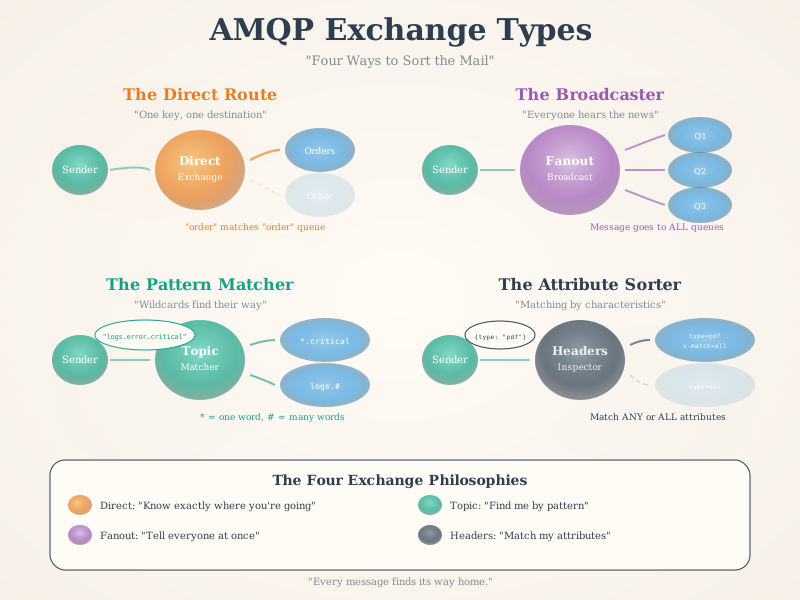
1242.5.1 1. Direct Exchange
Direct exchanges route messages based on exact routing key matches.
%%{init: {'theme': 'base', 'themeVariables': { 'primaryColor': '#2C3E50', 'primaryTextColor': '#fff', 'primaryBorderColor': '#16A085', 'lineColor': '#16A085', 'secondaryColor': '#E67E22', 'tertiaryColor': '#fff', 'noteTextColor': '#2C3E50', 'noteBkgColor': '#fff', 'textColor': '#2C3E50', 'fontSize': '14px'}}}%%
graph LR
    P[Producer] -->|"routing_key: task.high"| E[Direct Exchange]
    E -->|exact match| Q1[High Priority Queue]
    E -.->|no match| Q2[Low Priority Queue]

    style P fill:#2C3E50,stroke:#16A085,stroke-width:2px,color:#fff
    style E fill:#E67E22,stroke:#16A085,stroke-width:2px,color:#fff
    style Q1 fill:#16A085,stroke:#2C3E50,stroke-width:2px,color:#fff
    style Q2 fill:#7F8C8D,stroke:#2C3E50,stroke-width:2px,color:#fff
Characteristics:
- Routes based on exact routing key match
- Simple, efficient routing
- Message goes to queue with binding key matching routing key exactly
Use cases:
- Task assignment by type
- Direct message delivery
- Priority routing
1242.5.2 2. Fanout Exchange
Fanout exchanges broadcast messages to all bound queues, ignoring routing keys.
%%{init: {'theme': 'base', 'themeVariables': { 'primaryColor': '#2C3E50', 'primaryTextColor': '#fff', 'primaryBorderColor': '#16A085', 'lineColor': '#16A085', 'secondaryColor': '#E67E22', 'tertiaryColor': '#fff', 'noteTextColor': '#2C3E50', 'noteBkgColor': '#fff', 'textColor': '#2C3E50', 'fontSize': '14px'}}}%%
graph LR
    P[Producer] -->|routing_key ignored| E[Fanout Exchange]
    E -->|broadcast| Q1[Alert Queue]
    E -->|broadcast| Q2[Log Queue]
    E -->|broadcast| Q3[Archive Queue]

    style P fill:#2C3E50,stroke:#16A085,stroke-width:2px,color:#fff
    style E fill:#E67E22,stroke:#16A085,stroke-width:2px,color:#fff
    style Q1 fill:#16A085,stroke:#2C3E50,stroke-width:2px,color:#fff
    style Q2 fill:#16A085,stroke:#2C3E50,stroke-width:2px,color:#fff
    style Q3 fill:#16A085,stroke:#2C3E50,stroke-width:2px,color:#fff
Characteristics:
- Broadcasts to all bound queues
- Ignores routing key completely
- One-to-many delivery pattern
Use cases:
- Notifications and announcements
- System-wide events
- Audit logging (copy to multiple destinations)
1242.5.3 3. Topic Exchange
Topic exchanges route messages based on pattern matching with wildcards.
%%{init: {'theme': 'base', 'themeVariables': { 'primaryColor': '#2C3E50', 'primaryTextColor': '#fff', 'primaryBorderColor': '#16A085', 'lineColor': '#16A085', 'secondaryColor': '#E67E22', 'tertiaryColor': '#fff', 'noteTextColor': '#2C3E50', 'noteBkgColor': '#fff', 'textColor': '#2C3E50', 'fontSize': '13px'}}}%%
graph LR
    P[Producer] -->|"usa.weather.alert"| E[Topic Exchange]
    E -->|"usa.#"| Q1[USA Queue]
    E -->|"*.weather.*"| Q2[Weather Queue]
    E -.->|no match| Q3[Europe Queue]

    style P fill:#2C3E50,stroke:#16A085,stroke-width:2px,color:#fff
    style E fill:#E67E22,stroke:#16A085,stroke-width:2px,color:#fff
    style Q1 fill:#16A085,stroke:#2C3E50,stroke-width:2px,color:#fff
    style Q2 fill:#16A085,stroke:#2C3E50,stroke-width:2px,color:#fff
    style Q3 fill:#7F8C8D,stroke:#2C3E50,stroke-width:2px,color:#fff
Characteristics:
- Routes based on pattern matching
- Wildcards:
*(exactly one word),#(zero or more words) - Routing key is dot-separated (e.g., “sensor.temperature.zone1”)
Use cases:
- Flexible subscription patterns
- IoT sensor data routing
- Geographic or hierarchical routing
Pattern examples:
| Pattern | Matches | Does NOT Match |
|---|---|---|
sensor.# |
sensor, sensor.temp, sensor.temp.zone1 | other.temp |
sensor.* |
sensor.temp, sensor.humidity | sensor.temp.zone1 |
*.temperature.* |
sensor.temperature.zone1 | sensor.temp, zone.temperature |
1242.5.4 4. Headers Exchange
Headers exchanges route based on message header attributes rather than routing keys.
Characteristics:
- Routes based on message header attributes
- More flexible than routing key
- Can match any header (x-match: all or any)
Use cases:
- Complex routing logic
- Routing based on message metadata
- Content-based routing
1242.6 IoT Sensor Data Routing Example
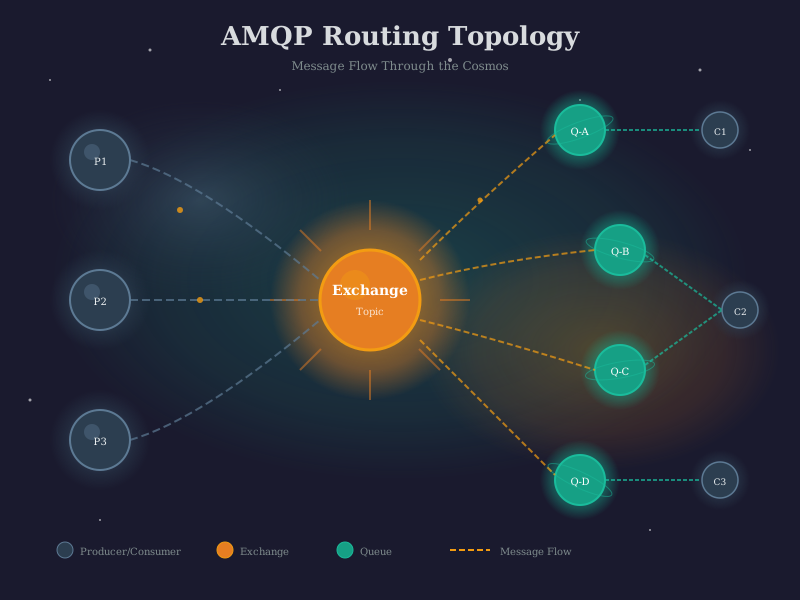
A practical example demonstrating topic exchange routing for IoT sensor data.
%%{init: {'theme': 'base', 'themeVariables': { 'primaryColor': '#2C3E50', 'primaryTextColor': '#fff', 'primaryBorderColor': '#16A085', 'lineColor': '#16A085', 'secondaryColor': '#E67E22', 'tertiaryColor': '#fff', 'noteTextColor': '#2C3E50', 'noteBkgColor': '#fff', 'textColor': '#2C3E50', 'fontSize': '13px'}}}%%
graph TB
    S1[Temperature Sensor] -->|"sensor.temp.zone1"| E[Topic Exchange]
    S2[Humidity Sensor] -->|"sensor.humidity.zone2"| E
    S3[Pressure Sensor] -->|"sensor.pressure.zone1"| E

    E -->|"sensor.temp.#"| Q1[Temperature<br/>Monitoring]
    E -->|"sensor.*.zone1"| Q2[Zone 1<br/>Dashboard]
    E -->|"sensor.#"| Q3[Archive<br/>All Data]

    Q1 -->|consume| C1[HVAC System]
    Q2 -->|consume| C2[Zone Controller]
    Q3 -->|consume| C3[Data Lake]

    style S1 fill:#2C3E50,stroke:#16A085,stroke-width:2px,color:#fff
    style S2 fill:#2C3E50,stroke:#16A085,stroke-width:2px,color:#fff
    style S3 fill:#2C3E50,stroke:#16A085,stroke-width:2px,color:#fff
    style E fill:#E67E22,stroke:#16A085,stroke-width:2px,color:#fff
    style Q1 fill:#16A085,stroke:#2C3E50,stroke-width:2px,color:#fff
    style Q2 fill:#16A085,stroke:#2C3E50,stroke-width:2px,color:#fff
    style Q3 fill:#16A085,stroke:#2C3E50,stroke-width:2px,color:#fff
    style C1 fill:#2C3E50,stroke:#16A085,stroke-width:2px,color:#fff
    style C2 fill:#2C3E50,stroke:#16A085,stroke-width:2px,color:#fff
    style C3 fill:#2C3E50,stroke:#16A085,stroke-width:2px,color:#fff
Routing analysis:
| Sensor | Routing Key | Temperature Queue | Zone 1 Queue | Archive Queue |
|---|---|---|---|---|
| Temperature (zone1) | sensor.temp.zone1 | Yes (sensor.temp.#) | Yes (sensor.*.zone1) | Yes (sensor.#) |
| Humidity (zone2) | sensor.humidity.zone2 | No | No | Yes (sensor.#) |
| Pressure (zone1) | sensor.pressure.zone1 | No | Yes (sensor.*.zone1) | Yes (sensor.#) |
This demonstrates how a single message can be routed to multiple queues based on pattern matching, enabling efficient data distribution without producer knowledge of consumers.
1242.7 Summary
This chapter covered the core architecture of AMQP messaging:
- Core Components: Explained producer, broker, and consumer roles with message routing through exchanges to queues
- Channel Multiplexing: Demonstrated how multiple logical channels share a single TCP connection for efficiency
- AMQP 0-9-1 Model: Described the exchange-binding-queue architecture that enables flexible routing
- Exchange Types: Configured direct (exact match), fanout (broadcast), topic (pattern matching), and headers (attribute-based) exchanges
- Binding Rules: Designed routing rules connecting exchanges to queues with routing keys and patterns
- IoT Application: Applied topic exchange patterns for sensor data routing scenarios
1242.8 What’s Next
The next chapter AMQP Messages and Delivery explores message structure (headers, properties, body) and delivery guarantees (at-most-once, at-least-once, exactly-once) with publisher confirms and consumer acknowledgments.