%%{init: {'theme': 'base', 'themeVariables': { 'primaryColor': '#2C3E50', 'primaryTextColor': '#fff', 'primaryBorderColor': '#16A085', 'lineColor': '#16A085', 'secondaryColor': '#E67E22', 'tertiaryColor': '#fff'}}}%%
flowchart TD
    subgraph "Development Environment"
        VS[VS Code + PlatformIO]
        Git[Git Version Control]
        Docker[Docker Containers]
    end

    subgraph "Build & Test"
        Compiler[ARM GCC Compiler]
        Unit[Unit Tests]
        Sim[Simulator/QEMU]
    end

    subgraph "Deploy & Debug"
        Flash[Flash Tool<br/>OpenOCD/J-Link]
        JTAG[JTAG Debugger]
        Monitor[Serial Monitor]
    end

    subgraph "Device"
        MCU[ESP32/STM32<br/>Microcontroller]
        Sensor[Sensors]
        Network[Wi-Fi/BLE]
    end

    VS --> Compiler
    Git --> Compiler
    Compiler --> Unit
    Unit --> Sim
    Sim --> Flash
    Flash --> MCU
    JTAG --> MCU
    Monitor --> MCU
    MCU --> Sensor
    MCU --> Network

    style VS fill:#16A085,stroke:#2C3E50,color:#fff
    style Git fill:#16A085,stroke:#2C3E50,color:#fff
    style MCU fill:#E67E22,stroke:#2C3E50,color:#fff
1548 IoT Programming Best Practices
1548.1 Learning Objectives
By the end of this chapter, you will be able to:
- Select Appropriate Tools: Choose development tools based on team size, project complexity, and budget
- Apply Paradigm Selection Criteria: Match programming paradigms to specific IoT requirements
- Design Hybrid Systems: Combine multiple paradigms effectively in real-world projects
- Integrate Tool Ecosystems: Create efficient development workflows combining multiple tools
1548.2 Prerequisites
Before diving into this chapter, you should be familiar with:
- Programming Paradigms: Understanding of imperative, OOP, event-driven, and functional approaches
- Development Tools: Familiarity with IDEs, debuggers, and version control
1548.3 Tool Ecosystem Integration
1548.3.1 Modern IoT Development Stack
Example Stack:
1548.3.2 Workflow Example
1. Feature Development:
# Create feature branch
git checkout -b feature/mqtt-client

# Develop in VS Code with PlatformIO
code .

# Write tests
# test/test_mqtt.cpp

# Run tests locally
pio test

# Commit changes
git add .
git commit -m "Add MQTT client with QoS support"

# Push to remote
git push origin feature/mqtt-client
2. Code Review: - Create pull request on GitHub - Automated CI runs tests - Team reviews code - Address feedback - Merge to main branch
3. Deployment: - CI builds firmware - OTA update pushed to devices - Monitor rollout - Rollback if issues detected
1548.4 Tool Selection Criteria
1548.4.1 By Team Size
| Team Size | Tools Recommendation |
|---|---|
| Small (1-3) | Lightweight tools (Arduino IDE, basic Git) |
| Medium (4-10) | Professional IDEs, CI/CD, project management |
| Large (10+) | Enterprise tools, sophisticated workflows |
1548.4.2 By Project Complexity
| Complexity | Tools Recommendation |
|---|---|
| Simple | Arduino IDE, basic version control |
| Moderate | PlatformIO, testing frameworks, documentation |
| Complex | Full toolchain, simulation, automated testing |
1548.4.3 By Budget
| Budget | Tools Recommendation |
|---|---|
| Low | Open-source tools (VS Code, Git, Unity) |
| Medium | Some commercial tools (CLion, Proteus) |
| High | Enterprise solutions (JIRA, full embedded IDEs) |
1548.5 Paradigm Selection Guidelines
1548.5.1 Choose Imperative When:
- Direct hardware control needed
- Real-time determinism critical
- Resource constraints severe
- Team familiar with procedural programming
1548.5.2 Choose OOP When:
- Multiple similar components (sensors, actuators)
- Code reusability important
- System complexity moderate to high
- Team experienced with OOP
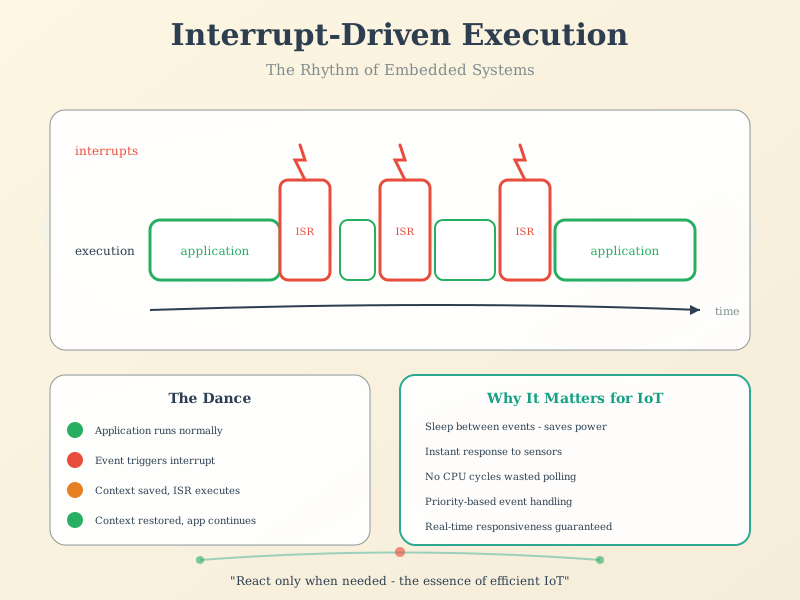
1548.5.3 Choose Event-Driven When:
- Multiple asynchronous inputs
- Low-power operation critical
- Responsive UI required
- Interrupt-driven architecture
1548.5.4 Choose Functional When:
- Data transformations central
- Predictability and testability paramount
- Side effects minimized
- Configuration-heavy systems
1548.5.5 Choose Reactive When:
- Complex sensor fusion
- Time-series processing
- Pattern detection needed
- Resources allow (Raspberry Pi, powerful MCUs)
1548.6 Hybrid Approaches
Most real-world IoT systems combine paradigms:
1548.6.1 Example - Smart Thermostat
| Component | Paradigm | Why |
|---|---|---|
| Sensor reading | Imperative | Direct hardware control |
| Sensor/actuator abstractions | OOP | Reusable components |
| Button presses, motion detection | Event-Driven | Responsive to inputs |
| Temperature filtering | Functional | Predictable data processing |
1548.6.2 Example - Industrial Monitor
| Component | Paradigm | Why |
|---|---|---|
| Device abstraction layer | OOP | Modular device management |
| Alarm conditions | Event-Driven | Immediate response to alerts |
| Multi-sensor data streams | Reactive | Complex stream processing |
| Data transformation pipelines | Functional | Clean data processing |
1548.7 Knowledge Check
Test your understanding of programming paradigms and development tools.
1548.8 Visual Reference Gallery
NoteAdvanced Programming and Debugging Visualizations
1548.9 Summary
- Tool Selection depends on team size (small→lightweight, large→enterprise), project complexity (simple→Arduino IDE, complex→full toolchain), and budget (low→open-source, high→commercial)
- Paradigm Selection matches requirements: imperative for hardware control, OOP for modularity, event-driven for responsiveness, functional for data processing, reactive for stream handling
- Hybrid Approaches are the norm—real IoT systems combine multiple paradigms (e.g., OOP for structure + event-driven for inputs + functional for data processing)
- Tool Integration creates efficient workflows: VS Code + PlatformIO + Git + CI/CD enables rapid iteration from development through deployment
- Composition over Inheritance produces more flexible, maintainable code than deep class hierarchies
- Configuration-driven behavior using YAML/JSON enables field customization without recompiling
1548.10 What’s Next
The next chapter provides Complete Code Examples demonstrating these paradigms and best practices in real Arduino/ESP32 projects, including OOP sensor libraries, functional data pipelines, and professional Git workflows.
NoteRelated Chapters & Resources
Continue Learning: - Programming Paradigms - Programming approaches - Development Tools - IDEs, debuggers, build systems - Code Examples - Complete practical implementations
Protocols: - MQTT - Messaging protocol - CoAP - RESTful IoT
Architecture: - IoT Reference Models - Application layer - Edge Compute Patterns - Edge programming