%%{init: {'theme': 'base', 'themeVariables': { 'primaryColor': '#2C3E50', 'primaryTextColor': '#fff', 'primaryBorderColor': '#16A085', 'lineColor': '#16A085', 'secondaryColor': '#E67E22', 'tertiaryColor': '#7F8C8D'}}}%%
graph TB
    subgraph "IoT Reference Model"
        L7["Layer 7: Application<br/>(Business Logic, UI)"]
        L6["Layer 6: Collaboration<br/>(Processes, Workflows)"]
        L5["Layer 5: Data Abstraction<br/>(Aggregation, Filtering)"]
        L4["Layer 4: Data Accumulation<br/>(Storage, Databases)"]
        L3["Layer 3: Edge Computing<br/>(Analytics, Processing)"]
        L2["Layer 2: Connectivity<br/>(Networks, Protocols)"]
        L1["Layer 1: Physical Devices<br/>(Sensors, Actuators)"]
    end

    L1 --> L2 --> L3 --> L4 --> L5 --> L6 --> L7

    style L1 fill:#16A085,stroke:#2C3E50,color:#fff
    style L3 fill:#E67E22,stroke:#2C3E50,color:#fff
    style L5 fill:#2C3E50,stroke:#16A085,color:#fff
    style L7 fill:#2C3E50,stroke:#16A085,color:#fff
171 Introduction to IoT Reference Architectures
171.1 Learning Objectives
By the end of this chapter, you will be able to:
- Explain what a reference architecture is and why it matters for IoT systems
- Compare 3-layer and 5-layer architecture approaches
- Identify when to use different architectural complexity levels
- Apply the blueprint analogy to understand architecture patterns
171.2 Prerequisites
Before diving into this chapter, you should be familiar with:
- IoT Reference Models: Understanding the Seven-Level IoT Reference Model provides a foundation for comparing different reference architectures and their layer organizations
- Architectural Enablers: Familiarity with the enabling technologies (compute, miniaturisation, energy, connectivity) helps you reason about trade-offs when choosing a reference architecture
171.3 Getting Started (For Beginners)
171.3.1 What is a Reference Architecture? (Simple Explanation)
Analogy: Think of a reference architecture as a blueprint for building a house.
{fig-alt=“IoT reference model showing 7 layers: Physical devices with sensors and actuators, connectivity with networks and protocols, edge computing with analytics and processing, data accumulation in storage and databases, data abstraction with aggregation and filtering, collaboration with processes and workflows, and application layer with business logic and UI”}
171.3.2 Why Do We Need Reference Architectures?
The Problem: Everyone building IoT systems their own way leads to:
- Devices from different vendors can’t communicate
- No clear security boundaries
- Difficult to scale or modify
- Hard to compare solutions
The Solution: Reference architectures provide:
- Common vocabulary (everyone agrees what “device layer” means)
- Standard interfaces (devices can interoperate)
- Best practices (proven patterns for scalability)
- Security guidelines (clear where to implement protection)
171.3.3 The Three Major Reference Architectures
%%{init: {'theme': 'base', 'themeVariables': { 'primaryColor': '#2C3E50', 'primaryTextColor': '#fff', 'primaryBorderColor': '#16A085', 'lineColor': '#16A085', 'secondaryColor': '#E67E22', 'tertiaryColor': '#7F8C8D', 'fontSize': '12px'}}}%%
graph LR
    subgraph ITU["ITU-T Y.2060<br/>(Telecom Focus)"]
        direction TB
        I4["Application<br/>Layer"]
        I3["Service Support<br/>Layer"]
        I2["Network<br/>Layer"]
        I1["Device<br/>Layer"]
        I1 --> I2 --> I3 --> I4
    end

    subgraph IOTA["IoT-A<br/>(Enterprise Focus)"]
        direction TB
        A3["Functional<br/>View"]
        A2["Information<br/>View"]
        A1["Deployment<br/>View"]
    end

    subgraph WSN["WSN<br/>(Sensor Focus)"]
        direction TB
        W3["Application<br/>Layer"]
        W2["Network<br/>Layer"]
        W1["Perception<br/>Layer"]
        W1 --> W2 --> W3
    end

    style ITU fill:#2C3E50,stroke:#16A085,color:#fff
    style IOTA fill:#E67E22,stroke:#2C3E50,color:#fff
    style WSN fill:#16A085,stroke:#2C3E50,color:#fff
171.4 Choosing Between 3-Layer and 5-Layer Architectures
TipTradeoff: 3-Layer vs 5-Layer Architecture
Decision context: When designing an IoT system, choosing between simpler (3-layer) and more detailed (5-layer) reference architectures affects development complexity, team communication, and system modularity.
| Factor | 3-Layer Architecture | 5-Layer Architecture |
|---|---|---|
| Layers | Perception, Network, Application | Perception, Transport, Processing, Application, Business |
| Complexity | Lower - easier to understand and implement | Higher - more detailed separation of concerns |
| Team Size | Small teams (2-5 developers) | Large teams (10+ developers with specialists) |
| Modularity | Coarse-grained - tightly coupled components | Fine-grained - independent, replaceable layers |
| Documentation | Minimal layer interfaces needed | Extensive interface specifications required |
| Flexibility | Less flexible - changes ripple across layers | More flexible - isolated layer modifications |
Choose 3-Layer Architecture when:
- Building prototypes or MVPs with small teams
- System scope is well-defined and unlikely to change
- Time-to-market is critical
- Team members are generalists who handle multiple concerns
Choose 5-Layer Architecture when:
- Building enterprise or production systems at scale
- Multiple teams work on different system components
- Requirements are complex with distinct processing and business logic
- System needs to evolve with independent layer upgrades
- Regulatory compliance requires clear separation (e.g., data processing vs. business rules)
Default recommendation: Start with 3-Layer Architecture for prototypes and small deployments. Migrate to 5-Layer Architecture when your system grows beyond what a single team can manage, or when you need to replace individual components (e.g., swap cloud providers, change analytics engines) without affecting other layers.
171.5 Real-World Example: Smart City Architecture
How do these architectures help? Consider a smart city traffic system:
NoteAcademic Resource: Stanford IoT Course - Smart City Architecture
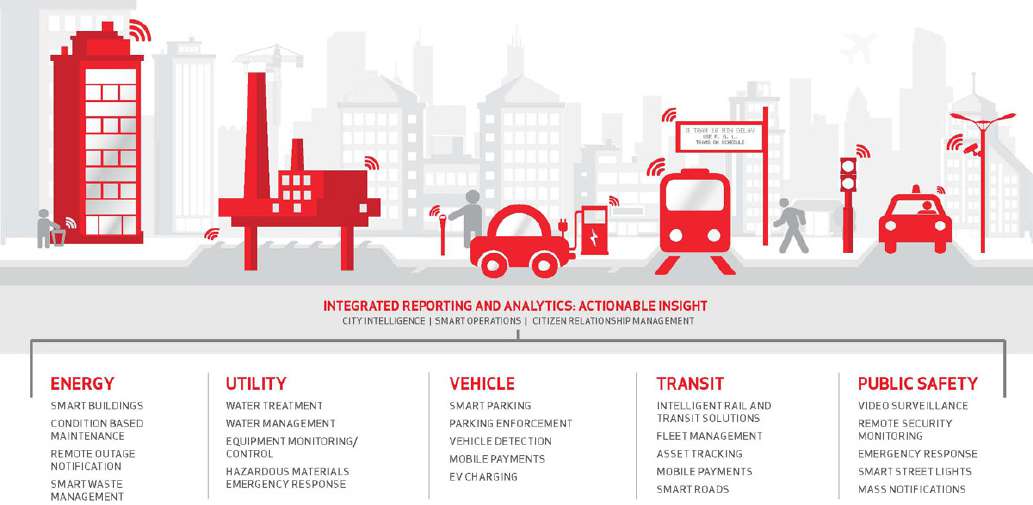
Source: Stanford University IoT Course - Smart City integrated architecture demonstrating how IoT reference models map to real-world urban deployments across multiple domains
%%{init: {'theme': 'base', 'themeVariables': { 'primaryColor': '#2C3E50', 'primaryTextColor': '#fff', 'primaryBorderColor': '#16A085', 'lineColor': '#16A085', 'secondaryColor': '#E67E22', 'tertiaryColor': '#7F8C8D', 'fontSize': '11px'}}}%%
graph TB
    subgraph App["Application Layer"]
        A1["Operator Dashboard"]
        A2["Driver Navigation App"]
        A3["Emergency Response"]
    end

    subgraph Collab["Collaboration Layer"]
        C1["Emergency Vehicle<br/>Coordination"]
        C2["Cross-Department<br/>Workflows"]
    end

    subgraph Abstraction["Data Abstraction Layer"]
        D1["Traffic Flow<br/>Aggregation"]
        D2["Congestion<br/>Patterns"]
    end

    subgraph Storage["Data Accumulation Layer"]
        S1["Traffic Database"]
        S2["Historical<br/>Analytics"]
    end

    subgraph Edge["Edge Computing Layer"]
        E1["Intersection<br/>Controllers"]
        E2["Real-time<br/>Signal Optimization"]
    end

    subgraph Connect["Connectivity Layer"]
        N1["LoRaWAN Sensors"]
        N2["5G Video"]
        N3["V2X Communication"]
    end

    subgraph Physical["Physical Devices Layer"]
        P1["Traffic Sensors"]
        P2["Cameras"]
        P3["Signal Actuators"]
    end

    Physical --> Connect --> Edge --> Storage --> Abstraction --> Collab --> App

    style App fill:#2C3E50,stroke:#16A085,color:#fff
    style Edge fill:#E67E22,stroke:#2C3E50,color:#fff
    style Physical fill:#16A085,stroke:#2C3E50,color:#fff
171.6 Self-Check: Understanding the Basics
Before continuing, make sure you can answer:
- What is a reference architecture? → A standardized framework/blueprint for building IoT systems
- Why not just design ad-hoc? → Leads to incompatibility, poor scalability, and security gaps
- What does ITU-T focus on? → Telecom-oriented IoT (smart cities, 5G integration)
- How many layers does WSN typically use? → Three layers (Perception, Network, Application)
NoteKey Takeaway
In one sentence: Reference architectures like ITU-T, IoT-A, and WSN provide proven blueprints that ensure interoperability, clear security boundaries, and scalable design - choosing the right one depends on your focus (telecom, enterprise, or sensor networks).
Remember this rule: Always select a reference architecture before designing your IoT system - ad-hoc designs lead to vendor lock-in, integration nightmares, and security gaps that are expensive to fix later.
TipFor Kids: Meet the Sensor Squad!
IoT Architecture is like building a team where everyone has a special job!
171.6.1 The Sensor Squad Adventure: Building the Ultimate Treehouse
Imagine the Sensor Squad wants to build the most amazing smart treehouse ever! But they quickly realize they need a plan - a blueprint - so everyone knows what to do.
Sunny the Light Sensor says, “I’ll watch for daylight and turn on the treehouse lights when it gets dark!” Thermo the Temperature Sensor adds, “I’ll check if it’s too hot or cold inside!” Motion Mo the Motion Detector wants to guard the entrance: “I’ll let everyone know when friends arrive!” But wait - how will they all talk to each other? That’s where Signal Sam the Communication Expert comes in: “I’ll make sure everyone’s messages get to the right place!” And Power Pete the Battery Manager reminds everyone: “Don’t forget - we need to save energy so our batteries last all day!”
The Sensor Squad learned that building something amazing works best when you have a reference architecture - a master plan that shows where everyone fits. Just like a sports team has positions (goalkeeper, midfielder, striker), an IoT system has layers (sensors, network, application). Without a plan, Sunny might try to do Thermo’s job, messages would get lost, and the whole treehouse would be chaos!
171.6.2 Key Words for Kids
| Word | What It Means |
|---|---|
| Reference Architecture | A master plan that shows how all the parts of an IoT system work together |
| Layer | A group of team members who do similar jobs, like all the sensors being on one “team” |
| Interoperability | When different devices can talk to each other and work together, like friends who speak the same language |
171.6.3 Try This at Home!
Draw your own “smart room” blueprint! On a piece of paper, make three sections (layers):
- Bottom layer - The Sensors: Draw circles for things that sense (thermometer, light bulb, motion sensor)
- Middle layer - The Messengers: Draw lines showing how sensors send messages to a central hub (like a walkie-talkie)
- Top layer - The Brain: Draw a computer or phone that receives all the information and makes decisions
Now you’ve created your own reference architecture! Show a family member and explain what each layer does.
171.7 Summary
Reference architectures are essential blueprints for building IoT systems that can grow, interoperate, and remain secure. The key points from this introduction:
- Reference architectures provide standardized patterns that ensure devices from different vendors can work together
- 3-layer architectures are ideal for small teams and prototypes; 5-layer architectures suit enterprise deployments
- The three major frameworks (ITU-T, IoT-A, WSN) each address different deployment contexts
- Starting with a reference architecture - even a simplified one - makes future scaling dramatically easier
171.8 What’s Next
Now that you understand what reference architectures are and why they matter:
- To go deeper: Key Reference Models - Detailed exploration of ITU-T, IoT-A, and WSN architectures
- To apply it: Architecture Selection Framework - Learn how to choose the right architecture for your project
- Related concept: IoT Reference Models - Understand the seven-layer IoT model in detail