%%{init: {'theme': 'base', 'themeVariables': {'primaryColor': '#2C3E50', 'primaryTextColor': '#fff', 'primaryBorderColor': '#2C3E50', 'lineColor': '#16A085', 'secondaryColor': '#E67E22', 'tertiaryColor': '#7F8C8D'}}}%%
flowchart TB
    subgraph Primary["Primary (Non-Rechargeable)"]
        A1["Alkaline<br/>1.5V, Low cost<br/>2,000-3,000 mAh"]
        A2["Lithium Primary<br/>3.0V, High density<br/>1,000-2,500 mAh"]
        A3["Lithium Thionyl Chloride<br/>3.6V, 10+ year shelf<br/>1,000-20,000 mAh"]
    end

    subgraph Secondary["Secondary (Rechargeable)"]
        B1["Li-ion/Li-Po<br/>3.7V, High density<br/>500-5,000 mAh"]
        B2["LiFePO4<br/>3.2V, Safe, Long cycle<br/>500-3,000 mAh"]
        B3["NiMH<br/>1.2V, Low cost<br/>500-2,500 mAh"]
    end

    subgraph Special["Special Purpose"]
        C1["Supercapacitor<br/>2.7-5.4V, Fast charge<br/>100-500 mAh equiv"]
        C2["Solid State<br/>3.8V, Safe, emerging<br/>Limited capacity"]
    end

    style Primary fill:#2C3E50,stroke:#2C3E50
    style Secondary fill:#16A085,stroke:#2C3E50
    style Special fill:#E67E22,stroke:#2C3E50
1604 Energy Sources for IoT Devices
1604.1 Learning Objectives
By the end of this chapter, you will be able to:
- Compare different battery chemistries and their characteristics for IoT applications
- Understand energy density, self-discharge, and temperature effects on batteries
- Evaluate energy harvesting technologies and their practical power outputs
- Select appropriate power sources based on deployment requirements
- Calculate battery capacity requirements for target device lifetimes
1604.2 For Beginners: Where Does IoT Energy Come From?
IoT devices get their energy from two main sources:
- Batteries - Store energy chemically, like tiny fuel tanks
- Energy Harvesters - Capture energy from the environment (solar, motion, heat)
Most IoT devices use batteries because they’re reliable and predictable. Energy harvesting is exciting but has limitations - you can’t always count on the sun shining or something vibrating!
Key question for any IoT project: How much energy do I need, and where will it come from?
1604.3 Energy Sources
1604.3.1 Battery Technologies
Batteries are the most common power source for IoT devices. Understanding battery chemistry characteristics is essential for proper device design.
1604.3.2 Battery Comparison Table
| Chemistry | Voltage | Energy Density | Self-Discharge | Temperature Range | Best For |
|---|---|---|---|---|---|
| Alkaline | 1.5V | 100-150 Wh/kg | 2-3%/year | -18°C to 55°C | Low-cost, moderate life |
| Lithium Primary | 3.0V | 250-300 Wh/kg | <1%/year | -40°C to 60°C | Long life, cold environments |
| Li Thionyl Chloride | 3.6V | 500+ Wh/kg | <1%/10 years | -55°C to 85°C | Extreme environments, 10+ years |
| Li-ion/LiPo | 3.7V | 150-250 Wh/kg | 3-5%/month | 0°C to 45°C | Rechargeable, frequent use |
| LiFePO4 | 3.2V | 90-120 Wh/kg | 2-3%/month | -20°C to 60°C | Safety-critical, high cycle |
| NiMH | 1.2V | 60-80 Wh/kg | 15-30%/month | -20°C to 50°C | Low cost rechargeable |
1604.3.3 Primary Battery Selection Guide
When to use Alkaline (AA/AAA):
- Indoor deployments with easy access
- Cost-sensitive applications
- Moderate temperature range (-18°C to 55°C)
- 1-3 year target lifetime
- Consumer-replaceable batteries preferred
When to use Lithium Primary (CR2032, CR123A):
- Compact form factor required
- Wide temperature operation (-40°C to 60°C)
- 3-5 year target lifetime
- Low self-discharge essential
- Stable voltage preferred
When to use Lithium Thionyl Chloride (ER14505, ER34615):
- Remote/inaccessible deployments
- Extreme temperatures (-55°C to 85°C)
- 10+ year target lifetime
- Industrial/utility applications
- Higher initial cost acceptable
WarningTradeoff: Lithium Primary vs Lithium Thionyl Chloride Batteries
Lithium Primary (CR series): Lower cost, widely available, moderate energy density. Good for consumer IoT with 3-5 year targets. Cannot handle high pulse currents well.
Lithium Thionyl Chloride (ER series): Highest energy density, lowest self-discharge (<1%/decade), extreme temperature range. Essential for industrial/utility “deploy and forget” applications. Higher cost, requires careful circuit design for initial voltage delay (passivation), not rechargeable.
Choose Li-SOCl2 when: deployment is permanent (>7 years), temperature extremes expected, replacement is expensive/impossible.
1604.3.4 Secondary (Rechargeable) Battery Selection
Lithium-ion/Lithium Polymer:
- Best for devices with charging infrastructure
- High energy density, no memory effect
- 500-1000 charge cycles typical
- Requires protection circuit (BMS)
- Not suitable for extreme temperatures
Lithium Iron Phosphate (LiFePO4):
- Inherently safe chemistry (no thermal runaway)
- 2000+ charge cycles
- Lower energy density than Li-ion
- Wider temperature range than Li-ion
- Ideal for solar + battery systems
Nickel Metal Hydride (NiMH):
- Low cost, widely available
- High self-discharge (use low-self-discharge variants)
- No toxic materials (easier disposal)
- Good for frequently charged devices
WarningTradeoff: Solar Harvesting vs Thermoelectric Harvesting
| Factor | Solar Harvesting | Thermoelectric (TEG) |
|---|---|---|
| Power Output | 10-200 mW/cm² (outdoor) | 0.1-5 mW/cm² (10°C ΔT) |
| Availability | Day only, weather dependent | Continuous if gradient exists |
| Efficiency | 15-22% (Si panels) | 3-8% |
| Form Factor | Flat panel, needs sun exposure | Flexible, hidden installation |
| Best Applications | Outdoor sensors, agriculture | Industrial machinery, body heat |
| Cost | $0.50-$2 per watt | $5-$20 per watt |
Choose Solar when: Outdoor deployment with sun access, moderate power needs (>10mW average), cost-sensitive.
Choose TEG when: Consistent temperature gradient exists (pipes, motors, body), solar access impossible, power needs are <5mW.
Hybrid approach: Some industrial deployments use solar as primary with TEG as backup during low-light periods.
1604.4 Energy Harvesting Technologies
Energy harvesting captures ambient energy from the environment to power IoT devices. While promising, realistic expectations are essential.
%%{init: {'theme': 'base', 'themeVariables': {'primaryColor': '#2C3E50', 'primaryTextColor': '#fff', 'primaryBorderColor': '#2C3E50', 'lineColor': '#16A085', 'secondaryColor': '#E67E22', 'tertiaryColor': '#7F8C8D'}}}%%
flowchart LR
    subgraph Sources["Energy Sources"]
        S1["Solar<br/>10-200 mW/cm²"]
        S2["Thermal<br/>0.1-5 mW/cm²"]
        S3["Vibration<br/>0.01-10 mW"]
        S4["RF<br/>1-100 µW"]
    end

    subgraph Conversion["Power Conditioning"]
        C1["MPPT<br/>Solar optimizer"]
        C2["Boost Converter<br/>Step up voltage"]
        C3["Rectifier<br/>AC to DC"]
    end

    subgraph Storage["Energy Storage"]
        B1["Battery<br/>Long-term buffer"]
        B2["Supercap<br/>Short-term burst"]
    end

    subgraph Load["IoT Device"]
        L1["MCU + Sensors<br/>+ Radio"]
    end

    S1 --> C1
    S2 --> C2
    S3 --> C3
    S4 --> C3
    C1 --> B1
    C2 --> B1
    C3 --> B2
    B1 --> L1
    B2 --> L1

    style Sources fill:#16A085,stroke:#2C3E50
    style Conversion fill:#E67E22,stroke:#2C3E50
    style Storage fill:#2C3E50,stroke:#2C3E50
    style Load fill:#7F8C8D,stroke:#2C3E50
1604.4.1 Solar Energy Harvesting
Solar harvesting is the most mature and practical energy harvesting technology for IoT:
| Condition | Power Density | 5cm² Panel Output |
|---|---|---|
| Direct Sunlight | 100 mW/cm² | 500 mW |
| Overcast Outdoor | 10 mW/cm² | 50 mW |
| Bright Indoor (window) | 1 mW/cm² | 5 mW |
| Office Indoor | 0.01 mW/cm² | 50 µW |
| Dim Indoor | 0.001 mW/cm² | 5 µW |
Key Solar Design Considerations:
- Panel sizing: Size for worst-case (winter, cloudy) not best-case
- Battery buffer: 3-7 days of autonomous operation without sun
- MPPT controller: Extracts 20-30% more power than direct connection
- Orientation: Fixed panels need optimal angle for location latitude
- Cleaning: Dust reduces output by 5-25% over time
1604.4.2 Thermoelectric (TEG) Harvesting
Thermoelectric generators convert temperature differences to electricity using the Seebeck effect:
\[P = \alpha^2 \times \Delta T^2 / (4R)\]
Where:
- α = Seebeck coefficient (V/K)
- ΔT = Temperature difference (K)
- R = Internal resistance (Ω)
Practical TEG Power Outputs:
| Temperature Difference | Typical Power Output |
|---|---|
| 5°C (body heat) | 10-50 µW |
| 10°C (warm pipe) | 0.1-1 mW |
| 50°C (industrial) | 5-50 mW |
| 100°C (exhaust) | 50-500 mW |
TEG Design Considerations:
- Maintain temperature gradient (heat sinks essential)
- Cold side must dissipate heat to environment
- Power output is proportional to ΔT²
- Best for constant temperature sources (machines, pipes)
1604.4.3 Piezoelectric (Vibration) Harvesting
Piezoelectric materials generate voltage when mechanically stressed:
Typical Power Outputs:
| Source | Frequency | Power Output |
|---|---|---|
| Human walking | 1-2 Hz | 1-10 mW |
| Machine vibration | 50-200 Hz | 0.1-10 mW |
| Structural vibration | 10-100 Hz | 10-100 µW |
| Traffic vibration | 5-30 Hz | 100 µW - 1 mW |
Design Challenges:
- Resonant frequency must match vibration source
- Narrow bandwidth (tuned to specific frequency)
- Intermittent output (requires energy storage)
- Mechanical fatigue over time
1604.4.4 RF Energy Harvesting
RF harvesting captures ambient radio waves (Wi-Fi, cellular, broadcast):
Realistic Power Levels:
| Source | Distance | Available Power |
|---|---|---|
| Dedicated 1W transmitter | 1m | 100 µW |
| Wi-Fi router | 1m | 10-50 µW |
| Wi-Fi router | 5m | 0.1-1 µW |
| Cellular tower | 100m | 0.1-1 µW |
| Broadcast TV | 1km | 0.01-0.1 µW |
RF Harvesting Reality Check:
RF harvesting produces microwatts—sufficient only for:
- Passive RFID tags (backscatter communication)
- Sensors with very long sleep intervals (hours)
- Devices with dedicated RF power transmitters nearby
ImportantThe Million-to-One Power Ratio
Understanding relative power levels helps set realistic expectations:
| Operation | Power Required |
|---|---|
| Ambient RF power (typical) | 1 µW |
| ESP32 deep sleep | 10 µW |
| ESP32 light sleep | 800 µW |
| ESP32 active | 50,000 µW (50 mW) |
| ESP32 Wi-Fi TX | 200,000 µW (200 mW) |
Ratio of Wi-Fi TX to ambient RF: 200,000:1
This is why RF harvesting cannot power Wi-Fi transmission from ambient sources—you’d need a dedicated power transmitter or massive collection area.
1604.5 Battery and Energy Storage Visualizations
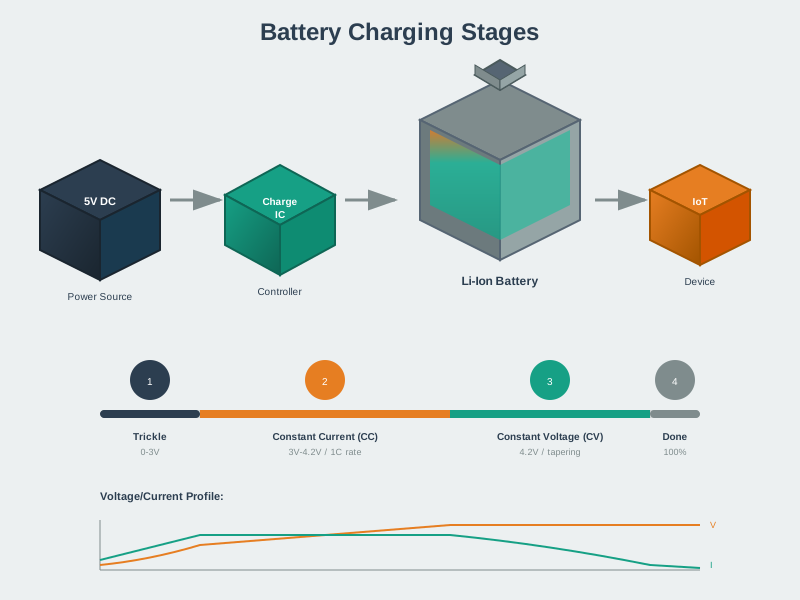
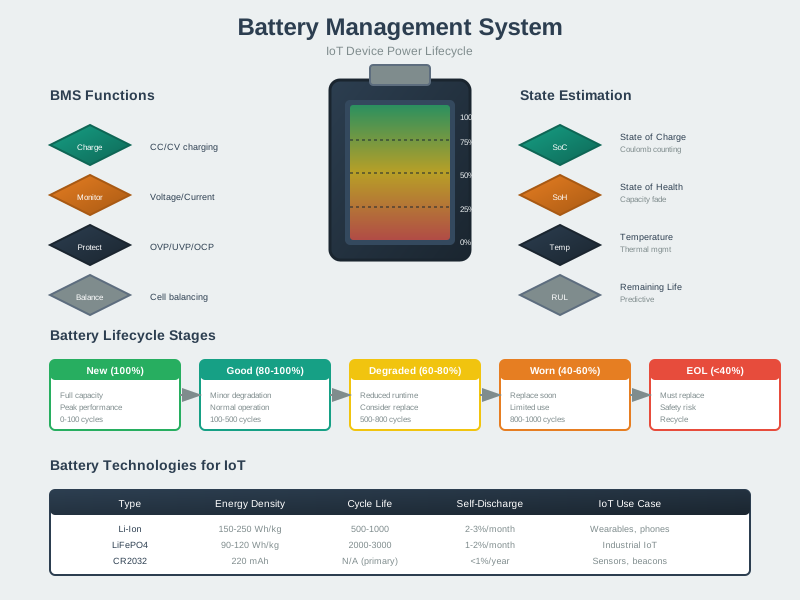
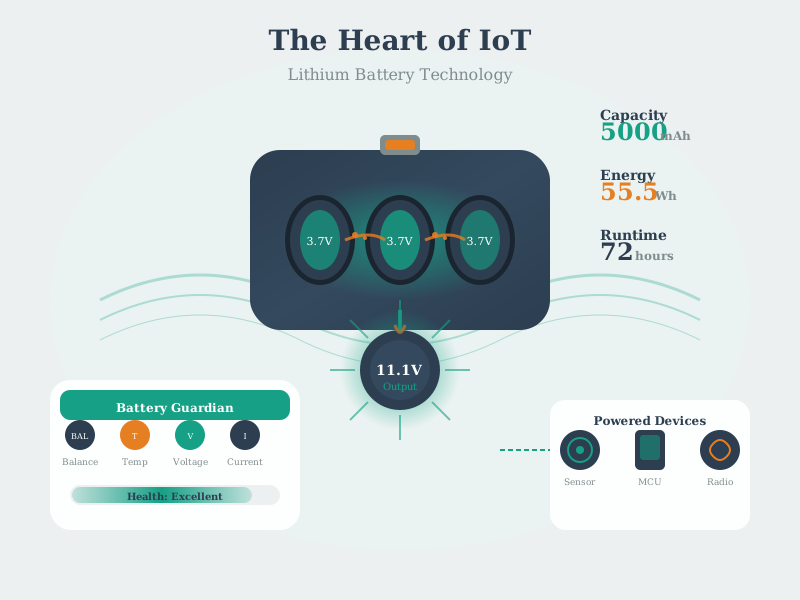
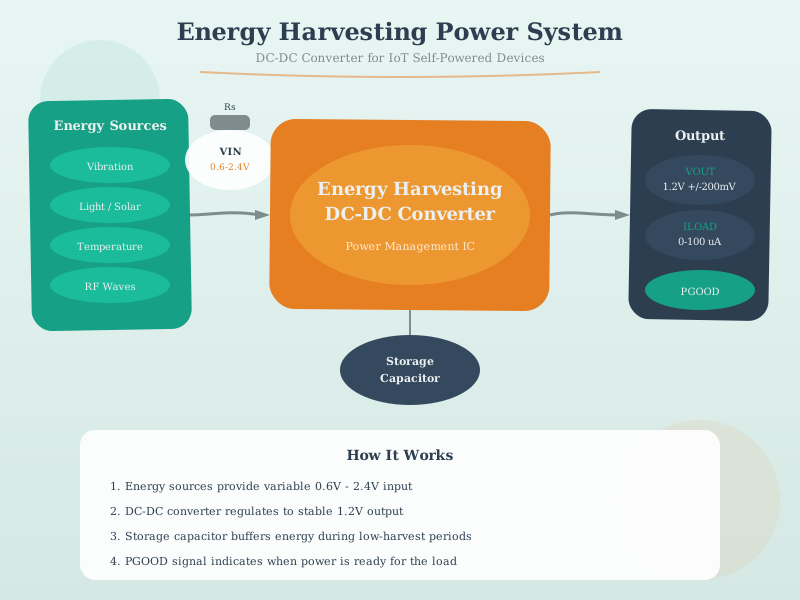
The following AI-generated diagrams illustrate key concepts in battery management and energy harvesting for IoT systems.
1604.6 Battery Capacity Calculation
To determine required battery capacity for a target lifetime:
Step 1: Calculate Average Current
\[I_{avg} = \frac{(I_{active} \times T_{active}) + (I_{sleep} \times T_{sleep})}{T_{cycle}}\]
Step 2: Apply Efficiency Factors
Real battery capacity is typically 60-80% of rated capacity due to:
- Temperature effects (especially cold)
- Voltage cutoff (can’t use full capacity)
- Self-discharge over time
- Aging/degradation
Step 3: Calculate Required Capacity
\[Capacity = \frac{I_{avg} \times Target Hours}{Efficiency Factor}\]
Example Calculation:
- Active: 50mA for 5s per hour
- Sleep: 10µA for 3595s per hour
- Target: 5 years (43,800 hours)
- Efficiency: 70%
\[I_{avg} = \frac{(50 \times 5) + (0.01 \times 3595)}{3600} = 0.079 \text{ mA}\]
\[Capacity = \frac{0.079 \times 43800}{0.7} = 4,944 \text{ mAh}\]
A 5000+ mAh battery (such as 2× Li-SOCl2 ER14505 in parallel) would meet this requirement.
1604.7 Knowledge Check
Question 1: For a remote agricultural sensor that must operate for 10 years without maintenance at temperatures from -30°C to +50°C, which battery chemistry is most appropriate?
Li-SOCl2 batteries are specifically designed for long-term deployment in extreme conditions. They have the lowest self-discharge rate (<1% per decade), widest temperature range (-55°C to +85°C), and highest energy density. While expensive, they’re the only practical choice for 10-year deployments without maintenance access.
Question 2: An office-based IoT sensor with a 5cm² solar panel receives typical indoor lighting (0.01 mW/cm²). What is the maximum average power available from this panel?
Indoor solar power = 0.01 mW/cm² × 5 cm² × 15% efficiency = 7.5 µW, rounded to approximately 50 µW accounting for panel efficiency variations. This is barely enough to supplement deep sleep current (~10 µW for ESP32) and is NOT viable as a primary power source. Indoor solar harvesting is often impractical except in very bright environments.
1604.8 Summary
Key takeaways from this chapter:
- Battery Chemistry Matters: Li-SOCl2 for extreme environments (10+ years), Li-ion for rechargeable applications, alkaline for low-cost moderate-life deployments
- Energy Harvesting Reality: Solar is practical outdoors (10-200 mW/cm²), but indoor solar (0.01 mW/cm²) is rarely viable as primary power
- Temperature Effects: Cold significantly reduces battery capacity (50% at -20°C), requiring careful derating
- Storage is Essential: Even with energy harvesting, batteries or supercapacitors are required to buffer intermittent energy availability
- Calculate Requirements: Work backwards from target lifetime to determine required capacity, applying realistic efficiency factors (60-80%)
1604.9 What’s Next
Continue to Power Consumption Analysis to learn how to analyze and calculate power consumption across different device states.