One of the highest-value applications of Industrial IoT is predictive maintenance. By continuously monitoring equipment health through vibration, temperature, and other sensors, manufacturers can detect failures weeks before they occur, scheduling repairs during planned downtime rather than suffering costly unplanned outages.
TipMinimum Viable Understanding: Predictive Maintenance ROI
Core Concept: Predictive maintenance uses vibration, temperature, and acoustic sensors with machine learning to detect equipment degradation 2-4 weeks before failure, enabling planned repairs instead of emergency downtime. Why It Matters: Reactive maintenance costs $10-15 per horsepower per year with 30-50% unplanned downtime. Predictive maintenance reduces this to $3-5/HP/year with 1-10% downtime - a 50-70% cost reduction. In automotive manufacturing, one hour of unplanned line stoppage costs $50,000-500,000; a single prevented failure can pay for an entire sensor deployment. Key Takeaway: Start with high-criticality, high-replacement-cost assets (motors above 50 HP, compressors, pumps). Deploy vibration sensors at 100-1000 Hz sampling, use edge FFT analysis for 99% data reduction, and target 14-30 day failure prediction windows to allow orderly parts procurement and maintenance scheduling.
149.4 Maintenance Strategies Comparison
Time: ~15 min | Difficulty: Advanced | Unit: P03.C06.U06
Graph diagram
Figure 149.1: Comparison of three maintenance strategies showing cost per horsepower per year: Reactive (run-to-failure) with equipment failing before emergency …
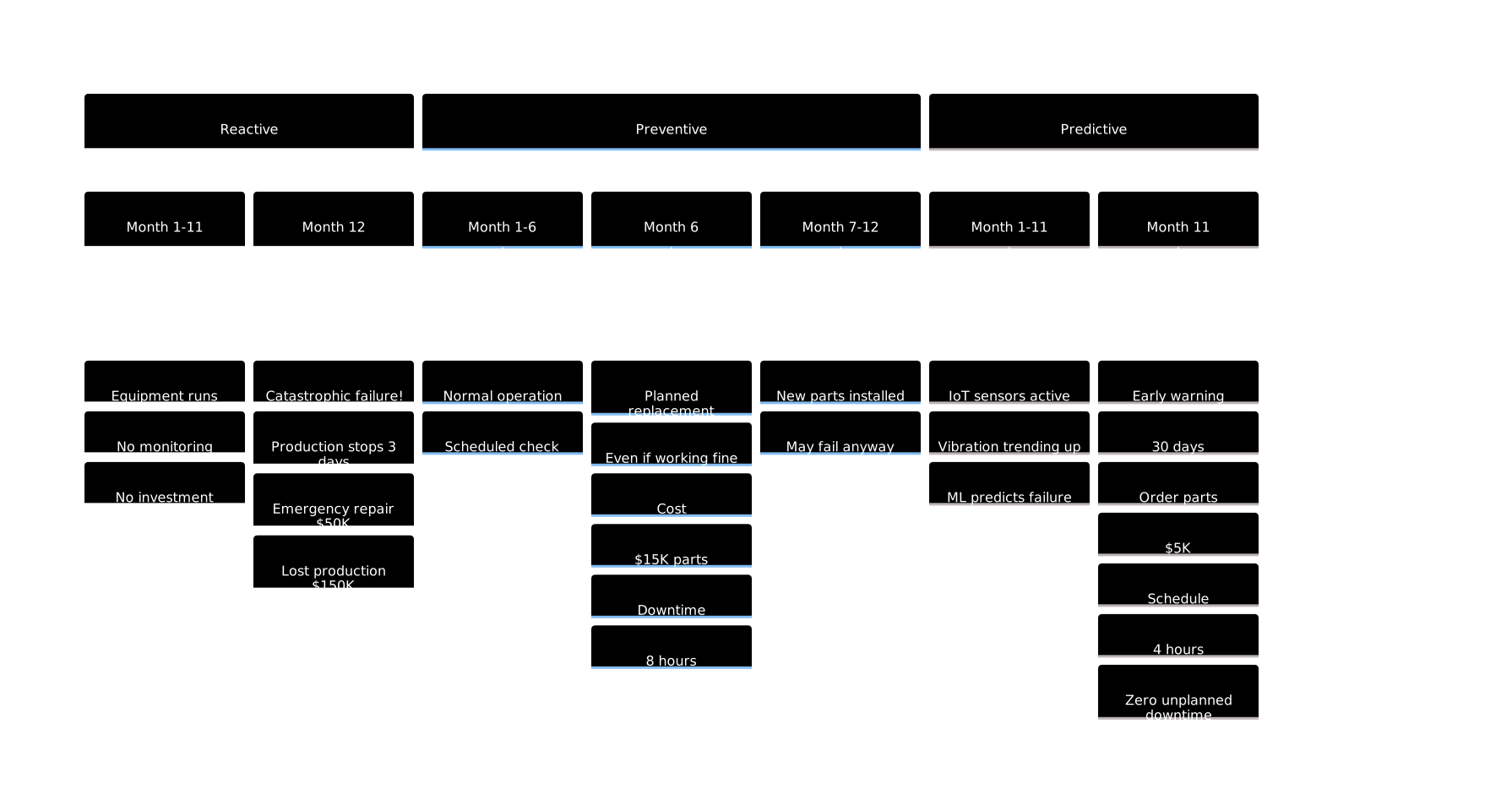
This timeline contrasts how the same equipment behaves under three maintenance regimes, helping students understand why predictive maintenance creates 10x ROI despite higher initial investment.
Timeline comparing three maintenance strategies across 12 months. Reactive section: Months 1-11 show equipment running with no monitoring or investment, Month 12 shows catastrophic failure with 3 days production stop, $50K emergency repair, and $150K lost production. Preventive section: Months 1-6 normal operation with scheduled checks, Month 6 shows planned replacement even if working costing $15K parts and 8 hours downtime, Months 7-12 new parts installed that may fail anyway. Predictive section: Months 1-11 IoT sensors active with vibration trending up and ML predicting failure, Month 11 shows early warning 30 days out, parts ordered for $5K, 4-hour scheduled repair, zero unplanned downtime.
Figure 149.2: Timeline comparing three maintenance strategies across 12 months: Reactive results in catastrophic $200K failure, Preventive replaces parts whether needed or not, and Predictive uses IoT sensors to detect degradation trend for optimal scheduling.
149.4.1 Cost Comparison (per horsepower per year)
Strategy
Cost
Maintenance Costs
Unplanned Downtime
Reactive
$10-15/HP/year
55% of budget
30-50%
Preventive
$7-9/HP/year
31% of budget
10-30%
Predictive
$3-5/HP/year
14% of budget
1-10%
149.5 Predictive Maintenance Pipeline
Graph diagram
Figure 149.3: Predictive maintenance data pipeline with five stages: IoT sensors (vibration, temperature, acoustics, power in green) send data to edge gateway (f…
NoteAlternative View: Data Flow with Real Numbers
This diagram adds concrete data volumes and processing details to each pipeline stage. This detailed view helps engineers design actual predictive maintenance systems.
Predictive maintenance pipeline with real data volumes. Sensing layer (teal): Vibration 3-axis 100 samples/sec, Temperature PT100 1 sample/sec, Current CT 1000 samples/sec. Edge Processing layer (navy): FFT 1024-point every 10 seconds, Feature extraction RMS Kurtosis Crest, Anomaly score with threshold alert. Cloud Analytics layer (orange): Historical 2 years 50GB per motor, ML Model LSTM trained on 500 failures, RUL 23 days Confidence 87%. Automated Actions layer (gray): CMMS Create work order Priority Medium, Parts SKF 6205 auto-order if less than 2, Tech John S with push notification.
Figure 149.4: Predictive maintenance pipeline with real data volumes: Sensing at various sample rates, Edge processing with FFT and feature extraction, Cloud analytics with ML model outputting RUL predictions, and Automated actions including work orders and parts ordering.
149.6 Vibration Analysis
Rotating machinery (motors, pumps, fans) reveals health through vibration signatures:
149.6.1 Common Defects and Frequencies
Defect
Frequency Signature
Detection Lead Time
Imbalance
1x shaft speed
1-2 weeks
Misalignment
2x shaft speed (axial and radial)
Immediate
Bearing defects
BPFO, BPFI, BSF, FTF harmonics
2-4 weeks
Gear mesh
Teeth count x shaft speed
1-3 weeks
Looseness
Multiple harmonics, random spikes
1-2 weeks
149.6.2 Analysis Techniques
Time-domain analysis:
RMS: Overall vibration level
Peak: Maximum amplitude
Crest factor: Peak-to-RMS ratio (indicates impulsive events)
Frequency-domain analysis:
FFT: Fast Fourier Transform identifies specific defect frequencies
Order analysis: Tracks frequency components relative to shaft speed
Spectral trending: Monitors changes in specific frequency bands over time
Advanced techniques:
Envelope analysis: Demodulates high frequencies to detect bearing faults
Wavelet analysis: Time-frequency analysis for transient events
Cepstrum analysis: Detects periodic patterns in spectrum (gear families)
149.6.3 Detection Timeline
Defect Type
Early Detection
Actionable Alert
Critical
Bearing wear
6-8 weeks
2-4 weeks
<1 week
Imbalance
2-4 weeks
1-2 weeks
Days
Misalignment
Immediate
Immediate
N/A
Lubrication
4-6 weeks
2-3 weeks
Days
149.7 Thermal Imaging
Infrared cameras detect thermal anomalies:
149.7.1 Electrical Applications
Hot spots on connections indicate high resistance
Overheated components indicate overload
Phase imbalance in motors
Can detect problems 6-12 months in advance
149.7.2 Mechanical Applications
Bearing overheating (friction)
Belt misalignment (heat buildup)
Lubrication issues (dry bearings)
Coupling problems
149.7.3 Temperature Thresholds
Component
Normal
Warning
Critical
Motor bearings
<70°C
70-85°C
>85°C
Electrical connections
<40°C rise
40-70°C rise
>70°C rise
Gearbox oil
<80°C
80-95°C
>95°C
149.8 Machine Learning Models
Modern predictive maintenance uses ML to learn normal behavior and detect anomalies:
149.8.1 Supervised Learning
Approach: Requires labeled failure data to train classifiers.
Algorithms:
Random Forest, XGBoost for classification
Neural networks for complex patterns
Output: “Will this bearing fail in next 30 days?” (Yes/No with probability)
Requirements:
Historical failure data (dozens to hundreds of examples)
Consistent sensor data leading up to failures
Domain expertise to label failure modes
149.8.2 Unsupervised Learning
Approach: Learns normal operation without failure labels.
Output: “Is this vibration signature abnormal?” (Anomaly score)
Advantages:
Works without historical failures
Detects novel failure modes
Good for rare events
149.8.3 Time-Series Forecasting
Approach: Predicts remaining useful life (RUL) based on degradation trends.
Algorithms:
LSTM neural networks
Prophet (trend + seasonality)
Gaussian Process Regression
Output: “How many hours/days until failure?” (RUL estimate with confidence interval)
Key metrics:
Mean Absolute Error (MAE)
Root Mean Square Error (RMSE)
Percentage within 10%/20% tolerance
Show code
{const container =document.getElementById('kc-iiot-predictive');if (container &&typeof InlineKnowledgeCheck !=='undefined') { container.innerHTML=''; container.appendChild(InlineKnowledgeCheck.create({question:"A factory has 500 motors ranging from 5 HP to 200 HP. They want to implement predictive maintenance but have limited budget for the pilot. Which approach maximizes ROI?",options: [ {text:"Monitor all 500 motors with low-cost vibration sensors",correct:false,feedback:"Spreading limited budget across all motors means lower-quality sensors and less sophisticated analytics. The small motors (5-25 HP) have low replacement costs, making the ROI minimal even if failures are predicted."}, {text:"Focus on the 50 largest motors (>50 HP) with high-quality vibration and thermal monitoring",correct:true,feedback:"Correct! Large motors have replacement costs of $10,000-$50,000+ and cause the most production impact when they fail. Focusing resources on high-criticality assets typically delivers 10x better ROI than broad, shallow monitoring."}, {text:"Start with the newest motors since they have better documentation",correct:false,feedback:"Newer motors are less likely to fail and have warranty coverage. Predictive maintenance ROI comes from preventing failures on aging equipment where the failure probability is higher."}, {text:"Monitor motors with the highest runtime hours first",correct:false,feedback:"Runtime hours alone don't determine criticality. A 5 HP motor with 50,000 hours is still a low-cost replacement. Focus on the business impact of failure, not just age or usage."} ],difficulty:"medium",topic:"predictive-maintenance" })); }}
149.9 Case Study: BMW Regensburg Smart Factory
Time: ~8 min | Difficulty: Intermediate | Unit: P03.C06.U07
BMW’s Regensburg plant exemplifies Industry 4.0 implementation:
Scale:
9,000 employees
1,200+ robots
50,000+ data points monitored continuously
Produces 1,100 vehicles per day
IoT implementation:
Every machine connected via OPC-UA
Real-time quality monitoring at 300+ inspection points
Computer vision systems check 100% of welds (previously 3% sampling)
Digital twin of entire production line
Results:
5-10% productivity improvement
30% reduction in quality defects
15% reduction in energy consumption
Predictive maintenance prevents 80% of unplanned downtime
Key technologies:
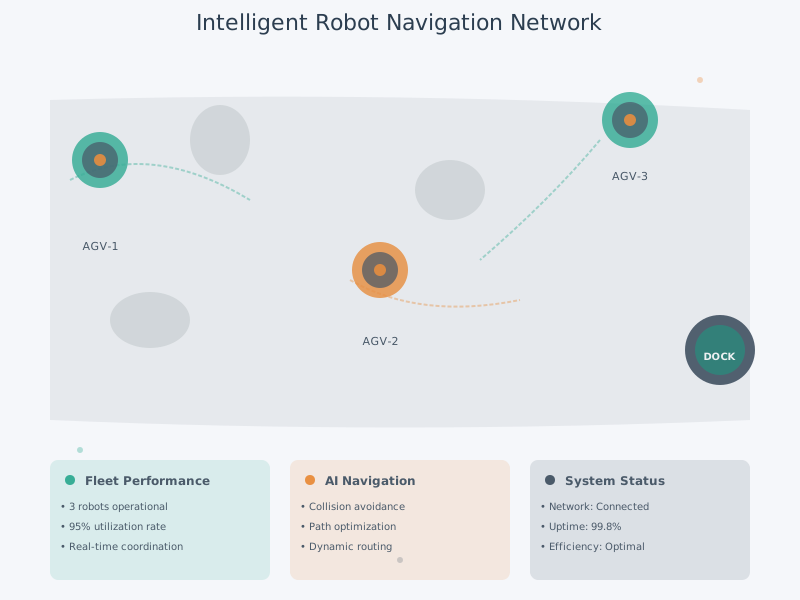
Smart Transport Systems: AGVs (Automated Guided Vehicles) optimize material delivery
Collaborative Robots: Cobots work alongside humans on final assembly
AI Quality Control: Computer vision detects defects invisible to human inspectors
Digital Twin: Entire factory simulated to test production changes virtually
Automated Guided Vehicle Navigation System
AGVs represent a cornerstone of smart factory material handling. These autonomous vehicles use sensor fusion combining LiDAR, cameras, and floor-embedded guidance systems to transport materials between workstations without human intervention.
Lesson learned: Success required cultural change, not just technology. Workers needed training, trust in automation, and empowerment to act on data insights.
Key Success Factor: The factory produces the same automation products it uses, creating a feedback loop where production improvements directly enhance the products sold to customers.
149.10 ROI Calculation Framework
149.10.1 Cost Components
Investment costs:
Sensors: $100-500 per motor (vibration, temperature)
Gateways: $500-2,000 per zone
Software: $50,000-500,000 (depending on scale)
Integration: 2-5x hardware cost for brownfield
Training: $1,000-5,000 per technician
Operating costs:
Platform licensing: $10-50 per asset/month
Connectivity: $5-20 per gateway/month
Data storage: $0.02-0.05 per GB/month
Analyst time: $50,000-100,000/year for dedicated resources
149.10.2 Benefit Categories
Direct savings:
Reduced emergency repairs (labor + parts + expediting)
Extended equipment life (deferred replacement)
Lower spare parts inventory (order when needed)
Reduced energy consumption (efficient equipment)
Indirect savings:
Avoided production losses (unplanned downtime)
Improved quality (equipment in specification)
Reduced safety incidents (early warning of hazards)
Better capital planning (known equipment condition)
149.10.3 Sample ROI Calculation
Scenario: 100-motor manufacturing plant
Item
Value
Average motor replacement cost
$15,000
Historical failures per year
8
Average downtime per failure
12 hours
Downtime cost per hour
$5,000
Annual failure cost
$600,000
With predictive maintenance:
Item
Value
Investment (sensors, software, integration)
$180,000
Annual operating cost
$36,000
Failure prediction rate
85%
Prevented failures
6.8 per year
Annual savings
$510,000
Payback period
4.2 months
149.11 Implementation Roadmap
149.11.1 Phase 1: Pilot (Months 1-6)
Select 10-20 critical assets
Deploy basic vibration and temperature sensors
Establish data collection infrastructure
Create baseline normal operation profiles
Success metric: Detect one previously undetected issue
149.11.2 Phase 2: Expansion (Months 7-18)
Expand to 50-100 assets
Implement ML-based anomaly detection
Integrate with CMMS for work order generation
Train maintenance technicians on new tools
Success metric: 30% reduction in unplanned downtime
149.11.3 Phase 3: Optimization (Months 19-36)
Full facility coverage (all critical assets)
Remaining useful life predictions
Automated parts ordering
Continuous model improvement
Success metric: 50%+ reduction in maintenance costs
149.12 Summary
Predictive maintenance represents the highest-ROI application of Industrial IoT:
Strategy comparison: Predictive maintenance costs $3-5/HP/year vs $10-15/HP/year for reactive, with 50-70% reduction in maintenance spending.
Sensing technologies: Vibration analysis detects bearing defects 2-4 weeks before failure; thermal imaging identifies electrical problems 6-12 months in advance.
ML approaches: Supervised learning predicts specific failure modes with labeled data; unsupervised learning detects anomalies without historical failures; time-series forecasting estimates remaining useful life.
Implementation: Start with high-criticality assets, focus on business impact not just technical capability, and expect 4-6 month payback on well-targeted deployments.
Success factors: Technology is necessary but not sufficient - cultural change, technician training, and organizational commitment are equally important.