%%{init: {'theme': 'base', 'themeVariables': {'primaryColor': '#2C3E50', 'primaryTextColor': '#fff', 'primaryBorderColor': '#16A085', 'lineColor': '#16A085', 'secondaryColor': '#E67E22'}}}%%
sequenceDiagram
    participant Device as IoT Device<br/>(RSA Key Pair)
    participant Server as Key Server<br/>(RSA Key Pair)

    Note over Device,Server: E5: Periodic Key Renewal

    Device->>Server: Public Key (PubD)
    Server->>Device: Public Key (PubS)

    Note over Server: Generate New<br/>AES-256 Key

    Server->>Server: Encrypt Key<br/>with PubD
    Server->>Server: Sign with<br/>PrivS

    Server->>Device: Encrypted Key<br/>+ Signature

    Device->>Device: Verify Signature<br/>with PubS
    Device->>Device: Decrypt Key<br/>with PrivD

    Note over Device,Server: Both now have<br/>new AES key

    Device->>Server: Acknowledge<br/>(encrypted with new AES key)

    Note over Device,Server: Switch to new key<br/>for E1/E2/E3 encryption
1434 E5: Key Renewal and Asymmetric Cryptography
1434.1 Learning Objectives
By the end of this chapter, you will be able to:
- Implement E5 Key Renewal: Design periodic key refresh using asymmetric encryption
- Compare RSA vs ECC: Select appropriate algorithms based on device constraints and security requirements
- Calculate Cryptographic Performance: Analyze TLS handshake time, energy consumption, and fleet throughput
- Design Key Rotation Strategies: Implement automated key lifecycle management for long-term deployments
1434.2 E5: Key Renewal with Asymmetric Encryption
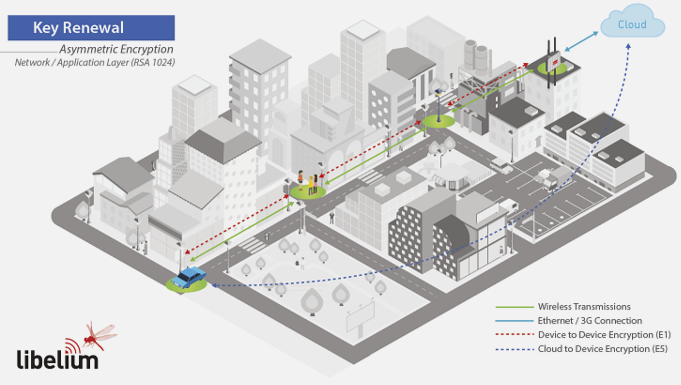
Purpose: Periodically refresh symmetric keys using asymmetric encryption.
Characteristics:
- RSA public/private key pairs
- Asymmetric encryption for key exchange
- Authentication and non-repudiation
- Returns to AES for data encryption (performance)
1434.2.1 E5 Implementation Details
Algorithm: RSA-2048 or ECC P-256 for key exchange + digital signatures
Key Renewal Process:
| Step | Actor | Action | Purpose |
|---|---|---|---|
| 1 | Device/Server | Generate RSA/ECC key pairs | One-time setup during provisioning |
| 2 | Both | Exchange public keys | Establish trust relationship |
| 3 | Server | Generate new AES-256 session key | Create fresh symmetric key |
| 4 | Server | Encrypt AES key with device’s public key | Secure key transport |
| 5 | Server | Sign encrypted key with server private key | Prove authenticity |
| 6 | Device | Verify signature with server public key | Authenticate sender |
| 7 | Device | Decrypt AES key with device private key | Recover session key |
| 8 | Device | Send acknowledgment encrypted with new AES key | Confirm receipt |
| 9 | Both | Switch to new AES key for E1/E2/E3 | Activate new encryption |
Asymmetric Algorithms Comparison:
| Algorithm | Key Size | Security Level | Speed | IoT Suitability |
|---|---|---|---|---|
| RSA-2048 | 2048 bits | 112-bit security | Slow | High power consumption |
| RSA-3072 | 3072 bits | 128-bit security | Very slow | Too heavy for constrained devices |
| ECC P-256 | 256 bits | 128-bit security | Fast | Recommended for IoT |
| ECC P-384 | 384 bits | 192-bit security | Moderate | High-security IoT |
| Ed25519 | 256 bits | 128-bit security | Very fast | Best for signatures |
1434.2.2 Why Use Asymmetric Encryption for Key Renewal?
%%{init: {'theme': 'base', 'themeVariables': {'primaryColor': '#2C3E50', 'primaryTextColor': '#fff', 'primaryBorderColor': '#16A085', 'lineColor': '#16A085', 'secondaryColor': '#E67E22'}}}%%
graph TB
    subgraph Symmetric["Symmetric Key Distribution Problem"]
        S1[Need new AES key]
        S2[How to send it securely?]
        S3[Need encryption to send key...]
        S4[Chicken-and-egg problem!]
        S1 --> S2 --> S3 --> S4
    end

    subgraph Asymmetric["Asymmetric Key Solution"]
        A1[Generate new AES key]
        A2[Encrypt with public key<br/>Anyone can encrypt]
        A3[Only device can decrypt<br/>Private key needed]
        A4[New AES key securely delivered!]
        A1 --> A2 --> A3 --> A4
    end

    style Symmetric fill:#F8D7DA,stroke:#E74C3C,stroke-width:2px
    style Asymmetric fill:#D4F4DD,stroke:#16A085,stroke-width:2px
Security Properties:
- Authentication: RSA/ECC signatures prove key origin
- Non-Repudiation: Server cannot deny sending key (legal proof)
- Forward Secrecy: Compromised old key doesn’t reveal past sessions
- No Pre-Shared Secret: Public keys can be distributed openly
- Performance: Asymmetric crypto is 100-1000x slower than AES
Best Practice:
Use asymmetric encryption (E5) only for key exchange, then switch to symmetric encryption (AES) for bulk data. This hybrid approach combines the security of RSA/ECC with the speed of AES—exactly how TLS and most secure protocols work.
1434.3 Key Rotation Strategies and Schedules
NoteDeep Dive: Key Rotation Implementation
Effective key rotation prevents long-term key compromise while minimizing operational overhead.
Rotation schedule recommendations:
| Key Type | Rotation Period | Rationale |
|---|---|---|
| Link keys (E1) | Never / On compromise | Changing affects all devices |
| Device keys (E2) | Annually or on compromise | Balance security vs complexity |
| Session keys (E3/E4) | Per connection or daily | Forward secrecy |
| Master keys (E5) | Bi-annually | Certificate validity periods |
Automated key rotation implementation:
import time
from cryptography.hazmat.primitives import hashes
from cryptography.hazmat.primitives.asymmetric import ec
from cryptography.hazmat.primitives.kdf.hkdf import HKDF

class KeyRotationManager:
    """
    Manages key lifecycle for IoT deployment.
    Supports scheduled rotation and emergency re-keying.
    """
    def __init__(self, device_id: str, key_server_url: str):
        self.device_id = device_id
        self.key_server = key_server_url
        self.current_key = None
        self.key_generation = 0
        self.key_valid_until = 0
        self.rotation_interval = 86400 * 90  # 90 days

    async def check_rotation_needed(self) -> bool:
        """Check if key rotation is due."""
        if self.current_key is None:
            return True

        # Time-based rotation
        if time.time() > self.key_valid_until:
            return True

        # Usage-based rotation (e.g., after N encryptions)
        if self.encryption_count > 1_000_000:
            return True

        return False

    async def rotate_key(self):
        """
        Perform key rotation using E5 asymmetric exchange.
        """
        # Step 1: Generate ephemeral ECDH key pair
        private_key = ec.generate_private_key(ec.SECP256R1())
        public_key = private_key.public_key()

        # Step 2: Request new key from server
        response = await self.key_server.request_key_rotation(
            device_id=self.device_id,
            device_public_key=public_key.public_bytes(...),
            current_generation=self.key_generation
        )

        # Step 3: Derive shared secret using ECDH
        server_public_key = load_public_key(response['server_public_key'])
        shared_secret = private_key.exchange(ec.ECDH(), server_public_key)

        # Step 4: Derive new symmetric key using HKDF
        hkdf = HKDF(
            algorithm=hashes.SHA256(),
            length=32,  # 256-bit AES key
            salt=response['salt'],
            info=b'iot-session-key-v1'
        )
        new_key = hkdf.derive(shared_secret)

        # Step 5: Verify key transition
        if await self.verify_new_key(new_key, response['verification_token']):
            self.transition_to_new_key(new_key)

    def transition_to_new_key(self, new_key: bytes):
        """Atomic key transition with overlap period."""
        # Keep old key valid for grace period (handles in-flight messages)
        self.previous_key = self.current_key
        self.previous_key_expiry = time.time() + 300  # 5 minute overlap

        # Activate new key
        self.current_key = new_key
        self.key_generation += 1
        self.key_valid_until = time.time() + self.rotation_interval
        self.encryption_count = 0
Compliance requirements:
| Standard | Key Rotation Requirement |
|---|---|
| PCI-DSS | Annually minimum, on compromise |
| HIPAA | Risk-based, document rationale |
| NIST 800-57 | Based on key type and algorithm |
| IEC 62443 | Zone-specific, documented policy |
1434.4 Worked Example: TLS Handshake Performance Analysis
NoteReal-World Problem: Smart Meter Fleet Registration
This worked example demonstrates how encryption algorithm choice impacts large-scale IoT deployments, particularly during device provisioning and registration.
Context: A utility company is deploying 10,000 smart meters that must register with their cloud platform using TLS mutual authentication. Each device must complete a full TLS handshake to establish secure communication.
Given:
| Parameter | Value |
|---|---|
| Device MCU | ARM Cortex-M4 @ 80 MHz |
| RSA-2048 signature verification | 200 ms on MCU |
| ECDSA-256 signature verification | 50 ms on MCU |
| RSA-2048 key generation | 30 seconds on MCU |
| ECDSA-256 key generation | 500 ms on MCU |
| Power during crypto operations | 50 mW |
| Network round-trip time | 50 ms |
Problem: Compare RSA-2048 vs ECDSA-256 for device registration. Calculate handshake time, energy consumption, and fleet registration throughput.
1434.4.1 Step 1: Single Device Handshake Time Analysis
%%{init: {'theme': 'base', 'themeVariables': {'primaryColor': '#2C3E50', 'primaryTextColor': '#fff', 'primaryBorderColor': '#16A085', 'lineColor': '#16A085', 'secondaryColor': '#E67E22'}}}%%
gantt
    title TLS Handshake Timing Comparison
    dateFormat X
    axisFormat %L ms

    section RSA-2048
    ClientHello to ServerHello (network)    :rsa1, 0, 50
    Server Certificate Verify              :rsa2, after rsa1, 200
    Key Exchange                           :rsa3, after rsa2, 100

    section ECDSA-256
    ClientHello to ServerHello (network)    :ecc1, 0, 50
    Server Certificate Verify              :ecc2, after ecc1, 50
    Key Exchange (ECDHE)                   :ecc3, after ecc2, 30
RSA-2048 Handshake Breakdown:
\[T_{RSA} = T_{network} + T_{verify} + T_{keyex}\]
\[T_{RSA} = 50\text{ ms} + 200\text{ ms} + 100\text{ ms} = 350\text{ ms}\]
ECDSA-256 Handshake Breakdown:
\[T_{ECDSA} = T_{network} + T_{verify} + T_{keyex}\]
\[T_{ECDSA} = 50\text{ ms} + 50\text{ ms} + 30\text{ ms} = 130\text{ ms}\]
Speedup Factor:
\[\text{Speedup} = \frac{T_{RSA}}{T_{ECDSA}} = \frac{350\text{ ms}}{130\text{ ms}} = 2.69\times\]
1434.4.2 Step 2: Energy Consumption per Handshake
Energy equals power multiplied by time. With MCU consuming 50 mW during cryptographic operations:
RSA-2048 Energy:
\[E_{RSA} = P \times T_{RSA} = 50\text{ mW} \times 350\text{ ms} = 17.5\text{ mJ}\]
ECDSA-256 Energy:
\[E_{ECDSA} = P \times T_{ECDSA} = 50\text{ mW} \times 130\text{ ms} = 6.5\text{ mJ}\]
Energy Savings with ECC:
\[\text{Savings} = \frac{E_{RSA} - E_{ECDSA}}{E_{RSA}} \times 100\% = \frac{17.5 - 6.5}{17.5} \times 100\% = 62.9\%\]
ImportantBattery Impact
For a battery-powered smart meter with 2,400 mAh @ 3.3V (28.5 kJ total capacity):
- RSA: 28,500 J / 0.0175 J = 1.63 million handshakes before battery depletion
- ECDSA: 28,500 J / 0.0065 J = 4.38 million handshakes before battery depletion
ECDSA enables 2.7x more reconnection events over device lifetime!
1434.4.3 Step 3: Fleet Registration Throughput
For the utility company registering 10,000 devices:
\[\text{Throughput}_{RSA} = \frac{3600\text{ s}}{0.35\text{ s/device}} = 10,286\text{ devices/hour}\]
\[\text{Throughput}_{ECDSA} = \frac{3600\text{ s}}{0.13\text{ s/device}} = 27,692\text{ devices/hour}\]
Time to Register 10,000 Device Fleet:
\[T_{fleet,RSA} = \frac{10,000}{10,286} = 0.97\text{ hours} \approx 58\text{ minutes}\]
\[T_{fleet,ECDSA} = \frac{10,000}{27,692} = 0.36\text{ hours} \approx 22\text{ minutes}\]
1434.4.4 Final Answer Summary
| Metric | RSA-2048 | ECDSA-256 | Improvement |
|---|---|---|---|
| Handshake time | 350 ms | 130 ms | 2.7x faster |
| Energy per handshake | 17.5 mJ | 6.5 mJ | 63% less energy |
| Fleet registration (10K) | 58 minutes | 22 minutes | 2.7x faster |
| Public key size | 256 bytes | 32 bytes | 8x smaller |
| Security level | 112-bit | 128-bit | ECC is stronger |
TipKey Insight: ECC is Strongly Preferred for Constrained IoT
ECDSA-256 (or Ed25519) should be the default choice for IoT device authentication:
- Faster: 2.7x faster handshakes improve user experience
- Energy Efficient: 63% less energy extends battery life
- Smaller Keys: 8x smaller certificates reduce storage and bandwidth
- Better Security: 128-bit security (ECC-256) exceeds 112-bit (RSA-2048)
When to Use RSA: Only if legacy infrastructure requires RSA, or for root CA certificates.
1434.5 Hash Collision Probability Calculator
NoteUnderstanding Hash Collisions and the Birthday Paradox
Hash functions are critical for IoT firmware verification, password storage, and message authentication (HMAC). Understanding collision probability helps you select appropriate hash sizes for your security requirements.
The Birthday Paradox: In a room of just 23 people, there’s a 50% chance two share a birthday. With 365 days available, this seems counterintuitive—but it’s a fundamental property of randomness that affects cryptographic hash security.
Use Cases by Hash Size:
| Hash Size | Security Level | Suitable For | Attack Resistance |
|---|---|---|---|
| 64-bit | Inadequate | Checksums only (CRC32) | Collisions trivial |
| 128-bit | Weak | Non-security uses | Birthday attack feasible |
| 160-bit | Deprecated | Legacy systems (SHA-1) | Broken (SHAttered 2017) |
| 256-bit | Standard | Firmware verification, HMAC | Secure for decades |
| 384-bit | High Security | Government, defense | Post-quantum resistant |
| 512-bit | Maximum | Ultra-high security | Overkill for most IoT |
1434.6 Summary
This chapter covered E5 key renewal and asymmetric cryptography:
- E5 Purpose: Periodic refresh of symmetric keys using asymmetric encryption (RSA/ECC) for long-term security
- Hybrid Approach: Use asymmetric crypto for key exchange, symmetric crypto for bulk data (how TLS works)
- ECC Advantages: 2.7x faster, 63% less energy, 8x smaller keys than RSA-2048 with equal or better security
- Key Rotation: Implement automated rotation schedules based on key type and compliance requirements
- Hash Selection: Use SHA-256 minimum for security applications; avoid MD5 and SHA-1
1434.7 What’s Next
Continue to Security Properties and Best Practices to understand how all five encryption levels (E1-E5) work together to provide defense-in-depth security, and learn how to design comprehensive encryption architectures for real-world IoT deployments.
NoteRelated Chapters
- E3-E4: Transport and End-to-End - TLS configuration
- Security Properties - Defense-in-depth strategies
- Encryption Principles - Cryptographic fundamentals
- Cyber Security Methods - Authentication using encryption