1630 Automotive Sensor Applications
1630.1 Learning Objectives
By the end of this chapter, you will be able to:
- Identify automotive sensor categories: Understand the types and purposes of sensors in modern vehicles
- Evaluate safety-critical specifications: Interpret ASIL safety levels and redundancy requirements
- Analyze seat occupancy systems: Compare sensor technologies for airbag enable/disable decisions
- Understand airbag deployment requirements: Specify high-g accelerometers with sub-millisecond response
- Design TPMS systems: Select pressure sensors for 10-year battery life in harsh environments
- Evaluate ADAS sensors: Compare radar, lidar, and camera technologies for adaptive cruise control
1630.2 Prerequisites
Before diving into this chapter, you should be familiar with:
- Specification Sheet Fundamentals: Understanding datasheet sections and vocabulary
- Sensor Selection Process: Component comparison and selection methodology
1630.3 Overview of Automotive Sensing
Modern vehicles contain 60-100+ sensors for safety, comfort, and performance:

Automotive Sensor Categories:
| Category | Examples | Typical Requirements |
|---|---|---|
| Safety | Airbag, TPMS, Seat occupancy | ASIL-B to ASIL-D, redundancy |
| Comfort | Climate, rain, ambient light | Wide temp range, long life |
| Performance | Engine, throttle, O2 | High accuracy, fast response |
| ADAS | Radar, lidar, camera | All-weather, high bandwidth |
1630.4 Application 1: Seat Occupancy Detection
Purpose:
- Enable/disable airbag deployment (child seats should disable airbag)
- Seatbelt reminder warnings
- Passenger counting for HOV lane compliance
Sensor Options:

Typical Specification:
| Parameter | Requirement | Sensor Choice |
|---|---|---|
| Detection Range | 0-120 kg | Load cell (0-150 kg range) |
| Accuracy | +/-2 kg | 1.5% full-scale accuracy |
| Response Time | < 100 ms | Bandwidth > 10 Hz |
| Operating Temp | -40C to +85C | Automotive-grade sensor |
| Safety Level | ASIL-B | Redundant sensing |
Technology Comparison:
| Technology | Pros | Cons | Cost |
|---|---|---|---|
| Load Cell (Strain Gauge) | High accuracy, passive | Single point measurement | $10-15 |
| Pressure Mat (Capacitive) | Distributed sensing, low cost | Requires power | $5-10 |
| Fluid Bladder | Comfort, distributed | Temperature sensitive | $20-30 |
1630.5 Application 2: Airbag Deployment
Purpose:
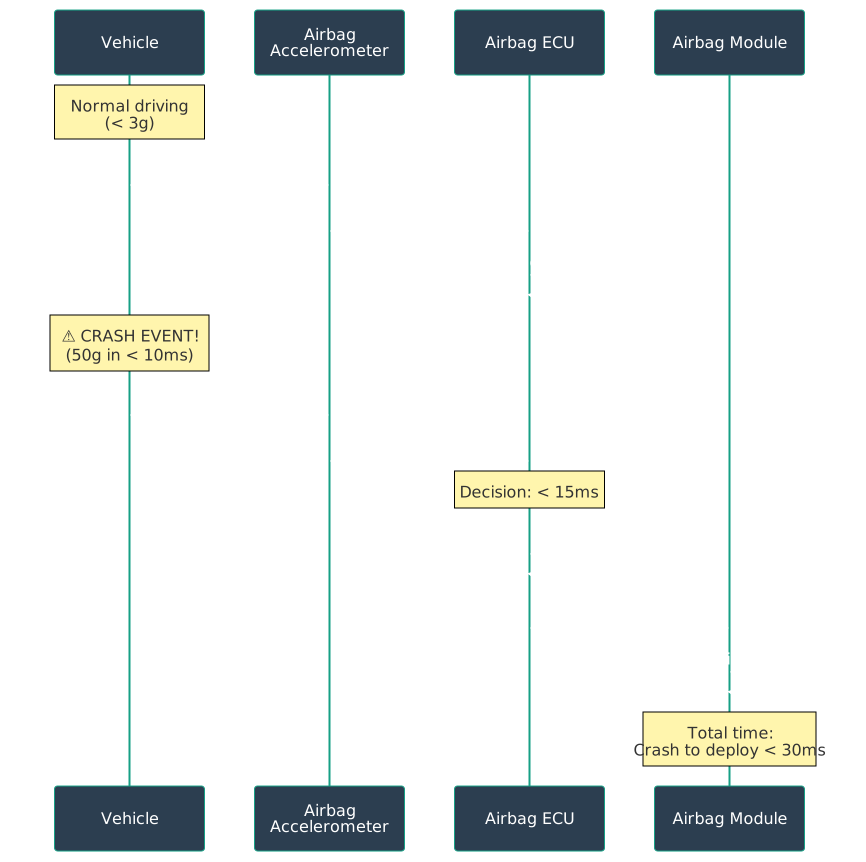
- Detect crash events requiring airbag deployment
- Distinguish between minor bumps and serious crashes
- Trigger within 15-30 milliseconds
Sensor Requirements:
Specification Requirements:
| Parameter | Value | Reasoning |
|---|---|---|
| Range | +/-50g or higher | Crash impacts: 10-100g |
| Bandwidth | > 1000 Hz | Capture fast impact transients |
| Response Time | < 1 ms | Critical safety timing |
| Shock Survival | > 2000g | Must survive crash to operate |
| Self-Test | Built-in | Verify operation on startup |
| Redundancy | Dual sensors | ASIL-D safety level |
Example Sensor: Bosch SMA5xx series
- Range: +/-50g
- Bandwidth: 3 kHz
- Response: < 0.5 ms
- Self-test: Yes
- Interface: SPI
Airbag systems must meet ASIL-D (Automotive Safety Integrity Level D), the highest automotive safety standard:
- Dual redundant sensors: Two independent accelerometers must agree
- Self-diagnostic: Continuous monitoring of sensor health
- Fail-safe: System must not deploy accidentally
- Worst-case response: Design for maximum specified timing, not typical
1630.6 Application 3: Tire Pressure Monitoring System (TPMS)
Purpose:
- Monitor tire pressure in real-time
- Alert driver to low pressure (safety + fuel efficiency)
- Required by law in many countries (USA since 2008)
System Architecture:

Sensor Specification:
| Parameter | Requirement | Design Impact |
|---|---|---|
| Pressure Range | 0-450 kPa (0-65 psi) | MEMS piezoresistive sensor |
| Accuracy | +/-7 kPa (+/-1 psi) | 1.5% full-scale |
| Temperature Range | -40C to +125C | Automotive-grade |
| Power Consumption | < 10 uA average | Ultra-low power for battery life |
| Sampling Rate | 1 sample/minute (moving) | Triggered by accelerometer |
| Communication | RF (315/434 MHz) | Wireless to avoid wiring |
Power Budget Calculation:
For 10-year battery life with CR2032 (220 mAh):
Required average current = 220 mAh / (10 years x 8760 hours/year)
                        = 220,000 uAh / 87,600 hours
                        = 2.5 uA average

Actual budget breakdown:
  Sleep mode: 0.5 uA x 99.9% = 0.5 uA
  Transmit mode: 15 mA x 0.1% = 15 uA
  Total: ~15.5 uA (need optimization!)

Solution: Reduce transmit duty cycle or use lower-power RF
1630.7 Application 4: Adaptive Cruise Control
Purpose:
- Maintain set speed
- Automatically adjust speed to maintain safe following distance
- Requires distance and relative velocity measurement
Sensor Technologies:

Typical 77 GHz Radar Specifications:
| Parameter | Value | Application Impact |
|---|---|---|
| Range | 0.5-200 m | Detect vehicles ahead |
| Range Accuracy | +/-0.1 m | Precise distance control |
| Velocity Range | +/-70 m/s (+/-250 km/h) | Detect approaching/receding |
| Angular FOV | +/-45 degrees | Wide forward coverage |
| Update Rate | 50-100 Hz | Smooth control response |
| Weather Performance | All conditions | Rain/fog penetration |
Technology Comparison:
| Technology | Range | Weather | Resolution | Cost |
|---|---|---|---|---|
| 77 GHz Radar | 200m | Excellent | Medium | Medium |
| Lidar | 150m | Poor (rain/fog) | High | High |
| Camera | 100m | Fair | High | Low |
| Ultrasonic | 10m | Good | Low | Low |
| Sensor Fusion | 200m | Excellent | High | High |
1630.8 Knowledge Check
1630.9 Automotive Sensor Selection Summary
| Application | Sensor Type | Key Requirements | Typical Specs |
|---|---|---|---|
| Seat Occupancy | Load Cell (Strain Gauge) | 0-120 kg range, +/-2 kg accuracy | ASIL-B safety, analog output |
| Airbag Deployment | High-g MEMS Accelerometer | +/-50g range, <1ms response | ASIL-D safety, dual redundancy |
| TPMS | MEMS Pressure Sensor | 0-450 kPa, 10-year battery | RF wireless, <10 uA power |
| Adaptive Cruise | 77 GHz Radar | 0.5-200m range, all-weather | 50-100 Hz update, +/-0.1m accuracy |
1630.10 Summary
Key Takeaways:
- Automotive sensors demand extreme specifications:
- Wide temperature ranges (-40C to +125C)
- High reliability (ASIL safety levels)
- Long lifetime (10-15 years)
- Harsh environment tolerance
- Safety-critical applications require:
- Redundant sensing (dual sensors)
- Self-diagnostic capabilities
- Worst-case design margins
- Certification to ASIL standards
- Power optimization is critical for battery-powered sensors:
- TPMS must last 10+ years on coin cell
- Aggressive duty cycling required
- Ultra-low-power modes essential
- Sensor fusion combines multiple technologies:
- Radar for all-weather range/velocity
- Camera for object recognition
- Lidar for high-resolution mapping
- Each compensates for others’ weaknesses
- Cost-performance trade-offs vary by application:
- Safety systems prioritize reliability over cost
- Comfort systems balance cost and performance
- ADAS systems invest in premium sensing
1630.11 Visual Reference Gallery
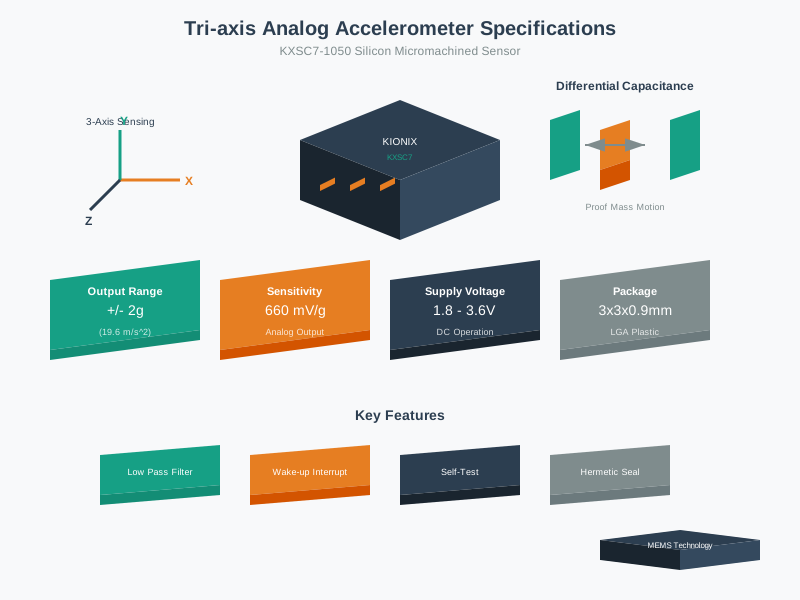
Understanding accelerometer specifications enables proper sensor selection for motion sensing, vibration monitoring, and orientation detection applications.
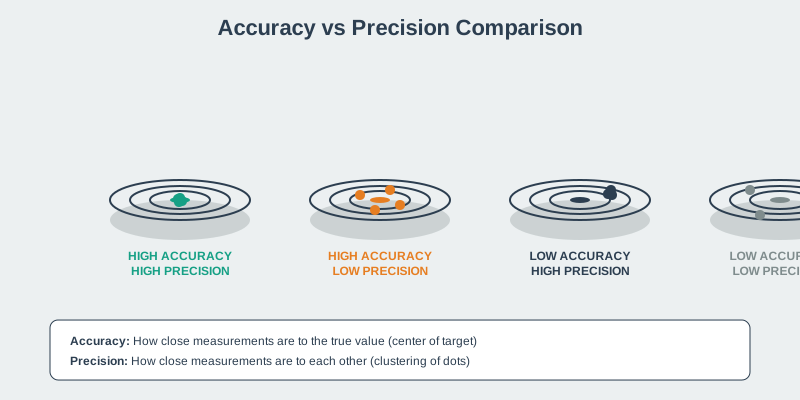
Distinguishing between accuracy (closeness to true value) and precision (repeatability) is essential for selecting sensors that meet application requirements.
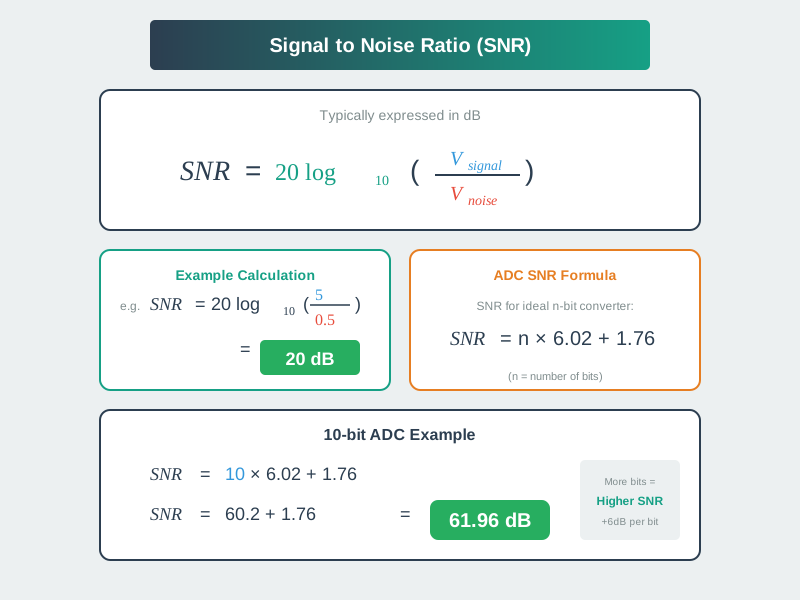
Signal-to-noise ratio determines the effective resolution of a sensor system, with higher SNR enabling detection of smaller signal variations.
1630.12 What’s Next
This concludes the specification sheet reading series. Continue to Design Thinking and Planning to learn how to integrate component selection with broader system design considerations.
Related Chapters:
- Specification Sheet Fundamentals - Basic datasheet concepts
- Accelerometer Case Study - Detailed datasheet analysis
- Sensor Selection Process - Component comparison methodology
- Energy Management - Power optimization for automotive systems
Component Selection:
- Hardware Prototyping - Using components in projects
- Energy Considerations - Power specifications
- Sensor Fundamentals - Sensor specifications
Simulation Tools:
- Circuit Simulation - Test before build
- Power Calculator - Estimate power needs