%%{init: {'theme': 'base', 'themeVariables': {'primaryColor':'#E8EAF6','primaryTextColor':'#2C3E50','primaryBorderColor':'#2C3E50','lineColor':'#16A085','secondaryColor':'#FFF3E0','tertiaryColor':'#E8F5E9','noteTextColor':'#2C3E50','noteBkgColor':'#FFF9C4','noteBorderColor':'#E67E22'}}}%%
graph TD
    IoT[IoT Devices] --> W[Wearables]
    IoT --> C[Consumer]
    IoT --> I[Industrial]
    IoT --> Inf[Infrastructure]

    W --> W1[Fitness Trackers]
    W --> W2[Smart Watches]
    W --> W3[Medical Monitors]

    C --> C1[Smart Home]
    C --> C2[Connected Appliances]
    C --> C3[Smart Speakers]

    I --> I1[Process Sensors]
    I --> I2[PLCs]
    I --> I3[Asset Trackers]

    Inf --> Inf1[Smart Streetlights]
    Inf --> Inf2[Parking Sensors]
    Inf --> Inf3[Air Quality Monitors]

    style IoT fill:#2C3E50,stroke:#2C3E50,color:#fff
    style W fill:#16A085,stroke:#16A085,color:#fff
    style C fill:#16A085,stroke:#16A085,color:#fff
    style I fill:#16A085,stroke:#16A085,color:#fff
    style Inf fill:#16A085,stroke:#16A085,color:#fff
1494 Connected Devices - Fundamentals and Categories
1494.1 Learning Objectives
After completing this chapter, you will be able to:
- Understand the characteristics and categories of IoT devices
- Identify the four main device categories: wearables, consumer, industrial, and infrastructure
- Apply the device design triangle to balance features, cost, and power
- Evaluate trade-offs in device design decisions
- Select appropriate device types for specific use cases
1494.2 Prerequisites
Before diving into this chapter, you should be familiar with:
- Sensor Fundamentals and Types: Understanding sensor characteristics helps you design devices that integrate sensors effectively
- IoT Reference Models: Knowledge of IoT architecture provides context for where devices fit in the overall system
1494.3 Introduction
In the Internet of Things, “things” are the physical devices that bridge the digital and physical worlds. These connected devices range from tiny sensors embedded in infrastructure to complex smart appliances in our homes. Understanding how to design, select, and deploy these devices is fundamental to building successful IoT systems.
This chapter explores the fundamentals of connected devices: what they are, their categories, and the critical design trade-offs that determine their success.
1494.4 What Are “Things” in IoT?
TipWhat Are “Things” in IoT? (Simple Explanation)
Analogy: IoT devices are like senses and limbs for the digital world. Just as your eyes see, ears hear, and hands interact with the physical world, IoT devices let computers see (cameras), hear (microphones), feel (sensors), and act (motors, switches) in the real world.
Simple definition: An IoT “thing” is any physical device that can: 1. Sense something (temperature, motion, light) 2. Connect to a network (Wi-Fi, Bluetooth, cellular) 3. Process data (even simple decisions) 4. Act on information (turn on/off, alert, adjust)
IoT “things” are physical objects embedded with electronics, software, sensors, and network connectivity that enable them to collect and exchange data.
1494.5 Device Categories
{fig-alt=“Hierarchical diagram showing four main categories of IoT devices: Wearables (fitness trackers, smart watches, medical monitors), Consumer devices (smart home, appliances, speakers), Industrial devices (sensors, PLCs, trackers), and Infrastructure devices (streetlights, parking sensors, air quality monitors)”}
NoteAlternative View: Device Lifecycle Stages
This timeline variant shows the complete lifecycle of an IoT device from purchase to disposal, helping understand the full user journey beyond just operation.
%%{init: {'theme': 'base', 'themeVariables': { 'primaryColor': '#2C3E50', 'primaryTextColor': '#fff', 'primaryBorderColor': '#16A085', 'lineColor': '#16A085', 'secondaryColor': '#E67E22', 'tertiaryColor': '#ECF0F1', 'fontSize': '11px'}}}%%
flowchart LR
    subgraph S1["PURCHASE"]
        P1["Research<br/>Compare<br/>Buy"]
    end

    subgraph S2["SETUP"]
        P2["Unbox<br/>Connect Wi-Fi<br/>Create account<br/>⚠️ High abandonment"]
    end

    subgraph S3["DAILY USE"]
        P3["Normal operation<br/>Automations<br/>Integrations"]
    end

    subgraph S4["MAINTENANCE"]
        P4["Firmware updates<br/>Battery replace<br/>Troubleshooting"]
    end

    subgraph S5["END OF LIFE"]
        P5["Decommission<br/>Data deletion<br/>Recycle/dispose"]
    end

    S1 --> S2
    S2 --> S3
    S3 --> S4
    S4 --> S3
    S4 --> S5

    style S1 fill:#7F8C8D,stroke:#2C3E50
    style S2 fill:#E67E22,stroke:#2C3E50
    style S3 fill:#16A085,stroke:#2C3E50
    style S4 fill:#E67E22,stroke:#2C3E50
    style S5 fill:#7F8C8D,stroke:#2C3E50
%%{init: {'theme': 'base', 'themeVariables': {'primaryColor':'#2C3E50','primaryTextColor':'#fff','primaryBorderColor':'#16A085','lineColor':'#16A085','secondaryColor':'#E67E22','tertiaryColor':'#7F8C8D'}}}%%
quadrantChart
    title Device Category Requirements
    x-axis Low Power --> High Power
    y-axis Consumer Focus --> Industrial Focus
    quadrant-1 Infrastructure
    quadrant-2 Industrial
    quadrant-3 Wearables
    quadrant-4 Consumer

    Smart Watch: [0.3, 0.25]
    Fitness Tracker: [0.15, 0.2]
    Medical Monitor: [0.25, 0.45]
    Smart Thermostat: [0.55, 0.25]
    Smart Speaker: [0.7, 0.2]
    Process Sensor: [0.25, 0.75]
    PLC Controller: [0.8, 0.85]
    Asset Tracker: [0.2, 0.65]
    Smart Streetlight: [0.75, 0.7]
    Parking Sensor: [0.15, 0.8]
    Air Quality Monitor: [0.35, 0.75]
{fig-alt=“Quadrant chart mapping IoT devices by two axes: power consumption (low to high) and market focus (consumer to industrial). Wearables cluster in low-power/consumer quadrant, consumer devices span mid-power/consumer area, industrial devices occupy high-power/industrial space, and infrastructure spans the low-power/industrial quadrant”}
1494.5.1 Wearable Devices
Wearable devices are worn on the body and are highly portable with strict size and power constraints where user comfort is critical.
Examples: Fitbit, Apple Watch, medical monitors
Key characteristics: - Body-worn, highly portable - Strict size and power constraints - User comfort critical
NoteAcademic Resource: Edinburgh IoT Design - Wearable Device Form Factors
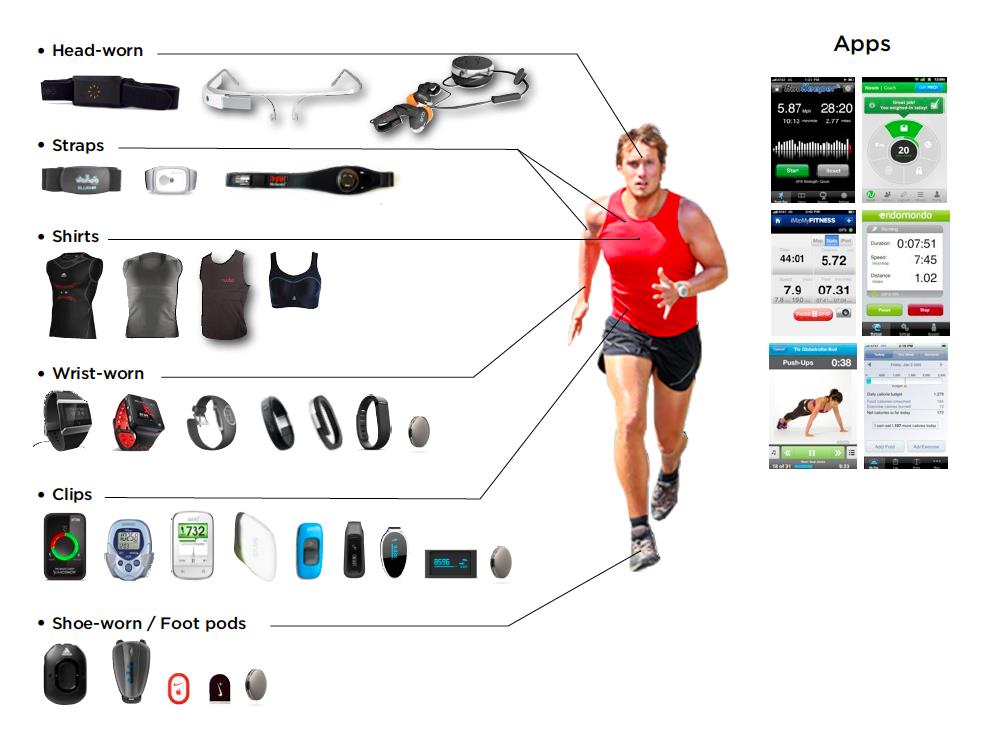
This device taxonomy illustrates the diversity of wearable IoT form factors: - Multiple placement options: Same sensing goal (activity tracking) achieved via different body locations - App ecosystem: Every wearable requires companion smartphone app for data visualization - User preference varies: Athletes prefer chest straps (accuracy), consumers prefer wrist (convenience) - Design trade-offs: Chest sensors are more accurate for heart rate, but wrist devices have higher adoption due to comfort
Source: University of Edinburgh - Principles and Design of IoT Systems
1494.5.2 Consumer Devices
Consumer devices are designed for household and personal use, requiring user-friendly interfaces and often being AC-powered.
Examples: Smart thermostats, connected lights, smart speakers
Key characteristics: - Household and personal use - User-friendly interfaces required - Often AC-powered
1494.5.3 Industrial Devices
Industrial devices operate in harsh environments with high reliability requirements, focusing on machine-to-machine (M2M) communication.
Examples: Process sensors, PLCs, industrial gateways
Key characteristics: - Harsh environment operation - High reliability requirements - M2M communication focus
1494.5.4 Infrastructure Devices
Infrastructure devices are deployed at scale in public spaces with long operational lifetimes (10+ years) and are difficult to service.
Examples: Smart parking sensors, air quality monitors, smart streetlights
Key characteristics: - Deployed at scale in public spaces - Long operational lifetime (10+ years) - Difficult to service
%%{init: {'theme': 'base', 'themeVariables': {'primaryColor': '#2C3E50', 'primaryTextColor': '#fff', 'primaryBorderColor': '#16A085', 'lineColor': '#16A085', 'secondaryColor': '#E67E22', 'tertiaryColor': '#fff'}}}%%
flowchart TD
    START{Application<br/>Type?} --> WEAR[Wearable]
    START --> HOME[Consumer/Home]
    START --> IND[Industrial]
    START --> CITY[Infrastructure]

    WEAR --> W_Q{Primary<br/>Function?}
    W_Q -->|Health monitoring| MEDICAL[Medical-grade<br/>FDA certified]
    W_Q -->|Fitness| FITNESS[Activity tracker<br/>Consumer-grade]
    W_Q -->|Communication| WATCH[Smartwatch<br/>Full connectivity]

    HOME --> H_Q{Power<br/>Source?}
    H_Q -->|Mains| PLUG[Plugged device<br/>Smart outlets, hubs]
    H_Q -->|Battery| BAT_H{Battery<br/>Life?}
    BAT_H -->|Years| SENSOR_H[Simple sensor<br/>Door/motion]
    BAT_H -->|Days-Months| PORTABLE[Portable device<br/>Remote, tracker]

    IND --> I_Q{Environment?}
    I_Q -->|Clean/indoor| STD_IND[Standard industrial<br/>IP20-40]
    I_Q -->|Harsh/outdoor| RUGGED[Ruggedized<br/>IP65-68, MIL-spec]

    CITY --> C_Q{Connectivity?}
    C_Q -->|Dense urban| MESH[Mesh network<br/>BLE, Zigbee]
    C_Q -->|Wide area| LPWAN[LPWAN<br/>LoRaWAN, NB-IoT]

    style MEDICAL fill:#16A085,stroke:#2C3E50,color:#fff
    style FITNESS fill:#16A085,stroke:#2C3E50,color:#fff
    style WATCH fill:#16A085,stroke:#2C3E50,color:#fff
    style PLUG fill:#E67E22,stroke:#2C3E50,color:#fff
    style SENSOR_H fill:#E67E22,stroke:#2C3E50,color:#fff
    style PORTABLE fill:#E67E22,stroke:#2C3E50,color:#fff
    style STD_IND fill:#7F8C8D,stroke:#2C3E50,color:#fff
    style RUGGED fill:#7F8C8D,stroke:#2C3E50,color:#fff
    style MESH fill:#2C3E50,stroke:#16A085,color:#fff
    style LPWAN fill:#2C3E50,stroke:#16A085,color:#fff
{fig-alt=“Device selection decision tree starting from application type (Wearable, Consumer/Home, Industrial, Infrastructure). Wearables branch by primary function to medical, fitness, or smartwatch. Consumer devices branch by power source and battery life. Industrial branches by environment (clean vs harsh). Infrastructure branches by connectivity density (mesh for urban, LPWAN for wide area).”}
%%{init: {'theme': 'base', 'themeVariables': {'primaryColor': '#2C3E50', 'primaryTextColor': '#fff', 'primaryBorderColor': '#16A085', 'lineColor': '#16A085', 'secondaryColor': '#E67E22', 'tertiaryColor': '#fff'}}}%%
stateDiagram-v2
    [*] --> Manufacturing: Production
    Manufacturing --> Provisioning: Ship to site
    Provisioning --> Active: Commission

    state Active {
        [*] --> Operating
        Operating --> Sleeping: Low power mode
        Sleeping --> Operating: Wake event
        Operating --> Updating: OTA update
        Updating --> Operating: Update complete
    }

    Active --> Maintenance: Service required
    Maintenance --> Active: Repaired

    Active --> Decommission: End of life
    Decommission --> [*]: Secure disposal
{fig-alt=“State diagram showing IoT device lifecycle stages: Manufacturing leads to Provisioning then to Active state. Active state contains Operating, Sleeping, and Updating sub-states with transitions between them. From Active, device can transition to Maintenance (then back to Active) or to Decommission for secure disposal at end of life.”}
1494.6 Key Device Characteristics
Critical device characteristics to consider:
- Power Source: Battery (with capacity and expected lifetime), AC power, or energy harvesting (solar, thermal, vibration)
- Connectivity: Primary and fallback protocols (Wi-Fi, BLE, LoRaWAN, Cellular) with range and power consumption trade-offs
- Operating Environment: Temperature range, humidity tolerance, IP rating, vibration/chemical resistance
- Form Factor: Physical dimensions, weight, mounting options
- Processing & Storage: Computational capability and local data storage requirements
1494.6.1 What Makes a Good IoT Device?
| Quality | What It Means | Example |
|---|---|---|
| Reliable | Works every time | Smart lock never fails to open |
| Efficient | Long battery life or low power | Sensor lasts 5 years on battery |
| Secure | Protected from hackers | Encrypted connection, strong passwords |
| Durable | Survives its environment | Outdoor sensor handles rain/heat |
| User-Friendly | Easy to set up and use | One-button pairing, clear status |
1494.7 The Device Design Triangle
Every IoT device must balance three competing factors:
%%{init: {'theme': 'base', 'themeVariables': {'primaryColor':'#E8EAF6','primaryTextColor':'#2C3E50','primaryBorderColor':'#2C3E50','lineColor':'#16A085','secondaryColor':'#FFF3E0','tertiaryColor':'#E8F5E9','noteTextColor':'#2C3E50','noteBkgColor':'#FFF9C4','noteBorderColor':'#E67E22'}}}%%
graph TD
    subgraph Design["Device Design Constraints"]
        F[Features/Performance]
        C[Cost]
        P[Power/Battery Life]
    end

    F -.You can pick TWO.-> C
    C -.You can pick TWO.-> P
    P -.You can pick TWO.-> F

    F --- EX1["Many features + Low cost<br/>= Short battery"]
    C --- EX2["Low cost + Long battery<br/>= Fewer features"]
    P --- EX3["Long battery + Many features<br/>= Expensive"]

    style F fill:#E67E22,stroke:#E67E22,color:#fff
    style C fill:#E67E22,stroke:#E67E22,color:#fff
    style P fill:#E67E22,stroke:#E67E22,color:#fff
    style EX1 fill:#FFF3E0,stroke:#E67E22
    style EX2 fill:#FFF3E0,stroke:#E67E22
    style EX3 fill:#FFF3E0,stroke:#E67E22
{fig-alt=“Triangle diagram showing three competing device design constraints: Features/Performance, Cost, and Power/Battery Life. Arrows between them illustrate the trade-offs: you can optimize for any two, but not all three simultaneously”}
You can’t have all three! Pick two:
- More features + Low cost = Short battery life
- More features + Long battery = Expensive
- Low cost + Long battery = Fewer features
%%{init: {'theme': 'base', 'themeVariables': {'primaryColor':'#2C3E50','primaryTextColor':'#fff','primaryBorderColor':'#16A085','lineColor':'#16A085','secondaryColor':'#E67E22','tertiaryColor':'#7F8C8D'}}}%%
flowchart TD
    START{What is your<br/>PRIMARY constraint?} --> BUDGET[Budget is Fixed]
    START --> FEATURES[Features are Fixed]
    START --> BATTERY[Battery Life is Fixed]

    BUDGET --> B_Q{Need long<br/>battery life?}
    B_Q -->|Yes| B_LOW[Reduce features<br/>Simple sensor only<br/>No display/Wi-Fi]
    B_Q -->|No| B_FEAT[Add more features<br/>Accept daily charging<br/>Wi-Fi + Display]

    FEATURES --> F_Q{Users willing<br/>to pay premium?}
    F_Q -->|Yes| F_BATT[Larger battery<br/>Premium materials<br/>Higher price point]
    F_Q -->|No| F_CHARGE[Frequent charging<br/>Smaller battery<br/>Lower price]

    BATTERY --> BAT_Q{Budget<br/>flexible?}
    BAT_Q -->|Yes| BAT_FEAT[Add features<br/>Premium components<br/>Solar/energy harvesting]
    BAT_Q -->|No| BAT_SIMPLE[Minimal features<br/>Optimized protocols<br/>Deep sleep modes]

    style START fill:#E67E22,stroke:#2C3E50,color:#fff
    style BUDGET fill:#2C3E50,stroke:#16A085,color:#fff
    style FEATURES fill:#2C3E50,stroke:#16A085,color:#fff
    style BATTERY fill:#2C3E50,stroke:#16A085,color:#fff
    style B_LOW fill:#16A085,stroke:#2C3E50,color:#fff
    style B_FEAT fill:#16A085,stroke:#2C3E50,color:#fff
    style F_BATT fill:#16A085,stroke:#2C3E50,color:#fff
    style F_CHARGE fill:#16A085,stroke:#2C3E50,color:#fff
    style BAT_FEAT fill:#16A085,stroke:#2C3E50,color:#fff
    style BAT_SIMPLE fill:#16A085,stroke:#2C3E50,color:#fff
{fig-alt=“Decision tree for IoT device design trade-offs: Starting from primary constraint (budget, features, or battery life), branches through secondary questions to arrive at specific design strategies. Budget-constrained with battery needs leads to simple sensors; feature-fixed with price sensitivity leads to frequent charging; battery-fixed with flexible budget enables premium components or solar harvesting”}
1494.7.1 Real-World Example: Fitness Tracker Design
%%{init: {'theme': 'base', 'themeVariables': {'primaryColor':'#E8EAF6','primaryTextColor':'#2C3E50','primaryBorderColor':'#2C3E50','lineColor':'#16A085','secondaryColor':'#FFF3E0','tertiaryColor':'#E8F5E9','noteTextColor':'#2C3E50','noteBkgColor':'#FFF9C4','noteBorderColor':'#E67E22'}}}%%
graph LR
    subgraph AW["Apple Watch"]
        AWF["Many Features<br/>GPS, ECG, Apps"]
        AWC["High Cost<br/>$400+"]
        AWP["1 Day Battery"]
    end

    subgraph FB["Fitbit"]
        FBF["Moderate Features<br/>Steps, HR, Sleep"]
        FBC["Medium Cost<br/>$150"]
        FBP["5-7 Day Battery"]
    end

    subgraph PD["Basic Pedometer"]
        PDF["Few Features<br/>Steps only"]
        PDC["Low Cost<br/>$25"]
        PDP["6 Month Battery"]
    end

    style AWF fill:#E67E22,stroke:#E67E22,color:#fff
    style AWC fill:#E67E22,stroke:#E67E22,color:#fff
    style AWP fill:#7F8C8D,stroke:#7F8C8D,color:#fff

    style FBF fill:#16A085,stroke:#16A085,color:#fff
    style FBC fill:#16A085,stroke:#16A085,color:#fff
    style FBP fill:#16A085,stroke:#16A085,color:#fff

    style PDF fill:#7F8C8D,stroke:#7F8C8D,color:#fff
    style PDC fill:#2C3E50,stroke:#2C3E50,color:#fff
    style PDP fill:#2C3E50,stroke:#2C3E50,color:#fff
{fig-alt=“Comparison of three fitness tracker design philosophies: Apple Watch (many features + high cost = short battery), Fitbit (balanced features + medium cost + good battery), and basic pedometer (few features + low cost + long battery), demonstrating different design trade-off decisions”}
Real products make these trade-offs differently! Compare an Apple Watch (features-focused) vs a Fitbit (battery-focused) vs a basic pedometer (cost-focused).
NoteKey Takeaway
Successful IoT device design is fundamentally about managing tradeoffs: power consumption versus connectivity range, form factor versus battery life, cost versus durability, and functionality versus simplicity. The best IoT devices are those that make the right tradeoffs for their specific use case and environment, not those that try to maximize every dimension simultaneously. Always start by deeply understanding the deployment context, then work backward to device specifications.
1494.8 Knowledge Check
TipUnderstanding Check: Device Design Trade-offs
Scenario: You’re designing an outdoor IoT soil moisture sensor for agriculture. It must last 5+ years in harsh conditions (temperature extremes, rain, UV exposure, dust). Farmers want: long battery life (replace battery once per season max), reliable connectivity (fields often have poor cellular), and accurate readings even when sensor buried in soil.
Think about: 1. What are the competing constraints in this design (power, connectivity, durability)? 2. How do you prioritize features when you can’t optimize everything? 3. What environmental factors require special design attention?
Key Insight: Successful IoT device design requires strategic trade-offs: - Power vs Connectivity: LoRaWAN uses less power than cellular (2-year battery vs 2-month), but requires gateway infrastructure - Durability vs Cost: IP68 rating + UV-stabilized enclosure costs 3x more than IP54 basic plastic, but prevents field failures - Features vs Simplicity: Adding soil temperature + pH sensors is valuable, but increases power draw 40% and cost 60% - Design Triangle: You can optimize for TWO of: Features, Cost, Battery Life—not all three - Real-world example: A $200 sensor with 2-year battery and LoRa connectivity succeeds better than a $50 sensor with 3-month battery that requires constant maintenance visits.
Question 1: Which device category typically has the LONGEST operational lifetime requirement?
Explanation: Infrastructure devices (smart streetlights, parking sensors, air quality monitors) are deployed at scale in public spaces and are difficult to service. They typically require 10+ year operational lifetimes, much longer than consumer devices (2-5 years) or wearables (1-3 years). Industrial devices may also have long lifetimes but typically have easier access for maintenance.
Question 2: According to the device design triangle, if you need both many features AND low cost, what must you sacrifice?
Explanation: The device design triangle states you can optimize for any TWO of: Features, Cost, or Power/Battery Life. If you want many features at low cost, you must accept shorter battery life. This is why feature-rich budget smartphones need daily charging, while simple devices like basic fitness bands can last weeks.
Question 3: What is the PRIMARY reason wearable devices have strict size and power constraints?
Explanation: Wearable devices are worn on the body, so user comfort is the primary driver of size and weight constraints. A heavy or bulky device will cause discomfort and skin irritation during all-day wear. Power constraints follow from size constraints—smaller devices mean smaller batteries, requiring more efficient power usage.
1494.9 Summary
This chapter covered the fundamentals of IoT connected devices:
Key Takeaways:
Device Categories: IoT devices span wearables, consumer products, industrial sensors, and infrastructure - each with unique constraints and requirements
Design Triangle: Every device balances three competing factors - Features, Cost, and Power/Battery Life. You can optimize for any two, but not all three
Category Selection: Choose device category based on application type, environment, power source, and connectivity requirements
Device Characteristics: Consider power source, connectivity, operating environment, form factor, and processing requirements when selecting or designing devices
Trade-offs: The best IoT devices make the right trade-offs for their specific use case, not trying to maximize everything simultaneously
1494.10 What’s Next
The next chapter explores Form Factors and Enclosures, examining how physical design impacts usability, durability, and environmental protection.
1494.11 Resources
Further Reading: - Mark Weiser’s vision of ubiquitous computing (Tabs, Pads, Boards) - Carnegie Mellon University - Building User-Focused Sensing Systems - University of Edinburgh - Principles and Design of IoT Systems