%%{init: {'theme': 'base', 'themeVariables': { 'primaryColor': '#2C3E50', 'primaryTextColor': '#fff', 'primaryBorderColor': '#16A085', 'lineColor': '#16A085', 'secondaryColor': '#E67E22', 'tertiaryColor': '#7F8C8D', 'fontSize': '14px'}}}%%
graph TB
    subgraph TOPO["Network Topologies"]
        T1["Star<br/>(Simple, Low Power)"]
        T2["Tree<br/>(Hierarchical)"]
        T3["Mesh<br/>(Robust, Multi-hop)"]
    end

    subgraph STACK["Protocol Stack"]
        S1["Application Layer<br/>(Smart Home, Industrial)"]
        S2["Network Layer<br/>(Zigbee/Thread/6LoWPAN)"]
        S3["802.15.4 MAC<br/>(CSMA/CA, Beacons)"]
        S4["802.15.4 PHY<br/>(2.4 GHz, 250 kbps)"]
    end

    TOPO --> STACK
    S1 --> S2 --> S3 --> S4

    NOTE["Core Features:<br/>✓ 127-byte max frame<br/>✓ 102-byte payload<br/>✓ AES-128 security<br/>✓ 16 channels @ 2.4 GHz<br/>✓ <30 mA TX, <5 µA sleep"]

    S4 -.-> NOTE

    style TOPO fill:#7F8C8D,stroke:#2C3E50,stroke-width:2px,color:#fff
    style STACK fill:#2C3E50,stroke:#16A085,stroke-width:2px,color:#fff
    style T1 fill:#e2e3e5,stroke:#7F8C8D,stroke-width:1px,color:#000
    style T2 fill:#e2e3e5,stroke:#7F8C8D,stroke-width:1px,color:#000
    style T3 fill:#e2e3e5,stroke:#7F8C8D,stroke-width:1px,color:#000
    style S1 fill:#d4edda,stroke:#2C3E50,stroke-width:1px,color:#fff
    style S2 fill:#d4edda,stroke:#16A085,stroke-width:1px,color:#000
    style S3 fill:#d4edda,stroke:#16A085,stroke-width:1px,color:#000
    style S4 fill:#d4edda,stroke:#16A085,stroke-width:1px,color:#000
    style NOTE fill:#e2e3e5,stroke:#16A085,stroke-width:1px,color:#000
941 IEEE 802.15.4 Review: Architecture and Fundamentals
TipFor Beginners: Where This Review Fits
This chapter builds on the material in:
802-15-4-fundamentals.qmd- frame format, addressing modes, and basic PHY/MAC concepts.wireless-sensor-networks.qmdor related WSN chapters - how 802.15.4 underpins low-power mesh networks.
Treat this review as a place to practice calculations and trade-offs:
- Expect questions about addressing overhead, frame efficiency, and MAC reliability in realistic IoT deployments.
- If you get stuck on a question, revisit the fundamentals chapter’s diagrams and tables, then return here for consolidation.
941.1 Learning Objectives
By the end of this review, you will be able to:
- Understand Architecture: Describe IEEE 802.15.4 network topologies and protocol stack layers
- Identify Device Types: Distinguish between FFD and RFD capabilities and roles
- Analyze Frame Structure: Calculate frame overhead for different addressing configurations
- Apply Protocol Stack Knowledge: Understand how upper layer protocols build on 802.15.4
941.2 Prerequisites
Required Chapters: - 802.15.4 Fundamentals - Core standard - Zigbee Overview - Upper layer protocol - 6LoWPAN - IPv6 adaptation
Technical Background: - Physical layer concepts - MAC layer operation - CSMA/CA mechanism
802.15.4 Parameter Summary:
| Parameter | Value |
|---|---|
| Frequency | 2.4 GHz / 868 MHz / 915 MHz |
| Data Rate | 250 kbps (2.4 GHz) |
| Range | 10-100 m |
| Channels | 16 (2.4 GHz) |
Estimated Time: 25 minutes
NoteRelated Chapters
Deep Dives: - 802.15.4 Fundamentals - Frame structure and addressing - 802.15.4 MAC Layer - CSMA/CA and beacon modes - 802.15.4 PHY Layer - Physical layer characteristics
Upper Layer Protocols: - Zigbee Overview - Network and application layers on 802.15.4 - Thread Overview - IPv6 mesh networking on 802.15.4 - 6LoWPAN - IPv6 adaptation layer
Review Series: - 802.15.4 Review: Frame Efficiency - Addressing and calculations - 802.15.4 Review: Power Management - Battery life analysis - 802.15.4 Review: Beacon Networks - Superframe structure - 802.15.4 Review: Security - Security and channel management
941.3 Network Topologies and Protocol Stack
Before diving into detailed review questions, let’s visualize the key architectural components of IEEE 802.15.4 networks.
TipAlternative View: 802.15.4 Upper Protocol Selection
%%{init: {'theme': 'base', 'themeVariables': {'primaryColor': '#2C3E50', 'primaryTextColor': '#fff', 'primaryBorderColor': '#16A085', 'lineColor': '#16A085', 'secondaryColor': '#E67E22', 'tertiaryColor': '#7F8C8D'}}}%%
quadrantChart
    title 802.15.4 Protocol Selection: IP vs Ecosystem
    x-axis Closed Ecosystem --> Open/IP-Based
    y-axis Battery Priority --> Interoperability Priority

    quadrant-1 Future-Proof Choice
    quadrant-2 Best for Vendors
    quadrant-3 Legacy/Simple
    quadrant-4 Enterprise IoT

    Zigbee: [0.25, 0.55]
    Thread: [0.75, 0.70]
    6LoWPAN Raw: [0.80, 0.30]
    Matter over Thread: [0.85, 0.85]
    Zigbee 3.0: [0.40, 0.65]
    WirelessHART: [0.20, 0.40]
    ISA100.11a: [0.30, 0.50]
941.4 Protocol Stack Layering
%%{init: {'theme': 'base', 'themeVariables': { 'primaryColor': '#2C3E50', 'primaryTextColor': '#fff', 'primaryBorderColor': '#16A085', 'lineColor': '#16A085', 'secondaryColor': '#E67E22', 'tertiaryColor': '#7F8C8D', 'fontSize': '14px'}}}%%
graph TD
    APP["Application Layer<br/>(User Applications)"]
    NWK["Network Layer<br/>(Routing, Address Management)"]
    MAC["802.15.4 MAC Layer<br/>(CSMA/CA, Beacons, Security)"]
    PHY["802.15.4 PHY Layer<br/>(Modulation, Channels, CCA)"]

    APP --> NWK
    NWK --> MAC
    MAC --> PHY

    UPPER["Upper Layer Protocols:<br/>Zigbee | Thread | 6LoWPAN"]
    LOWER["802.15.4 Standard:<br/>MAC + PHY"]

    UPPER -.-> APP
    UPPER -.-> NWK
    LOWER -.-> MAC
    LOWER -.-> PHY

    FEATURES["Key Features:<br/>✓ CSMA/CA collision avoidance<br/>✓ ACK-based reliability<br/>✓ AES-128 security<br/>✓ 250 kbps at 2.4 GHz<br/>✓ 127-byte max frame<br/>✓ 102-byte max payload"]

    PHY -.-> FEATURES

    style APP fill:#E67E22,stroke:#2C3E50,stroke-width:2px,color:#fff
    style NWK fill:#E67E22,stroke:#2C3E50,stroke-width:2px,color:#fff
    style MAC fill:#16A085,stroke:#2C3E50,stroke-width:2px,color:#fff
    style PHY fill:#16A085,stroke:#2C3E50,stroke-width:2px,color:#fff
    style UPPER fill:#7F8C8D,stroke:#2C3E50,stroke-width:1px,color:#fff
    style LOWER fill:#2C3E50,stroke:#16A085,stroke-width:2px,color:#fff
    style FEATURES fill:#e2e3e5,stroke:#16A085,stroke-width:1px,color:#000
941.5 Frame Structure and Efficiency
%%{init: {'theme': 'base', 'themeVariables': { 'primaryColor': '#2C3E50', 'primaryTextColor': '#fff', 'primaryBorderColor': '#16A085', 'lineColor': '#16A085', 'secondaryColor': '#E67E22', 'tertiaryColor': '#7F8C8D', 'fontSize': '14px'}}}%%
graph LR
    subgraph FRAME["802.15.4 Frame (127 bytes max)"]
        PHY["PHY Header<br/>6 bytes<br/>(Preamble+SFD)"]
        MAC["MAC Header<br/>3-23 bytes<br/>(Addressing)"]
        PAYLOAD["Payload<br/>81-102 bytes<br/>(App Data)"]
        FCS["FCS<br/>2 bytes<br/>(CRC)"]
    end

    PHY --> MAC --> PAYLOAD --> FCS

    subgraph ADDRESSING["Addressing Modes"]
        SHORT["Short (16-bit):<br/>6 bytes total<br/>102-byte payload<br/>80% efficiency"]
        EXTENDED["Extended (64-bit):<br/>18 bytes total<br/>90-byte payload<br/>71% efficiency"]
    end

    MAC -.-> ADDRESSING

    OPTIMAL["Optimal: Use 16-bit<br/>short addresses<br/>after association"]

    SHORT -.-> OPTIMAL

    style FRAME fill:#2C3E50,stroke:#16A085,stroke-width:2px,color:#fff
    style PHY fill:#7F8C8D,stroke:#2C3E50,stroke-width:1px,color:#fff
    style MAC fill:#E67E22,stroke:#2C3E50,stroke-width:1px,color:#fff
    style PAYLOAD fill:#16A085,stroke:#2C3E50,stroke-width:1px,color:#fff
    style FCS fill:#7F8C8D,stroke:#2C3E50,stroke-width:1px,color:#fff
    style ADDRESSING fill:#e2e3e5,stroke:#2C3E50,stroke-width:1px,color:#000
    style SHORT fill:#d4edda,stroke:#16A085,stroke-width:1px,color:#000
    style EXTENDED fill:#f8d7da,stroke:#E67E22,stroke-width:1px,color:#000
    style OPTIMAL fill:#16A085,stroke:#2C3E50,stroke-width:2px,color:#fff
941.6 Quick Reference: Key 802.15.4 Parameters
| Parameter | 2.4 GHz Band | 915 MHz Band | 868 MHz Band |
|---|---|---|---|
| Data Rate | 250 kbps | 40 kbps | 20 kbps |
| Number of Channels | 16 (Ch 11-26) | 10 (Ch 1-10) | 1 (Ch 0) |
| Channel Bandwidth | 2 MHz | 2 MHz | 0.6 MHz |
| Typical Range | 10-100 m | 20-200 m | 20-200 m |
| Max Frame Size | 127 bytes | 127 bytes | 127 bytes |
| Max Payload | 102 bytes (with short addressing) | 102 bytes | 102 bytes |
| Addressing | 16-bit short or 64-bit extended | 16-bit short or 64-bit extended | 16-bit short or 64-bit extended |
| Security | AES-128 CCM | AES-128 CCM | AES-128 CCM |
| Power Consumption | < 30 mA TX, < 15 mA RX, < 5 µA sleep | < 30 mA TX, < 15 mA RX, < 5 µA sleep | < 30 mA TX, < 15 mA RX, < 5 µA sleep |
941.7 Frame Efficiency Breakdown
802.15.4 Frame Structure (127 bytes maximum):
| Component | Size (bytes) | Efficiency Impact |
|---|---|---|
| PHY Header | 6 | Fixed overhead |
| MAC Header | 3-23 | Variable (depends on addressing) |
| - Frame Control | 2 | Required |
| - Sequence Number | 1 | Required |
| - PAN ID(s) | 2-4 | 2 (intra-PAN) or 4 (inter-PAN) |
| - Addresses | 0-20 | 0, 4, 8, 16, or 20 bytes |
| Payload | 81-102 | Application data |
| FCS (CRC) | 2 | Error detection |
Addressing Mode Efficiency:
- 16-bit short addressing: 6 bytes total - 102 bytes payload (80% efficiency)
- 64-bit extended addressing: 18 bytes total - 90 bytes payload (71% efficiency)
- Optimal configuration: Use 16-bit short addresses after association for maximum payload capacity
941.8 MAC Layer Key Features
CSMA/CA (Carrier Sense Multiple Access with Collision Avoidance): - CCA (Clear Channel Assessment): Listen before transmit - Random backoff: Reduce collision probability - ACK frames: 12-symbol turnaround time (~192 us at 250 kbps) - Retransmission: Up to 3 retries (configurable)
Device Types: - FFD (Full Function Device): Can act as coordinator or router, full MAC capabilities - RFD (Reduced Function Device): End device only, limited MAC capabilities, lower power
Network Roles: - PAN Coordinator: Network manager, address 0x0000, one per network - Router (FFD): Relay data, assign addresses in tree topology - End Device (RFD/FFD): Leaf nodes, communicate through coordinator/router
NoteCross-Hub Connections
This comprehensive review integrates concepts from multiple learning resources:
Hands-On Practice: - Visit the Simulations Hub to experiment with the Network Topology Visualizer that demonstrates star, mesh, and tree topologies discussed in this review - Try the interactive calculators to validate addressing overhead and battery life calculations from the quiz questions
Knowledge Assessment: - Explore the Quizzes Hub for additional 802.15.4 questions organized by difficulty level - Review the 802.15.4 Quiz Bank for topic-specific practice questions
Conceptual Understanding: - Check the Knowledge Gaps Hub for common 802.15.4 misconceptions like “802.15.4 is a complete protocol stack” (it’s only MAC/PHY) - Visit the Knowledge Map to see how 802.15.4 fits within the broader IoT networking landscape
Video Learning: - Browse the Videos Hub for visual explanations of CSMA/CA operation, beacon-enabled modes, and frame structure optimization
941.9 Knowledge Check: Architecture Fundamentals
941.10 Visual Reference Gallery
NoteVisual: IEEE 802.15.4 Protocol Stack
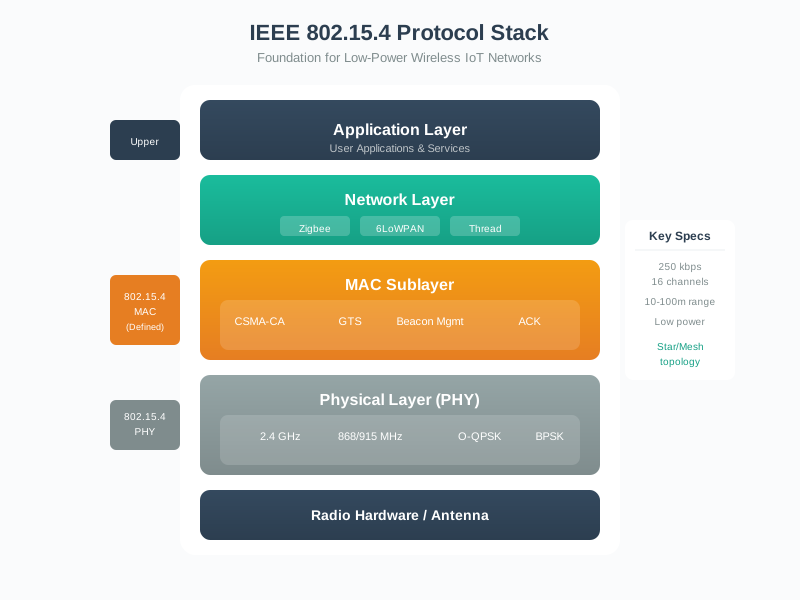
The 802.15.4 protocol stack provides the PHY and MAC layers that serve as the foundation for Zigbee, Thread, and 6LoWPAN.
NoteVisual: IEEE 802.15.4 Frame Format
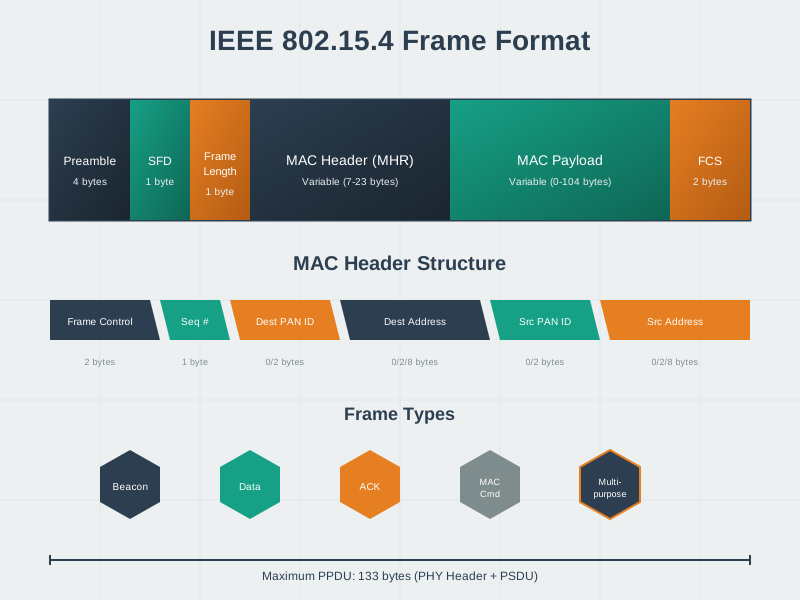
The MAC frame structure accommodates both short (2-byte) and extended (8-byte) addresses with optional security overhead.
NoteVisual: IEEE 802.15.4 Sensor Node Architecture
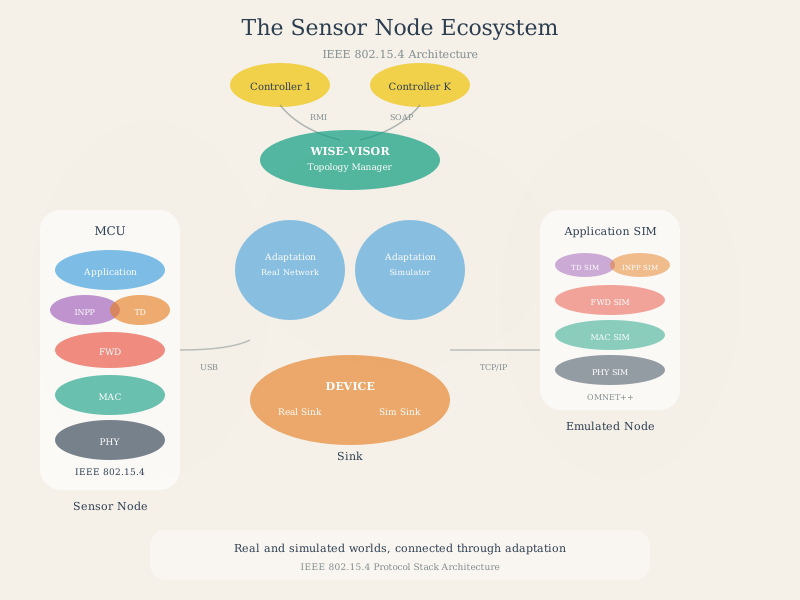
A typical 802.15.4 sensor node integrates low-power MCU, radio transceiver, and sensors for battery-powered wireless sensing applications.
941.11 Summary
This architecture review covered the foundational aspects of IEEE 802.15.4:
- Network Topologies: Star (simple), tree (hierarchical), and mesh (robust) configurations
- Protocol Stack: MAC and PHY layers defined by 802.15.4, with upper protocols (Zigbee, Thread, 6LoWPAN) providing network functionality
- Device Types: FFDs with full routing capability vs RFDs optimized for low-power end devices
- Frame Structure: 127-byte maximum with 102-byte payload using short addressing
- Addressing Optimization: Use 16-bit short addresses after association for maximum efficiency
941.12 What’s Next
Continue to 802.15.4 Review: Frame Efficiency to explore detailed calculations for tree addressing, Cskip allocation, and frame overhead optimization across different network configurations.