503Digital Twin Architecture: Building Virtual Replicas
503.1 Learning Objectives
By the end of this chapter, you will be able to:
Identify the four core components of digital twin architecture
Design digital twin systems for different scopes (component, asset, system, process)
Select appropriate technology stacks for data, model, visualization, and integration layers
Calculate ROI for digital twin implementations
Understand scalability and architectural considerations for enterprise deployments
503.2 Digital Twin Architecture
⏱️ ~12 min | ⭐⭐⭐ Advanced | 📋 P05.C01.U04
A complete digital twin architecture consists of multiple interconnected layers, each serving a specific purpose in maintaining synchronization between physical and digital realms.
503.2.1 Core Components
At the heart of every digital twin system are four fundamental components working in harmony:
1. Physical Entity: The Real Device/System - The actual physical system being mirrored, equipped with sensors for data collection and actuators for receiving commands. This could be a single device, a machine, a building, or an entire ecosystem. The physical entity is the source of truth for current state.
2. Virtual Entity: The Digital Model - The computational model that represents the physical entity, including its geometry, behavior, state, and relationships. This model updates continuously based on sensor data and runs simulations for prediction and optimization. Unlike the physical entity, the virtual entity can be duplicated, tested, and modified without risk.
3. Data Connection: Bidirectional Sync - The communication infrastructure that enables bidirectional data flow. This includes IoT protocols (MQTT, CoAP), gateways, edge computing nodes, and cloud connectivity. This connection must handle both real-time telemetry from physical to digital AND control commands from digital to physical.
4. Services: Analytics, Simulation, Prediction - The value-generating layer including machine learning models, physics-based simulations, optimization algorithms, and decision support systems. Services consume data from the virtual entity and generate actionable insights.
503.2.2 Architecture Overview
The following diagram shows how these components interact in a complete digital twin system:
Flowchart diagram
Figure 503.1: Complete digital twin architecture showing physical asset (navy) with sensors sending real-time data to digital twin (teal) containing 3D model and state. The twin feeds analytics and simulation layers, which generate predictive maintenance alerts, optimization recommendations, and visualizations. Optimizations flow back as commands to the physical asset.
Digital twin architecture with AI-generated artistic visualization
Figure 503.2: This artistic representation emphasizes the fundamental concept of digital twins: the seamless connection between physical reality and virtual representation. Like a mirror that not only reflects but also predicts and influences, digital twins enable organizations to experiment with virtual changes before implementing them in the physical world, reducing risk and accelerating innovation cycles.
Digital twin feedback loop visualization
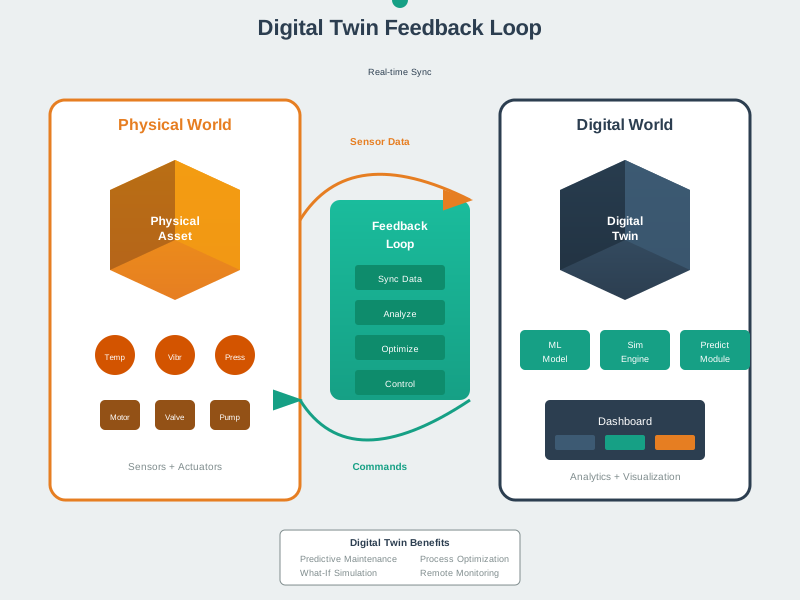
Figure 503.3: The bidirectional feedback loop is what distinguishes digital twins from traditional monitoring systems. Sensor data flows continuously from physical to digital, updating the virtual model’s state. Simultaneously, analytics and simulations generate optimization recommendations that flow back as control commands, creating an autonomous improvement cycle that continuously enhances system performance.
503.2.3 Types of Digital Twins
TipUnderstanding Model Fidelity
Core Concept: Model fidelity refers to how accurately a digital twin’s mathematical representation matches the physical system’s actual behavior, ranging from simple threshold monitoring to high-resolution physics simulation.
Why It Matters: Higher fidelity is not always better. A high-fidelity computational fluid dynamics model of an HVAC system might take hours to run, making it useless for real-time control decisions. Conversely, a low-fidelity model that ignores thermal mass cannot accurately predict how a building responds to temperature changes. The right fidelity level balances computational cost against decision accuracy. For most predictive maintenance, trend-based statistical models outperform complex physics simulations because sensor noise and calibration drift introduce more error than simplified physics assumptions.
Key Takeaway: Choose the minimum fidelity level that changes your operational decisions; if a simpler model produces the same recommendations as a complex one, use the simpler model.
Digital twins vary in scope and complexity depending on what they represent:
Type
Scope
Example
Update Rate
Typical Sensors
Component
Single part
Motor bearing
Seconds (1-10s)
Temperature, vibration, current draw (5-10 sensors)
Asset
Whole machine
Wind turbine
Minutes (1-5 min)
Power output, blade stress, gearbox health (50-100 sensors)
Material flow, quality metrics, bottlenecks (10,000+ sensors)
Choosing the Right Scope:
Component twins are used when individual part failure is expensive or dangerous (jet engine turbine blades, medical implants)
Asset twins balance detail with manageability for expensive equipment (industrial robots, HVAC systems)
System twins optimize interactions between multiple assets (traffic networks, supply chains)
Process twins model workflows and operations rather than physical objects (customer journeys, production workflows)
503.2.4 Implementation Stack
Building a production digital twin requires integrating multiple technology layers:
Data Layer: Foundation for State Management - Time-series databases: InfluxDB, TimescaleDB, or Azure Time Series Insights for high-frequency sensor data - Object storage: S3, Azure Blob Storage for 3D models, historical snapshots, and large simulation outputs - Graph databases: Neo4j, Azure Cosmos DB for relationship modeling between twins - Document stores: MongoDB for semi-structured metadata and configuration
Model Layer: Intelligence and Simulation - Physics simulation: ANSYS, COMSOL for structural, thermal, fluid dynamics modeling - Machine learning models: TensorFlow, PyTorch for predictive analytics and anomaly detection - Rules engines: For threshold monitoring and business logic (e.g., “if temperature > 80°C for 5 minutes, alert”) - Calibration algorithms: Continuously tune models to match real-world behavior
Visualization Layer: Human Interface - 3D rendering engines: Three.js, Babylon.js, Unity, Unreal Engine for spatial visualization - Dashboards: Grafana, Power BI, Tableau for metrics and KPIs - AR/VR interfaces: For immersive inspection and maintenance guidance - Mobile applications: Field technician access to twin state and maintenance history
Integration Layer: Connecting Everything - APIs: REST and GraphQL for external system integration - Event streams: Kafka, Azure Event Grid for real-time event distribution - Message brokers: MQTT for device-to-twin communication - Authentication: OAuth 2.0, Azure AD for secure access control
503.2.5 Return on Investment: Real Numbers
Digital twins deliver measurable financial and operational benefits:
Predictive Maintenance: 30% Reduction in Downtime
Example: A manufacturing plant with 50 critical machines: - Before digital twins: Reactive maintenance, 10% unplanned downtime, $2M annual losses - With digital twins: Predict failures 2-3 weeks early, schedule repairs during planned shutdowns - ROI: 30% downtime reduction = $600K annual savings, twin implementation cost $200K = payback in 4 months
Energy Optimization: 10-15% Efficiency Gain
Example: Commercial building portfolio (10 buildings, 5M sq ft): - Before twins: Static HVAC schedules, overheating/overcooling common - With twins: Real-time occupancy + weather prediction + thermal modeling - ROI: 12% energy reduction on $3M annual energy cost = $360K savings per year, twin platform cost $150K initial + $50K/year = 5-month payback
Design Iteration: 50% Faster Prototyping
Example: Automotive manufacturer designing new electric vehicle: - Before twins: Build 5 physical prototypes at $500K each, 6-month test cycle - With twins: Virtual testing of 100 design variations, 2 physical prototypes for validation - ROI: $1.5M cost savings on prototypes, 3-month faster time-to-market = $10M+ revenue acceleration
Lifetime Value Tracking:
Over a 10-year operational period, a well-implemented digital twin typically returns: - Year 1: Break-even or slight loss (implementation costs) - Years 2-3: 200-300% ROI from quick wins (predictive maintenance, energy) - Years 4-10: 400-600% cumulative ROI as models improve and new use cases emerge
Show code
{const container =document.getElementById('kc-twin-3');if (container &&typeof InlineKnowledgeCheck !=='undefined') { container.innerHTML=''; container.appendChild(InlineKnowledgeCheck.create({question:"A factory has 200 CNC machines. They want to implement digital twins for predictive maintenance. The current unplanned downtime costs $500K annually. Which approach provides the fastest path to ROI?",options: [ {text:"Build high-fidelity physics simulations of each machine type with CFD thermal modeling before connecting any sensors",correct:false,feedback:"High-fidelity simulations take months to develop and may not address the most common failure modes. Starting with data collection provides immediate value while models can be refined later."}, {text:"Start with simple telemetry monitoring (temperature, vibration) and threshold-based alerts, then add predictive models as data accumulates",correct:true,feedback:"Correct! Start simple and iterate. Basic monitoring with threshold alerts can catch 60-70% of issues immediately. As historical data accumulates, ML models can be trained for true prediction. This MVP approach delivers value in weeks, not months."}, {text:"Purchase a complete enterprise digital twin platform with 3D visualization before analyzing failure patterns",correct:false,feedback:"Enterprise platforms are expensive and require significant integration effort. Without understanding your specific failure modes first, you may implement features you do not need while missing critical monitoring capabilities."}, {text:"Wait until AI technology improves to enable fully autonomous predictive maintenance",correct:false,feedback:"Current technology is mature enough for significant ROI. Waiting means continued $500K annual losses. The best time to start collecting data was years ago; the second best time is now."} ],difficulty:"medium",topic:"digital-twins" })); }}
TipFor Beginners: Why Digital Twins Pay For Themselves
Think of a digital twin like having X-ray vision for your equipment. You can see problems forming weeks before they cause breakdowns.
Real Example: A factory motor costs $5,000. If it fails unexpectedly, you lose $50,000 in production downtime while waiting for a replacement. But sensors notice the motor is overheating and vibrating more each day. The digital twin predicts failure in 2 weeks. You order a replacement for $5,000 and swap it during next weekend’s maintenance window. You saved $50,000 in downtime.
Do this across 100 motors over a year, and you’ve saved millions. The digital twin system cost $200K but saved you $2M. That’s a 10× return on investment.
503.2.6 Simple Architecture Flow
Flowchart diagram
Figure 503.4: Basic digital twin architecture showing bidirectional data flow: physical asset (navy) sends sensor data through IoT gateway to synchronization engine (teal), which updates digital model (orange), feeding analytics and user interface with optional control commands flowing back.
503.2.7 Enterprise-Scale Architecture
For large deployments with thousands of interconnected twins, the architecture becomes more sophisticated:
Graph diagram
Figure 503.5: Enterprise-scale digital twin architecture with physical layer devices (navy, 100+ sensors each) sending data through edge computing for preprocessing and real-time analytics, cloud platform (teal) managing twin graph and time-series storage, and applications layer (orange) providing monitoring, predictive maintenance, and optimization with control feedback loop.
Architectural Considerations:
Scalability: Must handle growth from single devices to thousands of twins
Latency: Critical applications require edge processing to minimize round-trip time
Data Volume: Time-series databases and efficient storage strategies essential
Security: End-to-end encryption, authentication, and authorization across all layers
Resilience: Graceful degradation when connectivity is lost
Show code
{const container =document.getElementById('kc-twin-23');if (container &&typeof InlineKnowledgeCheck !=='undefined') { container.innerHTML=''; container.appendChild(InlineKnowledgeCheck.create({question:"A factory is scaling from a pilot of 10 machines to full deployment of 500 machines. The pilot used direct cloud connectivity for each machine. The IT architect warns this approach will not scale. Why?",options: [ {text:"Cloud platforms cannot handle more than 100 concurrent device connections",correct:false,feedback:"Modern cloud IoT platforms handle millions of device connections. The scaling concern is not about connection limits."}, {text:"At 500 machines with 100 sensors each reporting every second, the raw data volume (50,000 readings/second) and cloud ingestion costs become prohibitive without edge aggregation",correct:true,feedback:"Correct! The enterprise architecture diagram shows edge computing between devices and cloud for exactly this reason. At 50,000 readings/second, direct-to-cloud creates bandwidth costs (~200 MB/second), latency issues, and cloud ingestion charges. Edge gateways aggregate, filter, and forward only significant data - reducing volume by 95-99%."}, {text:"Each machine requires a dedicated cloud instance for its digital twin",correct:false,feedback:"Digital twins are logical constructs, not separate cloud instances. One platform instance can host thousands of twins. The concern is data volume, not compute instances."}, {text:"Cloud security does not support more than 100 authenticated devices",correct:false,feedback:"Cloud IoT security scales to millions of devices using certificate-based authentication and device registries. Security is not the scaling bottleneck."} ],difficulty:"medium",topic:"digital-twins" })); }}
503.3 Summary
In this chapter, you learned:
The four core components of digital twin architecture: physical entity, virtual entity, data connection, and services
Different types of twins: component, asset, system, and process twins with appropriate use cases
Technology stack requirements across data, model, visualization, and integration layers
Real ROI numbers: 30% downtime reduction, 10-15% energy savings, 50% faster prototyping
Enterprise scaling considerations: edge processing, data volume management, and architectural patterns
503.4 What’s Next
Now that you understand the architecture of digital twins, the next chapter explores the critical technical challenges of synchronization and data modeling - how to keep physical and digital entities in sync and how to structure twin data for interoperability.