%%{init: {'theme': 'base', 'themeVariables': {'primaryColor': '#2C3E50', 'primaryTextColor': '#fff', 'primaryBorderColor': '#16A085', 'lineColor': '#16A085', 'secondaryColor': '#E67E22', 'tertiaryColor': '#7F8C8D', 'edgeLabelBackground':'#ffffff'}}}%%
sequenceDiagram
participant Sensor as IoT Temperature<br/>Sensor
participant Gateway as Gateway Device<br/>(Blockchain Node)
participant Contract as Smart Contract<br/>(On Blockchain)
participant Shipper as Shipper Wallet
participant Recipient as Recipient Wallet
participant Insurance as Insurance System
Sensor->>Gateway: Temperature reading: 9C
Gateway->>Gateway: Sign with device private key
Gateway->>Contract: Submit signed reading
Contract->>Contract: Check condition:<br/>Temp > 8C for > 30 min?
Note over Contract: Condition MET:<br/>Breach detected
Contract->>Shipper: Deduct penalty: $10,000
Contract->>Recipient: Transfer: $10,000
Contract->>Insurance: Trigger claim event
Contract->>Contract: Record breach on ledger
Insurance-->>Contract: Acknowledge claim
Note over Sensor,Insurance: All actions automatic,<br/>tamper-proof, instant
307 Smart Contracts and Architectural Patterns for IoT
307.1 Learning Objectives
By the end of this chapter, you will be able to:
- Design smart contracts for IoT automation and machine-to-machine transactions
- Explain the oracle problem and how IoT devices bridge real-world data to blockchain
- Architect hybrid on-chain/off-chain solutions for scalable IoT systems
- Implement gateway-based patterns for resource-constrained blockchain clients
- Apply periodic anchoring and lightweight verification techniques
307.2 Smart Contracts for IoT
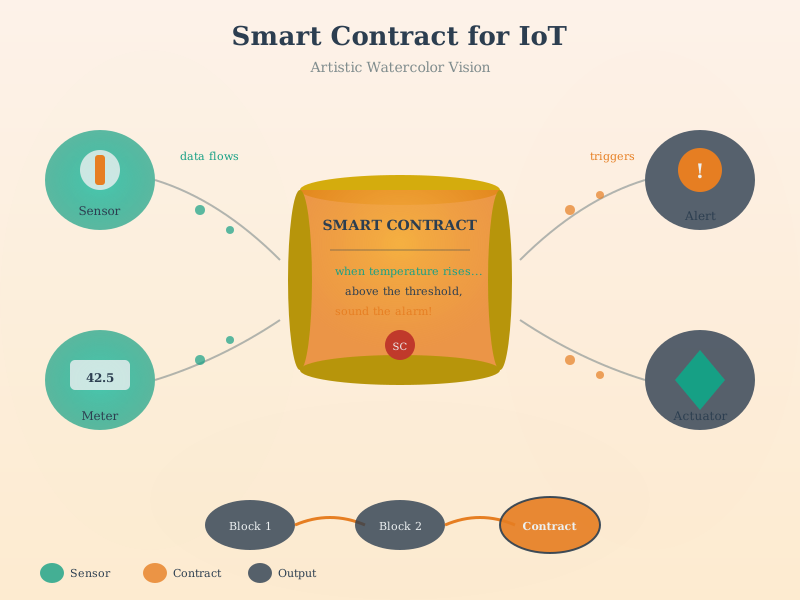
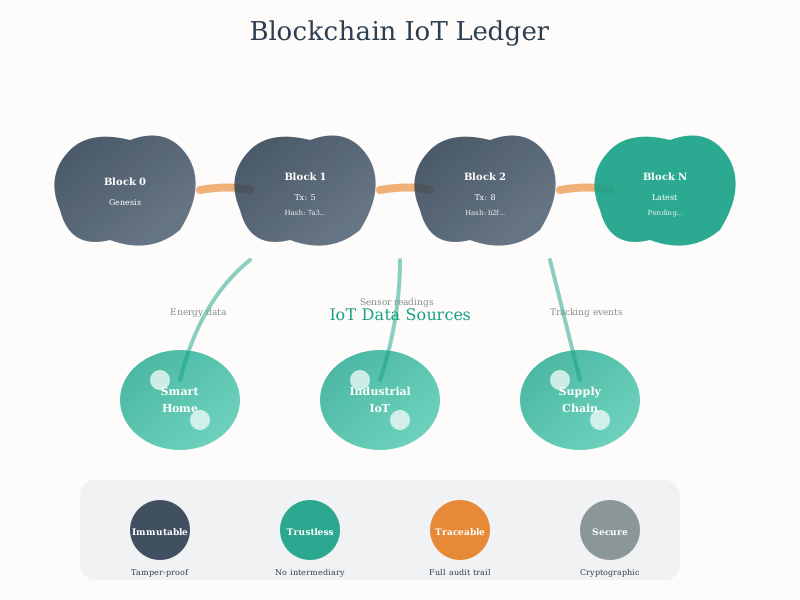
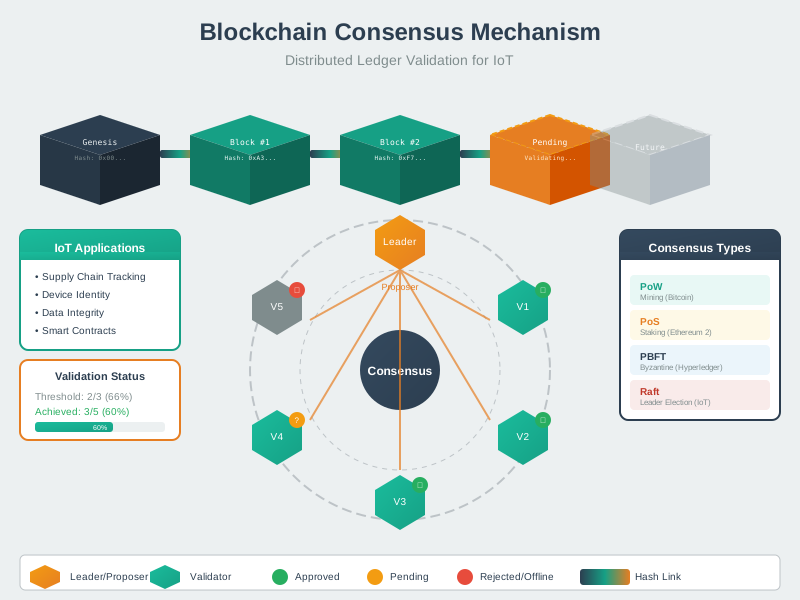
Smart contracts are self-executing programs stored on a blockchain. When predefined conditions are met, the contract automatically executes actions–no intermediaries needed.
WarningCommon Misconception: Smart Contracts Are Legally Binding
Myth: “Smart contracts automatically enforce legal agreements and replace lawyers.”
Reality: Smart contracts are code that executes automatically–they are NOT inherently legal contracts:
- Code does not equal legal contract: A smart contract is software. Legal enforceability depends on jurisdiction, proper contract formation, meeting of minds, and consideration.
- Bugs are permanent: Unlike traditional contracts that can be interpreted by judges, smart contract bugs become immutable once deployed (on most platforms). The DAO hack (2016) exploited a smart contract flaw to steal $60M in Ethereum.
- Legal gray area: Most jurisdictions don’t recognize code as a contract. You typically need both: (1) traditional legal agreement, and (2) smart contract that attempts to enforce it.
- Oracle problem: Smart contracts cannot access real-world data directly. They depend on oracles (trusted data feeds), which reintroduces centralization and trust assumptions.
Best practice: Use smart contracts for automated execution of agreements, but pair with traditional legal contracts and dispute resolution mechanisms. Smart contracts work best for simple, objective conditions (temperature > 8C) rather than subjective judgments (product quality is “acceptable”).
307.2.1 What Smart Contracts Do
Think of smart contracts as if-then logic enforced by mathematics:
IF (temperature > 25C for > 1 hour)
THEN (trigger insurance claim for $10,000)
AND (record breach on ledger)
AND (notify all supply chain participants)
Unlike traditional contracts requiring lawyers and courts, smart contracts are:
- Deterministic: Same inputs always produce same outputs
- Tamper-proof: Code cannot be changed after deployment (on most platforms)
- Self-executing: No human intervention required
- Transparent: All parties see the contract logic
307.2.2 Example: Pharmaceutical Cold Chain
Scenario: A pharmaceutical company ships temperature-sensitive vaccines. Contract terms require temperatures between 2-8C. Breaches trigger penalties and insurance claims.
Traditional approach: 1. Shipping container has temperature logger 2. Upon arrival, recipient manually downloads logs 3. If breach detected, they file claim with shipper 4. Shipper disputes; negotiations or arbitration ensue 5. Settlement takes weeks or months
Blockchain + Smart Contract approach: 1. Shipping container has IoT temperature sensor + GPS 2. Gateway device signs and submits readings to blockchain every 15 minutes 3. Smart contract monitors temperature stream 4. IF temperature exceeds 8C for >30 minutes: - Contract automatically transfers penalty payment from shipper to recipient - Triggers insurance claim with carrier - Notifies regulatory authorities if required - Records immutable evidence of breach 5. Settlement is instant and undisputable
307.2.3 Real-World Smart Contract Examples
Energy Trading: Residential solar panels sell excess energy to neighbors via smart contracts (Brooklyn Microgrid project).
Autonomous Vehicle Insurance: Usage-based insurance where smart contracts adjust premiums based on driving behavior recorded by vehicle sensors.
Equipment Maintenance: Industrial IoT sensors trigger maintenance payments when vibration signatures indicate bearing wear, automatically compensating service providers.
307.3 Architectural Patterns for IoT-Blockchain Integration
The fundamental challenge: IoT devices cannot run full blockchain nodes. A Raspberry Pi has 1GB RAM and 16GB storage; an Ethereum full node requires 1TB storage and gigabytes of RAM. How do we bridge this gap?
307.3.1 Pattern 1: On-Chain vs Off-Chain Data
Problem: Storing all sensor data on-chain is prohibitively expensive and slow.
Solution: Hybrid approach: - Off-chain: Store full sensor data in traditional database (IPFS, cloud storage, local database) - On-chain: Store cryptographic hash of data
This provides: - Verification: Anyone can hash the off-chain data and compare to on-chain hash - Immutability: Changing off-chain data changes its hash, exposing tampering - Efficiency: Only 32-byte hash stored on expensive blockchain
Example:
Sensor reading: {temp: 23.5, humidity: 65, timestamp: 1638360000, device_id: "sensor_42"}
SHA-256 hash: 0x8f3b2c1d...  <-- This goes on blockchain
Full data stored in IPFS or database
%%{init: {'theme': 'base', 'themeVariables': {'primaryColor': '#2C3E50', 'primaryTextColor': '#fff', 'primaryBorderColor': '#16A085', 'lineColor': '#16A085', 'secondaryColor': '#E67E22', 'tertiaryColor': '#7F8C8D', 'clusterBkg': '#f9f9f9', 'clusterBorder': '#2C3E50', 'edgeLabelBackground':'#ffffff'}}}%%
graph LR
subgraph IoT_Layer["IoT Device Layer"]
Sensor1[Temperature<br/>Sensor]
Sensor2[GPS<br/>Tracker]
Sensor3[Humidity<br/>Sensor]
end
subgraph Gateway_Layer["Gateway Layer"]
Gateway[IoT Gateway<br/>Aggregation & Signing]
end
subgraph Storage_Layer["Storage Layer"]
OffChain[(Off-Chain Storage<br/>IPFS / Database<br/>Full sensor data)]
OnChain[Blockchain<br/>Hashes only<br/>32 bytes each]
end
subgraph Verification["Verification Process"]
User[User/Auditor]
Hash{Compare<br/>Hashes}
end
Sensor1 --> Gateway
Sensor2 --> Gateway
Sensor3 --> Gateway
Gateway -->|Full data| OffChain
Gateway -->|Hash only| OnChain
OffChain -->|Retrieve data| User
OnChain -->|Get hash| User
User -->|Compute hash| Hash
Hash -->|Match = Valid<br/>Mismatch = Tampered| User
style Sensor1 fill:#7F8C8D,stroke:#2C3E50
style Sensor2 fill:#7F8C8D,stroke:#2C3E50
style Sensor3 fill:#7F8C8D,stroke:#2C3E50
style Gateway fill:#16A085,stroke:#2C3E50,stroke-width:2px
style OffChain fill:#E67E22,stroke:#2C3E50,stroke-width:2px
style OnChain fill:#2C3E50,stroke:#16A085,stroke-width:3px
style User fill:#7F8C8D,stroke:#2C3E50
style Hash fill:#16A085,stroke:#2C3E50
style IoT_Layer fill:#fff,stroke:#2C3E50,stroke-width:2px
style Gateway_Layer fill:#fff,stroke:#2C3E50,stroke-width:2px
style Storage_Layer fill:#fff,stroke:#2C3E50,stroke-width:2px
style Verification fill:#fff,stroke:#2C3E50,stroke-width:2px
307.3.2 Pattern 2: IoT Gateway as Blockchain Node
Problem: Individual IoT devices lack resources to participate in blockchain consensus.
Solution: Deploy gateway devices that: - Aggregate data from many IoT devices - Run full or light blockchain nodes - Sign and submit transactions on behalf of devices - Handle blockchain communication complexity
Architecture:
[IoT Devices] --BLE/Zigbee--> [Gateway] --Ethernet/LTE--> [Blockchain Network]
    ^                             ^
  Lightweight               Full/Light Node
(kB memory) (GB memory, wallet)Example: A smart building has 500 sensors. Instead of each sensor interacting with blockchain, a single gateway collects readings, batches them, and submits one transaction representing all 500 sensors every 15 minutes.
307.3.3 Pattern 3: Periodic Anchoring vs Real-Time
Real-time: Every sensor reading triggers blockchain transaction - Cost: High (gas fees per transaction) - Latency: Slow (block confirmation time) - Suitable for: Critical events only (equipment failure, security breach)
Periodic anchoring: Batch many readings, compute Merkle root, submit root to blockchain - Cost: Low (one transaction per batch) - Latency: Acceptable (delayed verification) - Suitable for: Regular monitoring data
Example: A fleet of 1,000 delivery trucks with GPS trackers: - Real-time: Log every location update to blockchain = 1,000 vehicles x 60 updates/hour = 60,000 TPS (impossible) - Periodic: Every 15 minutes, compute Merkle root of all updates, submit one transaction = 4 transactions/hour (feasible)
307.3.4 Pattern 4: Lightweight Verification (SPV)
Simplified Payment Verification allows resource-constrained devices to verify transactions without downloading entire blockchain.
How it works: 1. Device stores only block headers (~80 bytes each) 2. To verify a transaction, device requests Merkle proof from full node 3. Device checks proof against header–confirms transaction is in blockchain
Trade-off: - Pro: Minimal storage (10 years of Bitcoin headers = ~40MB) - Con: Trusts full nodes to provide honest Merkle proofs (acceptable in many scenarios)
307.4 Understanding Check: Cold Chain Design Challenge
NoteScenario: Pharmaceutical Cold Chain with Blockchain
You’re designing a global pharmaceutical cold chain system for COVID-19 vaccine distribution. Requirements:
- Scale: 10,000 shipments per day
- Sensors: Temperature logger recording every 1 minute
- Compliance: FDA requires complete temperature history for every shipment
- Stakeholders: Manufacturers, airlines, distributors, hospitals, regulators (all need access)
- Critical: Temperature breaches must trigger immediate alerts
Questions:
- Can you store all temperature readings directly on blockchain?
- Calculate: 10,000 shipments x 1,440 readings/day x 365 days = ?
- Compare to blockchain capacity
- Design an appropriate on-chain/off-chain strategy
- What goes on-chain?
- What stays off-chain?
- How do you ensure data integrity?
- Choose blockchain type (public, private, IoT-optimized)
- Justify your choice based on requirements
- Design smart contract for breach handling
- What are trigger conditions?
- What automated actions should occur?
- How to handle false positives (sensor malfunction)?
Solutions:
1. Direct on-chain storage calculation: - Daily readings: 10,000 x 1,440 = 14.4 million readings/day - Required TPS: 14.4M / 86,400 seconds = ~167 TPS - Storage per reading: ~100 bytes (timestamp, temp, sensor_id, signature) - Daily storage: 14.4M x 100 bytes = 1.44 GB/day - Annual storage: 525 GB/year
Verdict: Storing all readings on-chain is: - Technically challenging (requires 167 TPS sustained–possible with private blockchain, not public) - Economically prohibitive (Ethereum gas costs would be millions of dollars per day) - Unnecessary (full granularity not needed on immutable ledger)
2. Recommended on-chain/off-chain strategy:
Off-chain (stored in IPFS or cloud database): - Full granular temperature readings (every 1 minute) - GPS coordinates and timestamps - Sensor calibration data - Photos of packaging condition
On-chain (stored on blockchain): - Shipment initialization (batch ID, origin, destination, temperature range) - Merkle root of hourly temperature batches (60 readings -> 1 hash) - Breach events (timestamp, duration, severity) - Chain of custody transfers (manufacturer -> shipper -> distributor -> hospital) - Regulatory certifications and approvals
Integrity mechanism: - Every hour, IoT gateway computes Merkle tree of 60 temperature readings - Merkle root (32 bytes) submitted to blockchain - Anyone can verify data by: (1) requesting off-chain readings, (2) computing Merkle root, (3) comparing to on-chain root - Tampering with off-chain data invalidates Merkle proof
Benefits: - Reduces on-chain transactions from 14.4M/day to 240K/day (60x reduction) - Blockchain storage from 1.44 GB/day to 7.5 MB/day (200x reduction) - Maintains tamper-proof verification - Full audit trail available when needed
3. Blockchain type selection:
Recommended: Private/Consortium Blockchain (Hyperledger Fabric)
Justification: - Known participants: Pharmaceutical companies, logistics providers, hospitals, FDA - Performance: Need ~3 TPS for hourly anchoring (well within Fabric’s 10,000+ TPS) - Privacy: Confidential business data (pricing, quantities) must be restricted–Fabric supports channels - Compliance: HIPAA, FDA CFR 21 Part 11 require access controls and audit trails–easier with permissioned blockchain - Cost: Private blockchain avoids gas fees (critical for economically sustainable operation) - Governance: Consortium of pharmaceutical companies + regulators can jointly manage network
Why not public blockchain?: - Too slow (Ethereum: 15 TPS insufficient for global scale) - Too expensive (gas fees make micropayments for each shipment economically unviable) - Privacy issues (public transparency exposes confidential business data)
Why not IOTA/DAG: - Less mature ecosystem for enterprise use - Governance model unclear for regulated industry - Hyperledger has better enterprise tooling and support
4. Smart contract design for temperature breach:
// Pseudocode for pharmaceutical cold chain smart contract
contract VaccineShipment {
    struct Shipment {
        bytes32 batchId;
        address manufacturer;
        address currentCustodian;
        uint256 startTime;
        int8 minTemp;  // 2C
        int8 maxTemp;  // 8C
        uint8 maxBreachDuration;  // 30 minutes
        bool breached;
    }

    mapping(bytes32 => Shipment) public shipments;

    event TemperatureReading(bytes32 indexed batchId, int8 temp, uint256 timestamp);
    event BreachDetected(bytes32 indexed batchId, int8 temp, uint256 duration);
    event ShipmentCompromised(bytes32 indexed batchId);

    // Initialize shipment
    function createShipment(bytes32 batchId, address manufacturer, int8 minTemp, int8 maxTemp) public {
        shipments[batchId] = Shipment(batchId, manufacturer, manufacturer, block.timestamp, minTemp, maxTemp, 30, false);
    }

    // Submit temperature reading (called by IoT gateway with signed data)
    function submitReading(bytes32 batchId, int8 temperature, uint256 timestamp, bytes memory signature) public {
        require(verifySignature(batchId, temperature, timestamp, signature), "Invalid signature");

        Shipment storage s = shipments[batchId];
        emit TemperatureReading(batchId, temperature, timestamp);

        // Check if temperature is out of range
        if (temperature < s.minTemp || temperature > s.maxTemp) {
            emit BreachDetected(batchId, temperature, timestamp - s.lastBreachTime);

            // If breach duration exceeds threshold, mark shipment as compromised
            if (timestamp - s.lastBreachTime > s.maxBreachDuration * 60) {
                s.breached = true;
                emit ShipmentCompromised(batchId);

                // Trigger automated actions
                notifyStakeholders(batchId);
                triggerInsuranceClaim(batchId);
                alertRegulatoryAuthority(batchId);
            }
        }
    }

    // Transfer custody (manufacturer -> shipper -> distributor -> hospital)
    function transferCustody(bytes32 batchId, address newCustodian) public {
        Shipment storage s = shipments[batchId];
        require(msg.sender == s.currentCustodian, "Only current custodian can transfer");
        require(!s.breached, "Cannot transfer compromised shipment");

        s.currentCustodian = newCustodian;
    }

    // Handle false positives: Allow authorized party to dispute breach (with evidence)
    function disputeBreach(bytes32 batchId, bytes32 evidenceHash, string memory reason) public {
        require(isAuthorizedDisputer(msg.sender), "Unauthorized");
        // Log dispute for human review; may require multi-sig to clear breach flag
    }
}
Key features:
- Trigger conditions:
- Temperature outside 2-8C range
- Breach duration >30 minutes (configurable)
- Multiple consecutive breaches (pattern detection)
- Automated actions:
- Emit blockchain events (permanent record)
- Notify all stakeholders via off-chain notification service (email, SMS)
- Trigger insurance claim with carrier
- Alert FDA or relevant regulatory authority
- Mark shipment as compromised (preventing further custody transfers)
- False positive handling:
- Require sensor signature verification (prevents fake readings)
- Allow authorized parties to dispute breaches with evidence
- Use multi-signature approval for clearing critical flags
- Store calibration certificates on-chain; expired calibration flags readings as suspect
- Machine learning model (off-chain) analyzes temperature patterns to detect sensor malfunction vs genuine breach
- Additional safeguards:
- Chain of custody: Only current custodian can transfer to next party
- Access control: Only authorized IoT gateways can submit readings (whitelist public keys)
- Time-bound validity: Shipments have expiration; readings after expiration ignored
- Redundancy: Require 2-3 independent sensors per shipment; breach only if majority agree
Result: This design provides tamper-proof audit trail, automated compliance, rapid breach response, while remaining economically and technically feasible at global scale.
307.5 What’s Next?
You’ve learned how smart contracts automate IoT agreements and how architectural patterns bridge resource-constrained devices with blockchain networks. Continue exploring:
Blockchain Limitations and Real-World Implementations: Understand scalability challenges, energy consumption concerns, and see how companies are successfully deploying blockchain-IoT solutions.
Blockchain Interactive Lab: Build a working blockchain on ESP32 and experience hash chains, mining, and tamper detection firsthand.
Blockchain Fundamentals for IoT: Review the basics of blockchain types and when to choose public vs private blockchains.