Analyze self-powered sensor innovations in pediatric healthcare
Evaluate baby monitoring system tradeoffs and accuracy requirements
127.3 Video Introduction
NoteVideo: Baby Monitoring with IoT
Learn how connected baby monitors and smart diapers use IoT sensors to track infant health metrics, detect early signs of urinary tract infections, and provide parents and healthcare providers with actionable insights for proactive care.
127.4 The Closed-Loop Smart Nursery
Modern baby monitoring has evolved from simple audio monitors to comprehensive closed-loop systems that sense, analyze, and act on infant health data:
Flowchart diagram
Figure 127.1: Closed-loop smart nursery architecture showing multi-sensor infant monitoring, edge and cloud analytics, and automated environmental responses plus parent notifications.
Smart Nursery Sensor Integration:
Device
Primary Sensors
Data Collected
Parent Value
Wearable (sock/band)
Pulse oximeter (SpO2), accelerometer
Blood oxygen, heart rate, movement, sleep position
Breathing monitoring, SIDS risk reduction
Mattress Pad
Piezoelectric pressure array
Breathing motion, sleep position, bed exit
Contact-free monitoring, no wearable needed
Smart Diaper
Moisture, temperature, pH
Wetness, diaper rash risk, hydration
Reduce unnecessary changes, early UTI detection
Room Sensors
Temp, humidity, sound, light
Sleep environment quality
Optimal sleep conditions
Camera
HD video + IR night vision
Visual monitoring, movement detection
Remote visual check, recording
White Noise Machine
Microphone (feedback)
Cry detection, ambient noise levels
Automated soothing response
Baby Monitoring System
Figure 127.2: Baby health monitoring setup showing infant with wearable sensor, crib-mounted camera, and parent monitoring devices for comprehensive infant wellness tracking.
127.5 SIDS Prevention and Breathing Monitoring
Sudden Infant Death Syndrome (SIDS) remains a leading cause of infant mortality, driving demand for continuous monitoring:
Statistic
Value
Implication for IoT
SIDS deaths (US annual)
~3,400
Large addressable market for monitoring
Peak risk age
1-4 months
Critical monitoring window
Back sleeping reduction
50% SIDS decrease
Position monitoring valuable
Breathing cessation threshold
20 seconds (apnea)
Real-time detection required
How Breathing Monitors Work:
Wearable pulse oximeters (e.g., Owlet Smart Sock) use photoplethysmography (PPG) to measure blood oxygen saturation:
LED Light Source: Red (660nm) and infrared (940nm) LEDs shine through skin
Photodetector: Measures light absorption changes with each heartbeat
SpO2 Calculation: Ratio of red/IR absorption correlates to oxygen saturation
Algorithm: Continuous monitoring with 4-second averaging window
Accuracy vs. Medical Grade: - Consumer monitors: +/- 3% SpO2 accuracy (sufficient for trend detection) - Medical pulse oximeters: +/- 2% accuracy, FDA Class II cleared - Critical insight: Consumer monitors detect desaturation trends, not absolute values
WarningImportant Distinction: Wellness vs. Medical Device
Consumer baby monitors (Owlet, Snuza, Miku) are marketed as wellness devices, not medical devices. They are NOT FDA-cleared for SIDS prevention or apnea detection. Parents should never rely solely on these devices for infant safety. The American Academy of Pediatrics recommends safe sleep practices (back sleeping, firm mattress, no loose bedding) over electronic monitoring.
127.6 Self-Powered Smart Diaper Technology
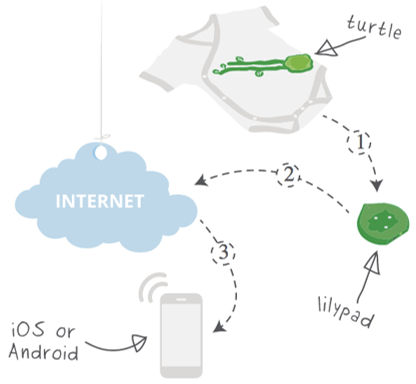
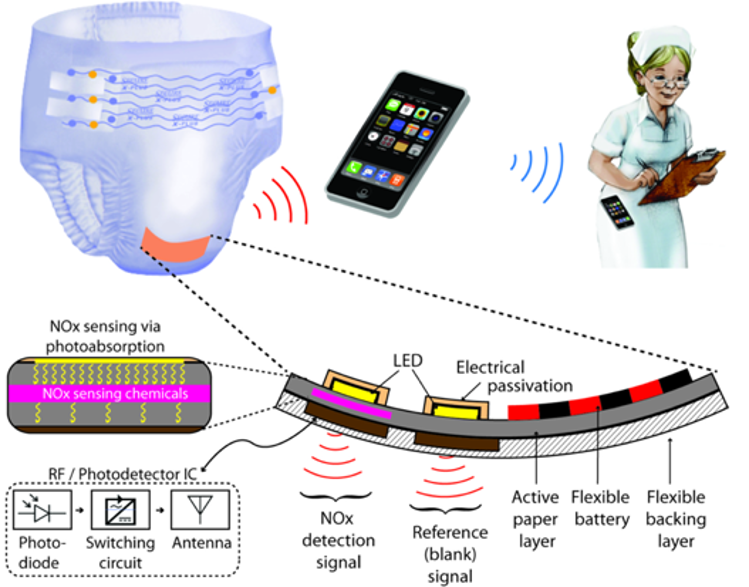
One of the most innovative pediatric IoT applications is the self-powered smart diaper that harvests energy from the very substance it’s detecting:
Flowchart diagram
Figure 127.3: Self-powered smart diaper system architecture showing urine-activated biofuel cell generating power for moisture sensors, temperature monitoring, and BLE transmission to parent smartphone app.
How the Biofuel Cell Works:
Urine Detection: When wet event occurs, urine contacts electrodes
Energy Generation: Microbial fuel cell uses bacterial enzymes in urine to generate ~0.5V DC
Power Storage: Tiny capacitor stores harvested energy
Sensor Activation: Powers moisture, pH, and temperature sensors
Wireless Transmission: BLE beacon signals wetness event to smartphone
Advantages of Self-Powered Design: - No batteries: Eliminates safety concerns about battery ingestion - No charging: Parents never need to remember to charge - Disposable integration: Works with standard disposable diapers - Low cost: Simple electrodes printed on diaper material
Connected Diaper UTI Monitoring
Figure 127.4: Connected diaper analytics for urinary tract infection monitoring showing real-time hydration tracking, wet/dry patterns, and early UTI risk detection through pH and frequency analysis.
127.7 UTI Early Detection: A Major Pediatric Application
Urinary tract infections (UTIs) are common in infants and often go undetected until symptoms become severe:
Statistic
Value
Clinical Impact
UTI prevalence in infants
7-8% of febrile infants
Common missed diagnosis
Delayed diagnosis risk
Kidney damage, sepsis
Serious long-term consequences
Traditional detection
Catheter urine sample
Invasive, often delayed
Symptoms in infants
Non-specific (fever, fussiness)
Easy to miss or misattribute
How Smart Diapers Enable UTI Detection:
Sensor
Measurement
UTI Indicator
pH Sensor
Urine acidity (normally 4.5-8.0)
Elevated pH (>8.5) suggests infection
Nitrite Sensor
Bacterial metabolite
Positive indicates bacterial presence
Frequency Pattern
Time between wet events
Increased frequency with UTI
Temperature
Diaper surface temperature
Elevated temp may indicate fever/infection
Color (optical)
Urine cloudiness/color
Cloudy or blood-tinged suggests UTI
The Detection Algorithm:
IF pH > 8.5 for 3+ consecutive samples
AND wet frequency increased >50% from baseline
AND (temperature elevated OR nitrite positive)
THEN flag "UTI Risk - Consult Pediatrician"
Key Insight: Smart diapers don’t diagnose UTIs - they flag patterns requiring clinical follow-up. A urinalysis is still required for diagnosis, but smart diapers enable 48-hour earlier detection than waiting for visible symptoms.
127.8 Smart Nursery Environmental Control
Beyond infant monitoring, smart nurseries integrate environmental control for optimal sleep conditions:
Smart Nursery Environment Control
Figure 127.5: Smart nursery environmental control system showing multi-sensor monitoring (temperature, humidity, sound, light) coordinating with automated responses (HVAC adjustment, smart blinds, white noise activation) to maintain optimal infant sleep conditions.
Optimal Infant Sleep Environment Parameters:
Parameter
Optimal Range
IoT Control Method
Risk if Outside Range
Temperature
68-72°F (20-22°C)
Smart thermostat with nursery zone
Overheating: SIDS risk; Too cold: waking
Humidity
40-60% RH
Humidifier/dehumidifier automation
Dry: congestion; Humid: mold risk
Light (sleep)
<1 lux (pitch dark)
Smart blackout blinds
Light disrupts melatonin production
Light (day)
Natural light cycle
Automated blind scheduling
Circadian rhythm development
Noise level
50-60 dB white noise
Smart sound machine
Silence: easily startled; Loud: hearing risk
127.9 Baby Monitoring System Comparison
Commercial Systems and Their Approaches:
System
Monitoring Method
Key Sensors
Price Point
Accuracy Level
Owlet Smart Sock
Wearable on foot
PPG (SpO2, HR)
$299
Consumer wellness
Snuza Hero
Clip-on to diaper
Accelerometer (breathing)
$99
Consumer wellness
Miku Pro
Camera-based
AI motion analysis
$399
Consumer wellness
Nanit
Camera + breathing band
Optical + accelerometer
$299
Consumer wellness
Pampers Lumi
Smart diaper + camera
Moisture, activity
$349
Consumer wellness
Tradeoff Comparison:
Factor
Wearable (Owlet)
Camera-Based (Miku)
Mattress Pad
Accuracy
Highest (direct contact)
Moderate (computer vision)
Moderate (indirect)
Comfort
Sock may be rejected
No wearable needed
No wearable needed
Maintenance
Charging daily
Always on
Pad replacement
Privacy
No video
Video recording concerns
No video
Cost
Higher
Higher
Lower
Portability
Works anywhere
Fixed camera position
Fixed to crib
127.10 Knowledge Check
Show code
{const container =document.getElementById('kc-usecase-baby');if (container &&typeof InlineKnowledgeCheck !=='undefined') { container.innerHTML=''; container.appendChild(InlineKnowledgeCheck.create({question:"A self-powered smart diaper uses a microbial fuel cell that generates electricity when activated by urine. What is the PRIMARY advantage of this energy harvesting approach over battery-powered alternatives for infant health monitoring?",options: [ {text:"Higher power output enabling more sophisticated sensors",correct:false,feedback:"Self-powered diapers generate minimal power (~0.5V, microamps). Battery-powered systems can power more sophisticated sensors. The advantage lies elsewhere."}, {text:"Eliminates battery safety concerns and parent charging burden",correct:true,feedback:"Correct! Infant products face stringent safety requirements - button battery ingestion is a major pediatric hazard. Self-powered designs eliminate this risk entirely while also removing the parent burden of remembering to charge devices. The 'disposable intelligence' model integrates seamlessly with existing diaper change workflows."}, {text:"More accurate pH and temperature measurements",correct:false,feedback:"Power source doesn't directly affect sensor accuracy. Both battery and self-powered systems can use identical sensor technology."}, {text:"Longer monitoring duration between diaper changes",correct:false,feedback:"Self-powered systems actually have shorter active windows (only when wet). Battery systems can monitor continuously. The advantage is safety and convenience, not monitoring duration."} ],difficulty:"medium",topic:"iot-use-cases-baby" })); }}
127.11 Tradeoff Analysis
WarningTradeoff: Wearable vs. Non-Contact Baby Monitoring
Option A: Wearable sensors (smart socks, chest bands) - Highest accuracy for vital signs, direct contact enables PPG and precise measurements. Risk: infant discomfort, sock rejection, daily charging, potential skin irritation. Option B: Non-contact monitoring (camera AI, mattress pads) - No wearable discomfort, no charging, no skin contact. Risk: Lower accuracy, sensitive to positioning, may not detect subtle breathing changes. Decision factors: Parent comfort with wearables on infant, importance of SpO2 monitoring (premature infants may need higher accuracy), tolerance for charging overhead, and privacy concerns about video monitoring.
127.12 Summary
Baby monitoring and infant care IoT applications demonstrate specialized healthcare IoT:
Closed-loop nursery systems integrate sensing, analytics, and automated response
Breathing monitors use PPG technology for SpO2 and heart rate tracking
Self-powered smart diapers harvest energy from urine using biofuel cells
UTI early detection flags patterns 48 hours before visible symptoms
Environmental control maintains optimal sleep conditions automatically
Consumer vs. medical-grade distinction is critical for setting parent expectations