%% fig-alt: "M2M architecture with latency breakdown: Smart meters have 0ms internal latency but 15-minute reading interval. Data concentrator adds 50ms processing plus 60-minute batch delay. Cellular network introduces 100-500ms variable latency depending on coverage. M2M platform adds 200ms for validation and storage. Total end-to-end latency ranges from 60 minutes in batch mode to 350-750ms in real-time mode. Critical path for on-demand reads highlighted."
%%{init: {'theme': 'base', 'themeVariables': { 'primaryColor': '#2C3E50', 'primaryTextColor': '#fff', 'primaryBorderColor': '#16A085', 'lineColor': '#16A085', 'secondaryColor': '#E67E22', 'tertiaryColor': '#7F8C8D'}}}%%
flowchart LR
    subgraph Device["Smart Meter"]
        D["Sensing: 0ms<br/>Buffer: 15min interval"]
    end

    subgraph Gateway["Data Concentrator"]
        G["Processing: 50ms<br/>Batch delay: 60min"]
    end

    subgraph Network["Cellular"]
        N["Latency: 100-500ms<br/>Variable by coverage"]
    end

    subgraph Platform["M2M Platform"]
        P["Validation: 100ms<br/>Storage: 100ms"]
    end

    subgraph Total["End-to-End"]
        T["Batch: ~60 min<br/>Real-time: 350-750ms"]
    end

    D -->|"15min"| G
    G -->|"60min batch"| N
    N -->|"100-500ms"| P
    P --> T

    style Device fill:#16A085,stroke:#2C3E50,color:#fff
    style Gateway fill:#E67E22,stroke:#2C3E50,color:#fff
    style Network fill:#7F8C8D,stroke:#2C3E50,color:#fff
    style Platform fill:#2C3E50,stroke:#16A085,color:#fff
    style Total fill:#E67E22,stroke:#2C3E50,color:#fff
471 M2M Communication: Implementations
471.1 Learning Objectives
By the end of this chapter, you will be able to:
- Implement M2M Systems: Build complete machine-to-machine solutions including device platforms and data collection
- Design Smart Metering: Create electricity meter systems with reading collection and billing integration
- Apply Data Classes: Use Python dataclasses for structured IoT data representation
- Implement Device Simulation: Build realistic M2M device simulators for testing and development
- Handle Time-Series Data: Process and aggregate meter readings over time periods
- Calculate Billing: Implement automated billing logic based on collected M2M data
471.2 Prerequisites
Before diving into this chapter, you should be familiar with:
- M2M Communication: Fundamentals: Understanding M2M architectures, service platforms, node types, and ETSI requirements provides the theoretical foundation for implementing practical M2M systems
- Machine-to-Machine (M2M) Communication: Knowledge of M2M vs IoT distinctions, protocol selection, and gateway design helps contextualize implementation decisions
- Networking Basics for IoT: Familiarity with network protocols (MQTT, CoAP, HTTP, Modbus) is essential for implementing protocol handlers and translation gateways
- IoT Reference Models: Understanding layered architectures guides the design of device platforms, application platforms, and orchestration engines
TipFor Beginners: Machine-to-Machine (M2M) Communication
M2M is when devices talk directly to each other without human intervention - like vending machines automatically reporting when they’re running low on inventory, or smart meters sending electricity usage to the utility company. It’s automation at scale.
Everyday Analogy: Think of your car’s automatic features. When tire pressure drops, the sensor communicates directly with the dashboard display (M2M). When your car’s warranty expires, the dealership’s computer might automatically send you a service reminder email (also M2M). No human manually checked your tires or looked up your warranty date - machines did it all.
| Term | Simple Explanation |
|---|---|
| M2M Platform | Software that manages thousands of connected devices, like a control center |
| Smart Meter | An electricity/water/gas meter that automatically reports usage readings |
| Device Management | Remotely monitoring, updating, and controlling IoT devices at scale |
| Protocol Translation | Converting between different communication “languages” devices use |
| Service Orchestration | Coordinating multiple automated tasks in the right order |
Why This Matters for IoT: M2M enables massive automation. Utility companies use M2M to read millions of meters remotely (no meter readers needed). Vending machine companies optimize restocking routes based on real-time inventory. Fleet management tracks thousands of trucks automatically. M2M reduces human labor, improves efficiency, and enables services impossible with manual monitoring.
NoteRelated Chapters
Deep Dives: - M2M Communication - M2M fundamentals and architecture - M2M Fundamentals - ETSI M2M framework and service platform
Protocols: - MQTT Overview - M2M messaging protocol - CoAP Architecture - Constrained application protocol - Modbus and Fieldbus - Industrial protocols
Architecture: - IoT Reference Models - Layered architectures - Edge-Fog Computing - Edge M2M gateways
Comparisons: - M2M Review - M2M vs IoT comparison - Sensing as a Service - Service-oriented architectures
Data Management: - Data Storage and Databases - M2M data persistence - Edge Data Acquisition - Local data collection
Learning: - Simulations Hub - M2M platform simulators
TipCross-Hub Connections
This chapter connects to multiple learning resources:
📺 Videos Hub: Watch M2M Architecture Explained for visual walkthroughs of smart metering systems, protocol translation gateways, and service orchestration in real deployments.
🧪 Simulations Hub: Try the M2M Platform Simulator to experiment with device registration, data collection pipelines, and billing workflows without physical hardware.
❓ Knowledge Gaps Hub: Review Common M2M Misconceptions covering protocol selection mistakes, gateway scalability issues, and billing calculation errors that plague production systems.
📝 Quizzes Hub: Test your understanding with M2M Implementation Quiz featuring scenario-based questions on smart meter data validation, protocol handler design, and workflow orchestration.
WarningCommon Misconception: “M2M Gateways Don’t Need Local Storage”
The Misconception: Many developers assume M2M gateways can operate purely as pass-through devices, immediately forwarding all data to the cloud without local storage.
The Reality: In 2018, a major utility company deployed 50,000 smart meters with gateways lacking adequate local storage. When a cellular network outage lasted 6 hours during peak billing period, the gateways could only buffer 30 minutes of readings before discarding data. This resulted in:
- 12,500 customers with incomplete billing data (25% of deployment)
- $2.3 million in estimated revenue requiring manual reconciliation
- 47 days to manually estimate and correct affected bills
- 18% customer complaint increase due to billing disputes
Why This Happens: Production M2M systems face real-world connectivity issues:
| Event Type | Frequency | Duration | Impact Without Buffer |
|---|---|---|---|
| Cellular Outage | 2-3x/year | 2-8 hours | Total data loss |
| Network Congestion | Daily | 5-20 minutes | Intermittent loss |
| Tower Maintenance | 1x/month | 30-90 minutes | Complete blackout |
| Weather Disruption | Seasonal | 1-12 hours | Extended loss |
Best Practice: Design gateways with store-and-forward capabilities:
- Minimum 24 hours of local data buffering (10,000+ messages for typical smart meter deployment)
- Persistent storage (SD card, eMMC) survives power loss
- Message age limits (discard data older than 48 hours to prevent stale readings)
- Batch replay (upload buffered data in efficient batches when connectivity restores)
- Monitoring alerts (notify operators when buffer reaches 70% capacity)
The lesson: M2M systems must be resilient to real-world network failures. Local storage isn’t optional—it’s a production requirement that prevents revenue loss and maintains data integrity.
471.3 Hands-On Lab: M2M Smart Meter System
471.3.1 Objective
Implement a complete M2M smart metering system with device platform, data collection, and billing.
471.3.2 System Architecture Overview
A complete M2M smart metering system consists of several interconnected components:

NoteAlternative View: Latency Budget Analysis
This variant shows the same architecture with latency contributions at each hop, helping engineers identify bottlenecks and optimize response times.
Latency Optimization Opportunities: - Gateway batch delay (60min): Largest contributor—reduce for near-real-time use cases - Cellular latency (100-500ms): Consider dedicated APN for consistent performance - On-demand reads: Bypass batch delay for command queries (~350ms end-to-end)
471.3.3 Smart Meter Data Model
The foundation of any M2M implementation is a well-defined data model. A typical smart‑meter record groups fields into three areas:
| Group | Example Fields | Purpose |
|---|---|---|
| Meter identity | Meter ID (unique identifier), location (GPS coordinates), customer ID (billing reference), installation date | Tie each reading to the correct physical device and customer |
| Reading data | Timestamp (UTC), active energy (kWh), reactive energy (kVARh), peak demand (kW), power factor | Capture what the meter is measuring over time |
| Status information | Communication status, tamper detection flags, battery level (for off‑grid meters), firmware version | Support health monitoring, fraud detection, and fleet management |
471.3.4 Implementation Components
471.3.4.1 Device Registration and Discovery
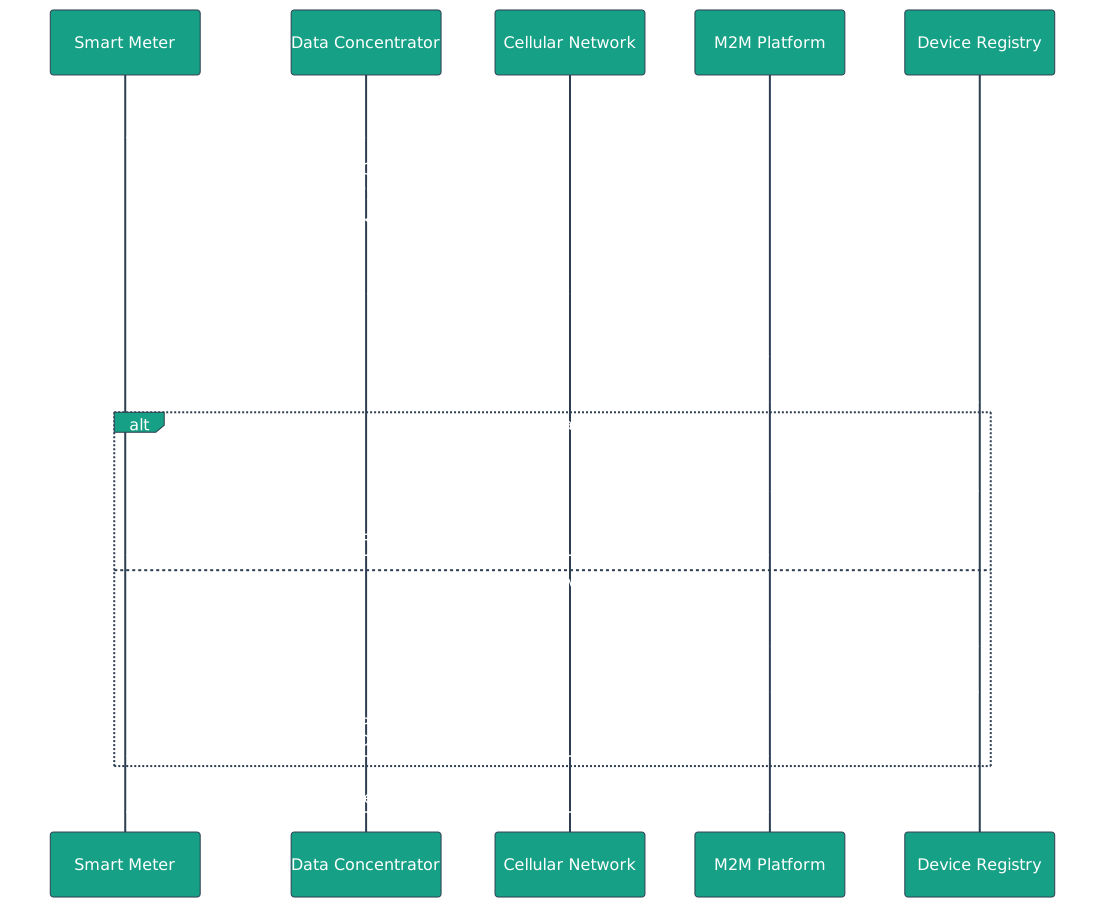
When a smart meter comes online, it must register with the M2M platform:
Registration Flow:
Registration Message Structure:
| Field | Type | Description |
|---|---|---|
deviceId |
String | Unique meter identifier |
manufacturerId |
String | Vendor code |
modelNumber |
String | Device model |
serialNumber |
String | Hardware serial |
firmwareVersion |
String | Current firmware |
capabilities |
Array | Supported features |
communicationProfile |
Object | Protocol preferences |
471.3.4.2 Data Collection Pipeline
The data collection pipeline handles meter readings efficiently:

Data Validation Rules:
- Timestamp Validation: Readings must have valid UTC timestamps within acceptable drift tolerance (±5 minutes)
- Range Checking: Energy values must be non-negative and within meter capacity
- Sequence Verification: Cumulative readings must be monotonically increasing
- Anomaly Detection: Sudden spikes or drops flagged for review
471.3.4.3 Reading Aggregation Logic
Smart meters generate high-frequency data that requires aggregation for billing and analysis:
| Aggregation Level | Interval | Use Case |
|---|---|---|
| Raw | 15 minutes | Real-time monitoring |
| Hourly | 1 hour | Load analysis |
| Daily | 24 hours | Billing preparation |
| Monthly | 30 days | Customer billing |
Aggregation Process:

471.3.4.4 Billing Integration
The billing module calculates charges based on aggregated consumption:

Tariff Structure Example:
| Tier | Consumption (kWh) | Rate ($/kWh) |
|---|---|---|
| 1 | 0-100 | 0.08 |
| 2 | 101-300 | 0.10 |
| 3 | 301-500 | 0.12 |
| 4 | 500+ | 0.15 |
Time-of-Use Rates:
| Period | Hours | Multiplier |
|---|---|---|
| Off-Peak | 10 PM - 6 AM | 0.8x |
| Mid-Peak | 6 AM - 2 PM, 7 PM - 10 PM | 1.0x |
| On-Peak | 2 PM - 7 PM | 1.5x |
471.4 Multi-Protocol M2M Communication Handler
471.4.1 Protocol Support Matrix
M2M systems must handle multiple communication protocols:
| Protocol | Use Case | Port | QoS Support |
|---|---|---|---|
| MQTT | Real-time telemetry | 1883/8883 | 0, 1, 2 |
| CoAP | Constrained devices | 5683/5684 | Confirmable |
| HTTP/REST | Management APIs | 80/443 | N/A |
| Modbus | Legacy industrial | 502 | N/A |
471.4.2 Protocol Handler Architecture

NoteAlternative View: Protocol Selection Matrix
This variant helps engineers choose the right protocol for different M2M device types based on constraints and requirements.
%% fig-alt: "Protocol selection decision matrix: For battery-powered constrained devices like sensors, use CoAP with UDP for minimal overhead. For real-time telemetry devices like smart meters, use MQTT with QoS 1 for reliable delivery. For management APIs and dashboards, use HTTP REST for broad compatibility. For legacy industrial equipment like PLCs, use Modbus TCP for direct integration. Decision path shows power constraint leading to CoAP, real-time need leading to MQTT, human interface leading to HTTP, and legacy integration leading to Modbus."
%%{init: {'theme': 'base', 'themeVariables': { 'primaryColor': '#2C3E50', 'primaryTextColor': '#fff', 'primaryBorderColor': '#16A085', 'lineColor': '#16A085', 'secondaryColor': '#E67E22', 'tertiaryColor': '#7F8C8D'}}}%%
flowchart TB
    Start["New Device<br/>Integration"]

    Power{"Power<br/>Constrained?"}
    Realtime{"Real-time<br/>Required?"}
    Legacy{"Legacy<br/>Equipment?"}
    Human{"Human<br/>Interface?"}

    CoAP["USE CoAP<br/>UDP, low overhead<br/>Port 5683<br/>Best for: Sensors"]
    MQTT["USE MQTT<br/>TCP, pub/sub<br/>Port 1883/8883<br/>Best for: Telemetry"]
    HTTP["USE HTTP/REST<br/>TCP, stateless<br/>Port 80/443<br/>Best for: APIs"]
    Modbus["USE Modbus<br/>TCP/RTU<br/>Port 502<br/>Best for: Industrial"]

    Start --> Power

    Power -->|"Yes<br/>Battery"| CoAP
    Power -->|"No<br/>Powered"| Realtime

    Realtime -->|"Yes<br/><1s"| MQTT
    Realtime -->|"No"| Legacy

    Legacy -->|"Yes<br/>PLCs"| Modbus
    Legacy -->|"No"| Human

    Human -->|"Yes<br/>Dashboard"| HTTP
    Human -->|"No"| MQTT

    style Start fill:#7F8C8D,stroke:#2C3E50,color:#fff
    style CoAP fill:#16A085,stroke:#2C3E50,color:#fff
    style MQTT fill:#E67E22,stroke:#2C3E50,color:#fff
    style HTTP fill:#2C3E50,stroke:#16A085,color:#fff
    style Modbus fill:#7F8C8D,stroke:#2C3E50,color:#fff
Quick Protocol Guide: | Protocol | Overhead | Connection | Best Use Case | |———-|———-|————|—————| | CoAP | Lowest | Connectionless | Battery sensors | | MQTT | Low | Persistent | Real-time telemetry | | HTTP | High | Per-request | Management APIs | | Modbus | Medium | Persistent | Industrial legacy |
471.4.3 Message Routing Logic
Routing Decision Tree:

471.4.4 Delivery Mode Selection
| Mode | Description | Use Case |
|---|---|---|
| Unicast | Single recipient | Device commands |
| Multicast | Group of devices | Firmware updates |
| Anycast | Any available instance | Load balancing |
| Broadcast | All devices | Emergency alerts |
471.5 Protocol Translation Gateway
471.5.1 Gateway Architecture
The protocol translation gateway bridges legacy industrial protocols to modern IoT protocols:

471.5.2 Data Normalization Process
Fieldbus protocols use different data representations that must be normalized:
| Source Protocol | Raw Data | Normalized Format |
|---|---|---|
| Modbus RTU | 16-bit registers | JSON with units |
| BACnet | Object properties | JSON with units |
| CAN Bus | 8-byte frames | JSON with units |
Normalization Example:
Modbus Input:
  Register 40001 = 0x0190 (400)
  Register 40002 = 0x000A (10)

Mapping Rule:
  40001 → temperature (scale: 0.1)
  40002 → humidity (scale: 1)

Normalized Output:
{
  "deviceId": "meter-001",
  "timestamp": "2025-01-15T14:30:00Z",
  "measurements": {
    "temperature": { "value": 40.0, "unit": "celsius" },
    "humidity": { "value": 10, "unit": "percent" }
  }
}
471.5.3 Store-and-Forward for Offline Operation
When network connectivity is lost, the gateway buffers data locally:

NoteAlternative View: Buffer Sizing Calculator
This variant shows how to calculate buffer requirements based on deployment parameters, preventing data loss during outages.
%% fig-alt: "Buffer sizing calculation flowchart: Input parameters are 100 meters at 15-minute intervals generating 9,600 readings per day at 200 bytes each. Step 1 calculates daily data volume as 1.92 MB. Step 2 determines buffer duration requirement of 24 hours based on worst-case outage. Step 3 adds 20% safety margin resulting in 2.3 MB minimum buffer. Step 4 rounds up to nearest practical size of 4 MB SD card. Final recommendation is 4 MB persistent storage with 24-hour retention and FIFO eviction policy."
%%{init: {'theme': 'base', 'themeVariables': { 'primaryColor': '#2C3E50', 'primaryTextColor': '#fff', 'primaryBorderColor': '#16A085', 'lineColor': '#16A085', 'secondaryColor': '#E67E22', 'tertiaryColor': '#7F8C8D'}}}%%
flowchart TB
    subgraph Inputs["Deployment Parameters"]
        I1["Meters: 100"]
        I2["Interval: 15 min"]
        I3["Readings/day: 9,600"]
        I4["Bytes/reading: 200"]
    end

    subgraph Calc["Calculation"]
        C1["Step 1: Daily Volume<br/>9,600 × 200 = 1.92 MB"]
        C2["Step 2: Buffer Duration<br/>Worst outage: 24 hours"]
        C3["Step 3: Safety Margin<br/>1.92 MB × 1.2 = 2.3 MB"]
        C4["Step 4: Round Up<br/>→ 4 MB minimum"]
    end

    subgraph Result["Recommendation"]
        R["Buffer: 4 MB<br/>Retention: 24 hours<br/>Eviction: FIFO oldest first"]
    end

    I1 --> C1
    I2 --> C1
    I3 --> C1
    I4 --> C1
    C1 --> C2 --> C3 --> C4 --> R

    style Inputs fill:#7F8C8D,stroke:#2C3E50,color:#fff
    style Calc fill:#E67E22,stroke:#2C3E50,color:#fff
    style Result fill:#16A085,stroke:#2C3E50,color:#fff
Sizing Formula:
Buffer Size = (Meters × Readings/Hour × Hours × Bytes/Reading) × Safety Margin
Buffer Size = (100 × 4 × 24 × 200) × 1.2 = 2.3 MB → Round to 4 MB
Buffer Management Parameters:
| Parameter | Value | Description |
|---|---|---|
| Max Buffer Size | 10,000 messages | Prevent memory overflow |
| Max Message Age | 24 hours | Discard stale data |
| Retry Interval | 30 seconds | Reconnection attempts |
| Batch Size | 100 messages | Efficient replay |
471.6 Service Orchestration Engine
471.6.1 Workflow Composition
M2M service orchestration coordinates multiple automated tasks:

471.6.2 Execution Modes
| Mode | Description | Example |
|---|---|---|
| Sequential | Tasks execute one after another | Read → Validate → Store |
| Parallel | Tasks execute simultaneously | Read multiple meters |
| Conditional | Branching based on results | Alert if threshold exceeded |
| Loop | Repeated execution | Retry failed readings |
471.6.3 Workflow Definition Example
A typical M2M workflow for daily billing:
Workflow: daily_billing_workflow
Trigger: Schedule (daily at 00:00 UTC)

Steps:
  1. [PARALLEL] Collect meter readings
     - Query all active meters
     - Timeout: 30 minutes

  2. [SEQUENTIAL] Validate readings
     - Check completeness (>95% required)
     - Identify gaps and estimate

  3. [SEQUENTIAL] Aggregate consumption
     - Calculate daily totals
     - Apply time-of-use rates

  4. [CONDITIONAL] Generate bills
     - IF billing_day == true
       - Generate customer invoices
       - Send notifications
     - ELSE
       - Store aggregates only

  5. [SEQUENTIAL] Archive data
     - Move processed readings to archive
     - Update system metrics
471.6.4 Error Handling and Recovery
Retry Strategy:
| Error Type | Action | Max Retries |
|---|---|---|
| Network timeout | Exponential backoff | 5 |
| Device offline | Skip, mark incomplete | 0 |
| Validation error | Log, alert operator | 1 |
| System error | Pause workflow, alert | 3 |
471.7 Real-World Application: Smart Building Automation
471.7.1 System Components
A smart building M2M system integrates multiple subsystems:

471.7.2 Integration Points
| Subsystem | Protocol | Data Frequency |
|---|---|---|
| HVAC | BACnet | 1 minute |
| Lighting | DALI | On change |
| Energy | Modbus | 15 seconds |
| Access Control | Wiegand | On event |
| Fire Safety | Proprietary | On event |
471.7.3 Optimization Algorithms
The building optimizer considers multiple factors:
- Occupancy Prediction: ML model predicts room usage
- Weather Forecast: External temperature impacts HVAC
- Energy Pricing: Time-of-use rates affect scheduling
- Comfort Constraints: Temperature setpoint boundaries
Decision Matrix:
| Scenario | HVAC Action | Lighting Action | Energy Action |
|---|---|---|---|
| Occupied, Hot, Peak Rate | Pre-cool, limit | Daylight harvest | Discharge battery |
| Unoccupied, Cold, Off-Peak | Setback | Off | Charge battery |
| Occupied, Mild, Mid-Peak | Ventilate only | Auto-dim | Grid power |
471.8 Knowledge Check
NoteQuestion 1: Data Pipeline Stages
In the M2M data collection pipeline, what is the correct order of processing stages?
- Aggregate → Validate → Receive → Store
- Receive → Validate → Normalize → Aggregate → Store
- Validate → Receive → Aggregate → Normalize
- Store → Receive → Validate → Aggregate
Answer: B) Receive → Validate → Normalize → Aggregate → Store
Data flows through the pipeline in a logical sequence: first received from devices, validated for correctness, normalized to a common format, aggregated for analysis, and finally stored.
NoteQuestion 2: Protocol Translation
When translating Modbus RTU data to MQTT JSON, what additional information should the gateway add during semantic enrichment?
- Raw binary values only
- Register addresses
- Engineering units, timestamps, and device context
- Checksum values
Answer: C) Engineering units, timestamps, and device context
Semantic enrichment transforms raw register values into meaningful data by adding units (e.g., celsius, percent), UTC timestamps, and device identification context that makes the data interpretable.
NoteQuestion 3: Service Orchestration
In a billing workflow, why would you use parallel execution for meter reading but sequential execution for bill generation?
- Parallel is always faster, sequential is slower
- Meter reading is independent per device; bill generation requires all readings complete
- They use different protocols
- Hardware limitations
Answer: B) Meter reading is independent per device; bill generation requires all readings complete
Meter readings can be collected simultaneously from thousands of devices because each reading is independent. However, bill generation must wait until all readings are aggregated to calculate accurate totals.
NoteAlternative View: M2M vs IoT Protocol Stack Comparison
This variant compares the protocol stacks of traditional M2M and modern IoT architectures, highlighting the evolution in communication patterns.
%%{init: {'theme': 'base', 'themeVariables': { 'primaryColor': '#2C3E50', 'primaryTextColor': '#fff', 'primaryBorderColor': '#16A085', 'lineColor': '#16A085', 'secondaryColor': '#E67E22', 'tertiaryColor': '#7F8C8D', 'fontSize': '11px'}}}%%
graph TB
    subgraph M2M["TRADITIONAL M2M"]
        M_APP["Proprietary<br/>Application"]
        M_SVC["SCADA/DCS<br/>Service Layer"]
        M_TRANS["SMS, GPRS<br/>Transport"]
        M_NET["Private APN<br/>Network"]
        M_DEV["Fixed Function<br/>Device"]

        M_APP --> M_SVC --> M_TRANS --> M_NET --> M_DEV
    end

    subgraph IoT["MODERN IoT"]
        I_APP["REST APIs<br/>Web Services"]
        I_SVC["MQTT, CoAP<br/>Pub/Sub"]
        I_TRANS["TCP/IP, DTLS<br/>Transport"]
        I_NET["Public Internet<br/>+ Edge"]
        I_DEV["Programmable<br/>Device"]

        I_APP --> I_SVC --> I_TRANS --> I_NET --> I_DEV
    end

    M_SVC -.->|"Migration"| I_SVC
    M_NET -.->|"Migration"| I_NET

    style M2M fill:#7F8C8D,stroke:#2C3E50,color:#fff
    style IoT fill:#16A085,stroke:#2C3E50,color:#fff
NoteAlternative View: Smart Metering Data Flow Timeline
This variant shows the temporal flow of data in smart metering systems, emphasizing the periodic nature of M2M communications.
%%{init: {'theme': 'base', 'themeVariables': { 'primaryColor': '#2C3E50', 'primaryTextColor': '#fff', 'primaryBorderColor': '#16A085', 'lineColor': '#E67E22', 'secondaryColor': '#E67E22', 'tertiaryColor': '#7F8C8D', 'fontSize': '11px'}}}%%
graph LR
    subgraph Meter["SMART METER"]
        M1["15-min reads<br/>96/day"]
    end

    subgraph Concentrator["CONCENTRATOR"]
        C1["Hourly aggregation<br/>100 meters × 4/hr"]
    end

    subgraph HeadEnd["HEAD-END SYSTEM"]
        H1["Daily batch<br/>1M reads/day"]
    end

    subgraph Billing["BILLING"]
        B1["Monthly cycle<br/>Usage + demand"]
    end

    Meter -->|"RF Mesh<br/>Every 15 min"| Concentrator
    Concentrator -->|"Cellular<br/>Hourly"| HeadEnd
    HeadEnd -->|"Database<br/>Daily"| Billing

    style Meter fill:#16A085,stroke:#2C3E50,color:#fff
    style Concentrator fill:#E67E22,stroke:#2C3E50,color:#fff
    style HeadEnd fill:#2C3E50,stroke:#16A085,color:#fff
    style Billing fill:#7F8C8D,stroke:#2C3E50,color:#fff
471.9 Visual Reference Gallery
Explore these AI-generated visualizations that complement the M2M implementation concepts covered in this chapter. Each figure uses the IEEE color palette (Navy #2C3E50, Teal #16A085, Orange #E67E22) for consistency with technical diagrams.
NoteVisual: M2M Architecture Layers

This visualization illustrates the layered architecture of M2M systems, showing how smart meters, gateways, and service platforms integrate to enable automated device management and billing.
NoteVisual: M2M Communication Flow
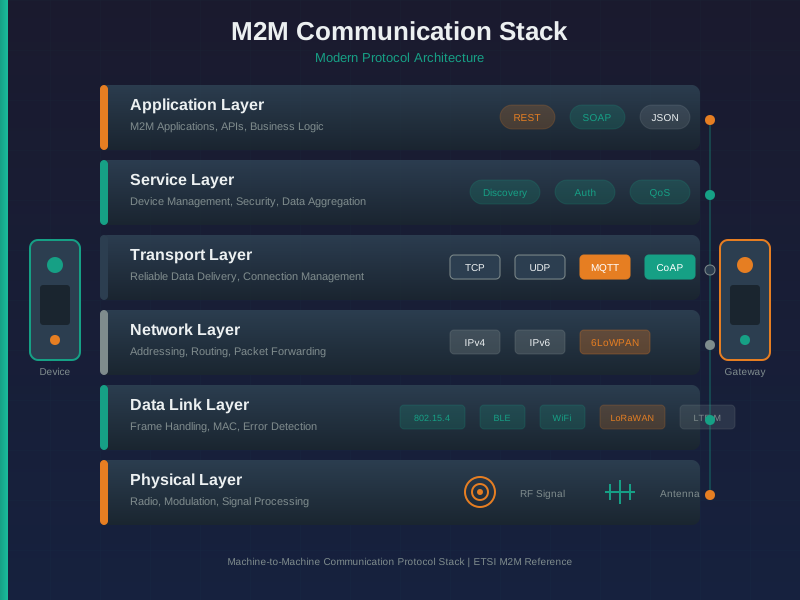
This figure depicts the M2M communication stack covered in the protocol handler implementation, illustrating how MQTT, CoAP, and HTTP protocols enable device-to-platform communication.
NoteVisual: M2M Device Management

This visualization shows the device management lifecycle implemented in the smart metering platform, from registration through reading collection to billing integration.
NoteVisual: M2M Data Aggregation
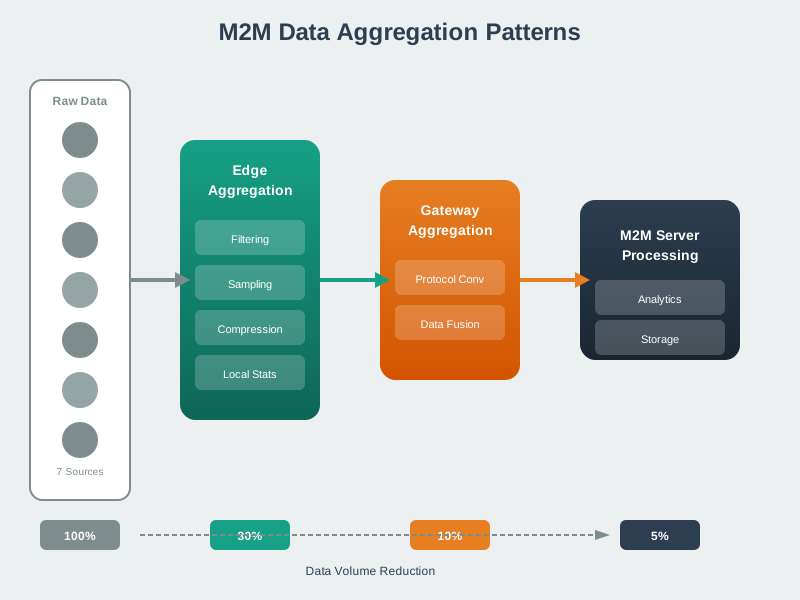
This figure illustrates the data aggregation patterns used in the protocol translation gateway, showing how fieldbus protocols are bridged to internet protocols with semantic enrichment.
NoteVisual: LwM2M Architecture
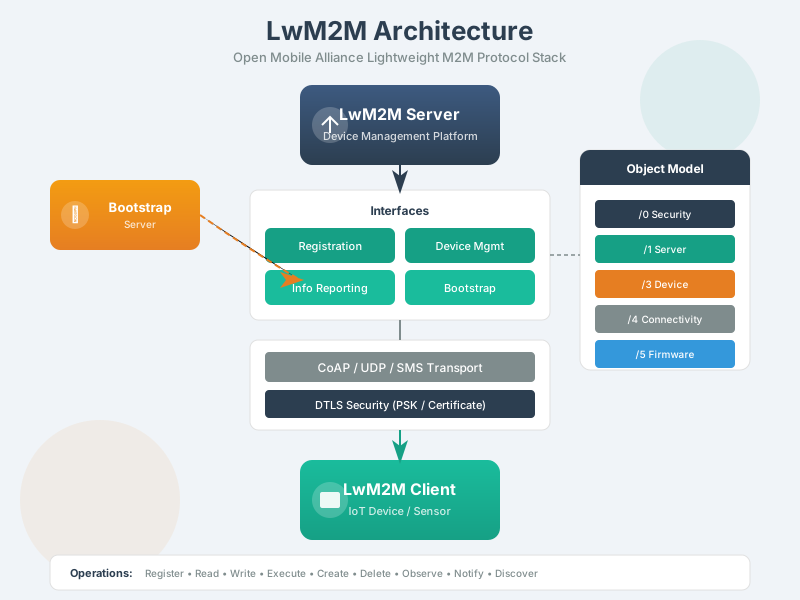
This visualization depicts the LwM2M protocol architecture used for remote device management, enabling firmware updates and configuration changes in M2M deployments.
471.10 Summary
This chapter covered practical M2M system implementations:
- Smart Metering Platform: Complete implementation of electricity meter management with automated reading collection, anomaly detection, and billing integration using Python dataclasses
- Multi-Protocol Handler: M2M protocol handler supporting MQTT, CoAP, HTTP, and Modbus with priority-based queuing, adaptive routing, and multiple delivery modes (unicast, multicast, anycast, broadcast)
- Protocol Translation Gateway: Bridging fieldbus protocols (Modbus RTU, BACnet) to internet protocols with data normalization, semantic enrichment, and store-and-forward capabilities for offline operation
- Service Orchestration: Workflow engine composing M2M services with dependency management, sequential/parallel execution, conditional branching, and data flow between services
- Real-World Applications: Implementations demonstrate smart building automation, industrial monitoring, and utility metering with practical Python code examples
- Production Patterns: Code uses dataclasses for structure, enum types for protocols, callable functions for extensibility, and dictionary-based context sharing
471.11 What’s Next
The next chapter explores Architectural Enablers: Fundamentals, covering the evolution of IoT systems, computing power trends (Moore’s Law driving exponential growth), miniaturization advances (from room-sized computers to wearable sensors), energy management techniques (duty cycling, energy harvesting), and communication protocol options (short-range Wi-Fi/Bluetooth to long-range LoRaWAN/NB-IoT) that enable modern M2M and IoT deployments at scale.