%%{init: {'theme': 'base', 'themeVariables': {'primaryColor': '#2C3E50', 'primaryTextColor': '#fff', 'primaryBorderColor': '#16A085', 'lineColor': '#E67E22', 'secondaryColor': '#16A085', 'tertiaryColor': '#7F8C8D'}}}%%
graph LR
    FC[Frame Control<br/>2 bytes] --> SEQ[Sequence<br/>1 byte]
    SEQ --> ADDR[Addressing Fields<br/>4-20 bytes variable]
    ADDR --> SEC[Security Header<br/>0-14 bytes optional]
    SEC --> PAY[Payload<br/>0-102 bytes]
    PAY --> FCS[FCS<br/>2 bytes]

    style FC fill:#E67E22,stroke:#2C3E50,color:#fff
    style SEQ fill:#16A085,stroke:#2C3E50,color:#fff
    style ADDR fill:#2C3E50,stroke:#16A085,color:#fff
    style SEC fill:#7F8C8D,stroke:#2C3E50,color:#fff
    style PAY fill:#27ae60,stroke:#2C3E50,color:#fff
    style FCS fill:#E67E22,stroke:#2C3E50,color:#fff
948 IEEE 802.15.4 Review: Frame Structure and Security
948.1 Learning Objectives
By the end of this chapter, you will be able to:
- Analyze Frame Structure: Understand MAC frame components and their sizes
- Calculate Overhead: Determine addressing and security overhead for different configurations
- Configure Security: Select appropriate security levels for application requirements
- Optimize Payload: Maximize application data within frame constraints
948.2 Prerequisites
Required Chapters:
- 802.15.4 Fundamentals - Core standard introduction
- Protocol Stack and Specifications - Stack architecture
NoteRelated Chapters
Deep Dives:
- 802.15.4 Topic Review - Complete review hub
- 802.15.4 Comprehensive Review - Detailed specification
Other Review Topics:
- Network Operations - Device types and CSMA-CA
- Protocols and Performance - Higher-layer protocols
Security Topics:
- IoT Security Fundamentals - Security principles
- Cryptographic Foundations - Encryption basics
Estimated Time: 15 minutes
948.3 MAC Frame Format
The 802.15.4 MAC frame structure is critical for understanding overhead and efficiency. The maximum frame size is 127 bytes, making efficient use of every byte essential for low-power wireless networks.
948.3.1 Frame Components
| Field | Size | Purpose |
|---|---|---|
| Frame Control | 2 bytes | Frame type, addressing modes, security flag |
| Sequence Number | 1 byte | Frame identification for ACK matching |
| Addressing Fields | 4-20 bytes | Destination and source addresses |
| Security Header | 0-14 bytes | Security control, frame counter, key ID |
| Payload | 0-102 bytes | Application data |
| FCS | 2 bytes | 16-bit CRC for error detection |
948.3.2 Frame Control Field Breakdown
The 2-byte Frame Control field contains critical information about the frame:
| Bits | Field | Values | Purpose |
|---|---|---|---|
| 0-2 | Frame Type | 000=Beacon, 001=Data, 010=ACK, 011=MAC Cmd | Identifies frame purpose |
| 3 | Security Enabled | 0=No, 1=Yes | Indicates encryption/auth |
| 4 | Frame Pending | 0=No, 1=Yes | More data available |
| 5 | ACK Request | 0=No, 1=Yes | Sender wants ACK |
| 6 | PAN ID Compression | 0=No, 1=Yes | Reduces overhead |
| 7-9 | Reserved | - | Future use |
| 10-11 | Dest Addr Mode | 00=None, 10=Short, 11=Extended | Address type |
| 12-13 | Frame Version | 00=2003, 01=2006 | Standard version |
| 14-15 | Source Addr Mode | 00=None, 10=Short, 11=Extended | Address type |
948.3.3 Frame Types
IEEE 802.15.4 defines four frame types:
| Frame Type | Code | Purpose | Typical Size |
|---|---|---|---|
| Beacon | 000 | Synchronization, network info | 15-25 bytes |
| Data | 001 | Application payload | Variable |
| ACK | 010 | Delivery confirmation | 5 bytes |
| MAC Command | 011 | Network operations | 10-25 bytes |
948.4 Addressing Field Variations
The addressing overhead varies significantly based on network configuration. Understanding these variations is essential for optimizing frame efficiency.
948.4.1 Addressing Modes
802.15.4 supports three addressing modes:
| Mode | Code | Size | Use Case |
|---|---|---|---|
| No Address | 00 | 0 bytes | ACK frames |
| Short Address | 10 | 2 bytes | Network-local addressing |
| Extended Address | 11 | 8 bytes | Globally unique addressing |
948.4.2 Addressing Overhead Comparison
| Scenario | Dest PAN | Dest Addr | Src PAN | Src Addr | Total Overhead |
|---|---|---|---|---|---|
| Intra-PAN Short | 2 bytes | 2 bytes | Omitted | 2 bytes | 6 bytes |
| Intra-PAN Extended | 2 bytes | 8 bytes | Omitted | 8 bytes | 18 bytes |
| Inter-PAN Short | 2 bytes | 2 bytes | 2 bytes | 2 bytes | 8 bytes |
| Inter-PAN Extended | 2 bytes | 8 bytes | 2 bytes | 8 bytes | 20 bytes |
| ACK Frame | 0 | 0 | 0 | 0 | 0 bytes |
948.4.3 PAN ID Compression
When bit 6 (PAN ID Compression) is set to 1:
- Both source and destination are within the same PAN
- Source PAN ID is omitted from the frame
- Saves 2 bytes per frame
When to use:
- Always use within a single PAN
- Disable only for inter-PAN communication or border routers
948.4.4 Efficiency Calculation
Understanding frame efficiency helps with capacity planning:
| Configuration | Fixed Overhead | Max Payload | Efficiency |
|---|---|---|---|
| Minimum (ACK) | 5 bytes | 0 bytes | N/A |
| Short addr, no security | 11 bytes | 116 bytes | 91.3% |
| Short addr, max security | 32 bytes | 95 bytes | 74.8% |
| Extended addr, no security | 23 bytes | 104 bytes | 81.9% |
| Extended addr, max security | 44 bytes | 83 bytes | 65.4% |
Formula:
Available Payload = 127 - FC(2) - Seq(1) - AddrFields - SecHeader - FCS(2)
Efficiency = Payload / 127 * 100%
948.5 Security Architecture
IEEE 802.15.4 provides link-layer security using AES-128 encryption. Security is optional but highly recommended for most IoT deployments.
948.5.1 Security Header Format
When security is enabled, additional overhead is added:
| Field | Size | Purpose |
|---|---|---|
| Security Control | 1 byte | Security level and key identifier mode |
| Frame Counter | 4 bytes | Replay attack prevention |
| Key Identifier | 0-9 bytes | Which key to use (variable) |
| Message Integrity Code (MIC) | 0, 4, 8, or 16 bytes | Authentication tag |
948.5.2 Security Control Byte
| Bits | Field | Description |
|---|---|---|
| 0-2 | Security Level | 0-7, determines encryption and MIC |
| 3-4 | Key Identifier Mode | 0-3, determines key lookup method |
| 5-7 | Reserved | Future use |
948.5.3 Security Levels
IEEE 802.15.4 defines 8 security levels:
| Level | Name | Encryption | MIC Size | Security Properties |
|---|---|---|---|---|
| 0 | None | No | 0 | None |
| 1 | MIC-32 | No | 4 bytes | Auth only |
| 2 | MIC-64 | No | 8 bytes | Auth only |
| 3 | MIC-128 | No | 16 bytes | Auth only |
| 4 | ENC | Yes | 0 | Confidentiality only |
| 5 | ENC-MIC-32 | Yes | 4 bytes | Auth + Confidentiality |
| 6 | ENC-MIC-64 | Yes | 8 bytes | Auth + Confidentiality |
| 7 | ENC-MIC-128 | Yes | 16 bytes | Maximum security |
948.5.4 Security Level Selection Guide
%%{init: {'theme': 'base', 'themeVariables': {'primaryColor': '#2C3E50', 'primaryTextColor': '#fff', 'primaryBorderColor': '#16A085', 'lineColor': '#16A085', 'secondaryColor': '#E67E22', 'tertiaryColor': '#7F8C8D'}}}%%
flowchart TD
    START["Security Required?"] --> Q1{"Need<br/>confidentiality?"}

    Q1 -->|"No"| Q2{"Need<br/>authentication?"}
    Q1 -->|"Yes"| Q3{"Need<br/>authentication?"}

    Q2 -->|"No"| L0["Level 0<br/>No Security"]
    Q2 -->|"Yes"| Q4{"Overhead<br/>budget?"}

    Q3 -->|"No"| L4["Level 4<br/>ENC only"]
    Q3 -->|"Yes"| Q5{"Security<br/>strength?"}

    Q4 -->|"Minimal"| L1["Level 1<br/>MIC-32 (4 bytes)"]
    Q4 -->|"Standard"| L2["Level 2<br/>MIC-64 (8 bytes)"]
    Q4 -->|"Maximum"| L3["Level 3<br/>MIC-128 (16 bytes)"]

    Q5 -->|"Standard"| L5["Level 5<br/>ENC-MIC-32"]
    Q5 -->|"High"| L6["Level 6<br/>ENC-MIC-64"]
    Q5 -->|"Maximum"| L7["Level 7<br/>ENC-MIC-128"]

    style START fill:#2C3E50,stroke:#16A085,color:#fff
    style L0 fill:#c0392b,stroke:#2C3E50,color:#fff
    style L5 fill:#27ae60,stroke:#2C3E50,color:#fff
    style L7 fill:#16A085,stroke:#2C3E50,color:#fff
948.5.5 Recommended Security Configurations
| Application | Recommended Level | Reasoning |
|---|---|---|
| Non-critical monitoring | Level 0 or 1 | Low value data |
| Home automation | Level 5 | Balance of security and overhead |
| Industrial control | Level 6 or 7 | High-value operations |
| Healthcare/medical | Level 7 | Regulatory compliance |
| Financial/metering | Level 7 | High security requirements |
948.5.6 Key Identifier Modes
| Mode | Size | Key Source | Use Case |
|---|---|---|---|
| 0 | 0 bytes | Implicit (from sender address) | Simple networks |
| 1 | 1 byte | Key index (0-255) | Small key sets |
| 2 | 5 bytes | Key source (4) + index (1) | Larger networks |
| 3 | 9 bytes | Full key source (8) + index (1) | Cross-network |
948.5.7 Security Overhead Summary
| Security Level | MIC Size | Min Security Header | Total Overhead |
|---|---|---|---|
| Level 0 | 0 | 0 bytes | 0 bytes |
| Level 1 | 4 bytes | 5 bytes | 9 bytes |
| Level 5 | 4 bytes | 5 bytes | 9 bytes |
| Level 7 | 16 bytes | 5 bytes | 21 bytes |
| Level 7 + Key ID Mode 3 | 16 bytes | 14 bytes | 30 bytes |
948.6 Frame Efficiency Examples
948.6.1 Example 1: Temperature Sensor (Optimized)
A temperature sensor sending 2-byte readings:
| Component | Size | Notes |
|---|---|---|
| Frame Control | 2 bytes | Data frame, short addresses |
| Sequence Number | 1 byte | |
| Dest PAN ID | 2 bytes | |
| Dest Short Address | 2 bytes | Coordinator |
| Source Short Address | 2 bytes | PAN ID compression |
| Payload | 2 bytes | Temperature reading |
| FCS | 2 bytes | |
| Total | 13 bytes | 15.4% payload efficiency |
948.6.2 Example 2: With Security (Level 5)
Same sensor with ENC-MIC-32 security:
| Component | Size | Notes |
|---|---|---|
| Frame Control | 2 bytes | Security enabled |
| Sequence Number | 1 byte | |
| Addressing | 6 bytes | Intra-PAN short |
| Security Control | 1 byte | Level 5, mode 0 |
| Frame Counter | 4 bytes | Anti-replay |
| Payload (encrypted) | 2 bytes | Temperature |
| MIC | 4 bytes | Authentication |
| FCS | 2 bytes | |
| Total | 22 bytes | 9.1% payload efficiency |
948.6.3 Example 3: Maximum Payload
Maximizing data transfer per frame:
| Configuration | Available Payload |
|---|---|
| Short addr, no security | 116 bytes |
| Short addr, Level 5 | 107 bytes |
| Extended addr, no security | 104 bytes |
| Extended addr, Level 7 | 83 bytes |
948.7 Visual Reference Gallery
NoteVisual: IEEE 802.15.4 Frame Format
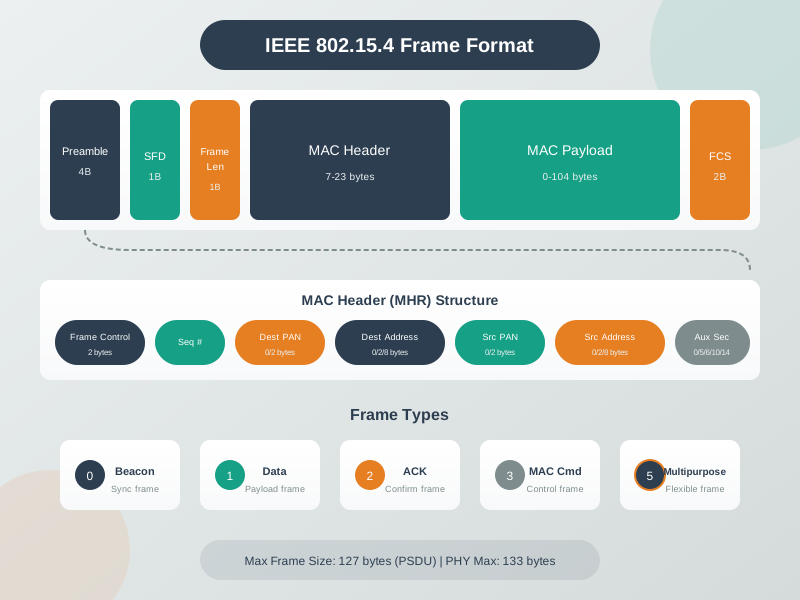
The flexible frame format supports various addressing modes and optional security, with overhead ranging from 6 to 25 bytes.
948.8 Summary
This chapter covered the frame structure and security mechanisms of IEEE 802.15.4:
- Frame Structure: Maximum 127 bytes with variable overhead (5-44 bytes) depending on addressing and security
- Addressing Modes: Short (2 bytes), Extended (8 bytes), or None; PAN ID compression saves 2 bytes for intra-PAN
- Security Levels: Eight levels (0-7) providing various combinations of encryption and authentication
- AES-128: All encryption uses AES-128 in CCM mode for authenticated encryption
- Overhead Trade-offs: Security Level 5 (ENC-MIC-32) offers good balance for most applications
- Frame Counter: 4-byte counter prevents replay attacks but limits to ~4 billion frames per key