%%{init: {'theme': 'base', 'themeVariables': {'primaryColor': '#2C3E50', 'primaryTextColor': '#fff', 'primaryBorderColor': '#16A085', 'lineColor': '#E67E22', 'secondaryColor': '#16A085', 'tertiaryColor': '#7F8C8D'}}}%%
timeline
    title 3GPP Release Timeline for IoT
    2016 : Release 13
         : NB-IoT, LTE-M introduced
    2018 : Release 15
         : 5G NR Phase 1
         : eMBB focus
    2020 : Release 16
         : 5G NR Phase 2
         : URLLC, V2X
    2022 : Release 17
         : 5G-Advanced begins
         : RedCap introduced
         : NTN (satellite)
    2024 : Release 18
         : Enhanced RedCap
         : AI/ML integration
         : XR support
    2025 : Release 19
         : Further 5G-A enhancements
    2030 : Release 21+
         : 6G begins
1162 5G Advanced and 6G for IoT
1163 5G Advanced: The Next Evolution in Cellular IoT
NoteLearning Objectives
By the end of this section, you will be able to:
- Understand 5G-Advanced (Release 17-18) features for IoT
- Compare RedCap, NB-IoT, LTE-M, and full 5G for different use cases
- Design network slicing architectures for diverse IoT requirements
- Evaluate private 5G networks for enterprise IoT deployments
- Understand URLLC capabilities for mission-critical applications
- Prepare for 6G and its implications for IoT (2030+)
1163.1 Prerequisites
Before diving into this chapter, you should be familiar with:
- Cellular IoT Fundamentals: Basic cellular IoT concepts
- NB-IoT Fundamentals: Narrowband IoT technology
- LPWAN Introduction: Low-power wide-area networking
NoteRelated Chapters
Cellular IoT: - Cellular IoT Fundamentals - Basic concepts - NB-IoT Fundamentals - Narrowband IoT - Cellular IoT Applications - Use cases
Comparisons: - LPWAN Introduction - LPWAN landscape - LoRaWAN Overview - Unlicensed alternative
NoteKey Takeaway
In one sentence: 5G-Advanced introduces RedCap devices that bridge the cost-capability gap between NB-IoT ($5) and full 5G ($100), while network slicing enables dedicated virtual networks for different IoT requirements on shared infrastructure.
Remember this: Match device category to requirements: NB-IoT for 10+ year battery sensors, LTE-M for mobile tracking, RedCap for wearables and cameras, and URLLC slice for sub-millisecond industrial control.
1163.2 Chapter Overview
This topic is covered in three focused chapters:
1163.2.1 5G Device Categories for IoT
Deep dive into selecting the right 5G device category:
- NB-IoT, LTE-M, RedCap, Full 5G NR comparison
- RedCap specifications and use cases (Release 17-18)
- Cost-performance trade-offs ($3-5 to $50-100 per module)
- Device category selection decision tree
1163.2.2 5G Network Slicing for IoT
Understanding virtual networks on shared infrastructure:
- Network slicing architecture (eMBB, URLLC, mMTC)
- Private 5G deployment models (standalone, hybrid, carrier slice)
- Spectrum options (CBRS, n78, mmWave)
- Cost analysis: private vs carrier slicing
1163.2.3 5G URLLC and 6G Vision
Mission-critical IoT and future technologies:
- URLLC requirements (<1ms latency, 99.9999% reliability)
- Power saving features (PSM, eDRX for 10+ year battery)
- 6G timeline and capabilities (2030+, 100x improvements)
- LTE-M handover optimization for mobile fleet tracking
1163.3 For Beginners: Understanding 5G Evolution
TipWhat is 5G-Advanced and Why Does It Matter for IoT?
The 5G Evolution: - 5G (Release 15-16): The initial 5G we have today - 5G-Advanced (Release 17-18): Enhanced 5G, arriving 2024-2025 - 6G (Release 21+): Next generation, expected 2030+
Why 5G-Advanced Matters for IoT:
- RedCap (Reduced Capability): New device class between full 5G and NB-IoT
- Cheaper than full 5G (simpler chips)
- More capable than NB-IoT (higher data rates)
- Perfect for: Wearables, industrial sensors, cameras
- Better Positioning: Centimeter-level location accuracy
- Critical for: Autonomous vehicles, drones, warehouses
- Improved Power Efficiency: Extended battery life
- Important for: All battery-powered IoT
- Network Slicing: Virtual private networks within 5G
- Use case: Dedicated capacity for critical IoT
Analogy: Think of it like airline tickets: - NB-IoT = Economy (cheap, basic, gets you there) - RedCap = Premium Economy (better comfort, reasonable price) - Full 5G = Business Class (all features, higher cost) - URLLC = Emergency lane (guaranteed priority, highest cost)
1163.4 5G Evolution Timeline
{fig-alt=“3GPP release timeline from 2016 to 2030 showing IoT evolution: Release 13 (2016) introduced NB-IoT/LTE-M, Release 15-16 (2018-2020) brought 5G NR with eMBB and URLLC, Release 17-18 (2022-2024) is 5G-Advanced with RedCap and NTN, Release 21+ (2030) begins 6G era.”}
1163.5 5G Device Categories Quick Reference
| Feature | NB-IoT | LTE-M | RedCap | Full 5G NR |
|---|---|---|---|---|
| Peak DL | 250 kbps | 1 Mbps | 150 Mbps | 10+ Gbps |
| Peak UL | 250 kbps | 1 Mbps | 50 Mbps | 1+ Gbps |
| Latency | 1-10 s | 10-15 ms | 5-10 ms | <1 ms (URLLC) |
| Bandwidth | 200 kHz | 1.4 MHz | 20 MHz | 100+ MHz |
| Modem Cost | $3-5 | $5-10 | $15-25 | $50-100 |
| Battery | 10+ years | 5-10 years | 1-5 years | Days-weeks |
| Use Case | Sensors, meters | Asset tracking | Wearables, cameras | Phones, FWA |
For detailed device category selection guidance, see 5G Device Categories for IoT.
1163.6 Network Slice Types for IoT
| Slice Type | SLA Guarantee | IoT Use Case |
|---|---|---|
| eMBB | Throughput (100+ Mbps) | Video surveillance, AR/VR |
| URLLC | Latency (<1 ms), Reliability (99.999%) | Factory automation, autonomous vehicles |
| mMTC | Density (1M devices/km²) | Smart meters, agriculture sensors |
| Custom | Application-specific | Private IoT networks |
For network slicing architecture and private 5G deployment, see 5G Network Slicing for IoT.
1163.7 6G Performance Targets
| Parameter | 5G | 6G Target | Improvement |
|---|---|---|---|
| Peak Rate | 20 Gbps | 1 Tbps | 50x |
| User Rate | 100 Mbps | 1 Gbps | 10x |
| Latency | 1 ms | 100 μs | 10x |
| Reliability | 99.999% | 99.99999% | 100x |
| Density | 1M/km² | 10M/km² | 10x |
| Energy Efficiency | Baseline | 100x better | 100x |
For URLLC details and 6G vision, see 5G URLLC and 6G Vision.
1163.8 Visual Reference Gallery
NoteVisual: Cellular IoT Technology Comparison
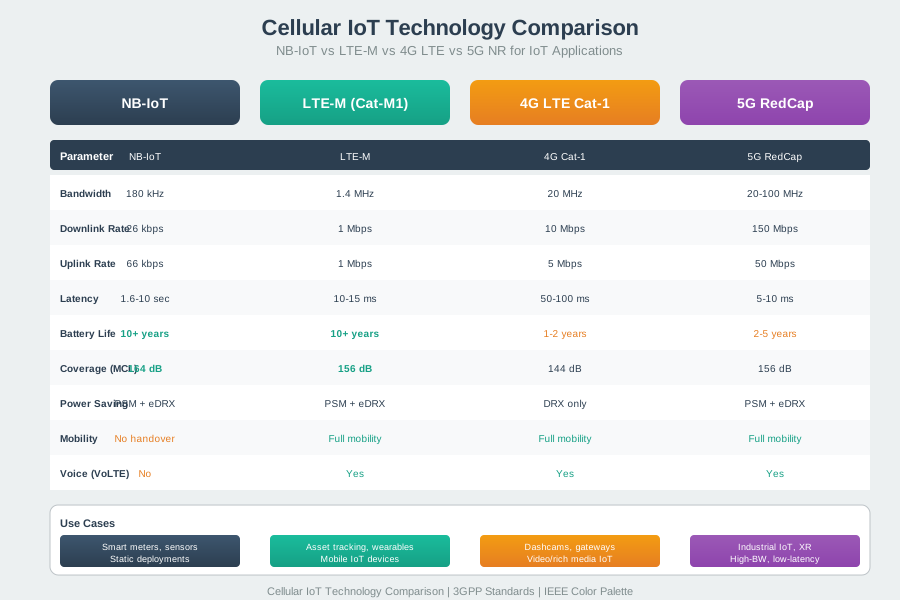
This visualization provides a comprehensive comparison of cellular IoT technologies from NB-IoT through full 5G NR, highlighting the trade-offs between power consumption, data rate, and latency that inform device category selection.
NoteVisual: Cellular IoT Evolution Timeline
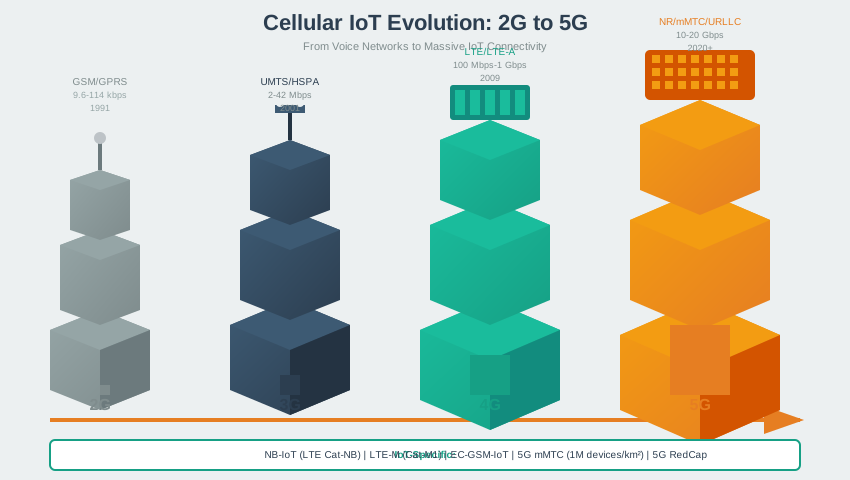
This evolution diagram traces the development of cellular IoT from early 2G M2M applications through today’s 5G-Advanced era, showing how each generation introduced new capabilities for IoT devices.
NoteVisual: Cellular Modem Architecture
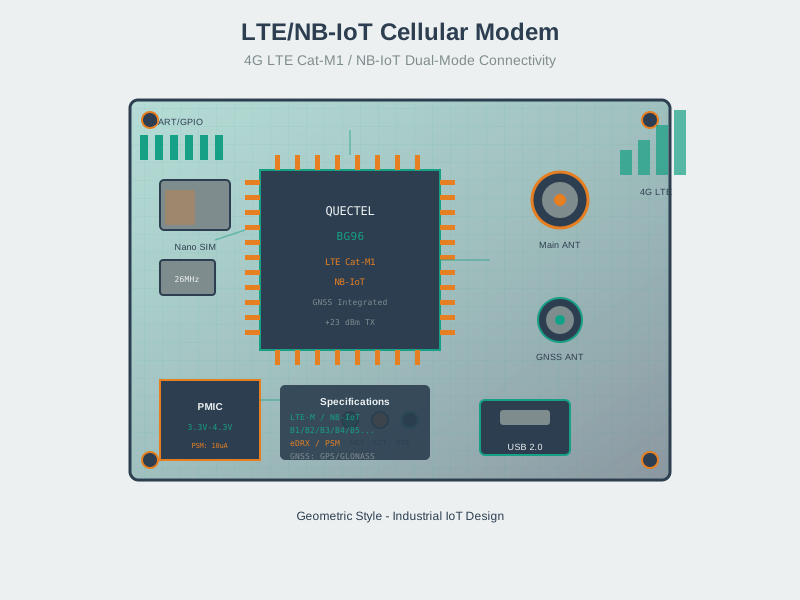
Understanding the internal architecture of cellular modems helps explain the cost and power differences between NB-IoT, RedCap, and full 5G NR device categories discussed in this chapter.
1163.9 Summary
TipKey Takeaways
5G-Advanced (Release 17-18) introduces RedCap for mid-tier IoT devices
RedCap fills the gap between NB-IoT ($5) and full 5G ($100) with ~$20 modems
Network slicing enables custom virtual networks for different IoT requirements
Private 5G offers dedicated capacity, low latency, and data sovereignty
URLLC achieves 1ms latency and 99.999% reliability for critical IoT
Power saving (PSM, eDRX) enables multi-year battery life for NB-IoT/LTE-M
6G (2030+) will bring sensing, AI-native networks, and 100x improvements
1163.10 What’s Next
Explore 5G for IoT in depth:
- 5G Device Categories - NB-IoT to 5G NR selection
- 5G Network Slicing - Virtual networks and private 5G
- 5G URLLC and 6G Vision - Mission-critical IoT and future
- Private 5G Networks - Enterprise deployment guide