388 WSN Review: Comprehensive Assessment
388.1 Learning Objectives
By the end of this chapter, you will be able to:
- Compare Design Philosophies: Understand when WSN vs. IoT approaches are appropriate
- Select Radio Technologies: Choose between 802.15.4, Wi-Fi, and other protocols
- Apply Protocol Knowledge: Understand asynchronous duty cycling with X-MAC
- Use Decision Frameworks: Apply comprehensive guidance for WSN deployment
388.2 Prerequisites
Required Chapters: - WSN Review: Architecture and Design - Architecture concepts - WSN Review: Knowledge Checks - Core understanding validation - WSN Review: Scenario Analysis - Detailed scenario walkthroughs
Estimated Time: 25 minutes
WSN Review Series: - WSN Overview Review (Index) - Series overview - WSN Review: Architecture and Design - Architecture concepts - WSN Review: Knowledge Checks - Quick assessment questions - WSN Review: Scenario Analysis - Detailed scenario walkthroughs
Advanced Topics: - WSN Coverage Fundamentals - Area and target coverage - WSN Tracking Fundamentals - Mobile target tracking
388.3 Comprehensive Review Scenarios
Scenario: Conservation biologists need to track 50 elephants migrating across 500 km² of African wilderness for 2 years. Recapturing animals for battery replacement is impossible—collar must last entire study period.
Design A (Naive - Continuous GPS Tracking): - GPS active continuously: 50 mA average - Cellular transmission every 5 minutes: 200 mA for 5 seconds - Daily energy: (50 mA x 24h) + (200 mA x 5s x 288 times) = 1,200 mAh + 400 mAh = 1,600 mAh/day - Collar battery: 10,000 mAh (max size animal can carry) - Battery life: 10,000 / 1,600 = 6.25 days - Result: Total failure—animals migrate, collar dies after 1 week
Design B (Scheduled Sampling - Aggressive Duty Cycling): - GPS active 5 min every 2 hours during day (12 activations): 50 mA x 5 min x 12 = 200 mAh - GPS off at night (12 hours sleep) - Cellular upload once daily at 6 PM: 200 mA x 30s = 1.7 mAh - Daily energy: 200 mAh + 1.7 mAh = 201.7 mAh/day - Battery life: 10,000 / 201.7 = 49.6 days - Result: Better, but still insufficient for 2-year study (730 days needed)
Design C (Event-Driven + Adaptive + Solar Harvesting): - Accelerometer monitors movement continuously: 10 µA - Stationary (animal resting, 14h/day): Deep sleep, no GPS (1 µA) - Walking (normal movement, 8h/day): GPS every 1 hour (50 mA x 5 min x 8) = 133 mAh - Running/Migration (detected by accelerometer, 2h/day): GPS every 10 min (50 mA x 5 min x 12) = 200 mAh - Cellular upload when near cell tower (detected, ~once/week): 200 mA x 60s = 3.3 mAh/day amortized - Solar panel on collar top (elephant in savanna sun): generates ~100 mAh/day - Daily energy budget: Consumption: 133 + 200 + 3.3 = 336 mAh/day. Generation: 100 mAh/day. Net: 236 mAh/day from battery - Battery life: 10,000 / 236 = 42.4 days… still insufficient!
Design D (Optimized - Bi-hourly + Nighttime Solar): - GPS active only 2x per day (6 AM, 6 PM): 50 mA x 10 min x 2 = 67 mAh - Accelerometer continuous activity logging (upload daily): 10 µA x 24h = 0.24 mAh - Solar charging: 8 hours sunlight x 15 mA = 120 mAh/day - Daily energy budget: Consumption: 67 + 0.24 = 67.24 mAh/day. Generation: 120 mAh/day. Net: +52.76 mAh/day surplus! - Battery life: INFINITE (solar surplus charges battery, operates indefinitely) - Data quality: 2 GPS fixes/day + continuous activity patterns = sufficient for migration research
Think about: 1. Sampling trade-off: Design C (10-min intervals during migration) vs. Design D (2x/day) - which provides scientifically useful data? 2. Solar economics: $30 solar panel enables 2+ year operation vs. $0 battery-only lasting 6 days 3. Event-driven intelligence: Accelerometer (10 µA) detecting movement enables adaptive GPS sampling without continuous GPS power drain
Key Insight: When battery replacement is impossible, energy harvesting converts “impossible” into “indefinite operation.” The elephant collar’s solar panel generates more energy than intelligent duty cycling consumes, creating a self-sustaining system. This is the only architecture that meets the 2-year requirement.
Real-world wisdom: “We spent 3 months optimizing GPS duty cycling, got battery life to 60 days. Added a $25 solar panel—suddenly had unlimited operation. Sometimes hardware is cheaper than software optimization.”
Scenario: A warehouse monitoring system uses 100 temperature/humidity sensors organized into 5 clusters of 20 nodes each. Network designer must decide on cluster head strategy.
Architecture A (Static Cluster Heads - No Rotation): - 5 dedicated nodes assigned as permanent cluster heads - Regular node energy budget (95 nodes): - Sense temperature: 1s x 5 mA = 5 mAs - Transmit to cluster head: 0.1s x 20 mA = 2 mAs - Sleep: 59s x 0.001 mA = 0.059 mAs - Total per minute: 7.059 mAs = 171 mAh/day - Battery life: 2000 mAh / 171 mAh = 11.7 days
- Cluster head energy budget (5 nodes):
- Receive from 20 members: 20 x (0.1s x 20 mA) = 40 mAs
- Aggregate data: 0.5s x 10 mA = 5 mAs
- Transmit to sink: 0.2s x 20 mA = 4 mAs
- Sleep: 39.3s x 0.001 mA = 0.039 mAs
- Total per minute: 49.039 mAs = 1,177 mAh/day
- Battery life: 2000 mAh / 1,177 mAh = 1.7 days
- Network failure: 1.7 days when cluster heads die (all 95 regular nodes become isolated)
- Operational cost: Replace 5 cluster head batteries every 2 days ($50/visit = $9,125/year)
Architecture B (LEACH - Rotating Cluster Heads): - Every 10-day round, randomly select 5 new nodes as cluster heads (all 100 nodes eligible) - Each node becomes cluster head ~10% of the time over year - Average energy per node: - 90% of time as regular node: 171 mAh/day x 0.9 = 154 mAh/day - 10% of time as cluster head: 1,177 mAh/day x 0.1 = 118 mAh/day - Total: 154 + 118 = 272 mAh/day - Battery life: 2000 mAh / 272 mAh = 7.35 days
- Network lifetime: 7.35 days (all nodes die simultaneously, maintaining coverage until the end)
- Operational cost: Replace all 100 batteries weekly ($50/visit = $2,600/year)
- Advantage: Network stays functional longer (7.4 vs 1.7 days) with graceful degradation
Architecture C (Hybrid - Mains-Powered Cluster Heads): - 5 cluster heads with PoE (Power over Ethernet) or AC mains - 95 battery-powered regular nodes (11.7-day lifetime) - Network lifetime: 11.7 days (limited only by regular node batteries) - Cluster head cost: 5 x $150 (PoE adapter) = $750 one-time - Operational cost: Replace regular node batteries biweekly ($50/visit = $1,300/year) - Advantage: 7x longer lifetime, 50% lower operational cost vs. rotation
Think about: 1. Energy asymmetry: Cluster heads consume 7x more energy than regular nodes (1,177 vs 171 mAh/day) 2. Rotation benefits: LEACH extends network life from 1.7 to 7.4 days by distributing the cluster head burden 3. Mains power economics: $750 infrastructure investment saves $7,825/year in battery replacement vs. static approach 4. When to use each: LEACH for true remote deployments, mains-powered for accessible buildings/infrastructure
Key Insight: Cluster head rotation doesn’t eliminate energy asymmetry—it distributes the pain democratically. All nodes die faster than they would as pure members, but the network survives longer than with static cluster heads. However, if mains power is available, skip rotation entirely—it’s energy optimization theater.
Real-world wisdom: “We implemented LEACH rotation, proud of our distributed fairness. Then facilities pointed out every cluster head location has a power outlet. Plugged in 5 adapters, quadrupled battery life overnight. Sometimes the low-tech solution beats the clever algorithm.”
Scenario: A 50-node environmental monitoring WSN uses gradient-based routing where each node maintains a “hop count to sink” metric. Nodes forward packets to neighbors with lower hop counts. After 6 months stable operation, packets begin circulating indefinitely.
Initial State (Healthy Network): - Sink (hop=0) → Neighbors A, B, C (hop=1) → Next layer D, E, F (hop=2) → Outer nodes (hop=3-5) - Node D (hop=2) receives packet, forwards to Node B (hop=1), reaches sink successfully - Network energy consumption: Normal
Failure Event: - Node B’s battery depletes and dies (silent failure, no notification) - Stale routing state: Node D still believes B has hop=1 (cached from last hello message 10 minutes ago) - Node A detects B’s failure, updates its routing: now forwards to Node C (hop=1)
Loop Formation: 1. Outer node sends packet to Node D (hop=2) 2. Node D forwards to Node B (hop=1) — packet lost, B is dead 3. Node D tries alternate path: forwards to Node E (hop=2) 4. Node E forwards back to Node D (hop=2) because its “best” neighbor F (hop=1) is also unreachable 5. Loop: D → E → D → E indefinitely 6. Energy waste: Packet retransmitted 1,440 times/day until TTL expires 7. Network energy consumption: +300% due to loop traffic 8. Symptom: D and E batteries drain in 3 days instead of 30 days
Prevention Strategy A (Periodic Gradient Refresh): - Sink broadcasts “gradient update” beacon every 5 minutes - All nodes recompute hop count from fresh neighbor advertisements - Loop resolution time: 5 minutes (next gradient refresh detects B’s absence, updates paths) - Energy cost: 100 bytes x 50 nodes every 5 min = 1.44 MB/day overhead - Trade-off: 5-minute loop exposure vs. continuous routing overhead
Prevention Strategy B (TTL + Sequence Numbers): - Every packet includes TTL (starts at 20, decrements each hop) - Packet dropped when TTL=0 (prevents indefinite circulation) - Sequence numbers identify duplicates: “Already forwarded packet #12345 from Node X” - Loop damage containment: 20 hops maximum before packet dies - Energy cost: 2 bytes overhead per packet (minimal) - Advantage: Kills loops without refresh overhead
Prevention Strategy C (Link Quality + Multi-Metric Routing): - Don’t use hop count alone—combine with ETX (Expected Transmission Count), RSSI, battery level - Node D measures: “B hasn’t responded to 10 packets, ETX=∞, mark as unreachable” - Dynamically switch to Node A (hop=2 but ETX=1.2, battery=90%) - Loop prevention: proactive (detect failure before loop forms) - Energy cost: Maintain link quality stats (~50 bytes RAM per neighbor)
Think about: 1. Stale state problem: Distributed systems fail when local information becomes inconsistent with reality 2. Loop energy cost: One looping packet can waste more energy than 1,000 normal packets 3. TTL universality: Why does the Internet use TTL in every IP packet? (Exactly this problem, at global scale)
Key Insight: Gradient routing assumes a stable world—when reality changes faster than routing updates propagate, loops emerge. The solution isn’t faster updates (too expensive), it’s defensive mechanisms (TTL, sequence numbers, multi-metric evaluation) that contain damage when staleness occurs.
Real-world wisdom: “Our WSN routing worked flawlessly in the lab. Deployed to forest, node failures created routing loops that drained the entire network in 2 weeks. Added TTL=15 to every packet—loops still form, but they die after 15 hops instead of consuming infinite energy.”
Scenario: An industrial facility monitors 200 motors for bearing failure vibration signatures. Bearing failures occur approximately every 2-3 days across the facility (rare events, catastrophic when missed).
Approach A (Periodic Sensing - 60-second intervals): - Sample accelerometer every 60 seconds - Check vibration signature (10 ms processing): 10 mA - Transmit “status OK” to cloud: 20 mA x 100 ms - Sleep: 1 µA x 59.89 seconds - Energy per minute: (10 mA x 0.01s) + (20 mA x 0.1s) + (0.001 mA x 59.89s) = 0.1 + 2 + 0.06 = 2.16 mAs = 3,110 mAh/day - Battery life: 2000 mAh / 3,110 mAh = 0.64 days (15 hours) - Annual operational cost: 200 nodes x 365 replacements x $50/visit = $3.65M - Data generated: 200 nodes x 1,440 samples/day = 288K “OK” messages/day (99.9% useless)
Approach B (Event-Driven with Interrupt-Based Detection): - Analog comparator monitors vibration continuously: 15 µA (hardware, no CPU wake) - Vibration exceeds threshold → hardware interrupt wakes CPU - CPU samples accelerometer (10 ms): 10 mA - Transmit alert to cloud: 20 mA x 100 ms - Return to sleep: 1 µA - Baseline energy (no events): 0.015 mA continuous = 21.6 mAh/day - Event energy (1 failure per 2.5 days): (10 mA x 0.01s + 20 mA x 0.1s) / 2.5 days = 0.88 mAh/day - Total: 21.6 + 0.88 = 22.48 mAh/day - Battery life: 2000 mAh / 22.48 mAh = 89 days (3 months) - Annual operational cost: 200 nodes x 4 replacements x $30/visit = $40K - Data reduction: 140x less data (only transmit on failures, not continuous “OK” spam)
Approach C (Event-Driven + Edge ML): - Accelerometer continuously samples at 1 kHz to local buffer (DMA, no CPU): 500 µA - TinyML model runs inference every 1 second checking for failure pattern: 2 mA x 10 ms = 0.02 mA avg - Normal operation: Sleep (no transmission) - Failure detected: Transmit 5-second vibration waveform clip + alert: 20 mA x 2s every 2.5 days - Energy budget: 0.5 mA (sampling) + 0.02 mA (inference) + 0.16 mA (amortized transmission) = 0.68 mA = 980 mAh/day - Battery life: 2000 mAh / 980 mAh = 2 days - BUT: Solar harvesting (100 mAh/day in industrial lighting) extends to 20+ days - Advantage: Captures actual failure waveform for root cause analysis, not just binary “failed” alert
Think about: 1. Energy ratio: Periodic (3,110 mAh/day) vs. Event-driven (22.48 mAh/day) = 138x improvement 2. Operational cost savings: $3.65M → $40K annually = $3.61M saved (99% reduction) 3. Data value: 288K “OK” messages vs. 146 “FAILURE + waveform” alerts—which is more useful? 4. False negative risk: Periodic approach might miss 59-second event. Event-driven with hardware comparator never sleeps through an event
Key Insight: For rare events, periodic sensing is economic suicide—you’re burning energy and generating noise 99.9% of the time to catch the 0.1% that matters. Event-driven sensing with hardware interrupts inverts the equation: sleep is free, wake only when value appears.
Real-world wisdom: “We deployed 500 periodic vibration sensors, burned through $2M in battery replacements first year. Switched to interrupt-driven sensing with analog comparators—operational cost dropped to $120K, and we captured higher-fidelity failure data. CFO asked why we didn’t do this from day one.”
388.4 Advanced Protocol Scenarios
Scenario: A city deploys both a parking sensor network (10,000 sensors) and a smart streetlight system (500 lights). Project manager must choose technology stack for each.
System A: Parking Sensors (WSN Design Philosophy): - Constraint: Battery-powered, 5-year replacement cycle (inaccessible underground) - Architecture: - 802.15.4 radio: 15 mA TX, 1 µA sleep - Duty cycle: Wake 1x per minute (detect car presence) - Data: 10 bytes/transmission (“occupied” or “vacant”) - In-network aggregation: Cluster heads report “45/50 spots occupied” vs. individual status - Energy budget: ~30 mAh/day → 2000 mAh battery lasts 5+ years - Design priorities: Energy first, features second - Sacrifices: No real-time updates (1-minute latency acceptable), limited data (binary status), simplified protocols
System B: Smart Streetlights (IoT Design Philosophy): - Constraint: Mains-powered (AC line voltage available), focus on features/responsiveness - Architecture: - Wi-Fi radio: 300 mA TX, 100 mA RX, always-on - Real-time dimming control (respond within 100 ms to motion sensors) - Rich data: Light level (12-bit), energy consumption, bulb health, environmental sensors - Direct cloud connectivity: AWS IoT Core, OTA firmware updates - Energy budget: Unlimited (mains power) - Design priorities: Features first, user experience second, energy irrelevant - Capabilities: HD camera integration, audio announcements, emergency alerts, air quality monitoring
Hybrid System C: Blending Both Philosophies: - 10,000 parking sensors use WSN techniques (802.15.4, duty cycling, 5-year battery) - 50 mesh gateways use IoT infrastructure (Wi-Fi, LTE, cloud connectivity, mains power) - Architecture: WSN edge tier → IoT gateway tier → Cloud application tier - Result: Battery longevity at edge + rich cloud features = best of both worlds
Think about: 1. False dichotomy: Why is “WSN vs. IoT” the wrong question? (They address different layers/constraints) 2. Energy constraint drives design: If parking sensors had mains power, would you still use 802.15.4? (Probably not—Wi-Fi’s features become attractive) 3. Convergence trend: Modern systems use WSN principles at constrained edge, IoT frameworks for infrastructure/cloud
Key Insight: WSN and IoT aren’t competing technologies—they’re complementary design philosophies for different constraints. WSN = energy-first (battery-powered edge), IoT = feature-first (powered infrastructure). Smart deployments use both where appropriate.
Real-world wisdom: “We debated WSN vs. IoT for months. Then realized we needed both: WSN techniques for 10K battery sensors, IoT infrastructure for gateways and cloud. Arguing ‘which is better’ is like debating cars vs. airplanes—depends where you’re going.”
Scenario: Building automation company designs sensor network for 200-unit apartment complex. Must choose between 802.15.4 (Zigbee) and Wi-Fi for 500 temperature/occupancy sensors.
Option A: Wi-Fi Architecture: - Radio power: TX 300 mW, RX 150 mW, Sleep 50 mW (Wi-Fi never truly sleeps—maintains association) - Battery capacity: 2000 mAh (same physical size constraint for all options) - Baseline energy (periodic beacon response to maintain Wi-Fi association): - Respond to AP beacon every 100 ms: 150 mW x 5 ms = 0.75 mWs per beacon - Daily beacon overhead: 0.75 mWs x 864,000 beacons/day = 648,000 mWs = 180 mAh/day - Sensing + transmission (every 5 min): - TX 50 bytes: 300 mW x 10 ms x 288 times/day = 864 mWs/day = 0.24 mAh/day - Total: 180 + 0.24 = 180.24 mAh/day - Battery life: 2000 / 180.24 = 11.1 days - Annual battery replacement: 500 sensors x 33 replacements x $30/visit = $495,000/year
Option B: 802.15.4 (Zigbee) Architecture: - Radio power: TX 30 mW, RX 25 mW, Sleep 3 µW (true deep sleep) - Sleep 99% of time, wake only to sense + transmit - Sensing + transmission (every 5 min): - Wake from sleep: 5 mW x 10 ms (startup) = 0.05 mWs - TX 50 bytes: 30 mW x 20 ms = 0.6 mWs (slower data rate than Wi-Fi, but lower power) - Per event: 0.65 mWs x 288 times/day = 187.2 mWs/day = 0.052 mAh/day - Sleep energy: 0.003 mW x 86,390 seconds/day = 259.2 mWs = 0.072 mAh/day - Total: 0.052 + 0.072 = 0.124 mAh/day - Battery life: 2000 / 0.124 = 16,129 days = 44 years (!!!) - Practical battery life (accounting for self-discharge): ~5-7 years - Annual battery replacement: 500 sensors x 0.15 replacements (gradual) x $30/visit = $2,250/year
Option C: Wi-Fi with Aggressive Power Saving (PSM): - Use Wi-Fi Power Save Mode (PSM): Sleep between beacons, wake only when AP has data buffered - Sleep 90% of time: 5 mW (light sleep, not deep sleep) - Wake 10% for beacons/polling: 150 mW - Energy: (0.9 x 5 mW) + (0.1 x 150 mW) = 4.5 + 15 = 19.5 mW average = 468 mAh/day - Battery life: 2000 / 468 = 4.3 days - Even with PSM, Wi-Fi’s baseline overhead (maintaining association, frequent beacon response) destroys battery life
Think about: 1. 1,450x energy difference: 802.15.4 (0.124 mAh/day) vs. Wi-Fi (180.24 mAh/day) 2. Operational cost: $495K vs. $2.25K annually for same sensor count 3. Protocol overhead: Wi-Fi’s association maintenance, beacons, and complex protocol stack consume energy even when “sleeping” 4. When Wi-Fi makes sense: Mains power available (smart plugs, appliances), high bandwidth needed (cameras), or single-hop to strong infrastructure required
Key Insight: For battery-powered, low-data-rate sensors, Wi-Fi is fundamentally the wrong technology—not because of transmission power alone, but because of protocol overhead. Even when “sleeping,” Wi-Fi maintains network association at 10-100x the power of 802.15.4’s true deep sleep.
Real-world wisdom: “Marketing wanted ‘Wi-Fi sensors’ for the buzzword. Engineering showed them the 11-day battery life vs. 5-year 802.15.4 life. CFO saw the $500K annual savings. We deployed Zigbee. Nobody misses the ‘Wi-Fi’ checkbox.”
Scenario: Factory deploys 100 vibration sensors for predictive maintenance. Sensors must communicate without time synchronization (nodes added/removed dynamically). Engineer evaluates X-MAC protocol.
X-MAC Protocol Mechanics: - Sender side: Node A wants to send 50-byte packet to Node B - Node A doesn’t know when B is awake (no synchronization) - Solution: Transmit preamble (short packet with destination address) continuously until B responds
Configuration: 100 ms Wake Interval: - Receiver (Node B) wakes every 100 ms, samples channel for 5 ms, returns to sleep - Question: How long must sender transmit preamble to guarantee B detects it? - Answer: Slightly longer than 100 ms (e.g., 110 ms) to account for clock drift/jitter
Timing Scenario (110 ms preamble):
Case 1: Best Case (B wakes immediately) - T=0 ms: Sender A starts preamble transmission - T=2 ms: Receiver B wakes (happens to be at start of wake cycle), detects preamble - T=3 ms: B sends early ACK (“I’m awake, send data now!”) - T=4 ms: A receives ACK, STOPS preamble (saves 106 ms of transmission) - T=5 ms: A sends 50-byte data packet (20 ms) - T=25 ms: Transmission complete - Energy cost (Sender A): 30 mW x 25 ms = 0.75 mWs
Case 2: Worst Case (B wakes at end of preamble) - T=0 ms: Sender A starts preamble, Receiver B just went to sleep (missed by 1 ms) - T=100 ms: B wakes, detects preamble (A still transmitting) - T=101 ms: B sends ACK - T=102 ms: A receives ACK, stops preamble - T=103 ms: A sends data packet (20 ms) - T=123 ms: Transmission complete - Energy cost (Sender A): 30 mW x 123 ms = 3.69 mWs
Case 3: Preamble Too Short (95 ms) - FAILURE - T=0 ms: A starts 95 ms preamble - T=2 ms: B just went to sleep - T=95 ms: A finishes preamble transmission - T=98 ms: B wakes (too late—preamble ended at 95 ms) - B sees empty channel, returns to sleep - Result: Communication failed, packet lost
Compare to B-MAC (Fixed Preamble): - B-MAC has no early ACK mechanism—sender transmits full 110 ms preamble every time - Average case energy: 30 mW x 110 ms = 3.3 mWs (vs. X-MAC’s avg 2.0 mWs) - X-MAC saves ~40% energy through early ACK optimization
Compare to S-MAC (Synchronized): - S-MAC synchronizes all nodes to wake simultaneously every 100 ms - No preamble needed—transmit immediately when nodes awake - Energy per transmission: 30 mW x 20 ms = 0.6 mWs (3x better than X-MAC) - Trade-off: Synchronization overhead (periodic SYNC packets), brittle to node mobility/churn
Think about: 1. Why 110 ms > 100 ms? Clock drift means “100 ms” varies ±5% node-to-node. 110 ms buffer ensures detection despite drift 2. Energy-latency trade-off: X-MAC average latency = 50 ms (half wake interval). S-MAC = 0 ms (coordinated wake). B-MAC = 100 ms (full preamble) 3. Early ACK optimization: Why X-MAC beats B-MAC in practice (average 50 ms vs. always 110 ms)
Key Insight: Asynchronous protocols (X-MAC, B-MAC) trade energy/latency for robustness—no synchronization maintenance means nodes can sleep/wake independently, join/leave dynamically. Preamble length must exceed wake interval to guarantee detection, but early ACK minimizes waste.
Real-world wisdom: “We chose X-MAC for factory sensors because forklifts constantly knock nodes offline/back online. S-MAC’s synchronization broke every 10 minutes. X-MAC just works—yes, it costs 2x more energy per packet, but nodes actually communicate reliably.”
388.5 Visual Reference Gallery
Explore these AI-generated visualizations that complement the WSN overview review concepts covered in this chapter. Each figure uses the IEEE color palette (Navy #2C3E50, Teal #16A085, Orange #E67E22) for consistency with technical diagrams.
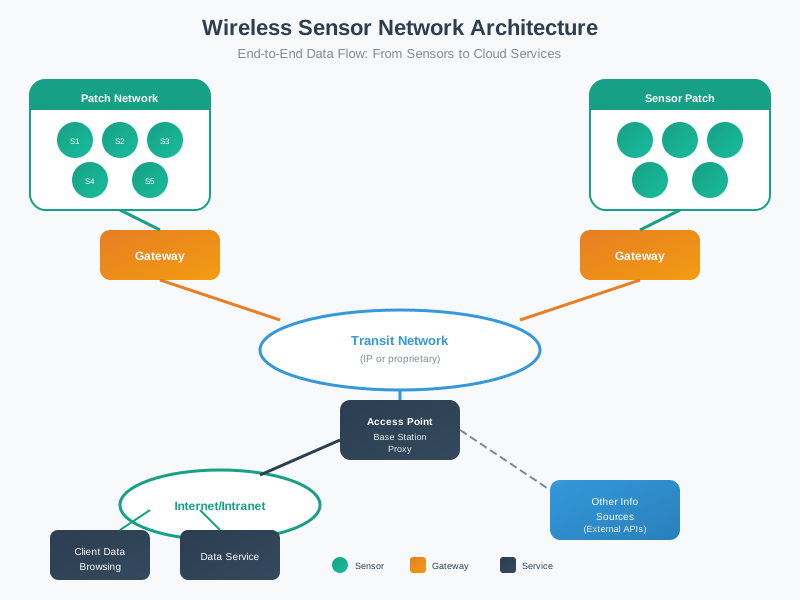
This visualization provides an overview of the WSN architecture reviewed in this chapter, showing how all components work together in a complete deployment.
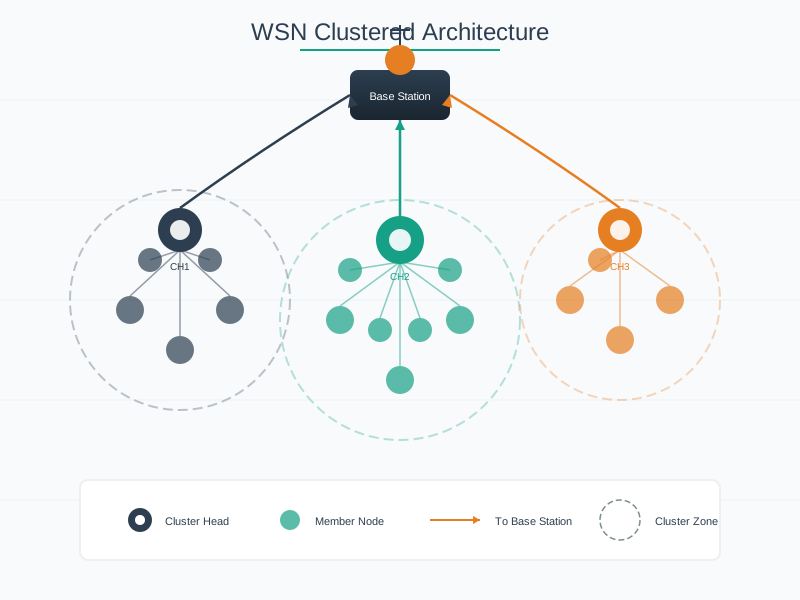
This figure illustrates the LEACH clustering concepts covered in the production framework, showing how cluster-based organization enables energy-efficient data collection.
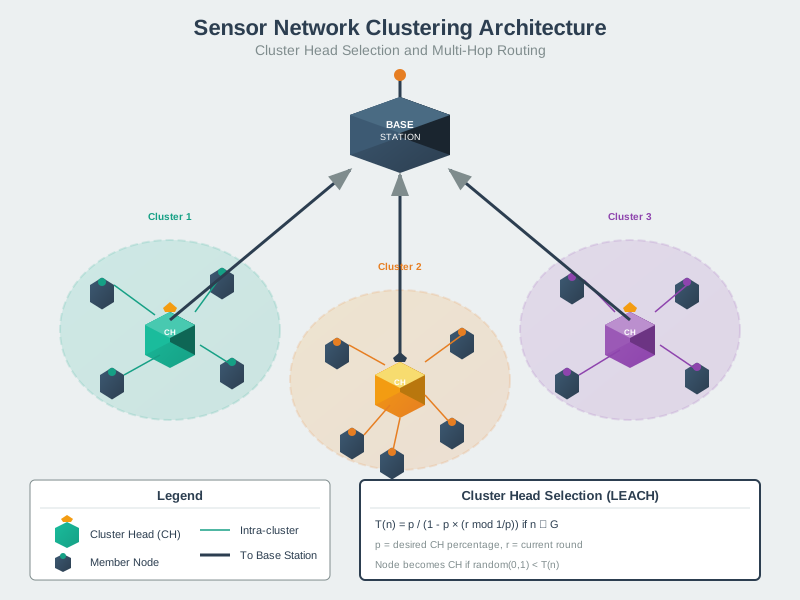
This visualization depicts the cluster management techniques reviewed in this chapter, summarizing how nodes organize and maintain hierarchical structures.
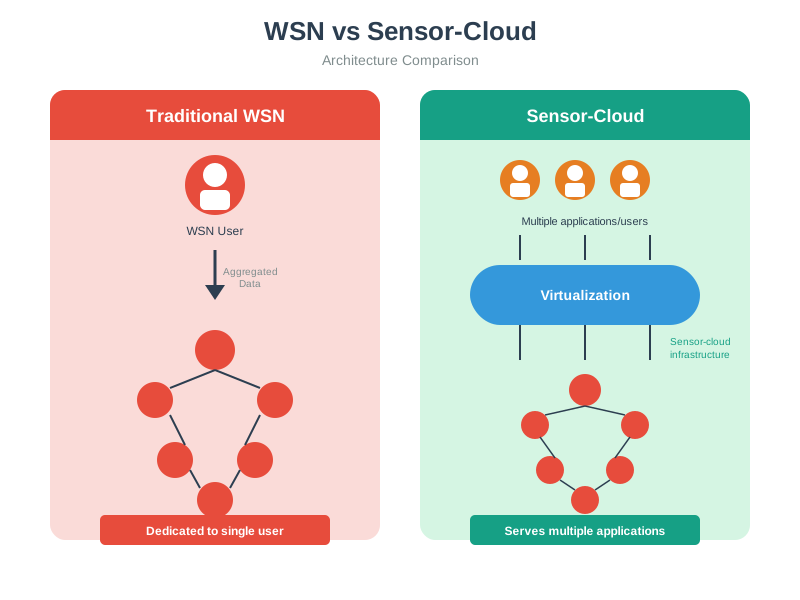
This figure illustrates the key differences between WSNs and traditional networks discussed in the review, highlighting unique design considerations.
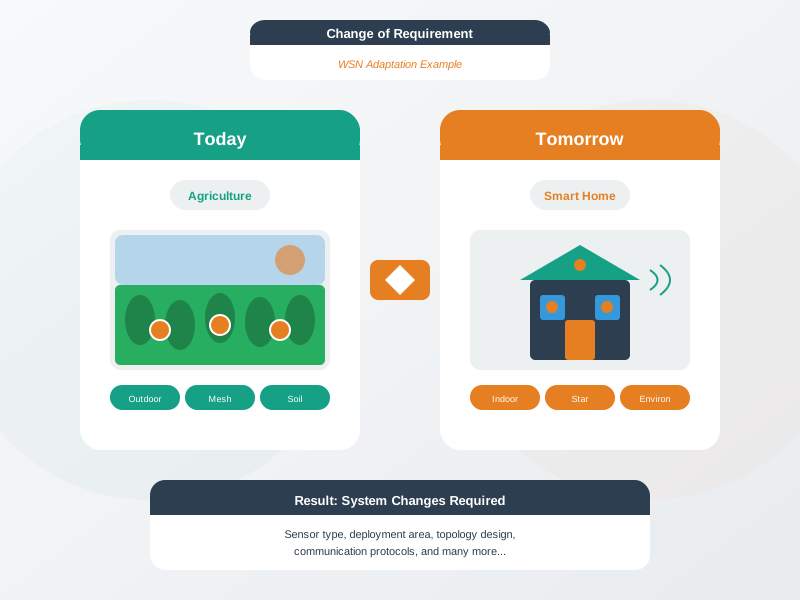
This visualization summarizes the limitations and constraints of WSNs discussed in the production framework, guiding design decisions for real-world deployments.
388.6 Conclusion
Wireless Sensor Networks form a critical foundation for IoT systems, providing distributed sensing capabilities with autonomous operation and wireless communication. Understanding the characteristics of sensor nodes—including their hardware components, resource constraints, and operational capabilities—is essential for designing effective WSN-based solutions.
The relationship between WSNs and IoT is symbiotic: WSNs provide proven architectures and protocols for resource-constrained sensing, while IoT frameworks offer cloud integration, scalability, and rich application ecosystems. Modern deployments increasingly blend these approaches, using WSN principles for efficient edge sensing while leveraging IoT infrastructure for data management and user interfaces.
Energy management remains the paramount challenge in WSN design, with radio duty cycling serving as one of the most effective conservation techniques. By carefully balancing energy consumption, latency, reliability, and throughput through intelligent duty cycling strategies, WSNs can achieve operational lifetimes spanning months to years on battery power.
As WSN technology continues to evolve with advances in ultra-low-power electronics, energy harvesting, and wireless protocols, these networks will remain indispensable components of the IoT landscape, enabling pervasive sensing across environmental monitoring, industrial control, smart cities, healthcare, and countless other applications.
This chapter introduced Wireless Sensor Networks (WSNs), a foundational IoT architecture for distributed environmental monitoring and tracking applications.
WSN Fundamentals: WSNs consist of numerous small, autonomous sensor nodes deployed in monitored environments to cooperatively gather data. Unlike traditional networks prioritizing performance and QoS, WSNs optimize for energy efficiency and longevity. Nodes typically operate on batteries for months or years without replacement, requiring careful power management at every protocol layer. The distributed, self-organizing nature enables monitoring in challenging environments where infrastructure deployment is impractical.
Network Design Considerations: We examined critical design factors including topology selection (star, mesh, cluster, hybrid), routing protocols, MAC layer coordination, and data aggregation strategies. Topology choice impacts energy consumption, latency, robustness, and scalability. In-network aggregation reduces transmitted data volume by combining sensor readings at intermediate nodes, significantly extending network lifetime while extracting meaningful patterns from raw data.
Applications and Challenges: WSNs enable applications spanning environmental monitoring, industrial sensing, precision agriculture, structural health monitoring, and wildlife tracking. However, resource constraints create challenges: limited processing power restricts on-node computation, battery capacity limits network lifetime, memory constraints affect data buffering, and wireless bandwidth limits data rates. Designers must carefully balance these competing requirements.
Understanding WSN principles provides the foundation for subsequent chapters examining specific WSN capabilities like tracking, coverage, mobility, and routing protocols.
388.7 Key Takeaways: Practical Decision Guidance
When designing WSN systems, use these decision frameworks to avoid common pitfalls:
1. Radio Technology Selection Matrix:
| Application | Battery Life Needed | Data Rate | Best Choice | Rationale |
|---|---|---|---|---|
| Building sensors | 5+ years | <1 kbps | 802.15.4 (Zigbee) | Deep sleep 1 µA, 44-year theoretical life |
| Security cameras | Mains powered | >1 Mbps | Wi-Fi | Power unlimited, high bandwidth needed |
| Wearables | 1+ week | 10-100 kbps | BLE | Optimized for burst data, mobile connectivity |
| Industrial | 2+ years | 100 bps | LoRaWAN | 10+ km range, extreme battery life |
| Agriculture | 3+ years | 500 bps | 802.15.4 + gateways | Balance of range, battery, and cost |
Critical insight: Wi-Fi’s protocol overhead (beacon response, association maintenance) consumes 150+ mW even when “idle”—1,450x more than 802.15.4’s 1 µA deep sleep. For battery sensors, Wi-Fi is architecturally wrong, not just inefficient.
2. Topology Selection Decision Tree:
Q1: Can you deploy mains-powered gateways? - YES → Use star topology (20-50 sensors per gateway) - Battery life: 5+ years (no relay burden) - Cost: $200 gateway + ($25 x 50 sensors) = $1,450 per zone - Reliability: Gateway failure isolates 50 nodes (add redundancy) - Best for: Buildings, infrastructure, accessible locations
- NO → Continue to Q2
Q2: Is sensor spacing >100m (beyond single-hop range)? - YES → Use hierarchical clustering (LEACH-style) - Rotate cluster heads every 30-90 days (distribute energy burden) - Expect 3-6 month battery life for cluster heads, 1-2 years for members - Best for: Forest monitoring, wildlife tracking, remote deployments
- NO → Use star with repeaters
- Place 2-3 mains-powered repeaters strategically
- Cheaper than full mesh (no routing overhead)
- Best for: Campuses, farms, industrial sites
3. Duty Cycling Protocol Selection:
| Protocol | Synchronization | Latency | Energy | Best For |
|---|---|---|---|---|
| S-MAC | Required (periodic SYNC) | 0-100 ms (avg 50 ms) | Excellent (sleep 99%) | Static networks, moderate latency OK |
| X-MAC | Not required (preamble) | 0-100 ms (avg 50 ms) | Good (early ACK saves 40%) | Dynamic networks (join/leave often) |
| B-MAC | Not required (long preamble) | 100 ms (full interval) | Fair (no early ACK) | Legacy systems only |
| Wake-up radio | Not required (always monitoring) | <10 ms | Excellent (10 µA monitoring) | Critical latency apps (+$5-10/node) |
Rule of thumb: Use S-MAC for fixed deployments (buildings), X-MAC for mobile/dynamic (vehicles), wake-up radio for life-safety (gas detection).
4. When WSN is the Wrong Solution:
| Application | Why WSN Fails | Right Solution |
|---|---|---|
| Structural monitoring (bridges) | Need 1000 Hz sampling, GPS time sync | Wired 802.3af PoE sensors |
| HD video surveillance | Bandwidth >1 Mbps | Wi-Fi or wired (mains available) |
| Real-time industrial control | <10 ms latency required | Wired fieldbus (Profibus, EtherCAT) |
| Medical implants | Zero packet loss tolerance | Dedicated medical radio (MICS band) |
| Smart home lighting | User expects <100 ms response | Wi-Fi mesh (mains powered) |
Critical insight: WSN optimizes for battery life and low data rates. If you have mains power or need high bandwidth/real-time response, don’t force WSN constraints—use the right tool for the job.
5. Quick Decision Flowchart:
START: Do you need wireless sensing?
  ↓ YES
Can you use mains power?
  ↓ NO (battery required)
Data rate < 10 kbps?
  ↓ YES
Deployment > 1 year?
  ↓ YES
→ USE 802.15.4 (Zigbee) with duty cycling
→ Deploy 3+ gateways (avoid hotspot problem)
→ Use MIN/MAX aggregation (actionable insights)
→ Budget $100/node/year operational cost
→ Target <50 mAh/day energy (1-year battery life)
Remember: 90% of WSN failures come from underestimating operational costs, ignoring hotspot problems, and using wrong aggregation functions—not from protocol selection. Get the architecture right first.
388.8 Summary
This chapter provided comprehensive review scenarios and practical decision guidance:
- Wildlife Tracking: Energy harvesting enables indefinite operation when battery replacement is impossible
- Cluster Head Rotation: LEACH distributes energy burden but doesn’t eliminate asymmetry
- Routing Loops: TTL and sequence numbers contain damage from stale routing information
- Event-Driven Sensing: 138x energy improvement over periodic sensing for rare events
- WSN vs IoT: Complementary design philosophies for different constraints
- Radio Selection: 1,450x energy difference between Wi-Fi and 802.15.4
- X-MAC Protocol: Asynchronous duty cycling with early ACK optimization
- Decision Frameworks: Practical guidance for technology and architecture selection
388.9 What’s Next
The next chapter explores WSN Tracking, examining algorithms and strategies for mobile target tracking in wireless sensor networks.