1170 IoT Application Protocols: Overview and Technical Comparison
1170.1 Learning Objectives
By the end of this chapter, you will be able to:
- Understand CoAP Architecture: Explain CoAP’s RESTful design, UDP transport, and resource discovery
- Understand MQTT Architecture: Explain MQTT’s publish-subscribe pattern, QoS levels, and broker role
- Compare Protocol Trade-offs: Analyze differences in transport, reliability, security, and resource usage
- Select Protocol for Scenarios: Choose between HTTP, MQTT, and CoAP based on application requirements
- Understand HTTP/2 and HTTP/3: Explain modern HTTP improvements for IoT applications
1170.2 Prerequisites
Before diving into this chapter, you should be familiar with:
- Introduction and Why Lightweight Protocols Matter: Understanding the motivation for lightweight protocols and common pitfalls with HTTP
- Networking Fundamentals: TCP vs UDP, packet structure, and basic network concepts
- Transport Fundamentals: Connection-oriented vs connectionless communication
1170.3 How This Chapter Fits
Chapter Series Navigation: 1. Introduction and Why Lightweight Protocols Matter 2. Protocol Overview and Comparison (this chapter) 3. REST API Design for IoT 4. Real-time Protocols 5. Worked Examples
This chapter provides the technical foundation for understanding CoAP and MQTT protocol architectures, enabling informed protocol selection decisions.
1170.4 Protocol Overview
1170.4.1 CoAP: RESTful IoT Communication
Pattern: Request-Response (like HTTP) Transport: UDP (lightweight, connectionless) Model: One-to-One Best For: Direct device queries, resource-constrained networks Header Size: 4 bytes minimum
Key Features: - RESTful architecture (GET, POST, PUT, DELETE) - UDP-based for minimal overhead - Built-in discovery mechanism - DTLS security - Designed for IEEE 802.15.4 networks
Typical Use Cases: - Smart home device control - Sensor data retrieval - Building automation - Direct machine-to-machine queries
1170.4.2 MQTT: Publish-Subscribe Messaging
Pattern: Publish-Subscribe (broker-based) Transport: TCP (reliable, connection-oriented) Model: Many-to-Many Best For: Event-driven systems, telemetry, multiple subscribers Header Size: 2 bytes minimum
Key Features: - Publish-subscribe pattern with broker - TCP-based for reliability - Three QoS levels (0, 1, 2) - Last Will and Testament - Retained messages
Typical Use Cases: - Sensor data collection - Remote monitoring dashboards - Alert and notification systems - Industrial telemetry
1170.5 Videos
1170.6 CoAP vs MQTT: Detailed Comparison
Choosing between CoAP and MQTT is not always straightforward. Both protocols excel in different scenarios. Here’s a comprehensive comparison:
1170.6.1 Architecture and Communication Model
| Aspect | CoAP | MQTT |
|---|---|---|
| Pattern | Request-Response (client-server) | Publish-Subscribe (broker-based) |
| Communication | One-to-One | Many-to-Many |
| Coupling | Tight (direct connection) | Loose (decoupled via broker) |
| Discovery | Built-in resource discovery | Topic-based addressing |
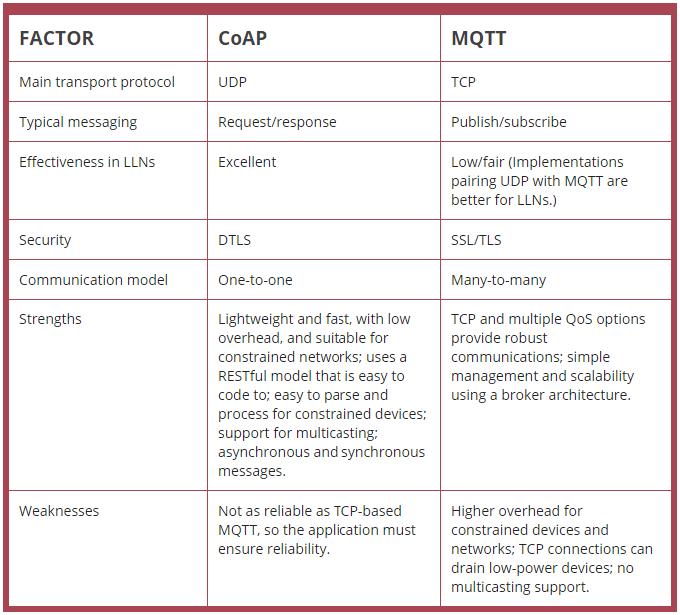
Table: Detailed CoAP vs MQTT Comparison
| FACTOR | CoAP | MQTT |
|---|---|---|
| Main transport protocol | UDP | TCP |
| Typical messaging | Request/response | Publish/subscribe |
| Effectiveness in LLNs | Excellent | Low/fair (Implementations pairing UDP with MQTT are better for LLNs.) |
| Security | DTLS | SSL/TLS |
| Communication model | One-to-one | Many-to-many |
| Strengths | Lightweight and fast, with low overhead, and suitable for constrained networks; uses a RESTful model that is easy to code to; easy to parse and process for constrained devices; support for multicasting; asynchronous and synchronous messages. | TCP and multiple QoS options provide robust communications; simple management and scalability using a broker architecture. |
| Weaknesses | Not as reliable as TCP-based MQTT, so the application must ensure reliability. | Higher overhead for constrained devices and networks; TCP connections can drain low-power devices; no multicasting support. |
1170.6.2 Network and Transport
| Aspect | CoAP | MQTT |
|---|---|---|
| Transport | UDP (User Datagram Protocol) | TCP (Transmission Control Protocol) |
| Reliability | Optional confirmable messages | TCP ensures delivery |
| Overhead | Very low (4-byte header) | Low (2-byte header + TCP) |
| Connection | Connectionless | Persistent connection |
| Latency | Lower (no handshake) | Slightly higher (TCP handshake) |
1170.6.3 Quality of Service and Reliability
| Aspect | CoAP | MQTT |
|---|---|---|
| Message Types | CON (confirmable), NON (non-confirmable) | QoS 0, 1, 2 |
| Acknowledgment | Optional ACK messages | Depends on QoS level |
| Retransmission | Application handles it | QoS 1&2 handle automatically |
| Duplicate Detection | Message IDs | Packet identifiers |
1170.6.4 Security
| Aspect | CoAP | MQTT |
|---|---|---|
| Security Layer | DTLS (Datagram TLS) | TLS/SSL |
| Authentication | Pre-shared keys, certificates | Username/password, certificates |
| Encryption | Yes (with DTLS) | Yes (with TLS) |
| Overhead | DTLS adds overhead to UDP | TLS integrated with TCP |
1170.6.5 Resource Usage
| Aspect | CoAP | MQTT |
|---|---|---|
| Memory Footprint | Minimal | Small |
| Power Consumption | Very low (UDP, sleep modes) | Low (keep-alive messages) |
| Battery Life | Excellent | Very good |
| Bandwidth | Very efficient | Efficient |
1170.6.6 Design Philosophy
| Aspect | CoAP | MQTT |
|---|---|---|
| Inspired By | HTTP (RESTful) | MQTT for SCADA |
| Paradigm | Resource-oriented | Message-oriented |
| Standards Body | IETF (RFC 7252) | OASIS (ISO/IEC 20922) |
| Target | Constrained nodes | Telemetry and messaging |
Decision context: When selecting an application protocol for IoT communication
| Factor | HTTP | MQTT | CoAP |
|---|---|---|---|
| Battery impact | High (connection overhead) | Medium (persistent TCP) | Low (connectionless UDP) |
| Bandwidth | High (verbose headers) | Low (2-byte header) | Very low (4-byte header) |
| Latency | Medium-High (TCP + headers) | Low (persistent connection) | Lowest (UDP, no handshake) |
| Reliability | TCP guaranteed | QoS 0/1/2 options | Optional CON/NON |
| Complexity | Simple (universal) | Moderate (broker required) | Low (direct communication) |
| Pattern | Request-Response | Publish-Subscribe | Request-Response + Observe |
| Ecosystem | Universal | Strong IoT | Growing |
Choose HTTP when:
- Integrating with existing web infrastructure and REST APIs
- Building mobile/web apps that communicate with gateways or cloud
- Debugging and development simplicity is priority
- Bandwidth and battery constraints are not critical (Wi-Fi/Ethernet devices)
Choose MQTT when:
- Many devices need to publish to or subscribe from a central system
- Event-driven architecture with multiple consumers per message
- Devices have intermittent connectivity (store-and-forward via broker)
- Smart home, telemetry dashboards, industrial monitoring
Choose CoAP when:
- Constrained devices with limited RAM/flash (8-bit MCUs)
- Battery-powered sensors on LPWAN (6LoWPAN, Thread)
- Direct device-to-device or device-to-gateway communication
- RESTful semantics needed on constrained networks
Default recommendation: MQTT for cloud/broker-based IoT systems, CoAP for constrained edge networks, HTTP only when interfacing with web systems or during prototyping
While HTTP/1.1 is often dismissed as too heavyweight for IoT, the newer HTTP/2 and HTTP/3 protocols offer significant improvements that make HTTP more viable for certain IoT applications. This deep dive explores when and how to leverage these modern HTTP versions.
1170.6.7 HTTP/2: Multiplexing and Header Compression
Key improvements over HTTP/1.1:
| Feature | HTTP/1.1 | HTTP/2 | IoT Benefit |
|---|---|---|---|
| Connections | Multiple TCP connections needed | Single connection, multiplexed streams | Reduced handshake overhead |
| Headers | Repeated in full each request | HPACK compression (90%+ reduction) | Smaller packet sizes |
| Server Push | Not supported | Server can proactively send resources | Efficient firmware distribution |
| Binary Protocol | Text-based (verbose) | Binary framing | Faster parsing on MCUs |
| Stream Priority | None | Priority hints for streams | Critical data first |
Header compression example:
HTTP/1.1 headers (repeated every request):
Content-Type: application/json
Authorization: Bearer eyJhbGciOiJIUzI1NiIsInR5cCI6IkpXVCJ9...
User-Agent: IoT-Sensor/1.0
Accept: application/json
Host: api.example.com
(~350 bytes per request)

HTTP/2 with HPACK:
First request: ~350 bytes (headers indexed)
Subsequent requests: ~15-30 bytes (index references only)
Savings: 90%+ for repeated headers
Multiplexing benefit for IoT gateways:
Scenario: Gateway aggregating 50 sensors, sending to cloud

HTTP/1.1 approach:
- 50 sequential requests OR 6-8 parallel connections
- Each connection: TCP handshake (1.5 RTT) + TLS (2 RTT)
- Total overhead: 50 × 200ms = 10 seconds

HTTP/2 approach:
- Single TCP+TLS connection (1 RTT handshake, amortized)
- 50 multiplexed streams in parallel
- Total time: ~200ms (1 RTT + minimal framing)
- 50× faster for gateway scenarios
1170.6.8 HTTP/3: QUIC Transport for Unreliable Networks
HTTP/3 replaces TCP with QUIC (UDP-based), offering advantages for IoT deployments with unstable connectivity:
Key features for IoT:
| Feature | HTTP/2 (TCP) | HTTP/3 (QUIC) | IoT Use Case |
|---|---|---|---|
| Connection establishment | 3-way handshake + TLS | 0-RTT or 1-RTT | Mobile/cellular IoT |
| Head-of-line blocking | Stream blocked by packet loss | Independent streams | Lossy wireless links |
| Connection migration | Breaks on IP change | Survives network switch | Vehicle telematics |
| Congestion control | Per-connection | Per-stream | Mixed priority data |
0-RTT connection resumption:
Scenario: Cellular IoT device waking from sleep

TCP + TLS 1.3:
1. TCP SYN                           (1 RTT)
2. TCP SYN-ACK + TLS ClientHello
3. TLS ServerHello + Application data (1 RTT)
Total: 2 RTT before sending data (~200-400ms on cellular)

QUIC (HTTP/3) with 0-RTT:
1. ClientHello + Encrypted data       (0 RTT!)
2. Server response
Total: 0 RTT for resumed connections
Power savings: 30-50% reduction in radio active time
Handling packet loss gracefully:
HTTP/2 (TCP): Sensor telemetry + firmware chunk in same connection
- Firmware packet lost → ALL streams blocked waiting for retransmit
- Telemetry delayed by firmware recovery (100-500ms)

HTTP/3 (QUIC): Independent stream handling
- Firmware packet lost → only firmware stream waits
- Telemetry continues unaffected
- Critical for real-time + bulk data mixing
1170.6.9 When to Use HTTP/2 or HTTP/3 for IoT
Choose HTTP/2 when:
- IoT gateway aggregating many device messages to cloud
- Existing HTTP/REST infrastructure must be preserved
- Devices have sufficient memory (32KB+ RAM for TLS+HTTP/2 stack)
- Connection reuse is possible (persistent connection to backend)
- Example: Smart building gateway sending HVAC data to cloud API
Choose HTTP/3 when:
- Cellular IoT with frequent sleep/wake cycles
- Mobile assets changing networks (vehicles, drones, wearables)
- Lossy wireless links (satellite, rural cellular)
- Mixing real-time telemetry with bulk transfers
- Example: Fleet tracking devices on LTE/5G
Avoid HTTP/2/3 when:
- Extremely constrained devices (<16KB RAM)
- Simple request-response suffices (use CoAP instead)
- UDP is blocked by network (enterprise firewalls)
- Battery sensors with infrequent transmissions (MQTT over TCP simpler)
1170.6.10 Implementation Considerations
Library support (as of 2025):
| Platform | HTTP/2 | HTTP/3 | Notes |
|---|---|---|---|
| ESP32 (ESP-IDF) | Partial (nghttp2) | Limited | Memory-constrained |
| Linux/Raspberry Pi | Full (libcurl, nghttp2) | Full (quiche, ngtcp2) | Recommended platform |
| Azure IoT SDK | Yes | Preview | Cloud-native support |
| AWS IoT | Yes (MQTT over WebSocket/HTTP/2) | Roadmap | Prefer MQTT |
| Nordic nRF9160 | Limited | No | Focus on LwM2M/CoAP |
Memory requirements:
HTTP/1.1 minimal: ~8KB RAM (no TLS)
HTTP/2 minimal: ~32KB RAM (HPACK tables + stream state)
HTTP/3 minimal: ~64KB RAM (QUIC connection + crypto state)

Recommendation:
- <32KB RAM: Use CoAP or MQTT over TCP
- 32-128KB: HTTP/2 feasible for gateway scenarios
- >128KB: HTTP/3 viable for advanced applications
Configuration best practices:
# nginx HTTP/2 config for IoT backend
http2_max_concurrent_streams 128;  # Many IoT clients
http2_recv_buffer_size 256k;       # Handle burst uploads
keepalive_timeout 3600s;           # Long-lived IoT connections
ssl_protocols TLSv1.3;             # Require TLS 1.3 for IoT security

# QUIC/HTTP/3 (nginx 1.25+)
listen 443 quic reuseport;
http3 on;
quic_retry on;                     # Mitigate amplification attacks
Performance tuning for IoT:
# Python example: HTTP/2 with connection reuse for gateway
import httpx

# Create reusable HTTP/2 client
client = httpx.Client(
    http2=True,
    timeout=30.0,
    limits=httpx.Limits(
        max_keepalive_connections=5,
        max_connections=10,
        keepalive_expiry=3600  # 1 hour for IoT
    )
)

# Batch sensor readings efficiently
async def upload_sensor_batch(readings: list[dict]):
    """Upload multiple sensor readings in parallel over single HTTP/2 connection"""
    tasks = [
        client.post(f"/api/v1/sensors/{r['device_id']}/data", json=r)
        for r in readings
    ]
    responses = await asyncio.gather(*tasks)
    # All 50 requests share single connection, multiplexed
    return responses
1170.6.11 Summary: HTTP Protocol Selection for IoT
| Protocol | Best For | Overhead | Latency | Reliability |
|---|---|---|---|---|
| CoAP | Constrained devices, 6LoWPAN | Very Low | Lowest | Application-managed |
| MQTT | Event streams, pub-sub | Low | Low | QoS 0/1/2 |
| HTTP/1.1 | Simple prototyping, debugging | High | Medium | TCP |
| HTTP/2 | Gateways, cloud APIs, bulk uploads | Medium | Medium | TCP + multiplexing |
| HTTP/3 | Mobile IoT, unreliable networks | Medium | Lowest | QUIC streams |
Key Takeaway: HTTP/2 and HTTP/3 don’t replace MQTT or CoAP for constrained IoT devices, but they significantly improve HTTP performance for gateways, cloud integration, and mobile IoT scenarios where HTTP infrastructure already exists.
1170.7 Knowledge Check
Test your understanding of these networking concepts.
1170.8 Summary
This chapter provided a comprehensive technical comparison of IoT application protocols:
Key topics covered: - CoAP characteristics: RESTful over UDP, 4-byte headers, resource discovery, DTLS security - MQTT characteristics: Publish-subscribe over TCP, 2-byte headers, QoS levels 0/1/2, broker architecture - Protocol comparison matrices: Architecture, transport, reliability, security, and resource usage trade-offs - HTTP/2 and HTTP/3: Modern HTTP improvements including multiplexing, header compression, QUIC transport - Selection criteria: When to use HTTP vs MQTT vs CoAP based on device constraints and communication patterns
1170.9 What’s Next?
Now that you understand the technical architectures and trade-offs of IoT protocols, continue with:
- REST API Design for IoT: Learn best practices for designing RESTful IoT APIs
- Real-time Protocols: Explore VoIP, SIP, and RTP for audio/video IoT
- Worked Examples: Apply protocol selection to real-world scenarios
For protocol-specific deep dives: - MQTT Fundamentals - CoAP Fundamentals and Architecture