447  UAV Swarm Coordination

447.1 Learning Objectives

By the end of this chapter, you will be able to:

  • Evaluate Swarm Algorithms: Compare centralized, distributed, and leader-follower coordination strategies
  • Design Formation Control: Implement swarm formation patterns for different mission types
  • Plan Payload Trade-offs: Calculate payload capacity constraints and their impact on sensor selection
  • Apply Operational Planning: Calculate fleet sizing for continuous UAV operations including maintenance and charging cycles
  • Navigate Regulatory Requirements: Design operationally feasible UAV deployment strategies that balance regulations with practical constraints

447.2 Prerequisites

Before diving into this chapter, you should be familiar with:

447.3 Swarm Coordination

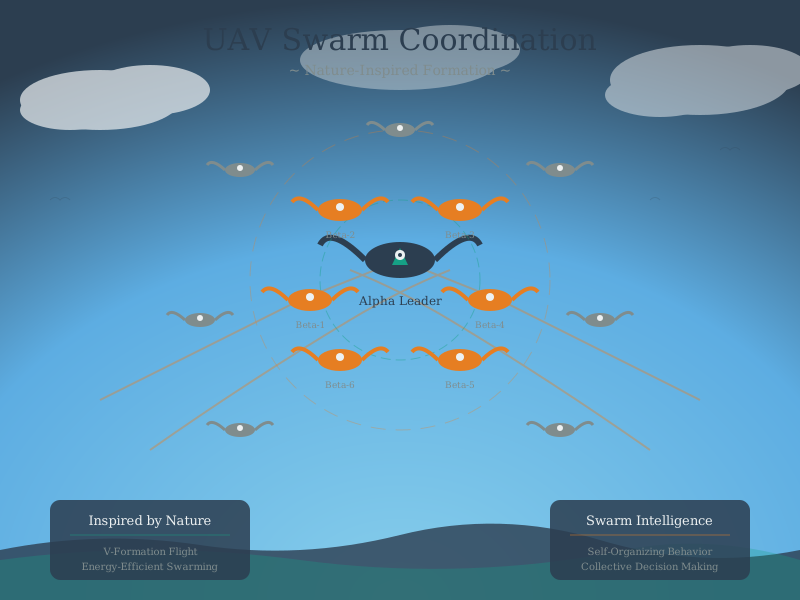
Swarm coordination enables multiple UAVs to work cooperatively on complex missions through distributed algorithms.

Artistic visualization of UAV swarm coordination showing multiple drones working together using distributed algorithms for task allocation, formation flying, and collective decision-making. Illustrates how individual UAVs follow simple rules to achieve complex collective behavior.

UAV Swarm Coordination
Figure 447.1: UAV swarm coordination showing distributed algorithms for cooperative mission execution.

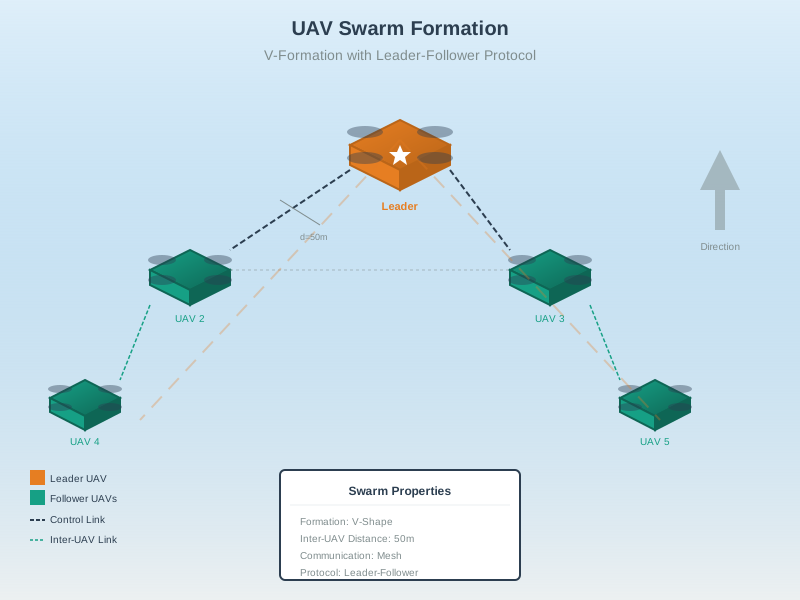
Geometric diagram of UAV swarm formation patterns including line, wedge, circle, and grid formations. Shows how swarms maintain relative positions while navigating as a coordinated group with leader-follower and consensus-based formation control.

UAV Swarm Formation
Figure 447.2: UAV swarm formation patterns showing various coordinated group configurations.

447.3.1 Coordination Algorithms

Centralized Task Allocation - Ground control assigns tasks to each UAV - Simple coordination but single point of failure - Best for stable conditions with reliable ground link

Distributed Consensus - UAVs negotiate task assignments via peer-to-peer communication - Resilient to failures - remaining UAVs redistribute tasks - Adapts to environment changes locally - Higher communication overhead

Leader-Follower Formation - One master UAV directs follower UAVs - Effective for coordinated movement patterns - Leader failure breaks coordination

447.3.2 UAV Relay Networks

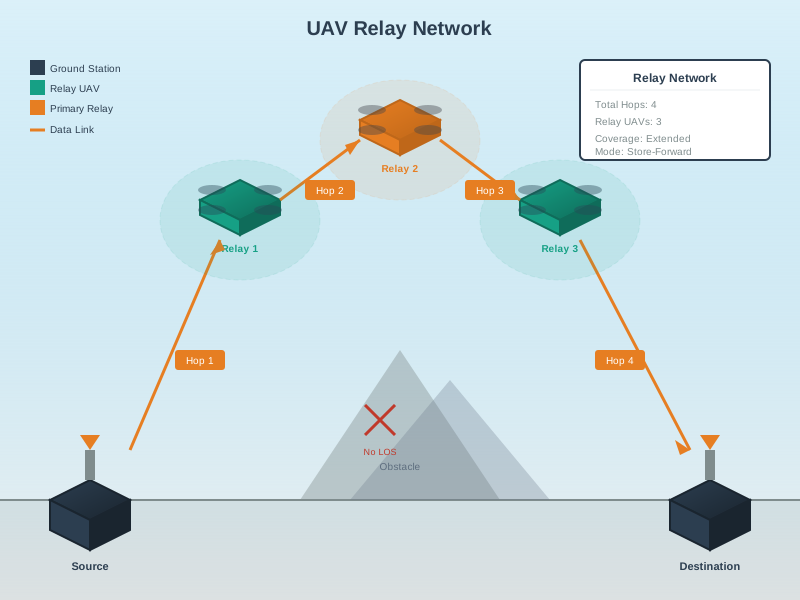
UAV relay networks extend communication range by using drones as mobile communication bridges.

Geometric diagram of UAV relay network showing drones positioned as communication bridges between ground users and base stations. Illustrates how UAVs extend network coverage and provide connectivity in areas lacking infrastructure.

UAV Relay Network
Figure 447.3: UAV relay network using drones as mobile communication bridges to extend coverage and connectivity.

447.4 Worked Example: Payload Capacity Trade-off

NoteWorked Example: Payload Capacity Trade-off for Agricultural Survey

Scenario: An agricultural technology company needs to survey a 500-hectare farm for crop health analysis. They must choose between two UAV configurations and determine if a single flight can cover the entire farm.

Given: - UAV maximum takeoff weight (MTOW): 25 kg - Empty weight: 12 kg - Battery options: Standard (4 kg, 45 min flight) or Extended (6 kg, 70 min flight) - Sensor options: - Multispectral camera only: 1.5 kg (NDVI analysis) - Multispectral + thermal: 3.2 kg (NDVI + water stress) - Multispectral + thermal + LiDAR: 6.5 kg (full canopy analysis) - Survey speed: 8 m/s at 100 m altitude - Swath width: 120 m with 20% overlap = 96 m effective

Steps: 1. Calculate available payload capacity: - With standard battery: 25 - 12 - 4 = 9 kg available - With extended battery: 25 - 12 - 6 = 7 kg available 2. Evaluate payload combinations: - Config A: Extended battery + full sensor suite = 6 + 6.5 = 12.5 kg > 7 kg available. NOT FEASIBLE - Config B: Standard battery + full sensor suite = 4 + 6.5 = 10.5 kg > 9 kg. NOT FEASIBLE - Config C: Extended battery + multispectral + thermal = 6 + 3.2 = 9.2 kg > 7 kg. NOT FEASIBLE - Config D: Standard battery + multispectral + thermal = 4 + 3.2 = 7.2 kg < 9 kg. FEASIBLE - Config E: Extended battery + multispectral only = 6 + 1.5 = 7.5 kg > 7 kg. NOT FEASIBLE - Config F: Standard battery + multispectral only = 4 + 1.5 = 5.5 kg < 9 kg. FEASIBLE 3. Calculate coverage per flight: - Config D (standard battery, 45 min): Coverage = 8 m/s x 45 min x 60 x 96 m = 2,073,600 m squared = 207 hectares - Config F (standard battery, 45 min): Same coverage = 207 hectares 4. Calculate flights needed for 500 hectares: 500 / 207 = 2.4 flights, so 3 flights minimum

Result: The optimal configuration is Config D (standard battery + thermal imaging), requiring 3 flights to cover the 500-hectare farm. Full LiDAR analysis would require a larger UAV platform (MTOW > 30 kg).

Key Insight: Payload capacity is the critical constraint in agricultural UAV operations, not battery life. Upgrading to an extended battery often backfires because the heavier battery reduces payload capacity.
447.5 Operational Fleet Sizing

447.6 Regulatory Compliance

447.7 Environmental Considerations

447.8 Cross-Hub Connections

TipExplore UAV Networks Through Interactive Learning

Simulations & Tools: - Simulations Hub - Network Topology Visualizer: Compare star vs mesh UAV configurations and see how topology affects coverage and resilience in real-time - Practice UAV swarm coordination algorithms with interactive aerial network simulators

Self-Assessment: - Quizzes Hub - Test your understanding of UAV network challenges, FANET routing protocols, and energy-aware mission planning - Architecture section quizzes include UAV topology selection and swarm coordination scenarios

Video Learning: - Videos Hub - Watch real-world UAV network deployments in disaster response, precision agriculture, and search & rescue missions - See demonstrations of autonomous swarm behavior and aerial base station configurations

Knowledge Reinforcement: - Knowledge Gaps Hub - Address common misunderstandings about UAV battery life, solar power limitations, and 3D mobility challenges - Clarify differences between FANET, VANET, and WSN architectures

Deep Dives: - UAV Production Review - Comprehensive UAV network summary - FANET and Integration - Flying ad hoc networks - UAV Interactive Lab - Hands-on FANET simulation

Related Architecture: - WSN Overview - Wireless sensor networks - Ad-hoc Networks - Mobile ad hoc networking - M2M Fundamentals - Machine-to-machine communication

Networking: - Mobile Wireless - Cellular and wireless technologies - Routing - Multi-hop routing protocols

Energy: - Energy Management - Battery and power optimization

Learning Resources: - Simulations Hub - Interactive UAV simulations

447.9 Summary

This chapter explored UAV swarm coordination strategies and operational planning:

  • Coordination Algorithms: Centralized control is simple but has single point of failure; distributed consensus provides resilience for dynamic missions; leader-follower works for formation flying
  • Payload Trade-offs: Available payload = MTOW - empty weight - battery weight determines sensor selection; upgrading battery can reduce sensor capacity
  • Fleet Sizing: 24/7 operations require active patrol UAVs + charging rotation + maintenance spares (typically 2x active fleet)
  • Regulatory Compliance: Mobile ground control stations enable VLOS compliance while maintaining operational efficiency; BVLOS waivers require extensive documentation
  • Environmental Planning: Cold temperatures reduce battery capacity 40-60%; battery heating systems are essential for polar operations

447.10 What’s Next

The next chapter provides a Hands-On FANET Lab where you’ll simulate a Flying Ad-hoc Network using ESP32 microcontrollers, exploring drone-to-drone communication, swarm behavior patterns, and GPS coordinate handling.

Continue to UAV Interactive Lab