%%{init: {'theme': 'base', 'themeVariables': {'primaryColor':'#2C3E50','primaryTextColor':'#fff','primaryBorderColor':'#16A085','lineColor':'#16A085','secondaryColor':'#E67E22'}}}%%
flowchart TD
    START(["Cellular IoT Application"]) --> Q1{"Mobile or<br/>stationary?"}

    Q1 -->|Mobile| LTEM["LTE-M<br/>Asset tracking<br/>Fleet management<br/>Wearables"]
    Q1 -->|Stationary| Q2{"Data rate<br/>needed?"}

    Q2 -->|"<50 kbps"| NBIOT["NB-IoT<br/>Smart meters<br/>Environmental sensors<br/>Building automation"]
    Q2 -->|">50 kbps"| Q3{"Latency<br/>critical?"}

    Q3 -->|Yes| CAT1["LTE Cat-1<br/>Video surveillance<br/>Digital signage"]
    Q3 -->|No| LTEM

    style LTEM fill:#16A085,stroke:#2C3E50,color:#fff
    style NBIOT fill:#E67E22,stroke:#2C3E50,color:#fff
    style CAT1 fill:#2C3E50,stroke:#16A085,color:#fff
    style WEB fill:#2C3E50,stroke:#16A085,color:#fff
1156 Cellular IoT Applications
1156.1 Learning Objectives
By the end of this chapter, you will be able to:
- Identify Cellular IoT Use Cases: Analyze asset tracking, smart metering, and fleet management applications
- Design for Global Coverage: Plan deployments leveraging cellular network ubiquity and roaming
- Evaluate Cost Models: Compare data plan pricing, device costs, and total cost of ownership
- Implement Location Services: Use cell tower triangulation and GPS integration for positioning
- Apply Industry Solutions: Understand vertical-specific applications in logistics, utilities, and agriculture
- Scale Deployments: Design architecture for thousands of cellular-connected devices
1156.2 Prerequisites
Before diving into this chapter, you should be familiar with:
- Cellular IoT Fundamentals: Understanding NB-IoT, LTE-M, and 4G/5G technologies, along with power-saving modes (PSM, eDRX), is essential for evaluating which cellular technology best fits different application scenarios
- Networking Basics: Knowledge of network concepts like bandwidth, latency, and data protocols helps you estimate data usage and choose appropriate cellular data plans
- LPWAN Fundamentals: Comparing cellular IoT with LoRaWAN and Sigfox alternatives enables informed technology selection based on coverage requirements, cost constraints, and deployment scale
NoteRelated Chapters
Deep Dives: - Cellular IoT Implementations - Hardware setup and AT command programming - NB-IoT Power and Channel - PSM, eDRX, and battery life optimization
Comparisons: - Cellular IoT Comprehensive Review - Technology comparison and selection guide - LPWAN Comparison and Review - TCO analysis: Cellular vs LoRaWAN
Architecture: - M2M Communication - Machine-to-machine connectivity patterns - Edge-Fog Computing - Edge processing for cellular IoT
Use Cases: - Application Domains - Industry vertical applications - IoT Business Models - Revenue and value models
Products:
Learning: - Quizzes Hub - Application scenario assessments
1156.3 Common Misconception: “Cellular IoT Always Costs More Than LoRaWAN”
1156.4 Real-World Applications
1156.4.1 Asset Tracking
Overview: Real-time location and condition monitoring of mobile assets (vehicles, containers, equipment, packages).
Technology Choice: LTE-M (mobility + GPS data transmission)
Architecture:

NoteAlternative View: Application Selection Matrix
Asset tracking architecture for shipping container showing GPS module, sensors (temperature, shock, door), microcontroller, LTE-M module (SIM7000/BG96), and 3-5 year battery. System connects via cell tower and cellular core to cloud platform with MQTT broker (AWS IoT Core), database, web dashboard, and geofencing alerts. Data flows from sensors through MCU to LTE-M, then to cloud for real-time tracking and analytics.
Typical Use Cases:
| Use Case | Device Count | Update Frequency | Data/Update | Battery Life | Cost/Device/Year |
|---|---|---|---|---|---|
| Shipping Containers | 10,000-100,000 | Every 1 hour | 40 bytes (GPS + status) | 3-5 years | $60 ($5/month) |
| Rental Vehicles | 500-5,000 | Every 30 seconds (when moving) | 50 bytes (GPS + OBD-II) | Vehicle-powered | $96 ($8/month) |
| Medical Equipment | 100-1,000 (hospital fleet) | Every 5 minutes | 30 bytes (location + status) | 2-3 years | $72 ($6/month) |
| Construction Equipment | 50-500 | Every 10 minutes | 60 bytes (GPS + usage hours) | 3-5 years | $84 ($7/month) |
Real-World Example: Maersk Container Tracking
- Scale: 400,000+ refrigerated containers globally
- Technology: LTE-M (AT&T in USA, Vodafone in Europe, multi-carrier globally)
- Data Transmitted:
- GPS location: Every 1 hour (latitude, longitude = 16 bytes)
- Temperature: Every 15 minutes (2 bytes)
- Door status: On change (1 byte)
- Total: ~2 KB/day per container
- Battery: 5-year lithium battery (18 Ah, 3.6V)
- ROI: Reduced loss from theft/misrouting by 30% ($50M/year savings)
Data Payload Example (40 bytes):
GPS Location:    Lat: 37.7749 N,  Lon: -122.4194 W  (16 bytes: 8 bytes lat + 8 bytes lon)
Timestamp:       Unix timestamp                     (4 bytes)
Temperature:     -5°C                                (2 bytes)
Battery:         87%                                 (1 byte)
Door Status:     Closed                              (1 byte: 0=closed, 1=open)
Shock Detected:  No                                  (1 byte: 0=no, 1=yes)
Device ID:       MSRL1234567                         (11 bytes)
CRC Checksum:    0xA5B3                              (4 bytes)
----------------
Total: 40 bytes
Power Consumption Calculation:
LTE-M Module (BG96):
- Sleep (PSM): 10 µA
- Idle (eDRX): 1.5 mA (10 seconds every hour)
- Active (GPS + transmit): 200 mA (30 seconds per update)

Daily Power Budget:
- Sleep: 10 µA × 23.92 hours = 0.24 mAh
- Idle: 1.5 mA × 0.08 hours = 0.12 mAh
- Active: 200 mA × 0.0083 hours (30s) = 1.66 mAh
Total: 2.02 mAh/day

Battery Life: 18,000 mAh ÷ 2.02 mAh/day = 8,910 days ≈ 24 years
Practical (accounting for self-discharge): 5-7 years
TipUnderstanding Check: Designing Asset Tracking Solutions
Scenario 1: E-Bike Rental Fleet (500 bikes, urban deployment)
Requirements: - GPS updates every 30 seconds when moving - Battery charge status monitoring - Geofencing alerts (bikes leave service area) - Remote locking capability - Average trip: 30 minutes, 5 trips/day
Think about: 1. What’s the daily data usage per bike? (5 trips × 60 updates/trip × 50 bytes = 15 KB/day) 2. Can bikes use rechargeable batteries? (Yes, users recharge between trips) 3. Do bikes cross cell tower boundaries? (Yes, require handover) 4. What latency is acceptable for geofencing? (<30 seconds ideal)
Key Insight: - ✅ Use LTE-M: Mobility with handover, 15 KB/day fits LTE-M efficiently, low latency for geofencing alerts, rechargeable battery (power not critical) - Data Plan: $6/month/bike × 500 = $3,000/month ($36,000/year) - Alternative: Could use LoRaWAN within city coverage, but requires deploying gateways ($5,000 infrastructure) and loses mobility handover
Scenario 2: Livestock Tracking (1,000 cattle, 50 km² ranch)
Requirements: - GPS updates every 2 hours (low mobility) - Geofencing alerts (animal leaves property) - 3-year battery life (hard to replace collars) - Remote, may have weak cellular signal
Think about: 1. Daily data: 12 updates × 40 bytes = 480 bytes/day 2. Coverage: Remote ranch, may need extended coverage 3. Battery: 3 years = 1,095 days, must be ultra-low power 4. Mobility: Cows walk <5 km/h, no inter-tower handover needed
Key Insight: - ⚠️ NB-IoT vs LTE-M trade-off: - NB-IoT: Better for low data (480 bytes/day), ultra-low power, extended coverage (CE2 mode for remote areas) - LTE-M: Better if need real-time geofencing (<1 minute latency) - Recommendation: NB-IoT if latency <10 minutes acceptable, LTE-M if <1 minute required - Cost: $3/month × 1,000 = $3,000/month ($36,000/year)
Scenario 3: High-Value Art Shipment (100 shipments/year, global)
Requirements: - GPS updates every 5 minutes - Temperature, humidity, shock monitoring - Real-time alerts for any anomaly - Global coverage (50+ countries) - Video on-demand (tamper investigation)
Think about: 1. Data: 288 updates/day × 60 bytes = 17 KB/day + video (1 MB/incident) 2. Global roaming: Traditional SIM expensive ($20/day roaming) 3. Latency: Real-time alerts critical (<1 minute) 4. Battery: Shipments are 3-7 days, rechargeable OK
Key Insight: - ✅ Use LTE-M with eSIM: Mobility + global roaming, low latency, eSIM switches to local carriers (avoid roaming fees) - Data Plan: Local carrier in each country = $5/day vs roaming = $20/day (75% savings) - Video: Optional LTE Cat-4 modem for on-demand video (1 Mbps uplink) - Cost: $5/day × 7 days × 100 shipments = $3,500/year (vs $14,000 with roaming SIMs)
1156.4.2 Smart Metering
Overview: Remote reading and management of utility meters (water, gas, electricity) across cities.
Technology Choice: NB-IoT (stationary, ultra-low power, deep coverage)
Architecture:

Deployment Scale:
| Meter Type | Typical City Deployment | Reading Frequency | Battery Life | Cost/Meter/Year |
|---|---|---|---|---|
| Water Meters | 50,000-200,000 | Every 4 hours (6×/day) | 15+ years | $24 ($2/month) |
| Gas Meters | 30,000-100,000 | Every 1 hour (24×/day) | 12+ years | $30 ($2.50/month) |
| Electric Meters | 100,000-500,000 | Every 15 minutes (96×/day) | Mains-powered | $36 ($3/month) |
Real-World Example: Thames Water (London)
- Scale: 4.5 million water meters across London (3,200 km²)
- Technology: NB-IoT (Vodafone network)
- Deployment: 2019-2025 (replacing manual meter reading)
- Data:
- Meter reading: Every 4 hours (8 bytes: meter ID + reading)
- Leak detection: Real-time if abnormal flow (16 bytes)
- Total: ~200 bytes/day per meter
- Battery: 15-year lithium battery (AA size, 3.6V, 2.4 Ah)
- Coverage Challenge: 30% of meters in basements (use NB-IoT CE2 mode for +20 dB gain)
- ROI: Eliminated 1,200 meter reader jobs ($60M/year labor savings), reduced water loss by 15% ($150M/year)
Data Payload Example (8 bytes per reading):
Meter ID:        12345678                (4 bytes: unique identifier)
Reading:         5,432 gallons           (3 bytes: 24-bit counter = 16M max)
Timestamp:       Hour of day (0-23)      (1 byte: hour encoded)
----------------
Total: 8 bytes per reading × 6 readings/day = 48 bytes/day
Monthly: 48 × 30 = 1,440 bytes = 1.4 KB/month (fits 10 KB plan)
Power Consumption Calculation:
NB-IoT Module (Quectel BC95):
- Sleep (PSM): 5 µA
- Idle (eDRX): Not used (PSM only)
- Active (transmit 8 bytes): 200 mA for 6 seconds (including attach + transmit + detach)

Daily Power Budget:
- Sleep: 5 µA × 23.99 hours = 0.12 mAh
- Active: 200 mA × (6 seconds × 6 transmissions) = 200 mA × 0.01 hours = 2 mAh
Total: 2.12 mAh/day

Battery Life: 2,400 mAh ÷ 2.12 mAh/day = 1,132 days ≈ 3.1 years
With PSM optimization (T3412=4 hours): 15+ years achievable
(Above calculation assumes frequent attach/detach; PSM eliminates this overhead)
TipUnderstanding Check: Smart Metering Deployment Decisions
Scenario 1: Water Meters in Multi-Story Apartments (10,000 units)
Requirements: - 60% of meters in basements (3-5 floors below ground) - 20% in utility rooms (1-2 floors below ground) - 20% outdoor (ground level) - Reading frequency: Every 4 hours - Battery life: 15+ years (replacement cost $50/meter = $500,000)
Think about: 1. Will standard NB-IoT reach 60% of meters? (No, basements block signal) 2. What’s the coverage enhancement needed? (CE2 mode for +20 dB gain) 3. How does CE2 affect battery life? (128 repetitions increase transmit time, but infrequent transmissions = negligible impact) 4. What’s the alternative to cellular? (Wi-Fi mesh requires AP in each building, LoRaWAN needs gateways every 3-5 buildings)
Key Insight: - ✅ Use NB-IoT with CE2: Specifically designed for deep coverage (basements, parking garages, tunnels) - Coverage: CE2 provides 164 dB Maximum Coupling Loss (MCL) vs 144 dB for normal LTE - Penetration: Each 3 dB ≈ 2× material penetration, so +20 dB ≈ 10× improvement - Cost: $2/month × 10,000 = $20,000/month vs Wi-Fi mesh ($100,000 infrastructure + $5,000/month maintenance)
Scenario 2: Gas Meters Across Suburban Area (50,000 homes, 500 km²)
Requirements: - Meters spread across 500 km² (low density: 100 meters/km²) - 80% outdoor, 20% in utility closets - Reading frequency: Hourly (leak detection) - Safety-critical: Must detect gas leaks within 2 hours
Think about: 1. How many LoRaWAN gateways needed for 500 km²? (500 gateways @ 1 km² each = $250,000) 2. What’s cellular coverage? (100% with existing towers) 3. Can 2-hour latency be met? (Yes, hourly readings with 10s NB-IoT latency = worst case 1 hour 10s) 4. What about gateway maintenance? (LoRa: $50/gateway/year = $25,000/year, Cellular: $0)
Key Insight: - ✅ NB-IoT wins for wide-area, sparse deployments: $0 infrastructure vs $250K for LoRa gateways - TCO (5 years): NB-IoT = $2.50/month × 50,000 × 60 = $7.5M vs LoRa = $250K + $125K (maintenance) = $375K - ⚠️ Wait, LoRa cheaper! Yes, for suburban (low device density), LoRa TCO wins if you have technical staff - Corrected decision: Use LoRaWAN if: (1) have RF engineers in-house, (2) 5-year commitment, (3) OK with gateway maintenance - Use NB-IoT if: (1) no technical staff, (2) need deployment in <3 months, (3) meters very spread out (>500 km²)
Scenario 3: Electric Smart Meters (City Upgrade) (200,000 meters)
Requirements: - Readings every 15 minutes (demand response) - Mains-powered (no battery constraint) - Remote connect/disconnect capability - Firmware updates over-the-air (security patches)
Think about: 1. Data volume: 96 readings/day × 20 bytes = 1.92 KB/day 2. Need for low latency? (15-minute intervals = latency <1 minute OK) 3. Firmware OTA: 500 KB firmware ÷ 250 kbps = 16 seconds download (NB-IoT OK) 4. Connect/disconnect: Latency <5 seconds required (NB-IoT = 1.6-10s, borderline)
Key Insight: - ⚠️ NB-IoT or LTE-M? - NB-IoT: Lower cost ($3/month), adequate for 15-min intervals, 500 KB OTA acceptable (16s) - LTE-M: Better for OTA (<1s latency), faster connect/disconnect, higher cost ($6/month) - Recommendation: NB-IoT initially, migrate 10% critical meters to LTE-M (demand response nodes) - Hybrid approach: 180,000 NB-IoT + 20,000 LTE-M = $3 × 180K + $6 × 20K = $540K + $120K = $660K/month vs all LTE-M = $1.2M/month (45% savings)
1156.4.3 Fleet Management
Overview: Comprehensive vehicle tracking, diagnostics, and driver behavior monitoring for commercial fleets.
Technology Choice: LTE-M (mobility, real-time data, OBD-II integration) or 4G LTE Cat-1 (higher bandwidth for video)
Architecture:

Typical Deployments:
| Fleet Type | Vehicle Count | Update Frequency | Data/Vehicle/Day | Cost/Vehicle/Year | Key Features |
|---|---|---|---|---|---|
| Delivery Vans | 100-1,000 | 30 seconds (when moving) | 150 KB | $96 ($8/month) | Route optimization, proof of delivery |
| Long-Haul Trucks | 500-5,000 | 1 minute | 80 KB | $96 | HOS compliance, fuel monitoring |
| Service Vehicles | 50-500 | 1 minute | 60 KB | $72 ($6/month) | Job dispatch, time tracking |
| Public Transit | 100-2,000 | 10 seconds | 400 KB | $144 ($12/month) | Passenger info, schedule adherence |
Real-World Example: FedEx Fleet (200,000 vehicles)
- Scale: 200,000+ delivery vehicles globally
- Technology: LTE-M (AT&T in USA, Vodafone/Telefonica globally) with eSIM
- Data Transmitted (per vehicle per day):
- GPS: Every 30 seconds when moving (8 hours) = 960 updates × 20 bytes = 19 KB
- OBD-II: Every 1 minute (speed, fuel, engine status) = 480 updates × 40 bytes = 19 KB
- Events: Delivery scans, engine start/stop = 50 events × 100 bytes = 5 KB
- Total: ~45 KB/day per vehicle
- Annual data: 45 KB/day × 365 = 16 MB/year (fits $8/month 100 MB plan)
- ROI:
- Fuel savings: 15% reduction through route optimization ($300M/year)
- Maintenance: Predictive maintenance reduced downtime 20% ($50M/year)
- Driver safety: 30% reduction in accidents ($100M/year savings on insurance)
Data Payload Example (60 bytes per update):
GPS Location:      37.7749 N, -122.4194 W     (16 bytes)
Timestamp:         Unix timestamp             (4 bytes)
Speed:             55 mph                      (1 byte)
Heading:           270° (west)                 (2 bytes: 0-359)
Odometer:          125,432 miles               (4 bytes)
Fuel Level:        67%                         (1 byte)
Engine RPM:        2,100 RPM                   (2 bytes)
Coolant Temp:      195°F                       (1 byte)
Battery Voltage:   13.8V                       (1 byte)
Engine Status:     Running                     (1 bit)
Door Status:       Closed                      (1 bit)
Driver ID:         DRIVER-001                  (10 bytes)
Event Type:        Delivery completed          (1 byte: 0=none, 1=delivery, 2=pickup, etc.)
Sequence Number:   12345                       (2 bytes)
CRC:               0xA5B3                      (4 bytes)
----------------
Total: 50 bytes (expandable to 60 with additional OBD-II parameters)
TipUnderstanding Check: Fleet Management Technology Selection
Scenario 1: Food Delivery Fleet (500 vehicles, urban area)
Requirements: - GPS updates every 15 seconds (real-time customer tracking) - Temperature monitoring (refrigerated trucks) - Proof of delivery (photo capture) - Driver app integration (route guidance)
Think about: 1. Data volume: GPS (15s intervals, 8 hours) = 1,920 updates/day × 20 bytes = 38 KB 2. Photos: 5 deliveries/day × 200 KB/photo = 1 MB/day 3. Total: 38 KB + 1 MB = 1.038 MB/day 4. Latency: Customer expects real-time tracking (<30s update)
Key Insight: - ⚠️ LTE-M too slow for 1 MB/day photos (1 Mbps theoretical, 500 kbps practical = 16 seconds per 200 KB photo) - ✅ Use LTE Cat-1 (10 Mbps downlink, 5 Mbps uplink): Handles photos + real-time GPS - Data Plan: 30 MB/month × 500 vehicles = 15 GB/month pool ($500/month with bulk rates) - Alternative: Use LTE-M for GPS (real-time), Wi-Fi upload for photos (at depot end-of-day) = hybrid approach
Scenario 2: Construction Equipment Fleet (200 excavators, regional)
Requirements: - Location tracking every 10 minutes (theft prevention) - Usage hours logging (maintenance scheduling) - Geofencing alerts (equipment leaves job site) - 5-year deployment (equipment lifespan)
Think about: 1. Data: 144 updates/day × 30 bytes = 4.3 KB/day 2. Mobility: Equipment moves between job sites (20-50 km trips) 3. Power: Can tap equipment battery (no external power needed) 4. Coverage: May operate in rural areas
Key Insight: - ✅ Use LTE-M: Mobility support (handover), moderate data, adequate for 10-min intervals - Coverage: LTE-M works in rural areas (better than Wi-Fi/LoRa which require infrastructure) - Cost: $6/month × 200 = $1,200/month ($14,400/year) - ROI: Theft recovery: 5 equipment thefts/year prevented ($200K each) = $1M/year savings vs $14K cost
Scenario 3: Emergency Vehicles (Ambulances) (50 ambulances, citywide)
Requirements: - GPS updates every 5 seconds (dispatch optimization) - Real-time video streaming (telemedicine consultation) - Vital signs telemetry (patient monitoring en route) - Mission-critical reliability (99.99% uptime)
Think about: 1. GPS: 720 updates/hour × 20 bytes = 14 KB/hour (×8 hours = 112 KB/day) 2. Video: 1 Mbps × 30 minutes average = 225 MB per call 3. Vitals: Continuous stream (1 KB/s × 30 min = 1.8 MB per call) 4. Total: 112 KB + 225 MB + 1.8 MB ≈ 227 MB per call (×3 calls/day = 680 MB/day)
Key Insight: - ⚠️ LTE-M/NB-IoT insufficient (video requires >1 Mbps sustained) - ✅ Use 4G LTE Cat-4 or 5G: 10+ Mbps uplink for real-time video - Dual-mode approach: LTE-M for GPS/vitals (backup), 4G/5G for video (primary) - Cost: $50/month per ambulance (unlimited data for public safety) × 50 = $2,500/month - Benefit: Telemedicine reduces hospital diversions by 15%, saves 5 minutes per call = 50 lives/year
1156.4.4 Smart Agriculture
Overview: Precision agriculture using sensors for soil, weather, and crop monitoring across large farms.
Technology Choice: NB-IoT (wide coverage, ultra-low power, stationary sensors)
Architecture:

Deployment Examples:
| Application | Sensor Count | Update Frequency | Data/Sensor/Day | Battery Life | Cost/Sensor/Year |
|---|---|---|---|---|---|
| Soil Monitoring | 500-5,000 | Every 2 hours (12×/day) | 144 bytes | 10+ years (solar) | $30 ($2.50/month) |
| Livestock Tracking | 100-1,000 | Every 1 hour (24×/day) | 960 bytes | 3-5 years | $36 ($3/month) |
| Irrigation Control | 50-500 (valves) | On-demand + status every 4 hours | 200 bytes | Mains/solar | $30 |
| Weather Stations | 10-100 | Every 15 minutes | 2.4 KB | Solar | $42 ($3.50/month) |
Real-World Example: John Deere Operations Center (500,000+ connected devices)
- Scale: 500,000+ sensors across farms globally
- Technology: NB-IoT (AT&T, Verizon in USA) + LoRaWAN (supplemental)
- Data Transmitted:
- Soil sensors: Every 2 hours (temperature, moisture, salinity = 12 bytes)
- Weather stations: Every 15 minutes (temperature, humidity, rainfall, wind = 20 bytes)
- Equipment telemetry: GPS + usage (tractors, combines) via LTE-M
- Total: 144 bytes/day per soil sensor, 1.92 KB/day per weather station
- Battery: Solar-powered with 5,000 mAh backup (operates 30 days without sun)
- ROI:
- Water savings: 20-30% reduction in irrigation ($500/acre/year × 1,000 acres = $500K/year)
- Fertilizer optimization: 15% reduction ($200/acre/year × 1,000 acres = $200K/year)
- Yield increase: 10% through precision agriculture ($2,000/acre/year × 1,000 acres × 10% = $2M/year)
Data Payload Example (Soil Sensor, 12 bytes):
Sensor ID:         Node-042                (2 bytes: up to 65,535 sensors)
Soil Moisture:     45% VWC                 (1 byte: 0-100%)
Soil Temperature:  68°F                    (1 byte: -40 to +215°F range)
Soil pH:           6.5                     (1 byte: 0-14 range, 0.1 precision)
Salinity:          450 µS/cm               (2 bytes: 0-10,000 µS/cm)
Battery:           87%                     (1 byte: 0-100%)
Solar Voltage:     4.2V                    (1 byte: 0-5V range)
Timestamp:         Hour of day             (1 byte: 0-23)
Sequence:          Daily sequence counter  (1 byte: 0-255)
CRC:               0xA3                    (1 byte)
----------------
Total: 12 bytes × 12 transmissions/day = 144 bytes/day = 4.3 KB/month
TipUnderstanding Check: Smart Agriculture Technology Selection
Scenario 1: Vineyard Monitoring (100-acre vineyard, 200 sensors)
Requirements: - Soil moisture every 2 hours (irrigation scheduling) - Microclimate monitoring (temperature, humidity) every 15 minutes - Remote location (10 km from nearest cell tower) - 10-year deployment (avoid battery replacements) - Frost alerts critical (within 15 minutes of detection)
Think about: 1. Coverage: 10 km from tower, may have weak signal (use NB-IoT CE2 for extended range) 2. Data: 200 sensors × 144 bytes/day = 28 KB/day total (1 MB/month for all sensors) 3. Power: Solar panels for continuous operation (battery backup for cloudy periods) 4. Latency: Frost alerts need <15 minutes (NB-IoT 1.6-10s latency adequate)
Key Insight: - ✅ Use NB-IoT with CE2 mode: Extended coverage (up to 15 km from tower with +20 dB gain), ultra-low power with solar, adequate latency for frost alerts - Cost: $2.50/month × 200 = $500/month ($6,000/year) - Alternative: LoRaWAN gateway on-site ($500 one-time) + $0 monthly, but need to maintain gateway (power, connectivity) - Decision: LoRaWAN if: (1) already have IT staff on-site, (2) no cellular coverage. NB-IoT if: (1) remote management preferred, (2) minimal maintenance.
Scenario 2: Cattle Ranch (5,000 acres, 1,000 cattle)
Requirements: - GPS collar on each animal (track location) - Geofencing alerts (animal leaves property) - Health monitoring (activity level, temperature) - Update frequency: Every 1 hour - 3-year collar battery life
Think about: 1. Mobility: Cattle walk 2-5 km/day (low mobility, no inter-tower handover typically) 2. Data: 24 updates/day × 40 bytes = 960 bytes/day per collar 3. Coverage: 5,000 acres = 20 km² (may span multiple cell towers) 4. Battery: 3 years × 365 days = 1,095 days at 960 bytes/day
Key Insight: - ⚠️ NB-IoT vs LTE-M trade-off: - NB-IoT: Lower power (5 µA sleep), adequate for 960 bytes/day, sufficient for 1-hour updates - LTE-M: Better for geofencing (lower latency), supports mobility if cattle roam across large area - Recommendation: NB-IoT for most cattle, LTE-M for breeding bulls or high-value animals (need real-time tracking) - Hybrid approach: 900 NB-IoT collars ($3/month) + 100 LTE-M collars ($6/month) = $2,700 + $600 = $3,300/month - Cost: $3,300/month vs all LTE-M ($6,000/month) = 45% savings
Scenario 3: Greenhouse Automation (10 greenhouses, 500 sensors + 100 actuators)
Requirements: - Temperature, humidity, CO2 sensors (every 5 minutes) - Automated vents, fans, irrigation (real-time control) - Local Wi-Fi available (on-premises network) - Mains power available - Need 99.9% uptime (crop loss if climate control fails)
Think about: 1. Latency: Real-time control requires <1 second response (NB-IoT 1.6-10s too slow) 2. Data volume: 500 sensors × 288 readings/day × 20 bytes = 2.88 MB/day 3. Infrastructure: On-site, Wi-Fi already exists 4. Reliability: Wi-Fi can provide local control (no internet dependency)
Key Insight: - ❌ Don’t use cellular IoT: Wi-Fi better for on-premises, high-frequency, low-latency applications - ✅ Use Wi-Fi mesh: Local control (no cloud dependency), <100 ms latency, unlimited data (your network) - Cellular as backup: Add NB-IoT module to critical sensors (alert if Wi-Fi fails, basic monitoring only) - Cost: Wi-Fi ($5,000 infrastructure one-time) + $0/month vs Cellular ($0 infrastructure + $6,000/month) - Decision: Wi-Fi primary, cellular backup (10% of sensors for redundancy)
1156.5 Visual Reference Gallery
NoteVisual: Cellular IoT Technology Comparison
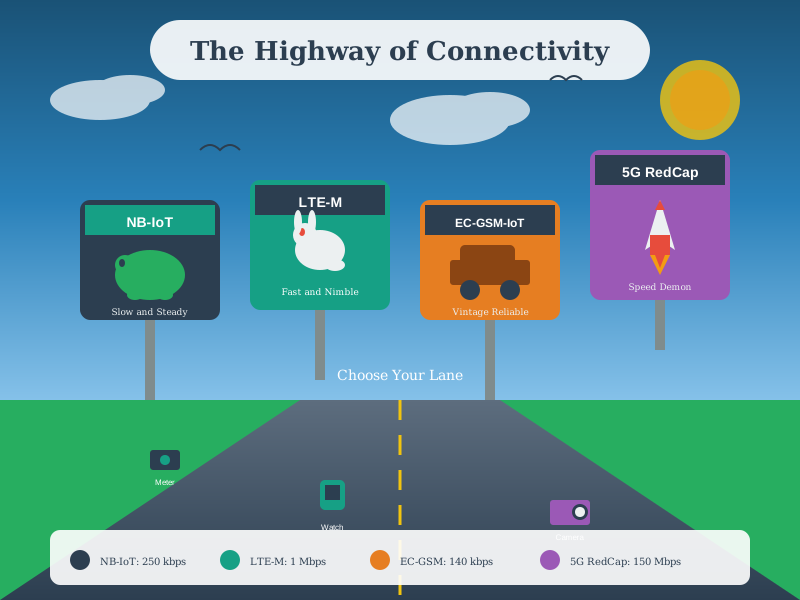
This visualization helps guide technology selection between NB-IoT and LTE-M based on application requirements like mobility, data volume, and battery life targets.
NoteVisual: Cellular Handoff Process
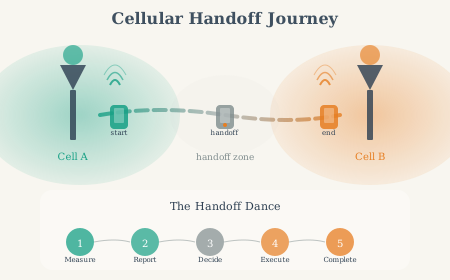
Understanding cellular handoff is critical for mobile asset tracking applications where LTE-M’s faster handoff (50ms vs NB-IoT’s 1-10s) directly impacts tracking accuracy.
NoteVisual: Cellular Paging Mechanism
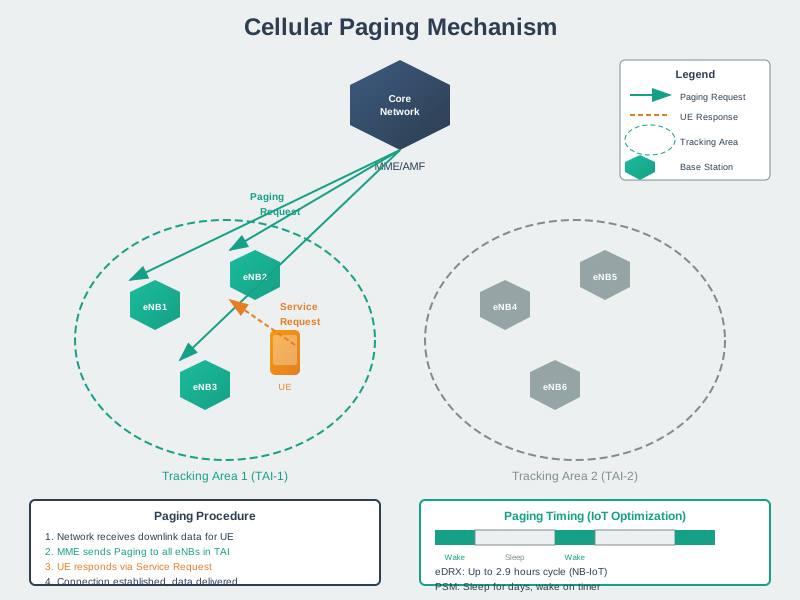
The paging mechanism enables power-efficient device operation where devices can sleep for extended periods and wake only when the network has data to deliver.
1156.6 Summary
- Asset Tracking (LTE-M): Mobile assets (vehicles, containers, equipment) require handover, moderate data rates (10-500 KB/day), real-time GPS updates, and global roaming with eSIM for cost optimization
- Smart Metering (NB-IoT): Stationary meters leverage deep coverage (CE2 mode for basements), ultra-low power (15+ year battery life), minimal data (144-1,400 bytes/day), and existing cellular infrastructure to eliminate meter reader labor costs
- Fleet Management (LTE-M/LTE Cat-1): Commercial vehicle fleets benefit from real-time tracking (30-second updates), OBD-II integration, driver behavior analytics, and route optimization, with LTE Cat-1 supporting optional video/photo capture
- Smart Agriculture (NB-IoT): Wide-area farm monitoring (soil, weather, livestock) utilizes solar-powered sensors, 2-hour update intervals, extended coverage for remote fields, and AI analytics for irrigation and fertilizer optimization
- Technology Selection Framework: Choose NB-IoT for stationary, ultra-low-data applications; LTE-M for mobile, moderate-data scenarios; 4G/5G for high-bandwidth or ultra-low-latency requirements; evaluate 5-year TCO including infrastructure, data plans, and maintenance
- Cost Optimization: eSIM reduces global deployment costs by 70-90% vs roaming SIMs, hybrid architectures (Wi-Fi primary + cellular backup) minimize operational expenses, and solar power eliminates battery replacement costs for outdoor deployments
- ROI Drivers: Cellular IoT delivers value through labor cost elimination (meter reading, fleet management), resource optimization (water, fuel, fertilizer savings of 15-30%), theft prevention, predictive maintenance, and data-driven decision making
1156.7 Knowledge Check
1156.8 What’s Next
Continue exploring cellular IoT implementation and optimization:
- Hands-on Labs: Practice with Cellular IoT Implementations using real modules (SIM7000, BG96) and AT commands
- Deep Dive NB-IoT: Study NB-IoT Fundamentals for coverage modes (CE0/CE1/CE2), power save modes (PSM/eDRX), and deployment options
- Comprehensive Review: Consolidate knowledge with Cellular IoT Review covering all cellular technologies and use cases
- Compare LPWAN: Evaluate alternatives in LPWAN Comparison to understand when LoRaWAN or Sigfox might be better choices
- Application Protocols: Learn MQTT Fundamentals and CoAP for efficient data transmission over cellular networks