360 Fog Production: Review and Knowledge Check
360.1 Fog Production Review and Knowledge Check
This chapter provides a comprehensive review of fog computing production concepts, including knowledge checks, visual references, and connections to related topics throughout the book.
360.2 Learning Objectives
By the end of this chapter, you will be able to:
- Synthesize Production Knowledge: Connect fog computing framework, scenarios, and case study insights
- Verify Understanding: Confirm mastery through comprehensive knowledge checks
- Navigate Related Topics: Identify next steps in your fog computing learning journey
360.3 Prerequisites
Required Chapters: - Fog Production Framework - Architecture patterns and deployment tiers - Fog Production Understanding Checks - Scenario-based analysis - Fog Production Case Study - Autonomous vehicle deployment
360.4 Conclusion
Edge and fog computing represent a fundamental architectural shift in how IoT systems are designed and deployed, moving computation, storage, and intelligence closer to where data is generated and actions are needed. This paradigm addresses critical limitations of purely cloud-centric approaches, particularly for latency-sensitive, bandwidth-constrained, and privacy-critical applications.
The hierarchical architecture spanning edge devices, fog nodes, and cloud data centers enables optimal distribution of processing tasks: time-critical and local-scope operations at the fog layer, while complex global analytics leverage cloud resources. This distribution delivers dramatic improvements in latency (10-100x reduction), bandwidth efficiency (90-99% reduction in cloud traffic), and system reliability through local autonomy.
However, fog computing introduces new challenges in resource management, security, programming complexity, and standardization. Organizations must carefully evaluate use cases to determine appropriate fog computing adoption, recognizing that not all IoT applications benefit equally from edge processing.
As IoT continues to proliferate with billions of connected devices, autonomous vehicles, smart cities, and industrial automation, fog computing will remain essential infrastructure enabling responsive, efficient, and privacy-preserving systems. The convergence of 5G networks, AI/ML at the edge, and maturing fog computing platforms promises to unlock entirely new classes of applications impossible with previous architectural paradigms.
360.5 See Also
Related Topics:
- Wireless Sensor Networks (WSN): Foundation of edge computing data collection showing how distributed sensor nodes self-organize and communicate at the network edge
- Data Analytics at the Edge: Techniques for processing, filtering, and analyzing data locally before cloud transmission, core capability enabled by fog computing architecture
- IoT Reference Architectures: Comprehensive system designs showing how edge/fog computing integrates with traditional cloud-centric architectures for hybrid deployments
- Network Design Considerations: Planning network topologies and communication patterns that leverage fog nodes for optimal latency and bandwidth utilization
Further Reading:
- Energy-Aware Design: Edge processing reduces energy consumption by minimizing data transmission, critical for battery-powered IoT devices
- MQTT Protocol: Lightweight messaging protocol commonly deployed on fog nodes to aggregate data from edge devices before cloud synchronization
- Modeling and Inferencing: Running ML models at the edge/fog layer for real-time predictions without cloud round-trip latency
Practical Applications:
- IoT Use Cases: Real-world examples including smart cities, manufacturing, and autonomous vehicles demonstrating edge/fog computing benefits with quantified latency reductions and bandwidth savings
- Application Domains: Comprehensive exploration of edge computing deployments across smart cities, industrial automation, healthcare, and transportation showing architectural patterns
This chapter series explored edge and fog computing architectures that distribute processing across the IoT system rather than centralizing all computation in the cloud.
Edge-Fog-Cloud Continuum: Modern IoT architectures employ a computing continuum spanning edge devices (sensors, actuators), fog nodes (gateways, local servers), and cloud data centers. Edge computing performs time-sensitive processing directly on or near devices, fog computing provides intermediate aggregation and analysis, and cloud computing handles large-scale batch analytics and long-term storage. This distribution optimizes latency, bandwidth, energy consumption, and computational capability based on application requirements.
Fog Computing Benefits: Fog nodes address several cloud computing limitations for IoT. They provide low-latency processing for real-time applications (industrial control, autonomous vehicles, AR/VR), reduce bandwidth requirements by filtering and aggregating data before cloud transmission, enable offline operation when connectivity is lost, improve security and privacy by keeping sensitive data locally, and support location-aware services. Fog computing effectively extends cloud resources to the network edge while maintaining many cloud benefits.
Architectural Considerations: Designing effective edge-fog-cloud systems requires careful consideration of where to perform different processing tasks. Simple filtering and threshold checks suit edge devices with limited resources. Data aggregation, protocol translation, and local decision-making fit fog nodes. Complex analytics, machine learning training, and long-term data warehousing belong in the cloud. The challenge lies in determining optimal task placement considering latency constraints, bandwidth costs, device capabilities, security requirements, and application characteristics.
Edge and fog computing represent essential architectural patterns for modern IoT systems, enabling responsive, efficient, and scalable applications that traditional cloud-only architectures cannot support.
360.6 Visual Reference Gallery
Explore these AI-generated visualizations that complement the fog computing concepts covered in this chapter. Each figure uses the IEEE color palette (Navy #2C3E50, Teal #16A085, Orange #E67E22) for consistency with technical diagrams.
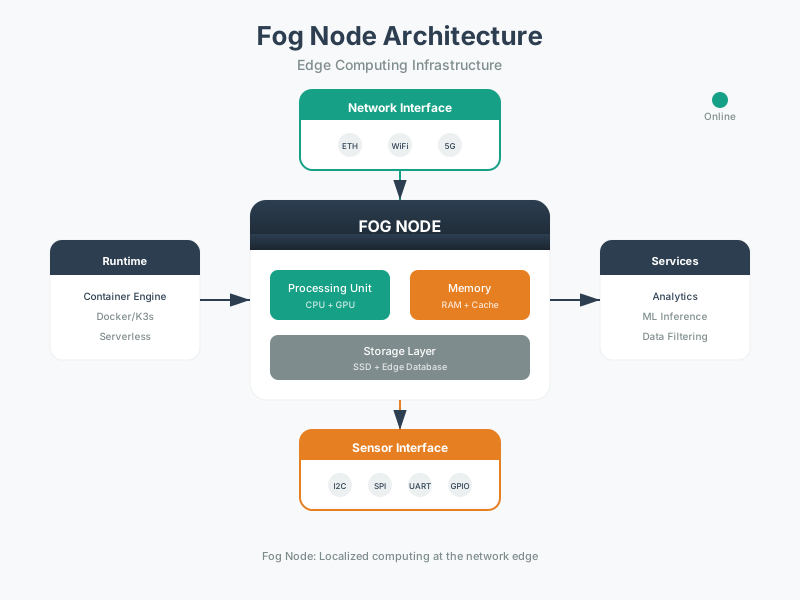
This visualization illustrates the internal architecture of fog nodes, showing how they serve as intermediate processing points between edge devices and cloud infrastructure, enabling local analytics and reduced latency.
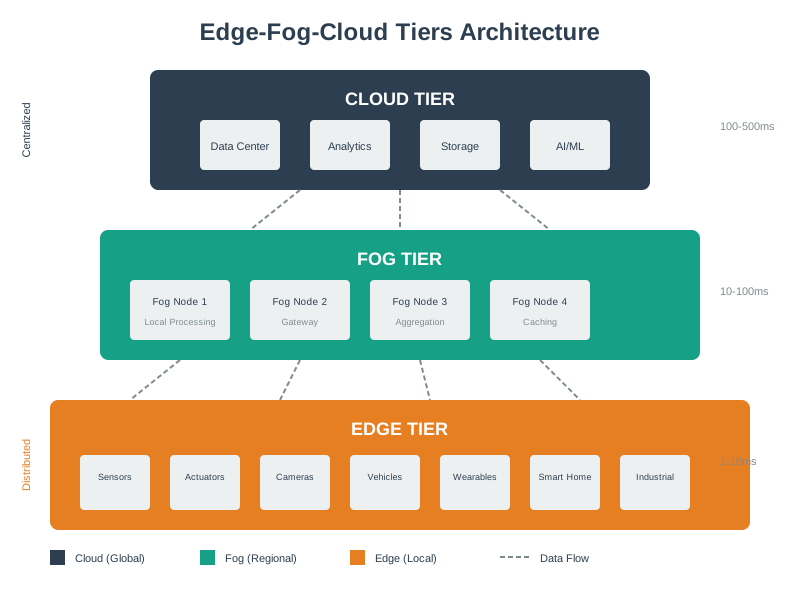
This figure depicts the hierarchical relationship between edge, fog, and cloud computing tiers, emphasizing the trade-offs in latency, bandwidth, and processing power discussed in the production framework.
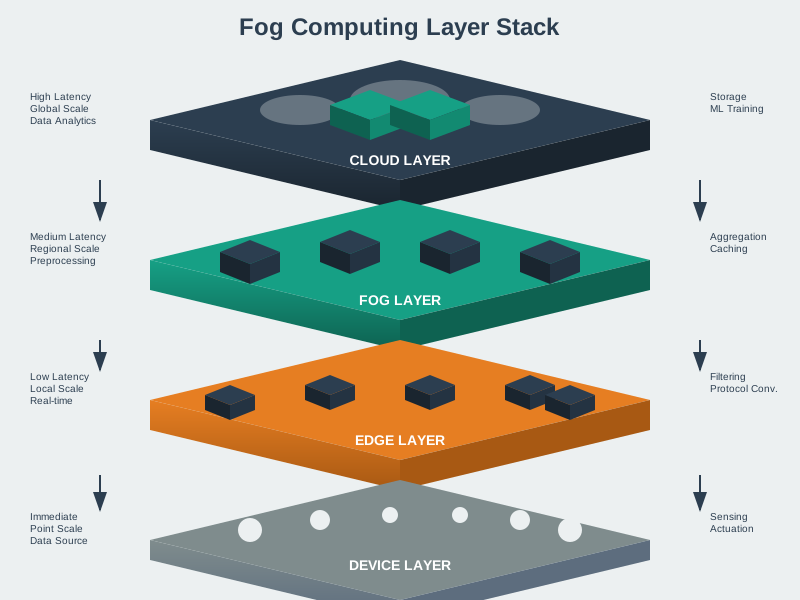
This visualization breaks down the functional layers within a fog computing deployment, corresponding to the ingestion, processing, decision engine, and storage components covered in the production framework.
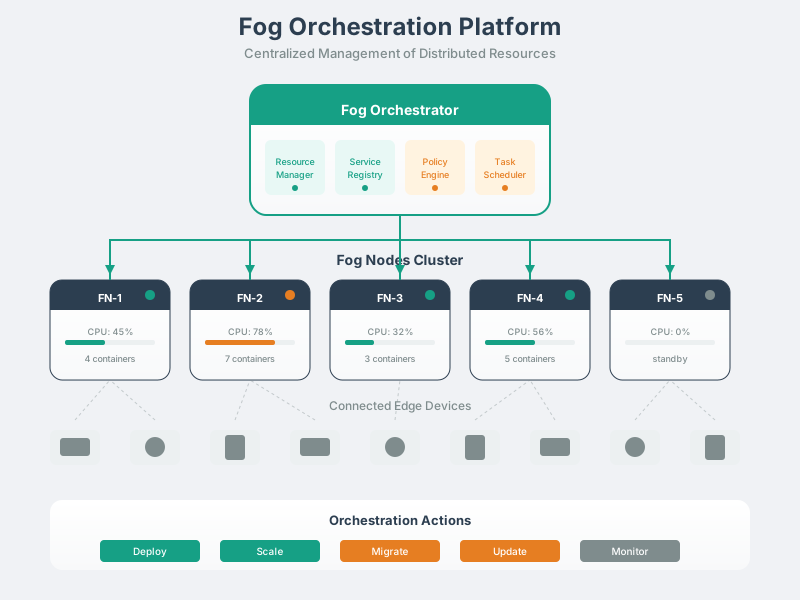
This figure illustrates the orchestration mechanisms that coordinate multiple fog nodes, manage workload distribution, and optimize resource utilization across the fog computing infrastructure.
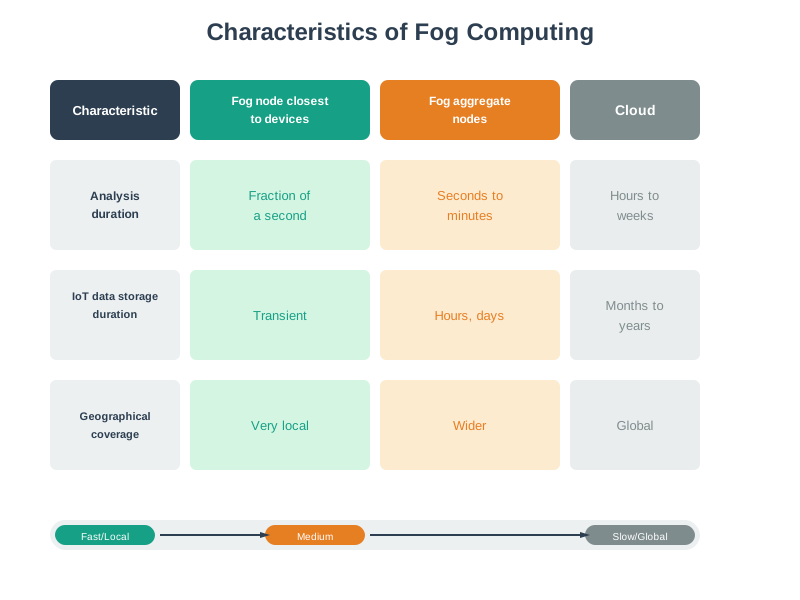
This visualization summarizes the defining characteristics of fog computing that make it suitable for IoT applications requiring real-time processing and local autonomy.
360.7 Summary
This chapter series covered production-ready edge and fog computing architectures:
- Edge-Fog-Cloud Continuum: Hierarchical computing architecture distributes processing across edge devices (sensors, actuators), fog nodes (gateways, regional servers), and cloud data centers, optimizing latency, bandwidth, energy consumption, and computational capability based on application requirements
- Task Offloading Strategies: Intelligent workload distribution algorithms (latency-aware, energy-aware, cost-aware, load-balanced) dynamically assign computation to appropriate tiers, achieving 10-100x latency reduction compared to cloud-only architectures
- Bandwidth Optimization: Edge and fog processing reduces cloud data transmission by 90-99% through local filtering, aggregation, and analytics, cutting bandwidth costs from $800K/month to $12K/month in real deployments
- Autonomous Vehicle Case Study: Production deployment demonstrated <10ms collision avoidance (vs 180-300ms cloud latency), 99.998% data reduction (2 PB/day to 50 GB/day), 98.5% bandwidth cost savings, and zero accidents due to delayed decisions
- Local Autonomy: Fog nodes enable continued operation during network outages, critical for smart grids, healthcare, transportation, and industrial control systems requiring 99.999% availability
- Orchestration Framework: Complete architecture for edge-fog-cloud orchestrator with resource management, task scheduling, energy estimation, and multi-tier coordination for production IoT systems
360.8 Knowledge Check
Deep Dives: - Fog Fundamentals - Core fog computing concepts and edge-fog-cloud continuum - Edge Compute Patterns - Data processing at the edge - Fog Optimization - Task offloading and resource management strategies
Comparisons: - Cloud Computing - Understanding when cloud vs fog is appropriate - Edge-Fog-Cloud Overview - Three-tier architecture decision framework
Products: - IoT Use Cases - Real-world fog deployments (autonomous vehicles, smart cities)
Learning: - Simulations Hub - Tools for testing fog architectures - Quizzes Hub - Test your fog computing knowledge
360.9 What’s Next
Now that you understand fog computing production deployment, continue your learning journey:
Next in Architecture: - Sensing As A Service: Explore sensor virtualization and sensing as a service models that leverage fog infrastructure for sensor data aggregation and distribution
Apply These Concepts: - Network Design and Simulation: Design latency budgets and bandwidth envelopes for your fog deployments using NS-3 and OMNeT++ - Edge Compute Patterns: Choose data placement and edge filtering strategies that optimize your fog architecture - Data in the Cloud: Integrate fog nodes with cloud analytics and data lakes for hybrid processing
Security Considerations: - Security and Privacy Overview: Plan distributed authentication and policy enforcement across edge-fog-cloud tiers
Real-World Examples: - IoT Use Cases: See more fog computing deployments in smart cities, industrial automation, and healthcare