%% fig-alt: "Diagram showing IoT architecture components and their relationships with data flow and processing hierarchy."
%%{init: {'theme': 'base', 'themeVariables': { 'primaryColor': '#2C3E50', 'primaryTextColor': '#fff', 'primaryBorderColor': '#16A085', 'lineColor': '#16A085', 'secondaryColor': '#E67E22', 'tertiaryColor': '#7F8C8D', 'clusterBkg': '#ECF0F1', 'clusterBorder': '#2C3E50', 'edgeLabelBackground':'#fff'}}}%%

graph TB
    subgraph WMSN["WMSN Network Architecture"]
        subgraph ScalarTier["Scalar Sensor Tier - Low Power PIR"]
            SS1[SS Node 1<br/>PIR Motion]
            SS2[SS Node 2<br/>PIR Motion]
            SS3[SS Node 3<br/>PIR Motion]
        end

        subgraph CameraTier["Camera Sensor Tier - High Power"]
            CS1[CS Node 1<br/>Camera+Image]
            CS2[CS Node 2<br/>Camera+Image]
        end

        SS1 & SS2 & SS3 -->|Trigger| CS1 & CS2
        CS1 & CS2 -->|Images| CH[Cluster Head<br/>Data Fusion]
        CH -->|Compressed| Sink[Sink/Gateway]
    end

    Sink -->|Alert| Cloud[Cloud Platform]

    style SS1 fill:#16A085,stroke:#2C3E50,color:#fff
    style SS2 fill:#16A085,stroke:#2C3E50,color:#fff
    style SS3 fill:#16A085,stroke:#2C3E50,color:#fff
    style CS1 fill:#E67E22,stroke:#2C3E50,color:#fff
    style CS2 fill:#E67E22,stroke:#2C3E50,color:#fff
    style CH fill:#2C3E50,stroke:#16A085,color:#fff
    style Sink fill:#2C3E50,stroke:#16A085,color:#fff
399 Wireless Multimedia Sensor Networks (WMSNs)
TipFor Beginners: Camera Networks That Save Energy
Imagine you want to catch pictures of rare animals in a forest. You could leave cameras running 24/7, but that would drain batteries in days. Instead, smart wildlife cameras use a simple trick:
- Motion sensors (cheap, low power) run all the time watching for movement
- Cameras (expensive, high power) stay asleep until motion is detected
- When an animal walks by, the motion sensor wakes up the camera for just a few seconds
This simple idea - using cheap sensors to trigger expensive ones - saves 90%+ of energy and extends battery life from weeks to months!
| Term | Simple Explanation |
|---|---|
| WMSN | Wireless Multimedia Sensor Networks - networks with cameras and microphones |
| Scalar Sensor | Simple sensor with one value (temperature, motion) - small and cheap |
| Camera Sensor | Takes pictures/video - large data, high power, expensive |
| PIR | Passive Infrared - detects body heat/motion, very low power |
| Coalition | Group of cameras working together to cover a target |
| Triggered Activation | Waking up cameras only when needed |
Why this matters: Without triggered activation, camera networks would need constant battery changes. With it, wildlife cameras can run for months, security systems can cover large areas affordably, and multimedia sensing becomes practical for remote deployments.
399.1 Learning Objectives
By the end of this chapter, you will be able to:
- Design WMSN Architectures: Plan networks combining scalar sensors with cameras and microphones
- Compare CS vs SS Nodes: Understand the 10-100x power difference between camera and scalar sensors
- Implement Camera Triggering: Create event-driven camera activation using scalar sensor inputs
- Calculate Energy Savings: Quantify battery life extension from triggered activation strategies
- Apply Coalition Formation: Use game-theoretic approaches to minimize active camera count
- Deploy Multi-Tier Systems: Design progressive activation architectures for surveillance
399.2 Prerequisites
Before diving into this chapter, you should be familiar with:
- Wireless Sensor Networks: Understanding of WSN architecture, node types, and deployment patterns
- WSN Tracking Fundamentals: Core tracking concepts including localization and sensor coordination
- Duty Cycling and Topology: Energy management techniques and topology control strategies
399.3 WMSN Architecture
Traditional WSNs use scalar sensors (temperature, light, motion). Wireless Multimedia Sensor Networks add cameras and microphones for rich contextual information.
399.3.1 Hierarchical Network Design
%%{init: {'theme': 'base', 'themeVariables': {'primaryColor': '#2C3E50', 'primaryTextColor': '#fff', 'primaryBorderColor': '#16A085', 'lineColor': '#16A085', 'secondaryColor': '#E67E22', 'tertiaryColor': '#7F8C8D'}}}%%
quadrantChart
    title WMSN Sensor Type Trade-offs
    x-axis Low Data Rate --> High Data Rate
    y-axis Low Power --> High Power
    quadrant-1 Use sparingly (triggered only)
    quadrant-2 Avoid if possible
    quadrant-3 Deploy densely (always-on OK)
    quadrant-4 Gateway candidates

    PIR Motion: [0.15, 0.12]
    Temperature: [0.10, 0.08]
    Humidity: [0.12, 0.10]
    Light Sensor: [0.08, 0.06]
    VGA Camera: [0.75, 0.72]
    HD Camera: [0.88, 0.85]
    Microphone: [0.55, 0.45]
    Video Stream: [0.95, 0.92]
WMSN architecture showing hierarchical integration of scalar sensors (PIR motion detectors) and camera sensors. Scalar sensors detect events and trigger nearby cameras for visual confirmation, achieving 99% energy savings through event-driven multimedia capture.
399.3.2 Key Differences: CS vs SS Nodes
| Feature | Scalar Sensor (SS) | Camera Sensor (CS) |
|---|---|---|
| Data Type | Scalar values (temperature, light) | Images, video frames |
| Data Size | Small (~10 bytes) | Large (~1-10 KB per frame) |
| Sensing Range | Omnidirectional (360 degrees) | Directional (30-60 degree FOV) |
| Power Consumption | Low (~10-50 mW) | High (~100-500 mW) |
| Cost | Inexpensive (~$1-10) | Expensive (~$20-100) |
| Processing | Minimal | Significant (image processing) |
| Deployment Density | High (hundreds per area) | Low (tens per area) |
WarningCommon Misconception: “Just Use Lower Resolution Cameras”
The Misconception: Many assume that using lower-resolution cameras solves WMSN energy problems without needing scalar sensor triggering.
The Reality: Resolution reduction provides only marginal energy savings compared to camera activation/deactivation strategies.
Real-World Example - Wildlife Camera Trap Deployment:
A conservation project deployed 50 camera traps across 100 hectares to monitor endangered species:
Approach A: Always-on Low-Resolution Cameras (320x240 QVGA) - Camera power: 250 mW continuous operation - Daily energy per node: 250 mW x 24 hours = 6 Wh/day - 50 cameras: 300 Wh/day total - Battery life (3000 mAh @ 3.7V): ~1.5 weeks - Maintenance visits required: 35 visits/year (every 1.5 weeks) - Useful images captured: 5% (most frames show empty forest)
Approach B: High-Resolution with PIR Triggering (1280x720 HD) - PIR sensor: 15 mW continuous - Camera (triggered): 600 mW for 10 seconds per event - Average events: 8 per day (animals passing) - Daily energy: (15 mW x 24h) + (600 mW x 80s/day) = 0.36 Wh + 0.013 Wh = 0.37 Wh/day - 50 cameras: 18.5 Wh/day total - Battery life: 10 months - Maintenance visits required: 1-2 visits/year - Useful images captured: 95% (cameras wake only for animals)
Results: - 94% energy reduction (300 Wh to 18.5 Wh per day) despite using 4x higher resolution - 20x longer battery life (1.5 weeks to 10 months) - 17x fewer maintenance visits (35 to 2 per year) - $12,000 annual savings in field technician costs (travel, labor) - 19x higher image quality (320x240 to 1280x720 pixels)
Key Insight: Event-driven activation provides orders of magnitude more benefit than resolution reduction because the camera is completely off 99.9% of the time, consuming zero power for image sensing and processing.
399.4 Wildlife Monitoring Application
%% fig-alt: "Diagram showing IoT architecture components and their relationships with data flow and processing hierarchy."
%%{init: {'theme': 'base', 'themeVariables': { 'primaryColor': '#2C3E50', 'primaryTextColor': '#fff', 'primaryBorderColor': '#16A085', 'lineColor': '#16A085', 'secondaryColor': '#E67E22', 'tertiaryColor': '#7F8C8D'}}}%%

graph LR
    PIR[PIR Sensor<br/>10mW 24/7] -->|Motion<br/>Detected| Trigger{Trigger<br/>Logic}
    Trigger -->|Wake Up| Camera[Camera Node<br/>500mW for 5s]
    Camera -->|Image| Compression[JPEG<br/>Compression]
    Compression -->|LoRa| Gateway[Gateway]

    style PIR fill:#16A085,stroke:#2C3E50,color:#fff
    style Camera fill:#E67E22,stroke:#2C3E50,color:#fff
    style Trigger fill:#2C3E50,stroke:#16A085,color:#fff
    style Compression fill:#7F8C8D,stroke:#2C3E50,color:#fff
    style Gateway fill:#2C3E50,stroke:#16A085,color:#fff
Wildlife monitoring WMSN system: PIR motion sensor runs continuously at 10mW, triggering camera activation only when animals detected. Camera operates for 5 seconds per event, extending battery life from 2 weeks (always-on) to 6+ months (event-driven).
Energy Optimization: - PIR (SS) runs 24/7 at 10 mW - Camera (CS) wakes only when PIR triggers - Camera on-time: ~5 seconds per event - Battery life: 6 months vs 2 weeks if camera always on
Implementation:
// WMSN: PIR triggers camera
class WMSNNode {
private:
    bool is_camera_node;
    int pir_pin, camera_enable_pin;

public:
    void loop() {
        if (!is_camera_node) {
            // Scalar sensor node: monitor PIR
            if (digitalRead(pir_pin) == HIGH) {
                // Motion detected - trigger nearby camera
                sendWakeupToCamera();
            }
        } else {
            // Camera node: wait for trigger
            if (receivedWakeupSignal()) {
                captureAndTransmitImage();
            }
        }
    }

    void captureAndTransmitImage() {
        // Power on camera
        digitalWrite(camera_enable_pin, HIGH);
        delay(100);  // Camera startup time

        // Capture image (simplified)
        uint8_t image[1024];
        captureImage(image, sizeof(image));

        // Compress (JPEG)
        uint8_t compressed[512];
        size_t compressed_size = compressJPEG(image, compressed);

        // Transmit via LoRa
        transmitImage(compressed, compressed_size);

        // Power off camera
        digitalWrite(camera_enable_pin, LOW);
    }
};
399.5 Security Surveillance Application
Challenge: Provide 24/7 coverage with limited bandwidth and energy.
Solution: Hierarchical WMSN - Tier 1: Dense scalar sensors (PIR, acoustic) for initial detection - Tier 2: Strategic camera placement for visual confirmation - Tier 3: PTZ (Pan-Tilt-Zoom) cameras for detailed investigation
%% fig-alt: "Diagram showing IoT architecture components and their relationships with data flow and processing hierarchy."
%%{init: {'theme': 'base', 'themeVariables': { 'primaryColor': '#2C3E50', 'primaryTextColor': '#fff', 'primaryBorderColor': '#16A085', 'lineColor': '#16A085', 'secondaryColor': '#E67E22', 'tertiaryColor': '#7F8C8D'}}}%%

graph TB
    subgraph Tier1["Tier 1: Dense Detection - 100 bytes/s"]
        PIR1[PIR Sensor]
        PIR2[PIR Sensor]
        Acoustic[Acoustic Sensor]
    end

    subgraph Tier2["Tier 2: Visual Confirmation - 10 KB/s"]
        Cam1[Fixed Camera]
        Cam2[Fixed Camera]
    end

    subgraph Tier3["Tier 3: Tracking - 1 MB/s"]
        PTZ[PTZ HD Camera]
    end

    PIR1 & PIR2 & Acoustic -->|Motion| Tier2
    Cam1 & Cam2 -->|Human<br/>Confirmed| PTZ
    PTZ -->|HD Video| Security[Security<br/>Personnel]

    style PIR1 fill:#16A085,stroke:#2C3E50,color:#fff
    style PIR2 fill:#16A085,stroke:#2C3E50,color:#fff
    style Acoustic fill:#16A085,stroke:#2C3E50,color:#fff
    style Cam1 fill:#E67E22,stroke:#2C3E50,color:#fff
    style Cam2 fill:#E67E22,stroke:#2C3E50,color:#fff
    style PTZ fill:#2C3E50,stroke:#16A085,color:#fff
Hierarchical security surveillance WMSN with progressive activation tiers. Dense Tier 1 scalar sensors detect motion (100 bytes/s), Tier 2 cameras confirm humans (10 KB/s on-demand), Tier 3 PTZ provides HD tracking (1 MB/s only for confirmed threats), achieving 99% bandwidth reduction vs. always-on HD cameras.
Progressive Activation: 1. PIR detects motion -> activates fixed camera 2. Camera confirms human -> activates PTZ for tracking 3. PTZ provides HD video to security personnel
Bandwidth Savings: - Tier 1: ~100 bytes/s (scalar data) - Tier 2: ~10 KB/s (low-res snapshots on demand) - Tier 3: ~1 MB/s (HD video only when confirmed threat)
Result: 99% bandwidth reduction vs always-on HD cameras
399.6 Topology Management in WMSNs
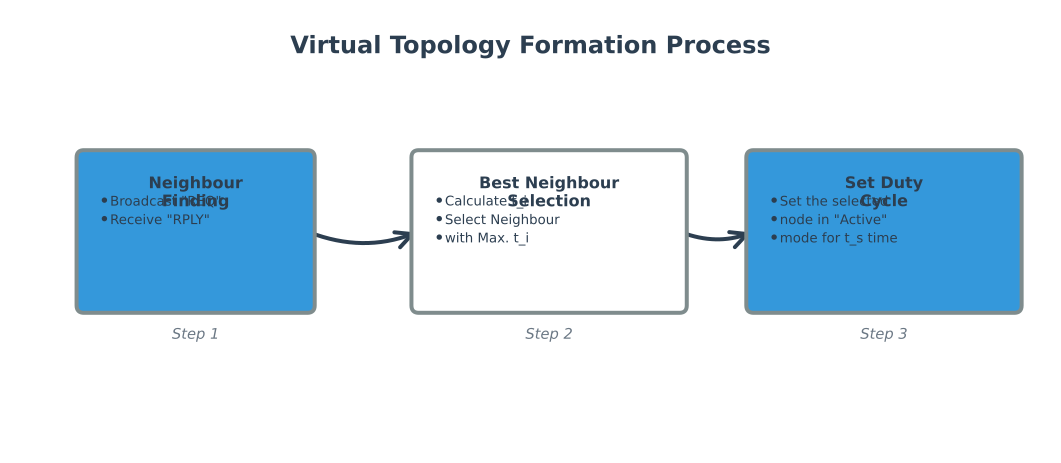
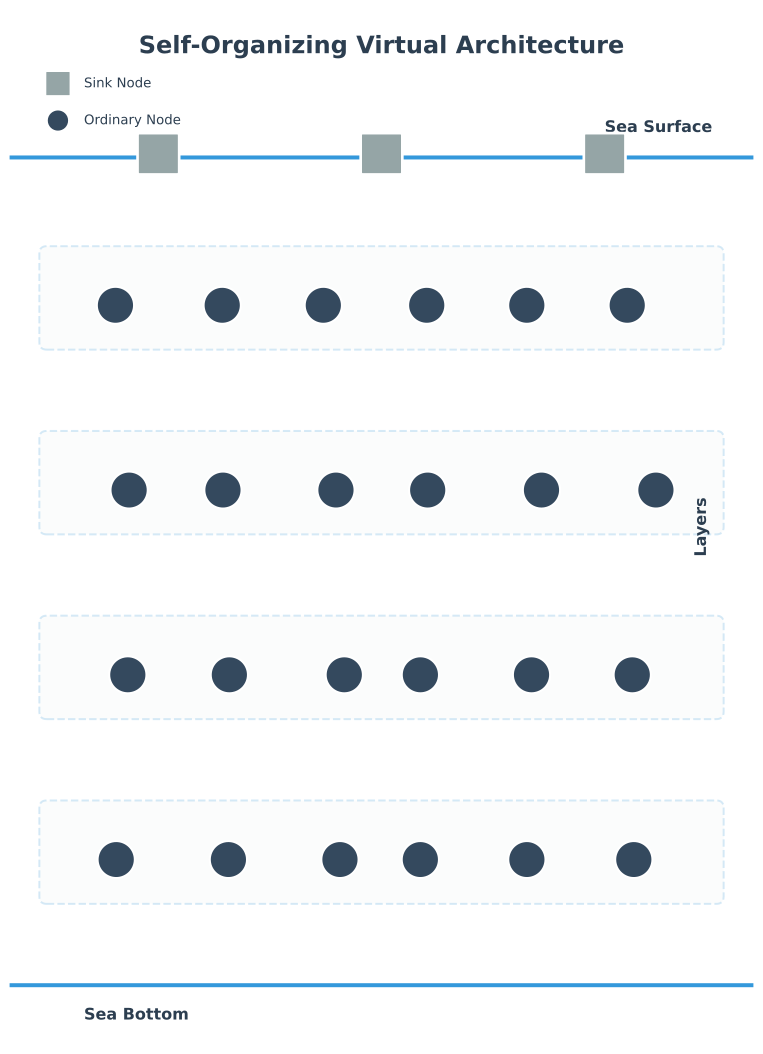
Challenge: Coordinate CS and SS nodes to provide coverage, connectivity, and maximize network lifetime.
Coalition Formation Game Approach:
Coalition formation uses game-theoretic principles where cameras negotiate to form the minimum set covering a target. This approach:
- Reduces active cameras: Instead of activating all cameras, only those with overlapping coverage of the target participate
- Balances energy: Cameras with higher remaining energy take priority
- Maintains coverage: Ensures no gaps in visual confirmation capability
399.7 Knowledge Check
TipQuestion: Multi-Tier Sensor Activation
In a three-tier WMSN surveillance system (PIR sensors -> fixed cameras -> PTZ cameras), what determines when to activate the next higher tier?
Options: - A) Timer-based activation on fixed schedule - B) Random sampling to ensure coverage - C) Confidence threshold - only activate higher tier when lower tier detection confidence exceeds threshold - D) Network bandwidth availability
NoteAnswer
Correct: C) Confidence threshold - only activate higher tier when lower tier detection confidence exceeds threshold
Three-tier progressive activation:
| Tier | Sensors | Power | Bandwidth | Activation Threshold |
|---|---|---|---|---|
| 1 | PIR, acoustic | 1-10 mW | 100 B/s | Always active |
| 2 | Fixed cameras | 100-500 mW | 10 KB/s | Tier 1 confidence > 50% |
| 3 | PTZ HD cameras | 500-2000 mW | 1 MB/s | Tier 2 confidence > 75% |
Workflow: 1. Tier 1 (PIR) detects motion -> 60% confidence (animal or human?) 2. 60% > 50% threshold -> activate Tier 2 fixed camera 3. Camera confirms human shape -> 85% confidence 4. 85% > 75% threshold -> activate Tier 3 PTZ for HD tracking 5. Tier 3 streams video to security personnel
Energy/bandwidth savings: - Without progressive activation: All tiers active = 2510 mW + 1.01 MB/s continuous - With progressive activation: Tier 1 always (10 mW), Tier 2/3 on-demand - During 8-hour shift with 5 incidents: 95%+ energy savings
399.8 Summary
This chapter explored Wireless Multimedia Sensor Networks (WMSNs) that integrate cameras and microphones with traditional scalar sensors:
WMSN Architecture: - Hierarchical integration of scalar sensors (PIR, acoustic) with camera/microphone nodes - Camera sensors consume 10-100x more power than scalar sensors - Event-driven activation achieves 99% energy savings vs. always-on operation
Key Design Principles: - Use low-power scalar sensors for continuous monitoring - Trigger high-power multimedia sensors only on confirmed events - Coalition formation minimizes active camera count while maintaining coverage
Real-World Impact: - Wildlife camera traps: Extended from 1.5 weeks to 10 months battery life - Security surveillance: 99% bandwidth reduction through progressive activation - Maintenance costs: 17x fewer field visits required
Application Patterns: - Wildlife monitoring: Motion-triggered HD cameras with 94% energy reduction - Security surveillance: 3-tier progressive activation (PIR -> fixed camera -> PTZ) - Industrial inspection: Periodic high-resolution imaging triggered by anomaly detection
399.9 What’s Next
Continue to Underwater Acoustic Sensor Networks to learn how sensor networks operate in underwater environments where radio waves cannot propagate.