%%{init: {'theme': 'base', 'themeVariables': { 'primaryColor': '#2C3E50', 'primaryTextColor': '#fff', 'primaryBorderColor': '#16A085', 'lineColor': '#16A085', 'secondaryColor': '#E67E22', 'tertiaryColor': '#ecf0f1'}}}%%
flowchart LR
    subgraph Without["Without ML: Just Numbers"]
        R1[Steps: 5000]
        R2[Heart Rate: 120 bpm]
        R3[Accel: 0.2, 9.8, -0.1]
    end

    subgraph With["With ML: Actionable Insights"]
        I1[You're Running]
        I2[High Intensity Workout]
        I3[Unusual Heart Pattern]
    end

    R1 & R2 & R3 --> ML[Machine Learning<br/>Model]
    ML --> I1 & I2 & I3

    style R1 fill:#7F8C8D,stroke:#2C3E50,color:#fff
    style R2 fill:#7F8C8D,stroke:#2C3E50,color:#fff
    style R3 fill:#7F8C8D,stroke:#2C3E50,color:#fff
    style ML fill:#2C3E50,stroke:#16A085,color:#fff
    style I1 fill:#27AE60,stroke:#2C3E50,color:#fff
    style I2 fill:#E67E22,stroke:#2C3E50,color:#fff
    style I3 fill:#E74C3C,stroke:#2C3E50,color:#fff
1348 IoT Machine Learning Fundamentals
1348.1 Learning Objectives
By the end of this chapter, you will be able to:
- Understand ML Basics for IoT: Differentiate between training and inference phases in machine learning
- Recognize Feature Extraction: Understand why raw sensor data must be transformed into meaningful features
- Compare Sensing Approaches: Differentiate between mobile/wearable sensing and traditional sensor networks
- Understand Edge vs Cloud: Recognize the trade-offs between running ML on devices vs in the cloud
1348.2 Prerequisites
Before diving into this chapter, you should be familiar with:
- Data Storage and Databases: Understanding how IoT data is collected, stored, and accessed provides foundation for building machine learning models
- Edge and Fog Computing: Knowledge of distributed computing architectures helps contextualize where ML inferencing occurs
- Basic statistics concepts: Understanding mean, variance, and standard deviation helps with feature engineering
NoteChapter Series: Modeling and Inferencing
This is the first chapter in a series on IoT Machine Learning:
- ML Fundamentals (this chapter) - Core concepts, training vs inference
- Mobile Sensing & Activity Recognition - HAR, transportation detection
- IoT ML Pipeline - 7-step pipeline, best practices
- Edge ML & Deployment - TinyML, quantization
- Audio Feature Processing - MFCC, keyword recognition
- Feature Engineering - Feature design and selection
- Production ML - Monitoring, anomaly detection
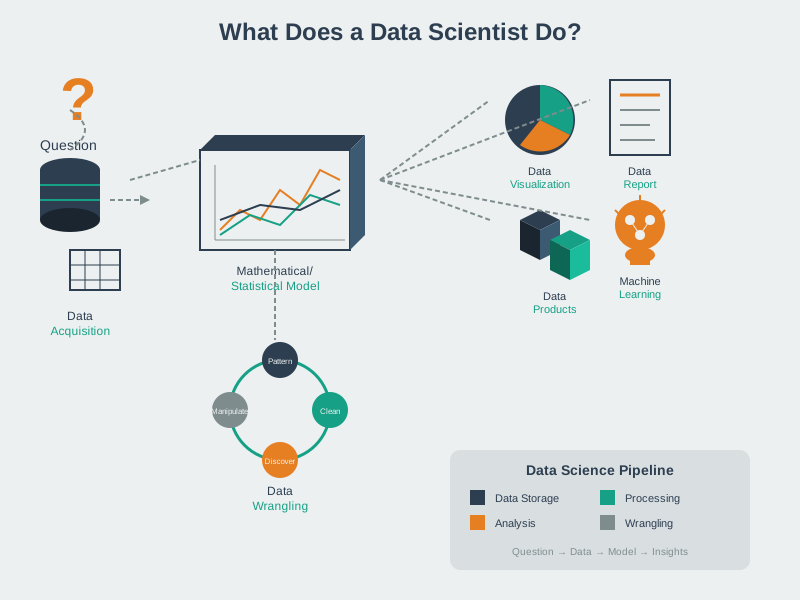
1348.3 Getting Started (For Beginners)
TipFor Kids: Meet the Sensor Squad!
Machine Learning is like teaching your sensors to become super-smart detectives!
1348.3.1 The Sensor Squad Adventure: The Pattern Patrol
It was a quiet Tuesday when Motion Mo noticed something strange. “Hey team, I keep seeing the same pattern every day! The humans wake up at 7am, eat breakfast at 7:30, and leave for work at 8:15.”
Thermo the Temperature Sensor nodded excitedly. “I see patterns too! The house gets warm around 6pm when everyone comes home, and it cools down at 11pm when they go to bed.”
Signal Sam gathered everyone for an important announcement. “Sensors, you’ve just discovered something AMAZING. You’re doing what scientists call Machine Learning - finding patterns in data and using them to make smart predictions!”
Sam drew a picture to explain:
Step 1 - COLLECT: “First, we gather lots of examples. Motion Mo, you’ve recorded 10,000 mornings of people waking up.”
Step 2 - LEARN: “Then we show a computer all those examples. ‘See how the motion always starts in the bedroom, then moves to the bathroom, then to the kitchen? THAT’S the wake-up pattern!’”
Step 3 - PREDICT: “Now the smart part! When Motion Mo sees that same pattern starting, the computer can predict: ‘Someone’s waking up! Better start warming up the coffee maker!’”
1348.3.2 Key Words for Kids
| Word | What It Means |
|---|---|
| Machine Learning | Teaching computers to find patterns and make predictions |
| Pattern | Something that happens the same way over and over |
| Training | Showing the computer LOTS of examples so it can learn |
| Prediction | A smart guess about what will happen next |
| Model | The “brain” that the computer builds after learning |
| Inference | When the trained model looks at NEW data and makes a prediction |
1348.3.3 Try This at Home!
Be a Pattern Detective:
- For one week, write down what time you go to bed and wake up
- Also note if it’s a school day or weekend
- After a week, look at your data - can you find the pattern?
- Now make a PREDICTION: What time will you wake up next Saturday?
Congratulations - you just did Machine Learning with your brain!
1348.4 What is Machine Learning for IoT?
TipSimple Explanation
Analogy: ML for IoT is like teaching a smart assistant to recognize patterns.
Imagine you have a fitness tracker. Instead of just showing raw numbers (steps: 5000, heart rate: 120), it can tell you: - “You’re running” (not walking) - “Your workout intensity is high” - “You might be getting sick” (unusual heart patterns)
That’s machine learning—turning raw sensor data into meaningful insights!
1348.5 Training vs Inference: Two Phases
Machine learning has two main phases:
| Phase | What Happens | Where | Example |
|---|---|---|---|
| Training | Learn patterns from data | Cloud (powerful computers) | Analyze 10,000 hours of walking/running data |
| Inference | Apply learned patterns | Edge/Device (real-time) | Detect current activity from live sensor |
%%{init: {'theme': 'base', 'themeVariables': { 'primaryColor': '#2C3E50', 'primaryTextColor': '#fff', 'primaryBorderColor': '#16A085', 'lineColor': '#16A085', 'secondaryColor': '#E67E22', 'tertiaryColor': '#ecf0f1'}}}%%
flowchart TB
    subgraph Cloud["TRAINING (Cloud - Once)"]
        D[Historical Data<br/>10,000 hours<br/>walking/running] --> T[Training<br/>Algorithm]
        T --> M[Trained Model<br/>100 MB]
    end

    M --> C[Compression<br/>Quantization]
    C --> SM[Small Model<br/>2 MB]

    SM --> Deploy[Deploy to<br/>IoT Devices]

    subgraph Edge["INFERENCE (Edge - Real-time)"]
        Deploy --> S[Live Sensor<br/>Data]
        S --> I[Inference<br/>Engine]
        I --> R[Result:<br/>Walking/Running]
    end

    style D fill:#2C3E50,stroke:#16A085,color:#fff
    style T fill:#16A085,stroke:#2C3E50,color:#fff
    style M fill:#E67E22,stroke:#2C3E50,color:#fff
    style SM fill:#27AE60,stroke:#2C3E50,color:#fff
    style I fill:#2C3E50,stroke:#16A085,color:#fff
    style R fill:#27AE60,stroke:#2C3E50,color:#fff
1348.6 Model Compression for IoT
IoT devices have limited resources. Large models must be compressed before deployment:
%%{init: {'theme': 'base', 'themeVariables': { 'primaryColor': '#2C3E50', 'primaryTextColor': '#fff', 'primaryBorderColor': '#16A085', 'lineColor': '#16A085', 'secondaryColor': '#E67E22', 'tertiaryColor': '#ecf0f1'}}}%%
flowchart TB
    Full[Full Model<br/>100 MB<br/>98% accuracy] --> Prune[After Pruning<br/>50 MB<br/>97% accuracy]

    Prune --> Quant[After Quantization<br/>12 MB<br/>95% accuracy]

    Quant --> Distill[After Distillation<br/>2 MB<br/>92% accuracy]

    Distill --> Edge[Edge Deployable<br/>Fits in 4MB RAM<br/>Runs on MCU]

    Full -.->|"50x smaller<br/>6% accuracy loss"| Edge

    style Full fill:#2C3E50,stroke:#16A085,color:#fff
    style Prune fill:#16A085,stroke:#2C3E50,color:#fff
    style Quant fill:#E67E22,stroke:#2C3E50,color:#fff
    style Distill fill:#27AE60,stroke:#2C3E50,color:#fff
    style Edge fill:#27AE60,stroke:#2C3E50,color:#fff
Model compression enables 50x size reduction with only 6% accuracy loss, making real-time inference possible on resource-constrained IoT devices.
1348.7 Feature Extraction: What the Model Actually Sees
ML models don’t understand raw sensor readings. We extract features—meaningful statistics:
| Raw Data | Extracted Features | Why It Matters |
|---|---|---|
| 1000 accelerometer samples | Mean, variance, peak frequency | Running has higher variance than sitting |
| Heart rate over 1 minute | Average, min, max, variability | Exercise vs rest patterns |
| Temperature readings | Rate of change, trend | Fire detection, HVAC optimization |
%%{init: {'theme': 'base', 'themeVariables': { 'primaryColor': '#2C3E50', 'primaryTextColor': '#fff', 'primaryBorderColor': '#16A085', 'lineColor': '#16A085', 'secondaryColor': '#E67E22', 'tertiaryColor': '#ecf0f1'}}}%%
flowchart LR
    Raw[Raw Accel Data<br/>1000 samples<br/>X, Y, Z values] --> Window[Sliding Window<br/>2 seconds]

    Window --> Features[Feature Extraction]

    Features --> F1[Mean: 1.2 m/s²]
    Features --> F2[Variance: 2.8]
    Features --> F3[Peak Freq: 2.5 Hz]

    F1 & F2 & F3 --> ML[ML Model]

    ML --> Activity[Activity:<br/>RUNNING]

    style Raw fill:#7F8C8D,stroke:#2C3E50,color:#fff
    style Features fill:#2C3E50,stroke:#16A085,color:#fff
    style F1 fill:#16A085,stroke:#2C3E50,color:#fff
    style F2 fill:#16A085,stroke:#2C3E50,color:#fff
    style F3 fill:#16A085,stroke:#2C3E50,color:#fff
    style ML fill:#E67E22,stroke:#2C3E50,color:#fff
    style Activity fill:#27AE60,stroke:#2C3E50,color:#fff
NoteKey Takeaway
In one sentence: The hardest part of IoT machine learning is not the algorithm - it is extracting the right features from noisy sensor data and compressing models small enough to run on constrained devices.
Remember this: Feature engineering contributes more to model accuracy than algorithm choice - spend 80% of your time on features (domain knowledge) and 20% on model selection.
1348.8 Edge ML: Running AI on Tiny Devices
TipEdge ML Overview
IoT devices have limited resources. Edge ML means running models directly on devices:
| Where | Pros | Cons | Example |
|---|---|---|---|
| Cloud | Powerful, complex models | Needs internet, latency | Voice assistants (Alexa) |
| Edge | Fast, works offline | Limited model size | Fall detection on smartwatch |
| Hybrid | Best of both | Complex architecture | Process locally, train in cloud |
Why Edge ML? - Fast: No network delay (critical for safety) - Private: Data never leaves device - Cheap: No cloud costs - Efficient: Process only what’s needed
1348.9 Common Misconception: Accuracy Metrics
Warning“95% Accuracy Means My Model Is Great!”
The Trap: Many IoT developers celebrate achieving 95% accuracy, assuming this guarantees production success. However, accuracy alone is misleading for imbalanced datasets.
Real-World Example: Smart Factory Anomaly Detection
A manufacturing company deployed a 95% accurate anomaly detector:
- Dataset: 10,000 normal operations + 500 anomalies (95% normal, 5% anomalies)
- Naive model: Always predict “normal” → 95% accuracy! (Detects 0% of anomalies)
- 95% accurate model: Catches 90% of anomalies BUT generates 10% false positives
The Financial Impact:
Production line: 1,000,000 checks/day
False positives: 950,000 normal × 10% = 95,000 false alarms/day
Cost: 95,000 false alarms × $50 investigation = $4.75M/day wasted
The Fix: Right Metrics for IoT
Instead of accuracy, use:
- Precision: True positives / (true positives + false positives)
- Recall: True positives / actual anomalies
- F1-Score: Harmonic mean balancing precision/recall
- Specificity: True negatives / actual normals
Key Lesson: For rare events (falls, machine failures, security breaches), optimize for high specificity (99.9%+) and high recall (95%+), NOT overall accuracy.
1348.10 Self-Check Questions
NoteTest Your Understanding
Before continuing, can you answer:
- What’s the difference between training and inference?
- Hint: One learns, one applies
- Why do we extract features from raw sensor data?
- Hint: Can an ML model understand “X: 0.2, Y: 9.8”?
- Why would you run ML on the edge instead of the cloud?
- Hint: Think about speed, privacy, and connectivity
- Why is 95% accuracy potentially misleading?
- Hint: What if 95% of your data is one class?
1348.11 Summary
This chapter introduced the fundamentals of machine learning for IoT:
- Training vs Inference: Training learns patterns in the cloud; inference applies them on edge devices
- Feature Extraction: Raw sensor data must be transformed into meaningful statistics
- Model Compression: Techniques like quantization and pruning enable deployment on constrained devices
- Accuracy Metrics: Use precision, recall, and F1-score instead of just accuracy for imbalanced IoT data
1348.12 What’s Next
Continue to Mobile Sensing & Activity Recognition to learn how smartphones and wearables recognize human activities using accelerometer and gyroscope data.