750 DTLS Performance and Implementation
750.1 Learning Objectives
By the end of this chapter, you will be able to:
- Benchmark DTLS Performance: Analyze handshake time, latency, memory, and CPU overhead across configurations
- Optimize Session Management: Implement session resumption and Connection ID for efficient reconnection
- Configure Replay Protection: Tune sliding window for high-loss networks
- Apply Best Practices: Design production-ready DTLS deployments for IoT
Core concept: DTLS adds 10-20ms latency per packet but session resumption can reduce handshake overhead by 60%, critical for battery-powered devices.
Why it matters: Without optimization, DTLS handshakes drain battery faster than the actual data transmission.
Key takeaway: Always enable session caching, use Connection ID for mobile devices, and prefer PSK for constrained gateways managing many connections.
750.2 Prerequisites
Before diving into this chapter, you should be familiar with:
- DTLS Fundamentals and Architecture: Basic DTLS concepts
- DTLS Handshake Protocols: Handshake process understanding
- DTLS Attack Scenarios and Authentication: PSK vs certificate trade-offs
750.3 Performance Benchmarking
Test Setup: ESP32 (240 MHz), CoAP request (100 bytes)
| Metric | UDP (no security) | DTLS 1.2 (PSK) | DTLS 1.2 (Cert) | DTLS 1.3 (PSK) |
|---|---|---|---|---|
| Handshake Time | N/A | 450 ms | 1200 ms | 250 ms |
| Per-packet Latency | 5 ms | 15 ms | 15 ms | 12 ms |
| Throughput | 1200 msg/s | 950 msg/s | 950 msg/s | 1000 msg/s |
| Memory (RAM) | 2 KB | 18 KB | 45 KB | 22 KB |
| Code Size (Flash) | 50 KB | 180 KB | 250 KB | 200 KB |
| CPU per packet | 0.5% | 3% | 3% | 2.5% |
Analysis: - Handshake: DTLS 1.3 is 44% faster than DTLS 1.2 - Certificates: 2.5x slower handshake than PSK (but better scalability) - Runtime overhead: DTLS adds 10ms latency (acceptable for most IoT) - Memory: DTLS requires 9x more RAM than unencrypted UDP
Recommendation for IoT: - Resource-constrained (< 32 KB RAM): PSK mode - Enterprise (> 128 KB RAM): Certificate mode - Firmware: Upgrade to DTLS 1.3 when available (faster, more secure)
750.4 Implementation Best Practices
750.4.1 Session Resumption
Problem: DTLS handshake costs 450ms + 10 UDP packets (battery drain)
Solution: Resume previous session
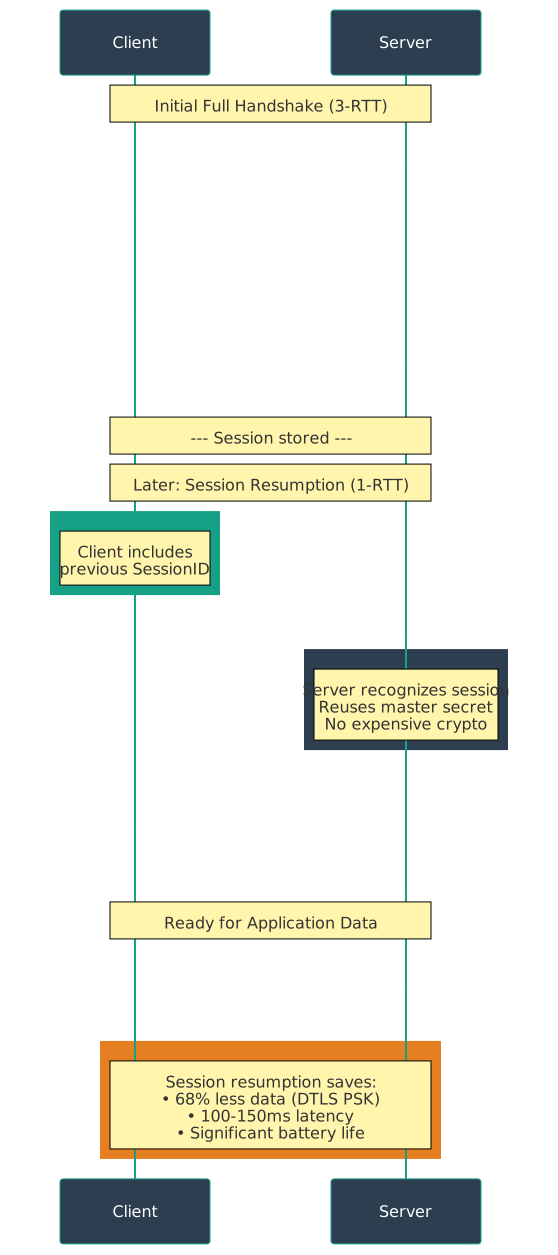
Savings: - Handshake time: 450ms -> 200ms - Packets sent: 10 -> 4 - Battery drain: 60% reduction
Implementation:
// mbedTLS example
mbedtls_ssl_conf_session_cache(&conf, &cache,
                               mbedtls_ssl_cache_get,
                               mbedtls_ssl_cache_set);
// Cache sessions for 1 hour
mbedtls_ssl_cache_set_timeout(&cache, 3600);
750.4.2 Connection ID Extension (RFC 9146)
Problem: IoT devices change IP addresses (NAT rebinding, mobile handoff)
Traditional DTLS:
Session tied to: (Client IP, Client Port, Server IP, Server Port)
IP changes -> Session invalidated -> Must re-handshake
Connection ID:
Session tied to: Connection ID (random 4-byte value)
IP changes -> Session persists!
Use case: Mobile sensor moving between Wi-Fi APs
750.4.3 Replay Window Tuning
Default: 64-packet sliding window
Problem: High packet loss (Wi-Fi in motion) -> legitimate packets rejected as “too old”
Solution: Increase window size
// mbedTLS
mbedtls_ssl_conf_dtls_anti_replay(&conf, MBEDTLS_SSL_ANTI_REPLAY_ENABLED);
mbedtls_ssl_conf_dtls_badmac_limit(&conf, 100); // Allow 100 bad MACs before abortTrade-off: Larger window = more memory, but tolerates more loss.
750.5 Worked Examples
Scenario: You are designing an IoT gateway for a smart factory that needs to maintain simultaneous DTLS connections to 150 sensors. The gateway has 512 KB RAM available for DTLS operations. You need to determine whether to use PSK or certificate-based authentication.
Given: - Number of sensors: 150 - Available RAM: 512 KB - PSK mode memory per session: ~1.5 KB (32-byte PSK + 1 KB session state + 512 bytes crypto context) - Certificate mode memory per session: ~5 KB (2-4 KB certificate storage + 1 KB session state + 512 bytes crypto context) - Session cache overhead: 64 bytes per cached session
Steps:
Calculate memory for PSK mode with all active sessions:
Active sessions: 150 x 1.5 KB = 225 KB
Session cache: 150 x 64 bytes = 9.6 KB
Total PSK: 225 + 9.6 = 234.6 KB
Calculate memory for certificate mode with all active sessions:
Active sessions: 150 x 5 KB = 750 KB
Session cache: 150 x 64 bytes = 9.6 KB
Total Certificates: 750 + 9.6 = 759.6 KB
Compare against available RAM (512 KB):
PSK mode: 234.6 KB < 512 KB (fits with 277 KB headroom)
Certificate mode: 759.6 KB > 512 KB (exceeds by 248 KB)
Calculate maximum concurrent certificate sessions possible:
Max sessions = (512 KB - overhead) / 5 KB = 100 sessions approx
Need: 150 sessions -> Would require session rotation
Result: Use PSK mode for this deployment. It requires 234.6 KB RAM, leaving 277 KB headroom for other gateway functions. Certificate mode would exceed available memory by 48%.
Key Insight: PSK authentication uses approximately 70% less memory than certificate-based authentication, making it the preferred choice for resource-constrained gateways managing many concurrent connections. The trade-off is reduced scalability and manual key provisioning compared to PKI-based systems.
Scenario: A battery-powered environmental sensor sends data to a cloud server every 60 seconds using CoAP over DTLS. The sensor’s battery capacity is 2000 mAh at 3.3V. You need to calculate the battery life difference between full handshake every connection versus using session resumption.
Given: - Reporting interval: 60 seconds (1,440 connections per day) - Full DTLS 1.2 handshake: 6 packets, 450ms total, radio at 25mA during TX/RX - Session resumption: 2 packets, 200ms total - Data transmission: 2 packets, 50ms - Sleep current: 10 uA - Active current (CPU): 15mA for packet processing (100ms per connection) - Battery: 2000 mAh, 3.3V
Steps:
Calculate daily energy for full handshake mode:
Per connection:
- Handshake radio: 25mA x 450ms = 11.25 mAs
- Data radio: 25mA x 50ms = 1.25 mAs
- CPU active: 15mA x 100ms = 1.5 mAs
Total per connection: 14 mAs

Daily:
- Connections: 1,440 x 14 mAs = 20,160 mAs = 5.6 mAh
- Sleep: 10 uA x 24h = 0.24 mAh
- Total: 5.84 mAh/day
Calculate daily energy with session resumption:
Per connection:
- Resumption radio: 25mA x 200ms = 5 mAs
- Data radio: 25mA x 50ms = 1.25 mAs
- CPU active: 15mA x 80ms = 1.2 mAs (faster processing)
Total per connection: 7.45 mAs

Daily:
- Connections: 1,440 x 7.45 mAs = 10,728 mAs = 2.98 mAh
- Sleep: 0.24 mAh
- Total: 3.22 mAh/day
Calculate battery life for each mode:
Full handshake: 2000 mAh / 5.84 mAh/day = 342 days
Session resumption: 2000 mAh / 3.22 mAh/day = 621 days
Calculate improvement:
Battery life improvement: 621 - 342 = 279 additional days
Percentage improvement: (621 - 342) / 342 x 100 = 82% longer battery life
Result: Enabling session resumption extends battery life from 342 days to 621 days, an 82% improvement (nearly doubling the operational lifetime).
Key Insight: DTLS session resumption provides dramatic battery savings for frequently-connecting IoT devices. The 250ms saved per connection (450ms to 200ms) accumulates to massive energy savings over thousands of daily connections. Always enable session caching on battery-powered devices, and consider using DTLS 1.3 for even faster handshakes.
750.6 Visual Reference Gallery
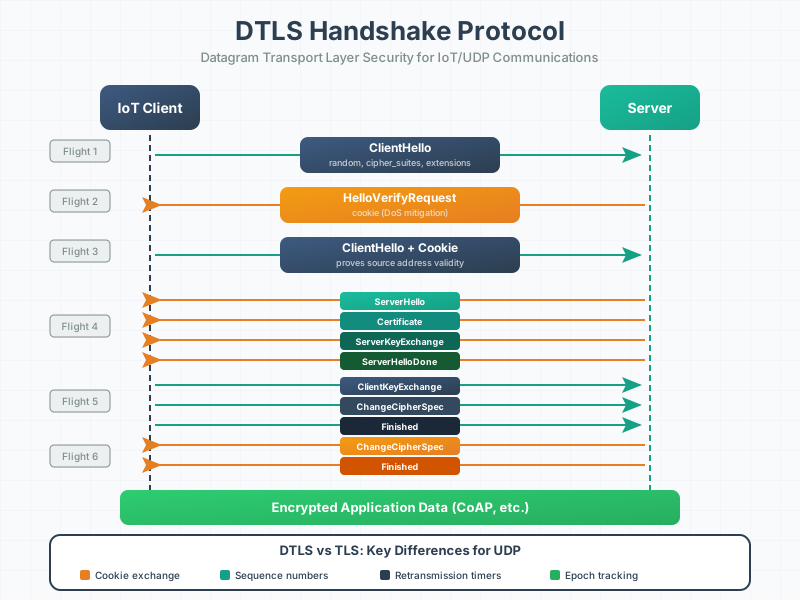
The DTLS handshake adapts TLS for UDP by adding cookie-based DoS protection and handling packet loss during key negotiation, enabling secure real-time IoT communication.
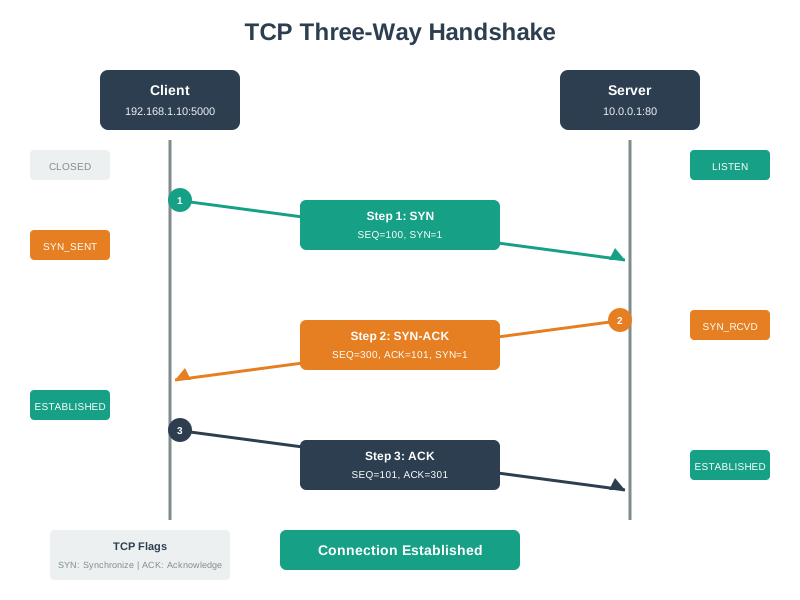
Understanding TCP’s connection overhead helps explain why DTLS over UDP provides lower latency for real-time IoT applications compared to TLS over TCP.
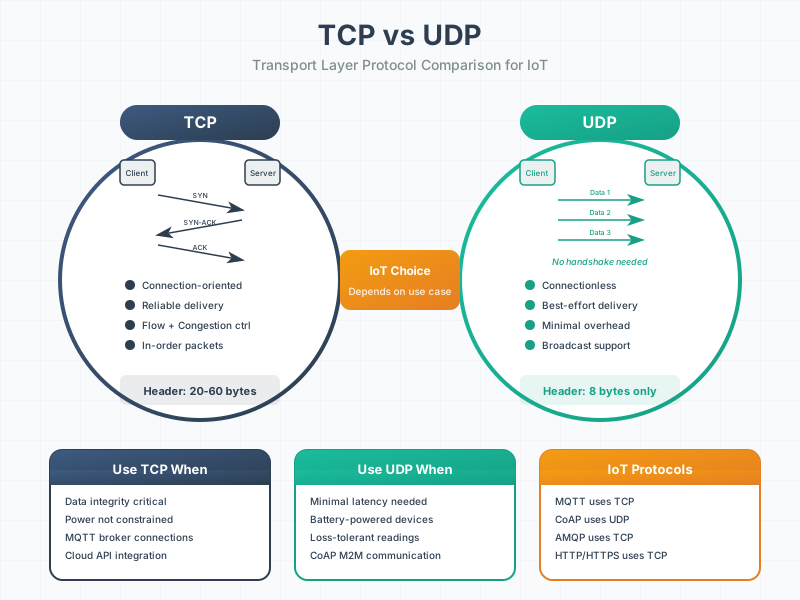
This comparison illustrates why UDP with DTLS is preferred for latency-sensitive IoT applications while TCP with TLS suits reliable data delivery scenarios.
This chapter connects to multiple learning resources across the book:
Interactive Learning: - Simulations Hub: Try the “DTLS Handshake Simulator” to visualize cookie exchange, key negotiation, and packet retransmission in real-time - Practice: Interactive CoAP-over-DTLS simulator shows encryption overhead and session resumption savings
Video Resources: - Videos Hub: “Transport Layer Security Fundamentals” series explains TLS concepts that carry over to DTLS - Recommended: “Real-World DTLS Attacks” video demonstrates amplification DoS, replay attacks, and downgrade attempts
Self-Assessment: - Quizzes Hub: “Transport Security Quiz Bank” tests your understanding of DTLS vs TLS trade-offs, PSK vs certificate modes, and performance optimization - Challenge: “Design Secure IoT System” scenario quiz requires choosing appropriate security architecture
Knowledge Gaps: - Knowledge Gaps Hub: “Why DTLS Cookie Mechanism Isn’t Optional” explains common misunderstanding about HelloVerifyRequest - Troubleshooting: “DTLS Session Resumption Failures” addresses why session caching sometimes doesn’t work
Deep Dives: - Cryptography: Visit Encryption Architecture and Levels for detailed cipher suite explanations (AES-GCM, ECDHE) - Protocol Comparison: See IoT Protocols Fundamentals for UDP vs TCP transport decision framework - Practical Implementation: CoAP Fundamentals shows real-world DTLS configuration for IoT REST APIs
Hands-On Labs: - Encryption Labs: Lab 3 guides you through setting up DTLS with mbedTLS on ESP32 - Performance Testing: Lab 5 measures DTLS handshake latency and battery impact with oscilloscope
These resources work together to build comprehensive DTLS expertise through multiple learning modalities.
Security Foundations: - IoT Security Overview - Comprehensive security landscape - Encryption Architecture and Levels - Cryptographic fundamentals - Cyber Security Methods - Defense mechanisms
Protocol Integration: - CoAP Fundamentals and Architecture - CoAP over DTLS (CoAPS) - IoT Protocols Fundamentals - UDP vs TCP transport - Transport Fundamentals - Transport layer protocols
Application Security: - Device Security - Endpoint protection - Secure Data - Data-in-transit security - Threats, Attacks and Vulnerabilities - Attack scenarios
Learning Resources: - Encryption Labs and Review - Hands-on security exercises - Simulations Hub - Security protocol simulations
750.7 Summary
DTLS Fundamentals: - Purpose: TLS security for UDP applications - Use cases: CoAP, VoIP, WebRTC, real-time telemetry - Trade-off: Adds 10-20ms latency for encryption
Security Features: - Encryption: AES-GCM, ChaCha20 - Authentication: PSK (simple) or Certificates (scalable) - Replay protection: Sequence numbers + sliding window - DoS protection: Cookie mechanism
Performance: - DTLS 1.3: 44% faster handshake than 1.2 - Session resumption: 60% battery savings - PSK vs Certs: PSK uses 70% less memory
Best Practices: - Enable session caching for battery-powered devices - Use Connection ID for mobile IoT - Choose PSK for small deployments, certificates for scale - Tune replay window for high-loss networks
DTLS makes real-time, secure IoT applications possible without the latency penalty of TCP.
750.8 What’s Next?
Continue to Transport Fundamentals to explore how transport layer protocols (TCP, UDP, QUIC) form the backbone of IoT communication, building on the security concepts you’ve learned here.