%%{init: {'theme': 'base', 'themeVariables': {'primaryColor': '#2C3E50', 'primaryTextColor': '#fff', 'primaryBorderColor': '#16A085', 'lineColor': '#E67E22', 'secondaryColor': '#16A085', 'tertiaryColor': '#7F8C8D'}}}%%
graph TB
    A[Network Manager<br/>Centralized Control] --> B[Topology Discovery]
    A --> C[Schedule Generation]
    A --> D[Route Calculation]
    A --> E[Blacklist Management]

    B --> B1[Periodic Network Scan<br/>All Device Neighbors]
    C --> C1[Global TDMA Schedule<br/>Optimized for Latency]
    D --> D1[Graph Routing<br/>Multiple Redundant Paths]
    E --> E1[Channel Quality Monitoring<br/>Blacklist Bad Channels]

    F[Field Devices] --> B
    B --> G[Complete Network View]
    G --> C
    G --> D
    G --> E

    style A fill:#E67E22,stroke:#2C3E50,color:#fff
    style B fill:#2C3E50,stroke:#16A085,color:#fff
    style C fill:#16A085,stroke:#2C3E50,color:#fff
    style D fill:#16A085,stroke:#2C3E50,color:#fff
    style E fill:#2C3E50,stroke:#16A085,color:#fff
1003 WirelessHART Network Management and Routing
1003.1 Learning Objectives
NoteLearning Objectives
By the end of this chapter, you will be able to:
- Explain the role of the centralized Network Manager in WirelessHART
- Compare centralized vs distributed routing approaches
- Understand graph routing and redundant path selection
- Evaluate WirelessHART’s self-healing mesh capabilities
- Compare WirelessHART with alternative protocols for different use cases
- Apply WirelessHART knowledge to industrial IoT deployment decisions
1003.2 Introduction
WirelessHART uses a centralized Network Manager architecture that provides global optimization of routing and scheduling. This chapter explores how centralized control enables WirelessHART’s industrial-grade reliability while examining the trade-offs compared to distributed approaches.
1003.3 Prerequisites
Before diving into this chapter, you should be familiar with:
- WirelessHART Fundamentals: Understanding the protocol architecture and HART background
- WirelessHART TDMA and Channel Hopping: Time-synchronized communication and frequency diversity
1003.4 Centralized Network Manager
1003.4.1 Network Manager Role
{fig-alt=“WirelessHART centralized network manager architecture showing manager performing topology discovery from field devices, generating global TDMA schedules, calculating graph routing with redundant paths, and managing channel blacklists based on quality monitoring”}
1003.4.2 Advantages of Centralized Control
- Global Optimization:
- Network Manager has complete network topology
- Can optimize routing for:
- Minimum latency
- Load balancing
- Power consumption
- Redundancy
- Better decisions than local (distributed) routing
- Efficient TDMA Scheduling:
- Centralized scheduler assigns timeslots
- Avoids conflicts, minimizes latency
- Optimizes superframe structure
- Distributed TDMA scheduling is very difficult
- Better Channel Management:
- Aggregate channel quality data from all devices
- Network-wide blacklisting decisions
- Consistent policies
- Easier Diagnostics:
- Single point to monitor network health
- Complete visibility into all devices
- Centralized logging and analytics
1003.4.3 Disadvantages and Mitigations
- Single Point of Failure:
- If Network Manager fails: No new devices can join, routing cannot adapt
- Mitigation: Redundant Network Managers (active/standby)
- Existing routes continue working (devices cache graphs)
- Scalability Concerns:
- Network Manager must process information from all devices
- Computational complexity increases with network size
- Typical limit: 100-500 devices per Network Manager
- Mitigation: Multiple Network Managers for large plants
- Single Point of Attack:
- Compromise Network Manager = compromise entire network
- Mitigation: Strong authentication, physical security, encryption
- Latency for Adaptation:
- Topology changes must be reported to Network Manager
- Network Manager computes new graphs
- New graphs distributed to devices
- Slower than distributed routing reaction
1003.5 Centralized vs Distributed Routing
1003.5.1 Zigbee Distributed Approach
%%{init: {'theme': 'base', 'themeVariables': {'primaryColor': '#2C3E50', 'primaryTextColor': '#fff', 'primaryBorderColor': '#16A085', 'lineColor': '#E67E22', 'secondaryColor': '#16A085', 'tertiaryColor': '#7F8C8D'}}}%%
graph TB
    A[Zigbee Distributed Routing] --> B[Router 1<br/>Local Decisions]
    A --> C[Router 2<br/>Local Decisions]
    A --> D[Router 3<br/>Local Decisions]

    B --> B1[Routing Table<br/>AODV Discovery]
    C --> C1[Routing Table<br/>AODV Discovery]
    D --> D1[Routing Table<br/>AODV Discovery]

    B1 --> E[Detect Link Failure<br/>Reroute Immediately]
    C1 --> E
    D1 --> E

    E --> F[No Central Authority<br/>Fast Local Adaptation]

    style A fill:#E67E22,stroke:#2C3E50,color:#fff
    style B fill:#16A085,stroke:#2C3E50,color:#fff
    style C fill:#16A085,stroke:#2C3E50,color:#fff
    style D fill:#16A085,stroke:#2C3E50,color:#fff
    style F fill:#2C3E50,stroke:#16A085,color:#fff
{fig-alt=“Zigbee distributed routing architecture showing multiple routers making independent local routing decisions using AODV protocol, detecting link failures and rerouting immediately without central authority coordination”}
Zigbee Distributed Advantages:
- No Single Point of Failure:
- Each router makes independent decisions
- Network continues if coordinator fails
- More resilient to individual device failures
- Fast Local Adaptation:
- Routers detect link failures immediately
- Can reroute without waiting for central authority
- Lower latency for topology changes
- Better Scalability:
- No central bottleneck
- Each router handles only local decisions
- Can scale to larger networks
Zigbee Distributed Disadvantages:
- Suboptimal Routing:
- Routers have only local knowledge
- Cannot optimize globally
- May choose longer paths or create congestion
- Difficult Determinism:
- Hard to guarantee latency with distributed decisions
- TDMA scheduling nearly impossible without coordination
- Inconsistent Policies:
- Different routers may make different decisions
- Harder to enforce network-wide policies
1003.5.2 Comparison Table
| Aspect | Centralized (WirelessHART) | Distributed (Zigbee) |
|---|---|---|
| Routing Quality | Optimal (global view) | Suboptimal (local view) |
| TDMA Support | Yes (centralized scheduling) | No (requires coordination) |
| Adaptation Speed | Slower (report + compute + distribute) | Faster (local decisions) |
| Resilience | Single point of failure (mitigated by redundancy) | No single point of failure |
| Scalability | Limited by manager capacity | Better (distributed load) |
| Determinism | Yes (centralized control) | Difficult (distributed decisions) |
| Diagnostics | Easier (centralized visibility) | Harder (distributed info) |
Why Centralized for Industrial:
Industrial automation prioritizes: 1. Determinism: TDMA requires centralized scheduling 2. Reliability: Optimized routing reduces failures 3. Managed environment: Industrial plants have IT staff for redundancy 4. Controlled scale: Plants typically < 500 devices per area
Why Distributed for Consumer:
Consumer IoT prioritizes: 1. Simplicity: No centralized infrastructure 2. Resilience: Must work if any device fails 3. Unmanaged: Home users won’t maintain redundant managers 4. Large scale: Home automation can have 100+ devices
1003.6 Graph Routing and Self-Healing
1003.6.1 Redundant Path Selection
WirelessHART uses graph routing where the Network Manager precomputes multiple paths for each device-to-gateway communication:
- Each device has at least two graphs (primary and backup)
- If a link fails, packets automatically follow the backup graph
- <100ms failover without requiring discovery protocols
1003.6.2 Multi-Hop Reliability Calculation
A WirelessHART device with three routes to the gateway: - Route A: 2 hops, 90% reliability per hop - Route B: 3 hops, 95% per hop - Route C: 4 hops, 98% per hop
Raw reliability calculation: - Route A: 0.90² = 81% - Route B: 0.95³ = 85.7% - Route C: 0.98⁴ = 92.2%
With hop-by-hop retransmission (3 retries per hop): - Route A: 1-(0.1)⁴ = 99.99% per hop → 99.98% end-to-end - Route B: 1-(0.05)⁴ = 99.9994% per hop → 99.998% end-to-end - Route C: 1-(0.02)⁴ = 99.999984% per hop → 99.9999% end-to-end
All routes achieve >99.9% with retransmission! The Network Manager then chooses based on: - Latency (Route A: 2 hops = 20 ms, Route C: 4 hops = 40 ms) - Power (fewer hops = less battery drain for intermediate routers) - Congestion (prefer routes with less traffic)
1003.7 Production Framework Overview
1003.7.1 Framework Capabilities
A production WirelessHART framework provides:
- Network Management: Centralized control, device join process, routing table management
- TDMA Scheduling: 10ms timeslots with 3 superframes (fast/medium/slow) for different update rates
- Channel Hopping: 15-channel pseudo-random hopping (2405-2480 MHz) with interference detection and blacklisting
- Mesh Routing: Dijkstra’s graph routing with link quality weights, up to 8 hops, redundant paths
- Security: AES-128 CCM* mode with network keys and session keys, hop-by-hop and end-to-end encryption
- Time Synchronization: Network-wide time sync with clock drift compensation (±20 ppm)
- Device Types: Field devices (sensors/actuators), routers, gateway with 3D positioning
- Industrial Features: 99.999% reliability target, deterministic latency, self-healing mesh
1003.7.2 QoS via TDMA Scheduling
For mixed-criticality deployments (e.g., refinery with 150 temperature sensors at 1-second updates, 30 pressure sensors at 100ms, 20 valve positioners at 100ms bidirectional):
Optimal allocation: 1. Critical control (50 devices: 30 pressure + 20 valves): Dedicated slots every 10 superframes (100 ms). Each device gets 1 uplink + 1 downlink slot. Use redundant graphs (2-3 routes).
- Monitoring (150 temp sensors): Slots every 100 superframes (1 second). Share available slots not used by critical devices. Best-effort, no redundancy needed.
1003.8 Protocol Comparison and Selection Guide
1003.8.1 WirelessHART vs LoRaWAN Trade-offs
The fundamental trade-off is real-time control vs long-range telemetry:
| Aspect | WirelessHART | LoRaWAN |
|---|---|---|
| Latency | <100 ms (deterministic) | 1-10 seconds (variable) |
| Reliability | >99.9% | 95-99% |
| Battery Life | Months | 10+ years |
| Device Cost | ~€150 | ~€15 |
| Range | 30-200m (mesh extends) | 10+ km |
| Use Case | Process control | Remote telemetry |
Choose WirelessHART for: PID controllers, safety interlocks, valve control Choose LoRaWAN for: Tank levels, weather monitoring, asset tracking
1003.8.2 When to Choose WirelessHART
✓ Industrial process control (deterministic latency required) ✓ Existing HART ecosystem (backward compatibility) ✓ High reliability required (99.999%+) ✓ Harsh environments (temperature, interference) ✓ Safety-critical applications
1003.8.3 When to Consider Alternatives
✗ Consumer/home automation → Zigbee, Thread ✗ Long-range outdoor → LoRaWAN, cellular IoT ✗ High bandwidth → Wi-Fi, cellular ✗ Low cost priority → Zigbee
1003.9 Worked Examples
NoteWorked Example: PTP Boundary Clock Deployment for Substation Automation
Scenario: A power substation requires sub-microsecond time synchronization for phasor measurement units (PMUs) and protective relays. The substation has 24 IEDs (Intelligent Electronic Devices) across 3 IEC 61850 process buses, with network switches introducing variable delays.
Given: - Number of IEDs requiring sync: 24 devices - Network topology: 3 process bus switches, 1 station bus switch - Grandmaster source: GPS-disciplined clock (Stratum 0) - Switch forwarding delay: 2-8 µs (varies with load) - Target accuracy: <1 µs for PMU timestamping - PTP profile: IEEE C37.238 (Power Profile)
Steps: 1. Calculate synchronization error without boundary clocks: - 4 network hops from GM to edge IEDs - Variable delay per hop: ±3 µs uncertainty - Cumulative error = 4 hops × 3 µs = ±12 µs (exceeds 1 µs target)
- Deploy boundary clocks at each switch:
- Boundary clock terminates PTP at each switch
- Recovers clock locally, re-transmits with fresh timestamps
- Eliminates accumulated jitter from upstream hops
- Calculate accuracy with boundary clocks:
- GM → Station switch BC: ±0.1 µs (direct connection)
- Station BC → Process bus BC: ±0.2 µs (single hop)
- Process bus BC → IED: ±0.3 µs (single hop)
- Total: ±0.6 µs (within 1 µs target)
- Configure PTP parameters:
- Sync message interval: 8 per second (125 ms)
- Announce interval: 1 per second
- Delay request interval: 8 per second
- Priority1: GM=128, Station BC=160, Process BC=192
Result: Boundary clocks at each network switch reduce synchronization error from ±12 µs to ±0.6 µs, meeting PMU accuracy requirements. Total cost: ~$2,000 per BC-enabled switch × 4 switches = $8,000.
Key Insight: PTP boundary clocks are essential in multi-hop networks. Each boundary clock acts as a “time firewall” that prevents jitter accumulation. Without them, PTP accuracy degrades linearly with hop count.
NoteWorked Example: Timestamp Ordering for Distributed Event Logging
Scenario: A smart factory has 200 sensors reporting events to a central historian. During a production incident, the operations team needs to reconstruct the exact sequence of events across all sensors. However, sensors use local clocks with varying accuracy.
Given: - Sensors: 200 devices with NTP sync - NTP accuracy: ±50 ms per device (typical for Wi-Fi sensors) - Event resolution required: Determine if Event A happened before Event B - Incident duration: 30 seconds with 847 logged events - Network latency to historian: 5-200 ms (variable)
Steps: 1. Calculate timestamp uncertainty: - Sensor clock accuracy: ±50 ms - Two sensors comparing: ±100 ms combined uncertainty - Events <100 ms apart cannot be reliably ordered by timestamp alone
- Analyze incident timeline:
- 847 events in 30 seconds = 28.2 events/second average
- Average inter-event gap = 35.4 ms
- Problem: Gap < uncertainty (35 ms < 100 ms)
- ~70% of adjacent events have ambiguous ordering
- Implement Lamport logical clocks:
- Each event gets a logical timestamp: L(e) = max(local_L, received_L) + 1
- Causal ordering preserved: If A→B, then L(A) < L(B)
- Physical timestamps used only as tiebreaker
- Combine physical + logical ordering:
- Primary sort: Logical timestamp (causal order)
- Secondary sort: Physical timestamp (approximate time)
- Tertiary sort: Sensor ID (deterministic tiebreaker)
- Calculate ordering confidence:
- Events >200 ms apart: 95% confidence in physical order
- Events 100-200 ms apart: 70% confidence
- Events <100 ms apart: Use logical order only
Result: Hybrid timestamp ordering correctly reconstructed incident sequence. 127 events (15%) had ambiguous physical ordering; logical timestamps resolved 124 of these. Remaining 3 events were concurrent (truly simultaneous within measurement precision).
Key Insight: Physical clock synchronization has fundamental limits. For causal event ordering in distributed systems, combine NTP timestamps with logical clocks (Lamport or vector clocks). Physical time tells “approximately when”; logical time tells “definitely before/after”.
1003.10 Knowledge Check
1003.11 Visual Reference Gallery
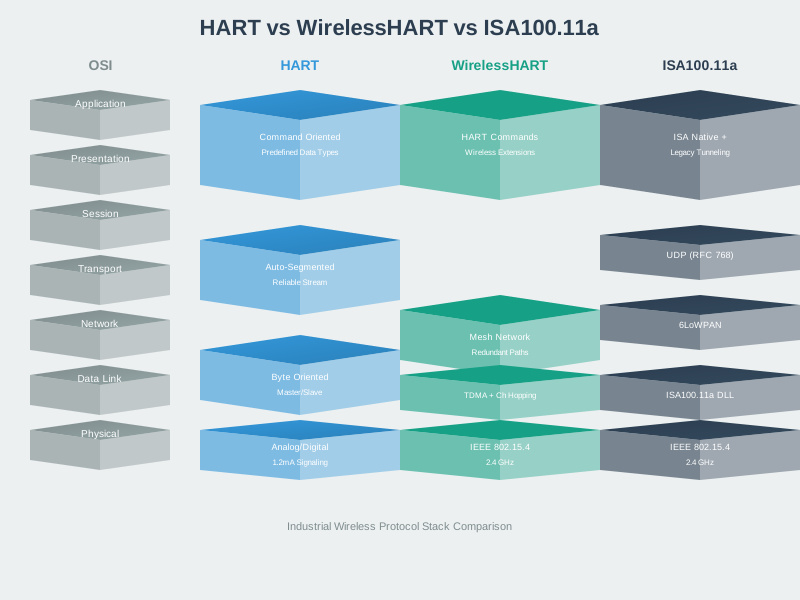
NoteHART and WirelessHART Comparison
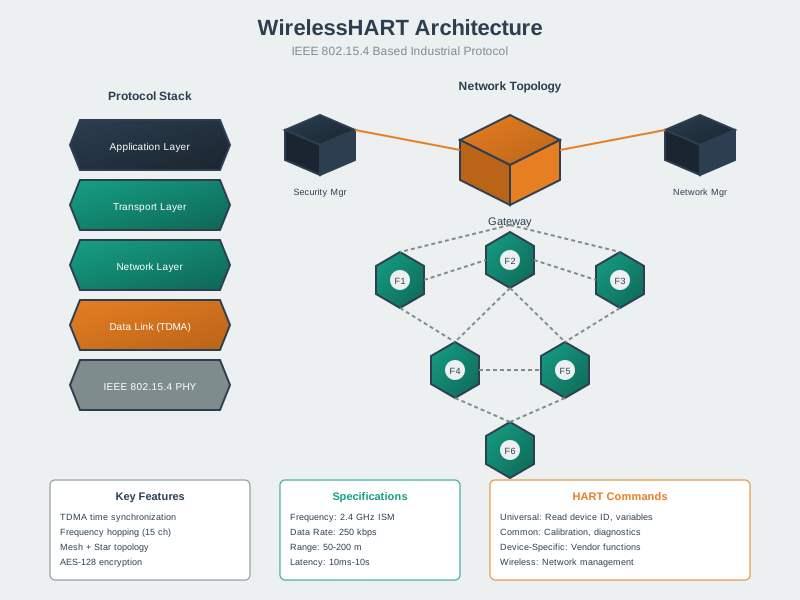
NoteWirelessHART Network Architecture
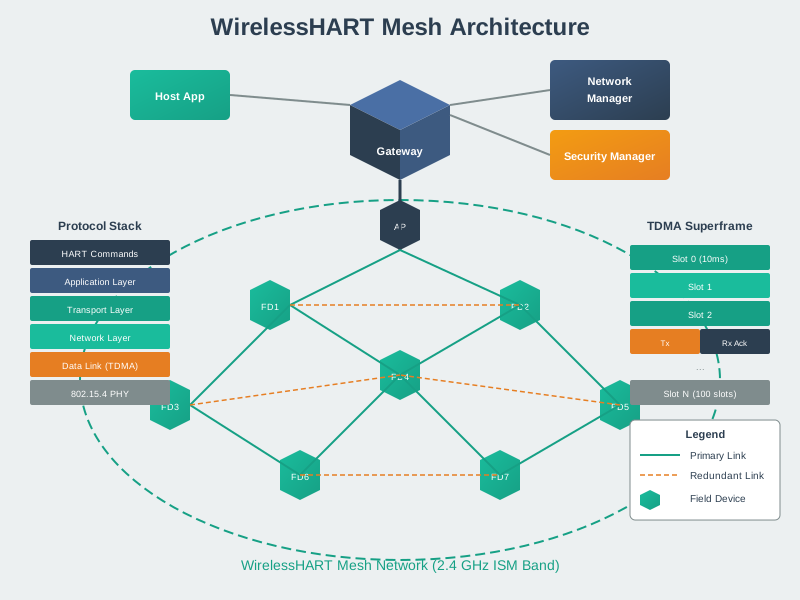
NoteWirelessHART Mesh Network
TipFor Kids: Meet the Sensor Squad!
WirelessHART is like a super-organized relay race where runners pass batons at exactly the right time!
1003.11.1 The Sensor Squad Adventure: The Factory Teamwork Challenge
Sammy the Temperature Sensor got a new job at a big chocolate factory! His mission: make sure the chocolate stays at exactly the right temperature so it comes out smooth and delicious. But there was a problem - the factory was HUGE, and Sammy was far away from the control room where the chocolate-making machine lived.
“How will my temperature readings get there in time?” worried Sammy. That’s when he met the WirelessHART team - a whole group of sensor friends who had figured out an amazing system. “We take turns talking!” explained Max the Motion Detector. “It’s like a super-organized classroom where the teacher gives each student their own special time to speak.”
Here’s how it worked: Every 10 milliseconds (that’s faster than a blink!), a different sensor got their turn to send a message. Sammy would send his temperature reading, then Bella the Button would send her “pressed or not pressed” status, then Lila the Light Sensor would report how bright things were. Nobody ever talked over each other because everyone knew exactly when their turn was!
But the coolest part was the “channel hopping” trick. “Imagine if someone in the factory turned on a noisy machine that made static on our walkie-talkie channel,” said Lila. “We’d just hop to a different channel - like changing radio stations! We switch channels with EVERY message, so even if one channel is noisy, our next message goes on a clear one.”
Thanks to this super-organized teamwork, the factory’s chocolate always came out perfect. Every sensor’s message arrived exactly when expected, and the chocolate-making machine knew exactly what to do!
1003.11.2 Key Words for Kids
| Word | What It Means |
|---|---|
| TDMA | Taking turns - each device gets a special time slot to talk, like raising your hand in class |
| Channel Hopping | Switching between different radio channels so static or noise can’t block your messages |
| Mesh Network | Friends helping friends - if one path is blocked, messages can take a different route |
| Time Slot | Your special moment to talk - like having your own 10-millisecond turn to send a message |
1003.11.3 Try This at Home!
The Relay Race Communication Game: Get 4-5 family members and try this: 1. Set a timer to beep every 5 seconds 2. Each person can ONLY speak during their assigned beep (Person 1 on beep 1, Person 2 on beep 2, etc.) 3. Try to pass a simple message like “The cat is sleeping” from the first person to the last 4. Notice how organized it is - nobody talks over anyone else! 5. Now try it WITHOUT taking turns… it gets messy fast! That’s why WirelessHART uses time slots!
1003.12 Summary
WirelessHART network management and routing provide industrial-grade reliability:
- Centralized Network Manager: Provides global optimization of routing and TDMA scheduling; single point of failure mitigated by redundancy and cached routing graphs
- Graph Routing: Network Manager precomputes multiple paths (primary + backup) for each device; <100ms failover on link failure
- Self-Healing Mesh: Automatic detection of failed routers via missed keep-alives; routing graphs updated without manual intervention
- Hop-by-Hop Retransmission: ARQ at each link means all routes achieve >99.9% reliability regardless of per-hop success rates
- QoS via Scheduling: Critical control traffic gets dedicated slots; monitoring traffic shares remaining capacity
- Protocol Selection: Choose WirelessHART for deterministic control (<100ms, >99.9%); choose LPWAN for long-range telemetry
WirelessHART represents the gold standard for industrial wireless sensor networks, bringing proven reliability and determinism to mesh networking in process automation.
1003.13 What’s Next
Continue exploring industrial wireless protocols and their alternatives:
- Next Chapter: ISA 100.11A - Learn about the competing industrial wireless standard with IPv6/6LoWPAN integration
- Compare: Zigbee - Understand how Zigbee differs from WirelessHART for building and home automation
- Smart Home: Z-Wave - Explore proprietary mesh networking for residential applications
- LPWAN: LoRaWAN - Contrast industrial determinism with long-range telemetry approaches