%%{init: {'theme': 'base', 'themeVariables': {'primaryColor':'#E8F4F8','primaryTextColor':'#2C3E50','primaryBorderColor':'#16A085','lineColor':'#16A085','secondaryColor':'#FEF5E7','tertiaryColor':'#FDEBD0','fontSize':'14px'}}}%%
graph TB
    subgraph IoTDevices["IoT Devices"]
        Temp["Temperature<br/>Sensors"]
        Camera["Security<br/>Cameras"]
        Actuator["Smart<br/>Actuators"]
    end

    subgraph FogLayer["Fog Layer"]
        Gateway["IoT Gateway"]
    end

    subgraph SDNControl["SDN Control"]
        Controller["SDN Controller<br/>• Energy-aware routing<br/>• QoS prioritization<br/>• Network slicing<br/>• Security policies"]
    end

    subgraph Network["Network Switches"]
        SW1["Switch 1"] & SW2["Switch 2"] & SW3["Switch 3"]
    end

    Cloud["Cloud Services"]

    Temp & Camera & Actuator --> Gateway
    Gateway --> SW1
    SW1 <--> SW2 <--> SW3
    SW3 --> Cloud

    Controller -->|"Flow Rules"| SW1 & SW2 & SW3
    SW1 & SW2 & SW3 -->|"Statistics"| Controller

    style Temp fill:#2C3E50,stroke:#16A085,color:#fff
    style Camera fill:#2C3E50,stroke:#16A085,color:#fff
    style Actuator fill:#2C3E50,stroke:#16A085,color:#fff
    style Gateway fill:#E67E22,stroke:#2C3E50,color:#fff
    style Controller fill:#16A085,stroke:#2C3E50,color:#fff,stroke-width:3px
    style SW1 fill:#2C3E50,stroke:#16A085,color:#fff
    style SW2 fill:#2C3E50,stroke:#16A085,color:#fff
    style SW3 fill:#2C3E50,stroke:#16A085,color:#fff
    style Cloud fill:#7F8C8D,stroke:#2C3E50,color:#fff
281 SDN IoT Applications
281.1 Learning Objectives
By the end of this chapter, you will be able to:
- Apply SDN to IoT: Implement software-defined networking for dynamic IoT environments
- Design SD-WSN: Apply SDN principles to wireless sensor networks
- Implement Mobile SDN: Configure SDN for mobile IoT with handoff management
- Analyze SDN Benefits: Evaluate advantages of programmable networks for sensor deployments
TipFor Kids: Meet the Sensor Squad!
SDN helps IoT devices work together like a super-organized team!
281.1.1 The Sensor Squad Adventure: The Smart City Orchestra
The Sensor Squad was now managing an entire smart city! There were temperature sensors in every building, cameras on every corner, and traffic sensors on every road. But different sensors needed different things:
“My fire alarm needs to get through IMMEDIATELY!” said Thermo. “Lives depend on it!”
“My traffic data can wait a few seconds,” said Motion Mo. “But I send a LOT of data!”
“My soil moisture reading only needs to be sent once an hour,” said Green Leaf the Garden Sensor.
Connie the Controller smiled. “This is called Network Slicing! I can create different ‘lanes’ for different types of traffic.”
Connie set up three special lanes: 1. Emergency Lane - For fire alarms and security alerts (always gets through first!) 2. Regular Lane - For normal sensor readings (shared fairly) 3. Slow Lane - For bulk data that can wait (like video footage being stored)
Now every sensor got exactly what it needed! Fire alarms zoomed through instantly, traffic data flowed smoothly, and video uploads happened in the background without blocking anyone.
281.1.2 Key Words for Kids
| Word | What It Means |
|---|---|
| Network Slicing | Creating different “lanes” in the network for different types of messages |
| QoS (Quality of Service) | Making sure important messages get priority over less important ones |
| SD-WSN | Using SDN to manage wireless sensors (like making all sensors listen to one smart controller) |
281.2 Introduction
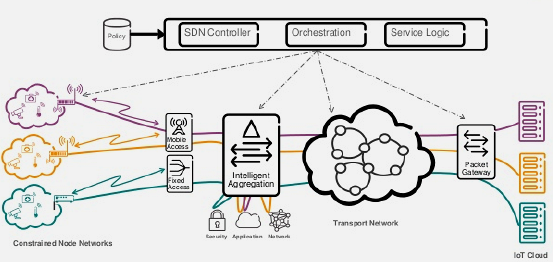
SDN brings significant benefits to IoT networks by providing centralized, programmable control over diverse device types and traffic patterns.
281.3 SDN Benefits for IoT
SDN addresses several critical IoT networking challenges:
1. Intelligent Routing - Dynamic path computation based on IoT traffic patterns - Energy-aware routing for battery-powered devices - Priority-based forwarding (critical alarms vs routine telemetry)
2. Simplified Management - Centralized view of heterogeneous IoT devices - Programmatic configuration via APIs - Rapid service deployment
3. Network Slicing - Logical network per IoT application - Isolation between applications - Custom QoS per slice
4. Traffic Engineering - Real-time adaptation to congestion - Load balancing across paths - Bandwidth allocation per IoT service
5. Enhanced Security - Centralized access control - Dynamic firewall rules - Anomaly detection via flow monitoring
{fig-alt=“SDN for IoT architecture showing diverse IoT devices (temperature sensors, security cameras, smart actuators) connecting through fog gateway and SDN-managed network switches to cloud, with centralized controller providing energy-aware routing, QoS, network slicing, and security policies”}
281.4 Software-Defined WSN
Traditional WSNs are resource-constrained and vendor-specific, making dynamic reconfiguration difficult. SD-WSN applies SDN principles to wireless sensor networks.
281.4.1 Sensor OpenFlow
Concept: Adapt OpenFlow for resource-constrained sensor nodes.
Forwarding Modes: - ID-Centric: Route based on source node ID - Value-Centric: Route based on sensed value threshold - Example: Forward only if temperature > 30C
Benefits: - Dynamic routing logic without firmware updates - Application-specific forwarding policies - Centralized network control
281.4.2 Soft-WSN
Features:
1. Sensor Management - Enable/disable sensors dynamically - Multi-sensor boards: activate subset based on application
2. Delay Management - Adjust sensing frequency in real-time - Balance freshness vs energy consumption
3. Active-Sleep Management - Dynamic duty cycling - Coordinated sleep schedules
4. Topology Management - Node-specific: Change routing at individual nodes - Network-wide: Broadcast policies (forward all, drop all)
Results: - Packet Delivery Ratio: +15-20% improvement over traditional WSN - Data Replication: -30-40% reduced redundant packets - Control Overhead: +10-15% increased due to PACKET_IN messages - Net Benefit: Overall efficiency gain despite control overhead
281.4.3 SDN-WISE
Architecture:
%%{init: {'theme': 'base', 'themeVariables': {'primaryColor':'#E8F4F8','primaryTextColor':'#2C3E50','primaryBorderColor':'#16A085','lineColor':'#16A085','secondaryColor':'#FEF5E7','tertiaryColor':'#FDEBD0','fontSize':'14px'}}}%%
graph TB
    subgraph Application["Application Layer"]
        App["Network Management<br/>Application"]
    end

    subgraph Control["Control Layer"]
        SDNWISE["SDN-WISE Controller"]
    end

    subgraph Sensor["Sensor Network"]
        Sink["Sink Node<br/>(Gateway)"]
        SN1["Sensor Node 1<br/>Flow Table"]
        SN2["Sensor Node 2<br/>Flow Table"]
        SN3["Sensor Node 3<br/>Flow Table"]
        SN4["Sensor Node 4<br/>Flow Table"]
    end

    App <-->|API| SDNWISE
    SDNWISE <-->|Control Messages| Sink
    Sink <--> SN1 & SN2
    SN1 <--> SN3
    SN2 <--> SN4
    SN3 <--> SN4

    SN1 & SN2 & SN3 & SN4 -->|"Sensor Data"| Sink

    style App fill:#E67E22,stroke:#2C3E50,color:#fff
    style SDNWISE fill:#16A085,stroke:#2C3E50,color:#fff,stroke-width:3px
    style Sink fill:#E67E22,stroke:#2C3E50,color:#fff
    style SN1 fill:#2C3E50,stroke:#16A085,color:#fff
    style SN2 fill:#2C3E50,stroke:#16A085,color:#fff
    style SN3 fill:#2C3E50,stroke:#16A085,color:#fff
    style SN4 fill:#2C3E50,stroke:#16A085,color:#fff
{fig-alt=“SDN-WISE architecture for wireless sensor networks showing application layer communicating with SDN-WISE controller, which manages sensor nodes with flow tables through sink gateway node, enabling programmable WSN routing”}
Key Features: - Flow tables adapted for sensor constraints - In-Network Packet Processing (INPP) for local computation - Programmable via any language through API - IEEE 802.15.4 compatible
281.5 SDN for Mobile Networks
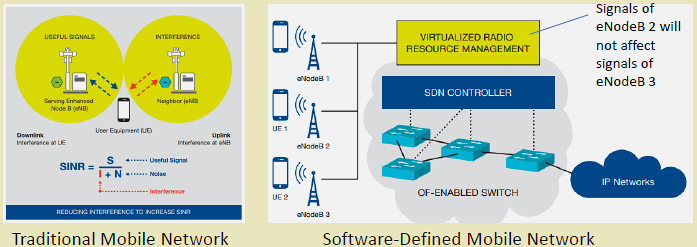
Traditional mobile networks (3G/4G/5G) face challenges: difficult to scale, inflexible, expensive. SDN addresses these:
Benefits:
1. Flow Table Paradigm - Seamless end-to-end communication across Wi-Fi, 3G, 4G, 5G - Unified forwarding model
2. Centralized Control - Base station coordination for interference mitigation - Efficient handoff management
3. Path Management - Route based on service requirements (latency, bandwidth) - Independent of core routing policies
4. Network Virtualization - Network slicing: dedicated slice per service type - Service differentiation: premium vs best-effort
Applications:
Mobile Traffic Offloading: - Intelligently offload from cellular to Wi-Fi - Based on user preferences, QoS requirements, network load - SDN controller coordinates: ANDSF (Access Network Discovery and Selection Function)
281.5.1 Mobility-Aware SDN
281.5.1.1 ODIN
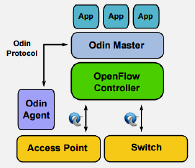
Concept: SDN-based enterprise WLAN with mobility support.
Components: - ODIN Agent: Runs on access points - ODIN Master: Runs on controller
Features: - Light Virtual APs: Multiple virtual APs per physical AP - Client association control - Seamless handoff
281.5.1.2 Ubi-Flow
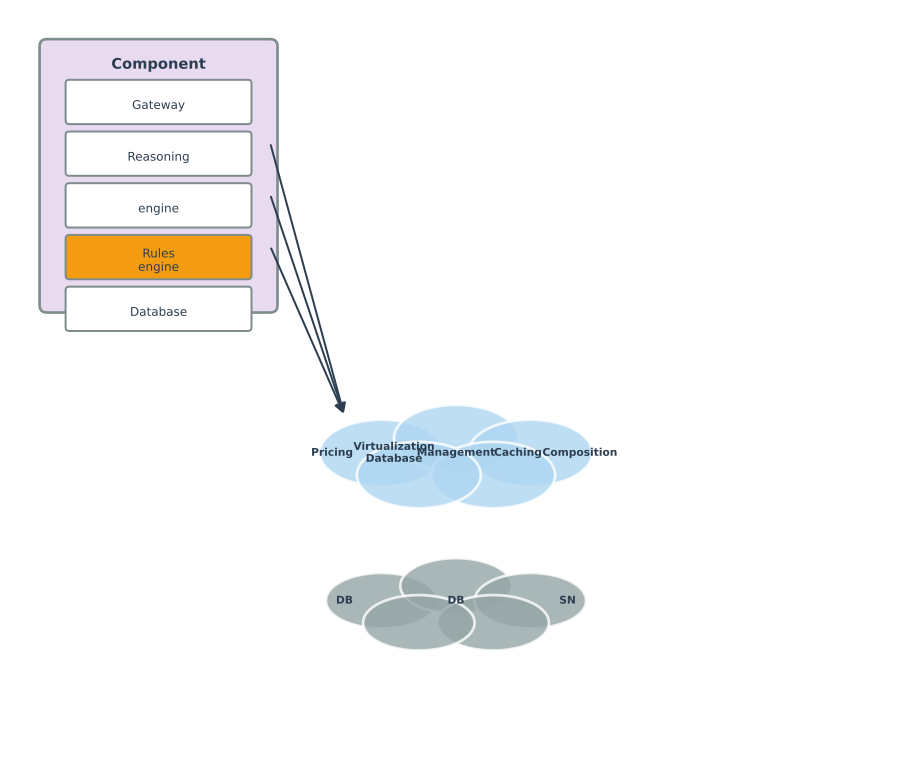
Focus: Mobility management in SD-IoT.
Features: - Scalable AP control - Fault tolerance - Flow scheduling: - Network partitioning - Load balancing - Network matching
281.5.1.3 Mobi-Flow
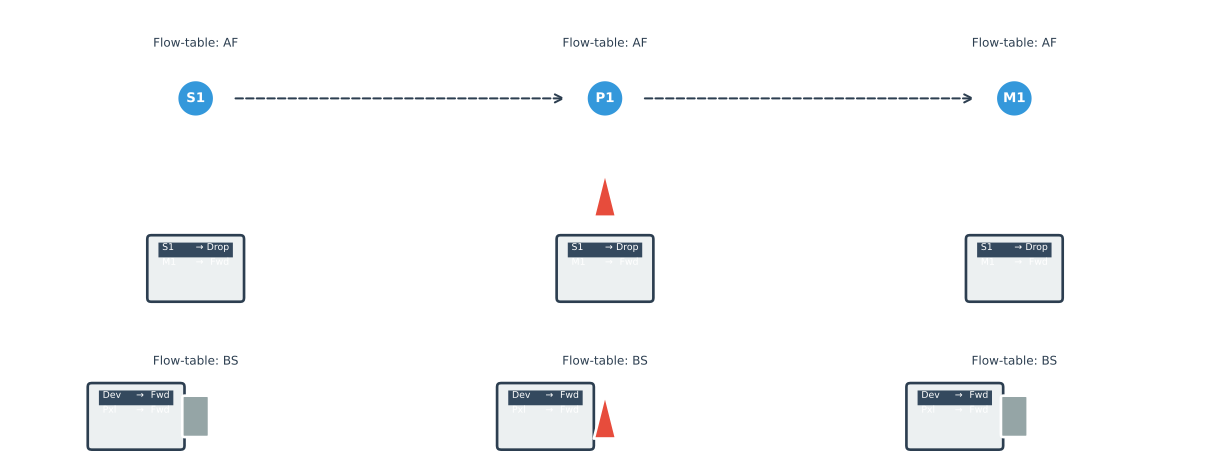
Concept: Proactive flow rule placement based on mobility prediction.
Approach: 1. Predict user location at time t+1 using Order-K Markov predictor 2. Install flow rules at predicted APs before user arrives 3. Minimize PACKET_IN messages and handoff delay
Results: - 30-40% reduction in control message overhead - 20-30% energy savings at mobile devices - Improved QoS (lower latency)
281.6 Knowledge Check
281.7 Summary
This chapter explored SDN applications for IoT, wireless sensor networks, and mobile environments:
Key Takeaways:
SDN for IoT: Provides intelligent routing, simplified management, network slicing, traffic engineering, and enhanced security for heterogeneous IoT deployments
SD-WSN Variants: Sensor OpenFlow (ID/value-centric routing), Soft-WSN (sensor/delay/topology management), and SDN-WISE (flow tables for 802.15.4)
Mobile SDN: ODIN (virtual APs, seamless handoff), Ubi-Flow (scalable mobility management), Mobi-Flow (predictive flow placement)
Performance Gains: 15-20% improved packet delivery, 30-40% reduced control overhead with mobility prediction, energy-aware routing extending network lifetime
Challenges: Controller scalability with thousands of sensors, maintaining connectivity during mobility, balancing control overhead vs. benefits
SDN’s programmable, centralized approach is particularly valuable for IoT where device diversity, dynamic topologies, and application-specific requirements demand flexible networking.
281.8 What’s Next?
Continue with SDN applications in data centers and security monitoring.