%%{init: {'theme': 'base', 'themeVariables': { 'primaryColor': '#2C3E50', 'primaryTextColor': '#fff', 'primaryBorderColor': '#16A085', 'lineColor': '#E67E22', 'secondaryColor': '#16A085', 'tertiaryColor': '#E67E22'}}}%%
graph TB
    subgraph "TCP - Connection-Oriented"
        TCP[TCP Protocol]
        TCP1["✓ 3-way handshake"]
        TCP2["✓ Guaranteed delivery"]
        TCP3["✓ Congestion control"]
        TCP4["✗ 20+ byte overhead"]
        TCP5["Use: Firmware updates"]
        TCP --> TCP1
        TCP --> TCP2
        TCP --> TCP3
        TCP --> TCP4
        TCP --> TCP5
    end

    subgraph "UDP - Connectionless"
        UDP[UDP Protocol]
        UDP1["✓ No handshake"]
        UDP2["✓ Best-effort delivery"]
        UDP3["✓ No congestion control"]
        UDP4["✓ 8 byte overhead"]
        UDP5["Use: Sensor readings"]
        UDP --> UDP1
        UDP --> UDP2
        UDP --> UDP3
        UDP --> UDP4
        UDP --> UDP5
    end

    Decision["Protocol Selection<br/>Decision"]
    Decision -->|Reliability Critical| TCP
    Decision -->|Power Constrained| UDP

    style TCP fill:#2C3E50,color:#fff
    style UDP fill:#16A085,color:#fff
    style Decision fill:#E67E22,color:#fff
    style TCP1 fill:#2C3E50,color:#fff
    style TCP2 fill:#2C3E50,color:#fff
    style TCP3 fill:#2C3E50,color:#fff
    style TCP4 fill:#2C3E50,color:#fff
    style TCP5 fill:#2C3E50,color:#fff
    style UDP1 fill:#16A085,color:#fff
    style UDP2 fill:#16A085,color:#fff
    style UDP3 fill:#16A085,color:#fff
    style UDP4 fill:#16A085,color:#fff
    style UDP5 fill:#16A085,color:#fff
753 Transport Optimizations and Implementation
753.1 Learning Objectives
By the end of this chapter, you will be able to:
- Optimize TCP for IoT: Apply keep-alive, fast open, and connection pooling techniques
- Select Lightweight Stacks: Choose between uIP, lwIP, and full TCP implementations based on constraints
- Implement UDP Reliability: Add application-layer acknowledgment and retransmission to UDP
- Configure DTLS: Set up Datagram TLS for secure UDP communication in CoAP applications
- Measure Protocol Performance: Profile latency, throughput, and power consumption of transport implementations
- Debug Transport Issues: Diagnose connection failures, timeouts, and packet loss problems
TipFor Beginners: How to Use This Implementation Chapter
What is this chapter? Advanced transport layer optimizations and implementation techniques for IoT.
Difficulty: Advanced ⭐⭐⭐
When to use: - After mastering transport fundamentals - When optimizing IoT communication - For production deployment planning
Optimization Techniques:
| Technique | Benefit |
|---|---|
| Header Compression | Reduce overhead |
| Connection Pooling | Reduce handshakes |
| Keep-alive Tuning | Balance latency/power |
| Buffer Sizing | Optimize throughput |
Prerequisites: - Transport Fundamentals - Transport Protocols - Understanding of TCP/UDP internals
Recommended Path: 1. Master transport fundamentals first 2. Study optimization techniques here 3. Apply to real implementations
753.2 Prerequisites
Before diving into this chapter, you should be familiar with:
- Transport Protocols: Fundamentals: Understanding TCP and UDP characteristics, header structures, and trade-offs is essential before optimizing these protocols for constrained IoT devices
- Transport Layer Protocols for IoT: Knowledge of how TCP handshakes, UDP datagrams, and DTLS security work provides the foundation for implementing optimizations and lightweight protocol stacks
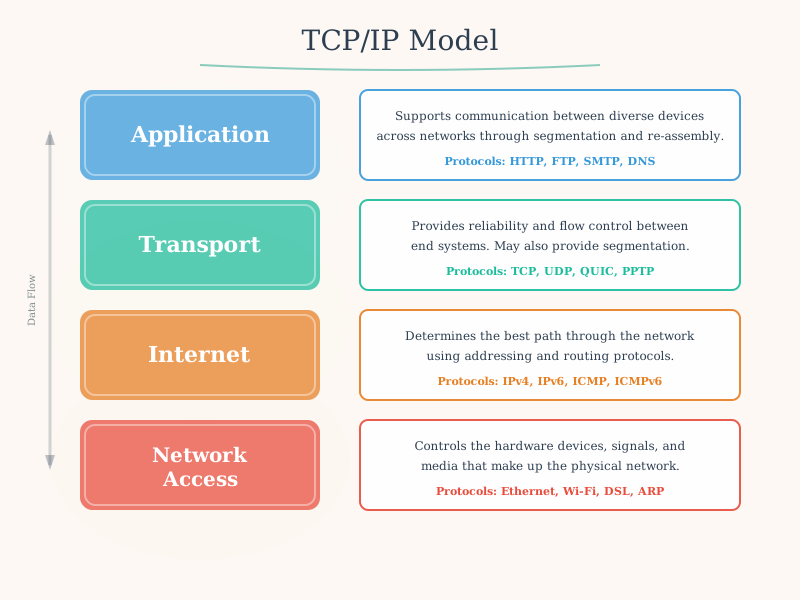
- Layered Network Models: Understanding the relationship between transport layer, network layer, and application layer helps you grasp where optimizations fit in the protocol stack
NoteCross-Hub Connections
Hands-On Learning: - Simulations Hub - Protocol performance simulators for TCP vs UDP comparison - Knowledge Gaps Hub - Common misconceptions about transport layer optimization
Practical Resources: - Videos Hub - DTLS handshake demonstrations and TCP optimization tutorials - Quizzes Hub - Test your understanding of protocol overhead calculations
Related Topics: - Protocol Selection Framework - Decision criteria for transport protocols - Edge Computing Patterns - Local processing reducing transmission needs - Energy-Aware Design - Power budget optimization strategies
753.3 TCP vs UDP for IoT: Protocol Comparison
Understanding the fundamental differences between TCP and UDP is critical for IoT protocol selection.
TipAlternative View: Protocol Selection Matrix by Use Case
This variant presents the same TCP vs UDP comparison as a use-case-driven matrix, helping you match application requirements to the right protocol:
%%{init: {'theme': 'base', 'themeVariables': { 'primaryColor': '#2C3E50', 'primaryTextColor': '#fff', 'primaryBorderColor': '#16A085', 'lineColor': '#E67E22', 'secondaryColor': '#16A085', 'tertiaryColor': '#E67E22'}}}%%
flowchart TB
    subgraph USE["Use Case Categories"]
        direction TB
        U1["Periodic Telemetry<br/>Temperature, Humidity"]
        U2["Critical Commands<br/>Lock, Actuator Control"]
        U3["Bulk Transfer<br/>Firmware, Logs"]
        U4["Real-Time Streaming<br/>Video, Audio"]
    end

    subgraph PROTO["Protocol Match"]
        direction TB
        P1["UDP<br/>Low overhead, loss OK"]
        P2["UDP + DTLS<br/>Secure, app-layer ACK"]
        P3["TCP + TLS<br/>Reliable, secure"]
        P4["UDP + RTP<br/>Low latency priority"]
    end

    subgraph POWER["Power Impact"]
        direction TB
        W1["1× baseline"]
        W2["1.5× baseline"]
        W3["8× baseline"]
        W4["2× baseline"]
    end

    U1 --> P1 --> W1
    U2 --> P2 --> W2
    U3 --> P3 --> W3
    U4 --> P4 --> W4

    style U1 fill:#16A085,stroke:#2C3E50,color:#fff
    style U2 fill:#E67E22,stroke:#2C3E50,color:#fff
    style U3 fill:#2C3E50,stroke:#16A085,color:#fff
    style U4 fill:#16A085,stroke:#2C3E50,color:#fff
    style P1 fill:#16A085,stroke:#2C3E50,color:#fff
    style P2 fill:#E67E22,stroke:#2C3E50,color:#fff
    style P3 fill:#2C3E50,stroke:#16A085,color:#fff
    style P4 fill:#16A085,stroke:#2C3E50,color:#fff
    style W1 fill:#16A085,stroke:#2C3E50,color:#fff
    style W2 fill:#E67E22,stroke:#2C3E50,color:#fff
    style W3 fill:#2C3E50,stroke:#16A085,color:#fff
    style W4 fill:#16A085,stroke:#2C3E50,color:#fff
This matrix approach helps developers quickly identify the right protocol based on their specific IoT use case rather than abstract protocol characteristics.
TipAlternative View: Protocol Overhead Timeline
This variant shows TCP vs UDP as a timeline comparison, emphasizing the temporal overhead of connection establishment:
%%{init: {'theme': 'base', 'themeVariables': { 'primaryColor': '#2C3E50', 'primaryTextColor': '#fff', 'primaryBorderColor': '#16A085', 'lineColor': '#E67E22', 'secondaryColor': '#16A085'}}}%%
sequenceDiagram
    participant S as Sensor
    participant G as Gateway

    Note over S,G: UDP Timeline (1 packet)
    rect rgb(22, 160, 133)
        S->>G: Data (10 bytes + 8 header)
    end
    Note over S: Radio: 1ms, Done!

    Note over S,G: TCP Timeline (8 packets)
    rect rgb(44, 62, 80)
        S->>G: SYN (26 bytes)
        G->>S: SYN-ACK (26 bytes)
        S->>G: ACK (26 bytes)
        Note over S,G: Handshake: 3× RTT
        S->>G: Data (36 bytes)
        G->>S: ACK (26 bytes)
        S->>G: FIN (26 bytes)
        G->>S: FIN-ACK (26 bytes)
    end
    Note over S: Radio: 13ms, 8 packets!
The timeline clearly shows why TCP’s connection overhead matters: 3 RTTs before any data can be sent, versus UDP’s immediate transmission.
WarningCommon Misconception: “TCP is Always More Reliable Than UDP for IoT”
The Misconception: Many developers assume TCP’s guaranteed delivery makes it universally better for IoT applications requiring reliability.
The Reality: TCP reliability comes at severe costs in constrained IoT environments:
Quantified Impact:
| Metric | TCP (Full Connection) | UDP + App-Layer ACK | Difference |
|---|---|---|---|
| Handshake Overhead | 3-way handshake (3× RTT) | None (0× RTT) | 300% penalty |
| Packet Overhead | 96% overhead (244 bytes for 10-byte payload) | 58% overhead (24 bytes) | 165% more |
| Battery Life (frequent transmission) | 8.58 years | 45.51 years | 5.3× shorter |
| Radio On-Time | 13.31 ms | 1.27 ms | 10× longer |
| Memory Footprint | 500 KB (full stack) | 4-10 KB (uIP) | 50× larger |
Real-World Example: A temperature sensor transmitting every 10 seconds (8,640 times/day): - TCP: Battery dies in 8.58 years - UDP: Battery lasts 45.51 years - TCP with keep-alive: 22.74 years (still 2× worse than UDP)
When TCP Actually Wins: - Firmware updates (data integrity critical, infrequent operation) - Financial transactions (guaranteed delivery required) - Mains-powered devices (energy constraints irrelevant)
Better Alternative for Most IoT: UDP + CoAP Confirmable messages provides application-layer reliability without TCP’s overhead burden—ideal for battery-powered devices requiring acknowledgments.
Key Lesson: “Reliable” doesn’t always mean “better”—TCP’s reliability mechanisms can kill battery life in frequent-transmission scenarios. Choose protocols based on total system cost, not just transport layer guarantees.
WarningTradeoff: TCP Guaranteed Delivery vs UDP Low Overhead
Option A: TCP with guaranteed delivery - automatic retransmission, in-order delivery, congestion control, but 20+ byte header and 3-way handshake overhead Option B: UDP with best-effort delivery - 8-byte header, no handshake, immediate transmission, but no built-in reliability Decision Factors: Choose TCP for firmware updates, configuration changes, and financial transactions where data integrity is critical and occasional latency spikes are acceptable. Choose UDP for periodic sensor telemetry where occasional packet loss is tolerable and power consumption matters. For security-critical UDP applications, add DTLS (13 bytes overhead vs TCP+TLS). Consider CoAP Confirmable messages as a middle ground - UDP transport with application-layer acknowledgments only for important messages.
753.4 TCP Optimizations for IoT
While UDP is often preferred, sometimes TCP is necessary. Several optimizations exist:
753.4.1 TCP Connection Keep-Alive
Problem: TCP handshake overhead
Solution: Keep connection open for multiple transmissions
Trade-off: Memory for connection state vs power for handshakes
Best for: Devices transmitting frequently (e.g., every minute)
753.4.2 TCP Fast Open (TFO)
RFC 7413: Allows data in SYN packet (reduces handshake to 1-RTT)
Benefit: Faster connection establishment
Limitation: Not widely deployed in IoT yet
753.4.3 Lightweight TCP Implementations
uIP: Micro IP stack (4-10 KB code) lwIP: Lightweight IP (40-100 KB) Comparison to full TCP stack: Linux TCP ~500 KB
753.4.4 Application-Level Optimizations
MQTT Keep-Alive: Maintain TCP connection with periodic pings HTTP Persistent Connections: HTTP/1.1 connection reuse CoAP over TCP: RFC 8323, combines CoAP efficiency with TCP reliability
753.4.5 TCP Optimization Techniques Overview
%%{init: {'theme': 'base', 'themeVariables': { 'primaryColor': '#2C3E50', 'primaryTextColor': '#fff', 'primaryBorderColor': '#16A085', 'lineColor': '#E67E22', 'secondaryColor': '#16A085', 'tertiaryColor': '#E67E22'}}}%%
graph TB
    Central["TCP Optimization<br/>Strategies"]

    subgraph "Connection Management"
        CM1["Keep-Alive<br/>Maintain connection"]
        CM2["TCP Fast Open<br/>1-RTT handshake"]
        CM3["Connection Pooling<br/>Reuse connections"]
    end

    subgraph "Lightweight Stacks"
        LS1["uIP<br/>4-10 KB"]
        LS2["lwIP<br/>40-100 KB"]
        LS3["Full TCP<br/>~500 KB"]
    end

    subgraph "Application Layer"
        AL1["MQTT Keep-Alive<br/>Periodic pings"]
        AL2["HTTP Persistent<br/>Connection reuse"]
        AL3["CoAP over TCP<br/>RFC 8323"]
    end

    subgraph "Congestion Control"
        CC1["Slow Start Tuning"]
        CC2["Window Scaling"]
        CC3["Selective ACK"]
    end

    Central --> CM1
    Central --> CM2
    Central --> CM3
    Central --> LS1
    Central --> LS2
    Central --> LS3
    Central --> AL1
    Central --> AL2
    Central --> AL3
    Central --> CC1
    Central --> CC2
    Central --> CC3

    style Central fill:#E67E22,color:#fff
    style CM1 fill:#2C3E50,color:#fff
    style CM2 fill:#2C3E50,color:#fff
    style CM3 fill:#2C3E50,color:#fff
    style LS1 fill:#2C3E50,color:#fff
    style LS2 fill:#2C3E50,color:#fff
    style LS3 fill:#2C3E50,color:#fff
    style AL1 fill:#16A085,color:#fff
    style AL2 fill:#16A085,color:#fff
    style AL3 fill:#16A085,color:#fff
    style CC1 fill:#16A085,color:#fff
    style CC2 fill:#16A085,color:#fff
    style CC3 fill:#16A085,color:#fff
TipAlternative View: Optimization Decision Flowchart
This variant presents TCP optimizations as a decision tree based on device constraints:
%%{init: {'theme': 'base', 'themeVariables': { 'primaryColor': '#2C3E50', 'primaryTextColor': '#fff', 'primaryBorderColor': '#16A085', 'lineColor': '#E67E22', 'secondaryColor': '#16A085'}}}%%
flowchart TD
    START["Need TCP for IoT?"] --> Q1{"Flash < 64KB?"}
    Q1 -->|Yes| UIp["Use uIP<br/>4-10 KB"]
    Q1 -->|No| Q2{"Flash < 128KB?"}
    Q2 -->|Yes| LWIP["Use lwIP<br/>40-100 KB"]
    Q2 -->|No| FULL["Use Full Stack<br/>~500 KB"]

    UIp --> Q3{"Frequent Tx?"}
    LWIP --> Q3
    FULL --> Q3

    Q3 -->|"Yes (>1/min)"| KA["Enable Keep-Alive<br/>Maintain connection"]
    Q3 -->|No| NOOPT["No connection<br/>optimization needed"]

    KA --> Q4{"TFO Supported?"}
    Q4 -->|Yes| TFO["Use TCP Fast Open<br/>1-RTT handshake"]
    Q4 -->|No| POOL["Use Connection Pooling<br/>on gateway"]

    style START fill:#E67E22,stroke:#2C3E50,color:#fff
    style Q1 fill:#2C3E50,stroke:#16A085,color:#fff
    style Q2 fill:#2C3E50,stroke:#16A085,color:#fff
    style Q3 fill:#2C3E50,stroke:#16A085,color:#fff
    style Q4 fill:#2C3E50,stroke:#16A085,color:#fff
    style UIp fill:#16A085,stroke:#2C3E50,color:#fff
    style LWIP fill:#16A085,stroke:#2C3E50,color:#fff
    style FULL fill:#16A085,stroke:#2C3E50,color:#fff
    style KA fill:#16A085,stroke:#2C3E50,color:#fff
    style TFO fill:#16A085,stroke:#2C3E50,color:#fff
    style POOL fill:#16A085,stroke:#2C3E50,color:#fff
    style NOOPT fill:#7F8C8D,stroke:#2C3E50,color:#fff
This decision tree guides developers through selecting the right optimization techniques based on their specific device constraints.
TipAlternative View: Memory vs Features Trade-off
This variant shows TCP stack options as a trade-off visualization between memory footprint and feature set:
%%{init: {'theme': 'base', 'themeVariables': { 'primaryColor': '#2C3E50', 'primaryTextColor': '#fff', 'primaryBorderColor': '#16A085', 'lineColor': '#E67E22', 'secondaryColor': '#16A085'}}}%%
graph LR
    subgraph MEM["Memory Footprint"]
        direction TB
        M1["4-10 KB"]
        M2["40-100 KB"]
        M3["~500 KB"]
    end

    subgraph STACK["TCP Stack"]
        S1["uIP<br/>Minimal"]
        S2["lwIP<br/>Balanced"]
        S3["Full TCP<br/>Complete"]
    end

    subgraph FEAT["Features"]
        direction TB
        F1["Single connection<br/>No options<br/>Basic reliability"]
        F2["Multiple connections<br/>Common options<br/>Good reliability"]
        F3["All features<br/>Full options<br/>Best reliability"]
    end

    M1 --- S1 --- F1
    M2 --- S2 --- F2
    M3 --- S3 --- F3

    style M1 fill:#16A085,stroke:#2C3E50,color:#fff
    style M2 fill:#E67E22,stroke:#2C3E50,color:#fff
    style M3 fill:#2C3E50,stroke:#16A085,color:#fff
    style S1 fill:#16A085,stroke:#2C3E50,color:#fff
    style S2 fill:#E67E22,stroke:#2C3E50,color:#fff
    style S3 fill:#2C3E50,stroke:#16A085,color:#fff
    style F1 fill:#16A085,stroke:#2C3E50,color:#fff
    style F2 fill:#E67E22,stroke:#2C3E50,color:#fff
    style F3 fill:#2C3E50,stroke:#16A085,color:#fff
Choose uIP (green) for the most constrained devices, lwIP (orange) for balanced needs, or Full TCP (navy) when resources allow.
WarningTradeoff: Lightweight TCP Stack vs Full TCP Implementation
Option A: Lightweight stack (uIP 4-10KB, lwIP 40-100KB) - fits in constrained flash, lower RAM usage, faster boot time, but limited features and single/few connections Option B: Full TCP stack (~500KB) - complete feature set, multiple simultaneous connections, all TCP options supported, but requires significant resources Decision Factors: Choose lightweight stacks for MCUs with <128KB flash where code size is critical, or battery devices where minimal wake-up processing matters. Use uIP for single-connection scenarios (sensor to gateway), lwIP when you need a few concurrent connections. Choose full stack when running on Linux/RTOS with ample resources, when you need advanced features (TCP Fast Open, SACK, window scaling), or when connecting to diverse servers that may require specific TCP options.
753.5 Python Implementation
753.5.1 Implementation 1: TCP vs UDP Overhead and Battery Life Calculator
This implementation calculates complete overhead analysis, radio on-time, and battery life impact for TCP vs UDP in IoT scenarios.
Expected Output:
=== TCP vs UDP Overhead and Battery Life Analysis ===

Scenario 1: Temperature Sensor - Infrequent Transmission
--------------------------------------------------------------------------------
Payload: 10 bytes
Frequency: 288 transmissions/day (every 5 min)
Battery: 2000 mAh

Protocol Comparison:
================================================================================
Protocol             Packet     Overhead     Efficiency   Radio Time   Battery Life
--------------------------------------------------------------------------------
UDP                    24 bytes     58.3%       41.7%       1.27 ms        45.6 years
TCP (Full Connection)  244 bytes     95.9%        4.1%      13.31 ms        43.8 years
TCP (Keep-Alive)       62 bytes     83.9%       16.1%       3.49 ms        45.2 years

================================================================================

Scenario 2: Frequent Transmission (Every 10 Seconds)
--------------------------------------------------------------------------------
Payload: 10 bytes
Frequency: 8640 transmissions/day (every 10 sec)
Battery: 2000 mAh

Protocol Comparison:
================================================================================
Protocol             Daily Energy    Battery Life
--------------------------------------------------------------------------------
UDP                    120.4 µA·h      16611 days (45.51 years)
TCP (Full Connection)  638.7 µA·h       3130 days ( 8.58 years)
TCP (Keep-Alive)       241.0 µA·h       8299 days (22.74 years)

================================================================================

Power Savings Analysis (Frequent Transmission):
--------------------------------------------------------------------------------
UDP battery life: 45.51 years
TCP (full) battery life: 8.58 years
  Power penalty: 81.1% shorter
TCP (keep-alive) battery life: 22.74 years
  Power penalty: 50.0% shorter

================================================================================

Key Insights:
- Infrequent transmission: Sleep dominates, protocol overhead minimal
- Frequent transmission: Protocol overhead significant (TCP full: 4× worse battery)
- TCP keep-alive: Reduces overhead but still 3× worse than UDP
Key Concepts Demonstrated: - Packet Overhead: UDP 58% vs TCP 96% (full connection) - Radio On-Time: UDP 1.3 ms vs TCP 13.3 ms (10× difference) - Battery Life Impact: Depends heavily on transmission frequency - TCP Keep-Alive Optimization: Reduces overhead but still 2-3× worse than UDP
753.5.2 Implementation 2: Transport Protocol Selector
This implementation provides intelligent protocol selection based on application requirements using a decision tree.
Expected Output:
=== Transport Protocol Selector ===

Scenario 1: Temperature Sensor (Battery-Powered)
--------------------------------------------------------------------------------
Recommended Protocol: UDP

Reasoning:
  • Best-effort reliability → UDP (no overhead for ACKs)

Implementation Notes:
  → Fire-and-forget transmission (no ACKs)
  → Application tolerates occasional packet loss

================================================================================

Scenario 2: Firmware Update (Critical Reliability)
--------------------------------------------------------------------------------
Recommended Protocol: TCP
Security Layer: TLS

Reasoning:
  • CRITICAL reliability requires TCP (guaranteed delivery)
  • Security required → TLS over TCP

Alternatives:
  • None - recommended protocol optimal

================================================================================

Scenario 3: Smart Lock (Security-Critical, Real-Time)
--------------------------------------------------------------------------------
Recommended Protocol: UDP
Security Layer: DTLS

Reasoning:
  • Power-constrained + reliable → UDP with application-level reliability
  • Use CoAP Confirmable messages (built-in ACKs)
  • Security required → DTLS over UDP

Implementation Notes:
  → Implement CoAP Confirmable (CON) messages with retries
  → Exponential backoff for retransmissions
  → Bidirectional: Both endpoints can initiate transmissions

================================================================================

Scenario 4: Video Surveillance Camera (Real-Time)
--------------------------------------------------------------------------------
Recommended Protocol: UDP
Security Layer: DTLS

Reasoning:
  • Best-effort reliability → UDP (no overhead for ACKs)
  • Security required → DTLS over UDP
  • Real-time latency → UDP preferred (predictable, no retransmissions)

Trade-offs:
  ⚠ DTLS adds ~13+ bytes overhead + handshake cost

================================================================================

Key Insight: Protocol selection depends on reliability, latency, power, and security requirements.
Key Concepts Demonstrated: - Decision Tree Logic: Reliability → Latency → Power → Security - TCP for Critical: Firmware updates, financial transactions - UDP for Power: Battery-powered sensors with best-effort reliability - CoAP Confirmable: Application-level reliability on UDP - DTLS for Security: Secure UDP without TCP overhead
753.5.3 Transport Protocol Selection Decision Flow
%%{init: {'theme': 'base', 'themeVariables': { 'primaryColor': '#2C3E50', 'primaryTextColor': '#fff', 'primaryBorderColor': '#16A085', 'lineColor': '#E67E22', 'secondaryColor': '#16A085', 'tertiaryColor': '#E67E22'}}}%%
flowchart TD
    Start["IoT Application<br/>Protocol Selection"]

    Q1{"Reliability<br/>Requirement?"}
    Q2{"Real-time<br/>Latency Critical?"}
    Q3{"Power<br/>Constrained?"}
    Q4{"Security<br/>Required?"}
    Q5{"Bi-directional<br/>Communication?"}

    R1["TCP + TLS<br/>Firmware updates<br/>Financial transactions"]
    R2["TCP<br/>Reliable non-sensitive<br/>Data logging"]
    R3["UDP + DTLS<br/>Secure real-time<br/>Smart locks, Video"]
    R4["UDP + CoAP<br/>Power-constrained<br/>App-layer ACK"]
    R5["UDP<br/>Best-effort<br/>Sensor readings"]

    Start --> Q1
    Q1 -->|Critical| Q4
    Q1 -->|Reliable| Q2
    Q1 -->|Best-effort| Q2

    Q2 -->|Yes| Q3
    Q2 -->|No| Q4

    Q3 -->|Yes| Q5
    Q3 -->|No| Q4

    Q4 -->|Yes - Critical| R1
    Q4 -->|Yes - Reliable| R3
    Q4 -->|No - Critical| R2

    Q5 -->|Yes| R4
    Q5 -->|No| R5

    style Start fill:#E67E22,color:#fff
    style Q1 fill:#2C3E50,color:#fff
    style Q2 fill:#2C3E50,color:#fff
    style Q3 fill:#2C3E50,color:#fff
    style Q4 fill:#2C3E50,color:#fff
    style Q5 fill:#2C3E50,color:#fff
    style R1 fill:#16A085,color:#fff
    style R2 fill:#16A085,color:#fff
    style R3 fill:#16A085,color:#fff
    style R4 fill:#16A085,color:#fff
    style R5 fill:#16A085,color:#fff
TipAlternative View: Protocol Stack Layers
This variant shows the protocol selection as a layered stack view, helping visualize how protocols combine:
%%{init: {'theme': 'base', 'themeVariables': { 'primaryColor': '#2C3E50', 'primaryTextColor': '#fff', 'primaryBorderColor': '#16A085', 'lineColor': '#E67E22', 'secondaryColor': '#16A085'}}}%%
graph TB
    subgraph STACK1["Firmware Update Stack"]
        A1["Application: HTTPS/REST"]
        S1["Security: TLS 1.3"]
        T1["Transport: TCP"]
        N1["Network: IPv4/IPv6"]
    end

    subgraph STACK2["Sensor Telemetry Stack"]
        A2["Application: CoAP"]
        S2["Security: Optional DTLS"]
        T2["Transport: UDP"]
        N2["Network: 6LoWPAN/IPv6"]
    end

    subgraph STACK3["Smart Lock Stack"]
        A3["Application: CoAP CON"]
        S3["Security: DTLS 1.3 PSK"]
        T3["Transport: UDP"]
        N3["Network: Thread/IPv6"]
    end

    A1 --> S1 --> T1 --> N1
    A2 --> S2 --> T2 --> N2
    A3 --> S3 --> T3 --> N3

    style A1 fill:#E67E22,stroke:#2C3E50,color:#fff
    style S1 fill:#2C3E50,stroke:#16A085,color:#fff
    style T1 fill:#2C3E50,stroke:#16A085,color:#fff
    style N1 fill:#7F8C8D,stroke:#2C3E50,color:#fff
    style A2 fill:#E67E22,stroke:#2C3E50,color:#fff
    style S2 fill:#16A085,stroke:#2C3E50,color:#fff
    style T2 fill:#16A085,stroke:#2C3E50,color:#fff
    style N2 fill:#7F8C8D,stroke:#2C3E50,color:#fff
    style A3 fill:#E67E22,stroke:#2C3E50,color:#fff
    style S3 fill:#2C3E50,stroke:#16A085,color:#fff
    style T3 fill:#16A085,stroke:#2C3E50,color:#fff
    style N3 fill:#7F8C8D,stroke:#2C3E50,color:#fff
Each stack shows how application, security, transport, and network layers combine for different IoT use cases.
TipAlternative View: Requirements-to-Protocol Mapping
This variant presents protocol selection as a mapping from requirements to recommended protocols:
%%{init: {'theme': 'base', 'themeVariables': { 'primaryColor': '#2C3E50', 'primaryTextColor': '#fff', 'primaryBorderColor': '#16A085', 'lineColor': '#E67E22', 'secondaryColor': '#16A085'}}}%%
flowchart LR
    subgraph REQ["Requirements"]
        R1["Critical Reliability"]
        R2["Security Required"]
        R3["Power Constrained"]
        R4["Real-time Latency"]
        R5["Bidirectional"]
    end

    subgraph PROTO["Protocol Choice"]
        P1["TCP + TLS"]
        P2["UDP + DTLS"]
        P3["UDP + CoAP"]
        P4["Plain UDP"]
    end

    R1 -->|"+ Security"| P1
    R2 -->|"+ Power"| P2
    R3 -->|"+ Reliable"| P3
    R4 -->|"+ No Sec"| P4
    R5 -->|"+ Power"| P3

    style R1 fill:#2C3E50,stroke:#16A085,color:#fff
    style R2 fill:#2C3E50,stroke:#16A085,color:#fff
    style R3 fill:#16A085,stroke:#2C3E50,color:#fff
    style R4 fill:#E67E22,stroke:#2C3E50,color:#fff
    style R5 fill:#16A085,stroke:#2C3E50,color:#fff
    style P1 fill:#2C3E50,stroke:#16A085,color:#fff
    style P2 fill:#2C3E50,stroke:#16A085,color:#fff
    style P3 fill:#16A085,stroke:#2C3E50,color:#fff
    style P4 fill:#E67E22,stroke:#2C3E50,color:#fff
This mapping shows how combining requirements leads to different protocol choices, with labels indicating additional factors that influence the decision.
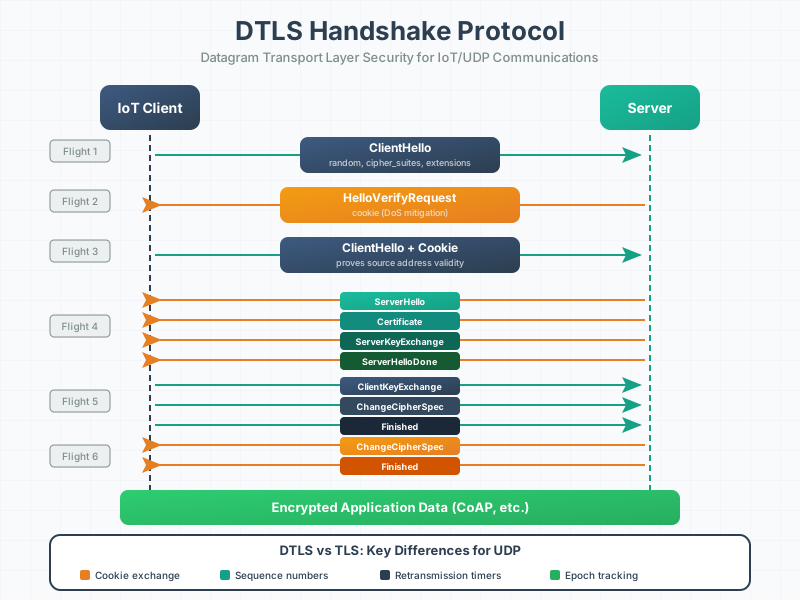
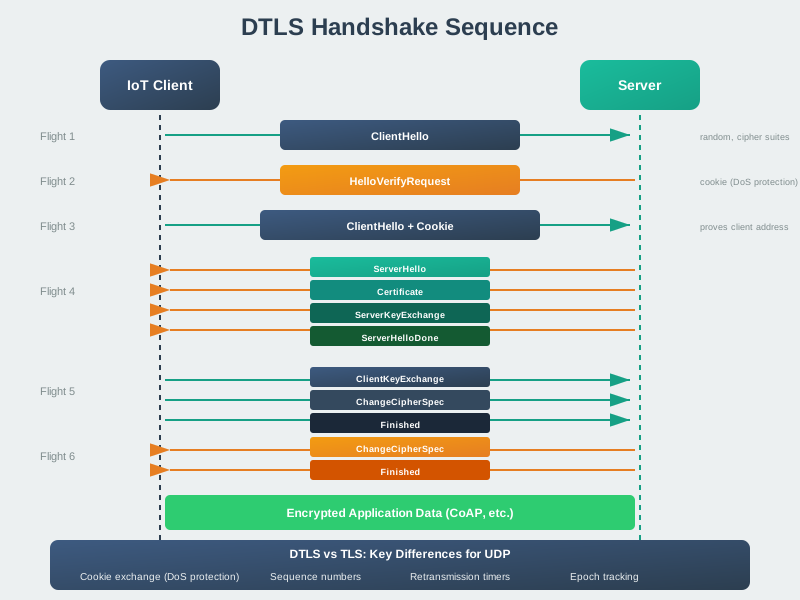
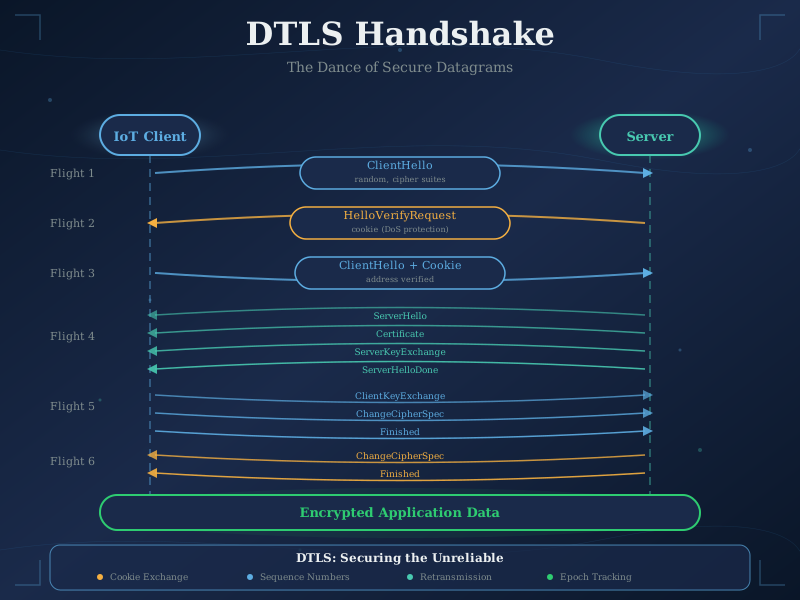
753.5.4 Implementation 3: DTLS Handshake Cost Analyzer
This implementation analyzes DTLS handshake overhead, timing, and energy consumption compared to unencrypted UDP and TLS/TCP.
Expected Output:
=== DTLS vs TLS Handshake Cost Analysis ===

Network Latency: 50 ms RTT
TX Power: 15 mW

Handshake Comparison:
====================================================================================================
Protocol                  Messages   Bytes    RTT   Time         Energy
----------------------------------------------------------------------------------------------------
None (Unencrypted)             N/A        0      0        0 ms           0 µJ
DTLS with PSK                    6      620      3      150 ms        2250 µJ
DTLS with Certificates           6     1790      3      150 ms        2250 µJ
TLS with PSK                     7      528      3      150 ms        2250 µJ
TLS with Certificates            7     1698      3      150 ms        2250 µJ

====================================================================================================

Per-Record Overhead:
----------------------------------------------------------------------
Protocol                  Record Overhead      100-byte Payload
----------------------------------------------------------------------
None (Unencrypted)              0 bytes             100.0% efficiency
DTLS with PSK                  13 bytes              88.5% efficiency
DTLS with Certificates         13 bytes              88.5% efficiency
TLS with PSK                    5 bytes              95.2% efficiency
TLS with Certificates           5 bytes              95.2% efficiency

======================================================================

Session Resumption (Repeat Connections):
--------------------------------------------------------------------------------
DTLS PSK:
  Full handshake: 620 bytes, 150 ms
  Session resumption: 200 bytes → 68% reduction

TLS PSK:
  Full handshake: 528 bytes, 150 ms
  Session resumption: 278 bytes → 47% reduction

================================================================================

Key Insights:
- DTLS handshake: 17% larger than TLS (cookie mechanism for DoS protection)
- DTLS record overhead: 13 bytes vs TLS 5 bytes (sequence number + epoch)
- PSK avoids expensive public key operations (certificates add ~1 KB)
- Session resumption critical for repeat connections (68% reduction)
Key Concepts Demonstrated: - DTLS vs TLS Handshake: DTLS larger due to cookie mechanism (DoS protection) - PSK vs Certificates: PSK 620 bytes vs Cert 1,790 bytes (3× difference) - Record Overhead: DTLS 13 bytes vs TLS 5 bytes (epoch + sequence number) - Session Resumption: 68% reduction for DTLS PSK (critical optimization) - Energy Cost: 150 ms handshake = 2,250 µJ at 15 mW
753.6 Visual Reference Gallery
NoteAI-Generated Figure Variants
Explore alternative visual representations of transport protocol optimization concepts. These AI-generated figures offer different artistic perspectives while maintaining technical accuracy.
753.7 Summary
- TCP optimizations for IoT include connection keep-alive, TCP Fast Open (TFO), and lightweight implementations like uIP (4-10 KB) and lwIP (40-100 KB)
- Protocol overhead calculator demonstrates UDP’s 58% overhead vs TCP’s 96% overhead for full connection lifecycle with small payloads
- Battery life impact varies by transmission frequency - infrequent transmissions make protocol choice minimal, frequent transmissions show TCP consuming 4× more battery than UDP
- Transport protocol selector uses decision tree logic prioritizing reliability, then latency, power, and security to recommend optimal protocol
- CoAP Confirmable messages provide application-layer reliability on UDP, offering middle-ground between TCP overhead and UDP unreliability
- DTLS handshake cost is 17% larger than TLS (620 vs 528 bytes for PSK) due to cookie mechanism protecting against DoS attacks
- Session resumption is critical optimization reducing DTLS handshake by 68% for repeat connections - essential for power-constrained IoT devices
753.7.1 Optimization Trade-off Matrix
| Optimization | Battery Savings | Implementation Complexity | When to Use |
|---|---|---|---|
| TCP Keep-Alive | 2× vs full connection | Low (socket option) | Frequent transmission (>1/min) |
| UDP + CoAP CON | 5× vs TCP | Medium (app-layer retry) | Battery-powered, selective reliability |
| DTLS Session Resumption | 3× vs full handshake | Medium (session cache) | Repeat connections, security needed |
| 6LoWPAN Compression | 7× vs uncompressed | Low (automatic) | Always on 802.15.4 networks |
| Lightweight Stack (uIP) | 10× code size vs full | High (limited features) | <64KB flash, constrained MCU |
Recommended Stack for Battery IoT:
Application: CoAP (Confirmable for critical, Non-confirmable for telemetry)
Security:    DTLS 1.3 with PSK + Session Resumption
Transport:   UDP (8-byte header)
Network:     IPv6 with 6LoWPAN compression (40B → 6B)
Link: 802.15.4 (2.4 GHz, 250 kbps)Result: 45+ year battery life for sensors reporting every 5 minutes
753.8 Knowledge Check
TipQuestion 1: Header Compression
What is the primary benefit of header compression in IoT communications?
Options: - A) Improved security - B) Reduced bandwidth and energy consumption - C) Faster encryption - D) Better error correction
NoteAnswer
Correct: B) Reduced bandwidth and energy consumption
Header compression (like 6LoWPAN or ROHC) reduces overhead, saving bandwidth and transmission energy—critical for constrained devices.
TipQuestion 2: Connection Management
Why is connection pooling beneficial for IoT gateways?
Options: - A) Increases security - B) Reduces handshake overhead for multiple devices - C) Improves data accuracy - D) Enables offline operation
NoteAnswer
Correct: B) Reduces handshake overhead for multiple devices
Connection pooling allows a gateway to reuse established connections for multiple sensors, avoiding repeated TCP/TLS handshake costs.
TipQuestion 3: Keep-alive Optimization
What is the trade-off when increasing keep-alive intervals?
Options: - A) Security vs speed - B) Power savings vs connection responsiveness - C) Bandwidth vs latency - D) Cost vs reliability
NoteAnswer
Correct: B) Power savings vs connection responsiveness
Longer keep-alive intervals save power but may cause longer delays in detecting disconnections or NAT timeout issues.
NoteRelated Chapters
Deep Dives: - Transport Fundamentals - TCP and UDP core concepts - Transport Protocols for IoT - Protocol selection criteria - Transport Selection and Scenarios - Real-world protocol choices
Optimizations: - 6LoWPAN Compression - Header compression for constrained networks - CoAP Protocol - Lightweight HTTP alternative - MQTT QoS and Session Management - Reliable messaging over TCP
Security: - DTLS and Security - Secure UDP communication - Encryption Architecture - TLS/DTLS implementation
Learning: - Simulations Hub - Protocol performance simulators - Knowledge Gaps - Transport layer concepts
753.9 What’s Next
Continue exploring IoT communication protocols and optimizations:
- CoAP Protocol: Constrained Application Protocol implementation details and message types
- MQTT Protocol: Quality of Service levels, persistent sessions, and broker architecture
- Security Protocols: DTLS 1.3, cipher suite selection, and certificate management for IoT
- 6LoWPAN Compression: Header compression techniques reducing IPv6 from 40 bytes to 6 bytes