Apply M2M Concepts: Identify when M2M patterns are appropriate for specific use cases
TipFor Kids: Meet the Sensor Squad!
M2M communication is like having walkie-talkies that let machines talk to each other without needing a person to pass messages!
465.1.1 The Sensor Squad Adventure: The Vending Machine Mystery
One day, Sammy the Temperature Sensor was walking past the school cafeteria when he noticed something amazing. The vending machine was talking! Not out loud, of course, but with invisible radio waves.
“What are you saying?” asked Sammy, curious about all the beeping inside.
The vending machine, named Vinnie, explained: “I just told the warehouse that I’m running low on apple juice! Without anyone pressing a button, my sensors counted the drinks and sent a message. Tomorrow morning, the delivery truck will know exactly what to bring.”
Lila the Light Sensor was amazed. “So machines can order their own supplies?”
“That’s M2M - Machine-to-Machine communication!” said Vinnie proudly. “My friend at the gas station does the same thing. When the underground fuel tank gets low, it automatically tells the fuel company to send more. No human has to check or call anyone!”
Max the Motion Detector added, “That’s like how the ATM at the bank talks to the computer far away to check if you have enough money before giving you cash. The machines figure it out themselves!”
Bella the Button realized something important: “So M2M is when machines have their own conversations to get work done, and humans only find out when something needs attention!”
465.1.2 Key Words for Kids
Word
What It Means
M2M (Machine-to-Machine)
When machines send messages directly to other machines without a person in the middle
Telemetry
Sending measurements from far away, like a thermometer reporting temperature to a computer
Gateway
A translator device that helps different machines understand each other
Autonomous
When something can work and make decisions all by itself
465.1.3 Try This at Home!
The Silent Conversation Game: See how machines communicate without words!
Find a TV remote control and a TV. When you press the remote, an invisible beam tells the TV what to do - that’s like M2M!
If you have a digital thermostat at home, watch how the display shows the temperature. The sensor is constantly “talking” to the display without anyone asking.
Notice your refrigerator - when it gets too warm inside, the motor turns on automatically. The temperature sensor inside is “telling” the motor what to do - M2M in action!
Ask a grown-up: “Does our home have any devices that talk to the internet by themselves?” (Like a smart meter, doorbell camera, or pet feeder)
465.2 Prerequisites
Before diving into this chapter, you should be familiar with:
Machine-to-Machine (M2M) Communication: Understanding the M2M overview chapter provides essential context for M2M architectures, platforms, and the evolution from M2M to IoT
IoT Reference Models: Knowledge of layered IoT architectures helps position M2M systems within the broader ecosystem
Networking Basics for IoT: Familiarity with network protocols, addressing, and communication patterns
465.3 Getting Started (For Beginners)
TipNew to M2M Communication? Start Here!
M2M (Machine-to-Machine) is the foundation that led to IoT. Understanding M2M helps you see how devices learned to “talk” to each other without human intervention.
465.3.1 What is M2M? (Simple Explanation)
M2M = Machines talking to machines, without humans in the loop
Before IoT became a buzzword, engineers called this “M2M” or “machine-to-machine communication.”
Graph diagram
Figure 465.1: Traditional vs M2M: M2M eliminates the human bottleneck, enabling faster, automated responses.
M2M Architecture Overview
Figure 465.2: Machine-to-Machine (M2M) communication architecture illustrating the layered structure from field devices through gateways to cloud platforms, enabling autonomous device communication without human intervention.
465.3.2 Real-World M2M Examples
You encounter M2M systems every day:
M2M System
What Talks
What Happens
Human Involvement
ATM Network
ATM <-> Bank servers
Dispenses cash, checks balance
None after you insert card
Fleet Tracking
Truck GPS <-> Dispatch center
Reports location every minute
None (automatic)
Vending Machines
Machine <-> Supplier
“I’m low on Coke, send more”
None until restocking
Utility Meters
Smart meter <-> Power company
Reports usage every 15 min
None (no meter reader!)
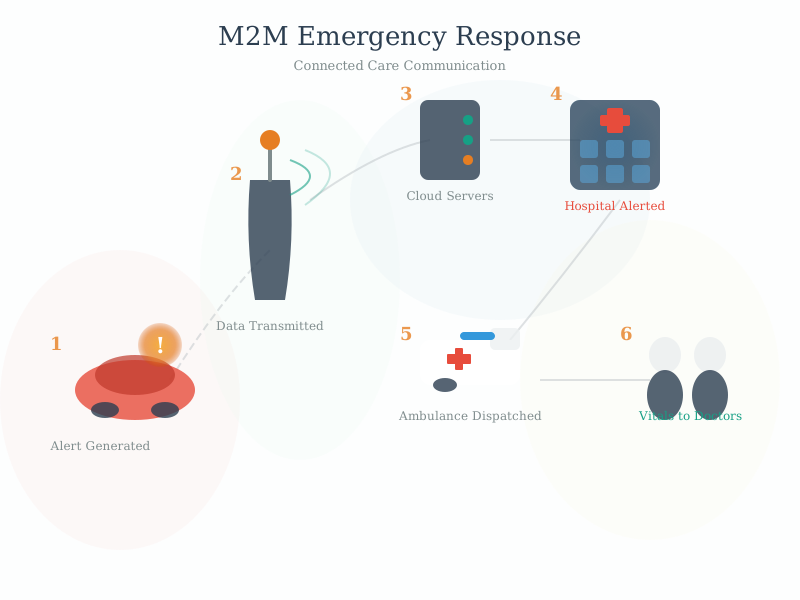
Medical Monitors
Heart monitor <-> Hospital
Alerts doctors if abnormal
Only if alert triggered
465.4 M2M vs IoT: Evolution and Comparison
While M2M and IoT share similarities, they represent different evolutionary stages of connected devices.
Two architecture diagrams comparing M2M and IoT
Figure 465.3: Architecture comparison: M2M shows proprietary protocol point-to-point communication, while IoT shows standard protocols enabling multi-device cloud connectivity.
465.4.1 Key Differences
Characteristic
M2M
IoT
Focus
Machines
Sensors
Architecture
Hardware-based
Software-based
Application Scope
Vertical applications
Horizontal applications
Deployment
Deployed in a closed system
Connects to a larger network
Communication Pattern
Machines communicating with machines
Machines, humans, applications interconnected
Protocols
Uses non-IP protocol
Uses IP protocols
Cloud Dependency
Can use cloud, but not required
Uses the cloud
Network Type
Point-to-point communication
IP networks
Communication Direction
Often one-way communication
Bidirectional communication
Purpose
Monitor and control
Multiple applications; multilevel
Integration
Limited integration options
Unlimited via software/APIs
Data Structure
Structured data
Structured and unstructured data
Summary Comparison:
Aspect
M2M
IoT
Scope
Device-to-device
Device-to-cloud-to-device
Communication
Point-to-point or point-to-server
Many-to-many via internet
Protocols
Proprietary (often)
Standardized (MQTT, CoAP, HTTP)
Data
Limited processing
Big data analytics, AI/ML
Integration
Vertical silos
Horizontal platforms
Scalability
Hundreds to thousands
Millions to billions
Examples
SCADA, Industrial HMI
Smart cities, Consumer IoT
Think of it this way: M2M is like two fax machines talking. IoT is like email - connected to everything, accessible from anywhere.
NoteKey Takeaway
In one sentence: M2M (Machine-to-Machine) communication enables autonomous device-to-device data exchange without human intervention, forming the foundation that evolved into modern IoT through standardization and cloud connectivity.
Remember this: M2M is the reliable, proven predecessor of IoT - when you need simple, direct device communication for specific purposes like fleet tracking or utility metering, M2M patterns often work better than over-engineered IoT solutions.
TipTradeoff Decision Guide: M2M vs IoT Approaches
Factor
M2M Approach
IoT Approach
When to Choose
Protocol Flexibility
Proprietary (vendor lock-in risk)
Standardized (MQTT, CoAP, HTTP)
IoT when multi-vendor interoperability needed
Integration Complexity
Simple (point-to-point)
Complex (cloud platform required)
M2M for single-purpose applications
Data Analytics
Limited (local processing)
Extensive (cloud AI/ML, big data)
IoT when insights from data are valuable
Deployment Cost
Lower (no cloud infrastructure)
Higher (cloud subscriptions, APIs)
M2M for cost-sensitive deployments
Scalability
Limited (100s-1000s devices)
Massive (millions of devices)
IoT when scale exceeds 10K devices
Time-to-Market
Faster (simpler stack)
Slower (more components)
M2M for MVP or proof-of-concept
Remote Access
Limited (VPN/dedicated lines)
Universal (apps, dashboards)
IoT when consumer or mobile access needed
Maintenance
On-site (firmware updates)
OTA updates via cloud
IoT when devices are geographically distributed
Quick Decision Rule: Choose M2M for proven, single-purpose industrial applications (fleet tracking, utility metering, SCADA) where simplicity and reliability matter more than cloud features. Choose IoT when you need multi-application data sharing, consumer interfaces, or AI-driven analytics.
465.5 M2M Applications
M2M enables automation across diverse sectors:
1. Smart Grid and Utilities
Automated meter reading (AMR)
Demand response management
Grid monitoring and fault detection
2. Healthcare
Remote patient monitoring
Wearable health devices
Medication compliance tracking
3. Intelligent Transport Systems (ITS)
Fleet management
Vehicle diagnostics
Traffic optimization
4. Supply Chain Management
Asset tracking
Inventory management
Cold chain monitoring
5. Environmental Monitoring
Weather stations
Air quality monitoring
Water quality sensors
6. Building Automation
HVAC control
Energy management
Security systems
7. Industrial Automation
Manufacturing process control
Predictive maintenance
Quality assurance
8. Agriculture
Precision farming
Irrigation control
Livestock monitoring
NoteKnowledge Check: M2M Application Domains
Show code
viewof kcM2mApp1 = {const container =html`<div id="kc-m2m-app-1-container"></div>`;if (container &&typeof InlineKnowledgeCheck !=='undefined') { container.innerHTML=''; container.appendChild(InlineKnowledgeCheck.create({question:"A pharmaceutical company must transport vaccines across the country while maintaining a strict temperature range of 2-8C. They need continuous monitoring during transit with alerts if temperature deviates, complete audit trail for regulatory compliance, and proof of proper handling for insurance claims. Which M2M application domain best fits this requirement?",options: [ {text:"Healthcare M2M - use patient monitoring devices attached to vaccine containers",correct:false,feedback:"Incorrect. While vaccines are medical products, patient monitoring devices are designed for vital signs, not environmental conditions. The application domain is supply chain management (specifically cold chain monitoring), not healthcare."}, {text:"Supply Chain M2M with cold chain monitoring - temperature sensors in containers report via cellular M2M to central platform with geofenced alerts and tamper-proof logging",correct:true,feedback:"Correct! Cold chain monitoring is a critical M2M application in supply chain management. The architecture includes temperature sensors with cellular M2M, GPS tracking, geofenced alerts, and tamper-proof logging for regulatory compliance."}, {text:"Environmental Monitoring M2M - weather stations can track temperature anywhere",correct:false,feedback:"Incorrect. Environmental monitoring focuses on fixed-location outdoor conditions. Vaccine transport is mobile with specific regulatory requirements that environmental stations don't provide."}, {text:"Building Automation M2M - HVAC systems can maintain the temperature range",correct:false,feedback:"Incorrect. Building automation handles stationary facilities, not mobile transport. The challenge is maintaining temperature during transit between facilities."} ],difficulty:"medium",topic:"m2m-application-domains" })); }return container;}
465.6 M2M Node Types
M2M devices span a spectrum of capabilities, categorized into three tiers:
465.6.1 Low-End Nodes
Characteristics:
Minimal processing power (8-16 bit MCU)
Very low power consumption (< 1mW idle)
Limited memory (KB range)
No IP stack (IEEE 802.15.4, BLE)
Battery-powered, long lifetime (years)
Capabilities:
Basic sensing and actuation
Simple data aggregation
Auto-configuration
Sleep/wake cycles
Applications:
Environmental monitoring
Smart agriculture sensors
Building sensor networks
465.6.2 Mid-End Nodes
Characteristics:
Moderate processing (32-bit MCU, ARM Cortex-M)
Medium power consumption
More memory (MB range)
IP stack support (IPv6, 6LoWPAN)
Possible mobility
Capabilities:
Complex sensing and actuation
Local data processing
Quality of Service (QoS) support
Power and traffic control
Localization
Applications:
Home automation
Asset management
Industrial monitoring
465.6.3 High-End Nodes
Characteristics:
High processing power (Application processors)
Significant memory (GB range)
Multimedia capabilities (video, audio)
Multiple connectivity options
Often mobile
Capabilities:
Complex data processing
Multimedia streaming
Real-time communication
User interfaces
QoS guarantees
Applications:
Smartphones as M2M devices
Vehicular systems (V2X)
Medical imaging devices
Surveillance systems
NoteKnowledge Check: M2M vs IoT Differences
Show code
viewof kcM2mVsIot = {const container =html`<div id="kc-m2m-vs-iot-container"></div>`;if (container &&typeof InlineKnowledgeCheck !=='undefined') { container.innerHTML=''; container.appendChild(InlineKnowledgeCheck.create({question:"A logistics company operates 500 delivery trucks with GPS trackers that report location to a central dispatch system every 30 seconds using a proprietary cellular protocol. The company wants to add driver behavior analytics, customer delivery notifications via mobile app, and integration with third-party route optimization services. What architectural change best describes this evolution?",options: [ {text:"Upgrade the GPS hardware to newer models with better accuracy - this is an M2M optimization project",correct:false,feedback:"Incorrect. The requirements (analytics, mobile apps, third-party integrations) go beyond M2M device upgrades. GPS accuracy improvements don't address the need for cloud platforms, standard APIs, and consumer-facing applications."}, {text:"Keep the proprietary protocol but add more cellular bandwidth - M2M just needs faster connections",correct:false,feedback:"Incorrect. Bandwidth isn't the limitation. Proprietary protocols create integration barriers. The transformation requires standardized protocols and cloud platform connectivity."}, {text:"Migrate from M2M to IoT architecture by adding cloud platform, standardized protocols (MQTT/HTTP), and APIs for third-party integration and mobile apps",correct:true,feedback:"Correct! This scenario illustrates the classic M2M-to-IoT evolution: cloud platform for analytics, standard protocols for integration, and APIs for third-party services and mobile apps."}, {text:"Deploy edge computing at each truck - all analytics should happen locally without cloud",correct:false,feedback:"Incorrect. While edge computing can help, the requirements (mobile app notifications, third-party integrations, centralized analytics) explicitly need cloud connectivity."} ],difficulty:"medium",topic:"m2m-iot-evolution" })); }return container;}
NoteKnowledge Check: M2M Gateway Functions
Show code
viewof kcM2mGateway = {const container =html`<div id="kc-m2m-gateway-container"></div>`;if (container &&typeof InlineKnowledgeCheck !=='undefined') { container.innerHTML=''; container.appendChild(InlineKnowledgeCheck.create({question:"A manufacturing plant has 200 legacy Modbus PLC sensors (temperature, pressure, vibration) installed 15 years ago. The plant manager wants real-time dashboards on tablets and predictive maintenance alerts. The Modbus devices cannot be replaced due to budget constraints. What is the correct M2M gateway solution?",options: [ {text:"Connect all Modbus devices directly to the cloud using cellular modems attached to each PLC",correct:false,feedback:"Incorrect. Modbus is not IP-based - devices can't speak directly to cloud. 200 cellular SIMs would cost $2,000+/month. A gateway is required for protocol translation."}, {text:"Install M2M gateways that translate Modbus RTU to MQTT/HTTP, aggregate sensor data, and forward to cloud platform via single cellular connection",correct:true,feedback:"Correct! M2M gateways solve this integration challenge: protocol translation (Modbus RTU to MQTT/HTTP), data aggregation, cost optimization (4-8 gateways vs 200 connections), local buffering, and edge processing."}, {text:"Replace the Modbus PLCs with modern Wi-Fi-enabled sensors that speak MQTT natively",correct:false,feedback:"Incorrect. The scenario explicitly states devices cannot be replaced due to budget constraints. Replacing 200 industrial sensors would cost $50,000-$200,000+ and require production downtime."}, {text:"Use VPN tunnels from each Modbus device to the cloud - encryption solves the protocol problem",correct:false,feedback:"Incorrect. VPN provides secure transport but doesn't solve protocol translation. Modbus uses RS-485 serial signaling - fundamentally incompatible with IP regardless of encryption."} ],difficulty:"easy",topic:"m2m-gateway-functions" })); }return container;}
465.7 In Plain English: M2M Communication
TipWhat is M2M Really About?
Think of M2M like machines having conversations without needing humans to translate.
Imagine you have a vending machine that needs to tell the supplier “I’m running low on Coca-Cola.” In the old days:
Someone physically checks the machine weekly
They write down inventory on paper
They call the warehouse
The warehouse schedules a delivery
With M2M, the vending machine talks directly to the supplier’s computer system:
The machine detects low inventory automatically
It sends a message: “Machine #4728 needs 24 Coke cans”
The supplier’s system schedules a delivery truck
No human intervention needed until restocking
The key idea: Machines monitoring themselves, reporting problems, and coordinating actions - all without waiting for a human to notice something is wrong.
Another everyday example: Your car’s tire pressure monitoring system (TPMS). Each tire has a sensor that talks to your dashboard computer. When pressure drops, the sensor sends a message, and the dashboard lights up the warning symbol. No mechanic needed to check tire pressure manually.
465.8 Summary
This chapter introduced Machine-to-Machine (M2M) communication fundamentals:
M2M Definition: Autonomous device-to-device data exchange without human intervention
M2M vs IoT Evolution: M2M focuses on point-to-point proprietary communication; IoT extends to cloud-connected standardized platforms
The next chapter explores M2M Architectures and Standards, covering the M2M Service Platform structure, network architectures (IP and non-IP based), and ETSI standardization requirements.