%%{init: {'theme': 'base', 'themeVariables': {'primaryColor': '#2C3E50', 'primaryTextColor': '#fff', 'primaryBorderColor': '#16A085', 'lineColor': '#16A085', 'secondaryColor': '#E67E22', 'tertiaryColor': '#7F8C8D'}}}%%
flowchart LR
    subgraph SENSORS["Sensor Tier"]
        GW1["Sensor<br/>Gateway 1"]
        GW2["Sensor<br/>Gateway 2"]
    end

    subgraph SWITCHES["Switch Tier"]
        SWA["Switch A"]
        SWB["Switch B"]
    end

    subgraph EDGE["Edge Tier"]
        ES1["Edge<br/>Server 1"]
        ES2["Edge<br/>Server 2"]
    end

    subgraph ROUTERS["Router Tier"]
        RA["Router A"]
        RB["Router B"]
    end

    subgraph INTERNET["Internet (Redundant ISP)"]
        ISP1["Internet 1"]
        ISP2["Internet 2"]
    end

    GW1 --> SWA
    GW1 --> SWB
    GW2 --> SWA
    GW2 --> SWB

    SWA --> ES1
    SWA --> ES2
    SWB --> ES1
    SWB --> ES2

    ES1 --> RA
    ES1 --> RB
    ES2 --> RA
    ES2 --> RB

    RA --> ISP1
    RA --> ISP2
    RB --> ISP1
    RB --> ISP2

    style GW1 fill:#16A085,stroke:#2C3E50,color:#fff
    style GW2 fill:#16A085,stroke:#2C3E50,color:#fff
    style SWA fill:#E67E22,stroke:#2C3E50,color:#fff
    style SWB fill:#E67E22,stroke:#2C3E50,color:#fff
    style ES1 fill:#2C3E50,stroke:#16A085,color:#fff
    style ES2 fill:#2C3E50,stroke:#16A085,color:#fff
    style RA fill:#7F8C8D,stroke:#2C3E50,color:#fff
    style RB fill:#7F8C8D,stroke:#2C3E50,color:#fff
    style ISP1 fill:#16A085,stroke:#2C3E50,color:#fff
    style ISP2 fill:#16A085,stroke:#2C3E50,color:#fff
789 IoT Network Design: Advanced Scenarios and Labs
NoteLearning Objectives
By the end of this section, you will be able to:
- Apply comprehensive design checklists to evaluate IoT device and data requirements
- Analyze industrial scenarios with high availability and redundancy requirements
- Design complete IoT network solutions from requirements to deployment
- Evaluate protocol selection through real-world case studies
789.1 Prerequisites
Before studying this chapter, review:
- IoT Network Design: Reference Model Framework: Understanding the 7-Level IoT Reference Model
- Protocol Selection Worked Examples: Spectrum allocation and cost analysis
- Five Key Design Considerations: Device, data, addressing, and topology planning
789.2 Comprehensive Design Questions
ImportantDesign Checklist: Know Your End Devices
What size is it? Where is it placed? Does it have an OS? What is its power supply? What data does it deliver? Does it have a sensing and/or actuator function?
Specific Questions:
- Physical Characteristics:
- Dimensions and weight?
- Environmental rating (IP rating)?
- Operating temperature range?
- Mounting requirements?
- Power Specifications:
- Mains powered, battery, or energy harvesting?
- Power consumption in active/sleep modes?
- Battery life requirements?
- Computational Capabilities:
- Processor type and speed?
- RAM and storage capacity?
- Operating system (RTOS, Linux, none)?
- Can it run TCP/IP stack?
- Connectivity:
- Built-in radio (Wi-Fi, BLE, LoRa)?
- Wired interfaces (Ethernet, RS-485)?
- Antenna type and placement?
- Communication range required?
- Data Characteristics:
- Sensor types and accuracy?
- Data format and size?
- Sampling frequency?
- Actuator control requirements?
789.3 Design Checklist: Know Your Data
How much data? How often is data sent? How big is the data? How fast is the data? How timely does a response to the data need to be? How accurate is the data? What is the useful part of the data?
Specific Questions:
- Volume:
- Bytes per message?
- Messages per second/minute/hour?
- Daily/monthly data volume?
- Peak vs average rates?
- Velocity:
- Real-time requirements (latency)?
- Acceptable delay before processing?
- Continuous vs periodic transmission?
- Burst vs steady data flow?
- Variety:
- Structured (JSON, CSV) or unstructured?
- Multiple data types (sensor, video, audio)?
- Metadata requirements?
- Data format standards?
- Veracity:
- Sensor accuracy and precision?
- Error rates and handling?
- Data validation requirements?
- Calibration needs?
- Value:
- Critical vs informational data?
- Data retention period?
- Which data requires immediate action?
- Long-term analytics requirements?
789.4 Case Study: Protocol Selection in Practice
%%{init: {'theme': 'base', 'themeVariables': {'primaryColor':'#2C3E50','primaryTextColor':'#fff','primaryBorderColor':'#16A085','lineColor':'#16A085','secondaryColor':'#E67E22','tertiaryColor':'#ecf0f1','textColor':'#2C3E50','fontSize':'14px'}}}%%
graph TD
    REQ["Requirements:<br/>10K parking sensors<br/>5 km² area<br/>10-year battery life<br/>5-min updates"]

    ANALYSIS["Decision Analysis"]

    REQ --> ANALYSIS

    ANALYSIS --> D1["Device: Battery-powered<br/>magnetic sensors"]
    ANALYSIS --> D2["Connectivity: LoRaWAN<br/>(long range, low power)"]
    ANALYSIS --> D3["Data: 1 byte/message<br/>MQTT to cloud"]
    ANALYSIS --> D4["Infrastructure: 20 gateways<br/>IPv6 addressing"]
    ANALYSIS --> D5["Topology: Star<br/>(sensors → GW → cloud)"]

    D1 --> DEPLOY["Deployment Success:<br/>10-year battery<br/>99.5% uptime<br/>Real-time availability"]
    D2 --> DEPLOY
    D3 --> DEPLOY
    D4 --> DEPLOY
    D5 --> DEPLOY

    style REQ fill:#E67E22,stroke:#2C3E50,color:#fff
    style ANALYSIS fill:#2C3E50,stroke:#16A085,color:#fff
    style D1 fill:#16A085,stroke:#2C3E50,color:#fff
    style D2 fill:#16A085,stroke:#2C3E50,color:#fff
    style D3 fill:#16A085,stroke:#2C3E50,color:#fff
    style D4 fill:#16A085,stroke:#2C3E50,color:#fff
    style D5 fill:#16A085,stroke:#2C3E50,color:#fff
    style DEPLOY fill:#2C3E50,stroke:#16A085,color:#fff
{fig-alt=“Smart city parking system case study flowchart showing requirements (10,000 sensors, 5km² area, 10-year battery, 5-minute updates in orange) leading to decision analysis (navy) which determines five key design choices: battery-powered magnetic sensors, LoRaWAN connectivity for long range and low power, 1-byte messages via MQTT to cloud, 20 gateways with IPv6 addressing, and star topology (all in teal). These decisions result in successful deployment achieving 10-year battery life, 99.5% uptime, and real-time parking availability (navy).”}
789.4.1 Example: Smart City Parking System
Requirements Analysis: - 10,000 parking spots across 5km² area - Battery-powered sensors (10-year life) - Occupancy status updates every 5 minutes - Real-time availability display - Monthly billing data
Design Decisions:
- Devices (Level 1-2):
- Magnetic sensor modules (battery powered)
- LoRaWAN connectivity (long range, low power)
- 10-year battery life with 5-minute reporting
- Data (Level 2-4):
- 1 byte per message (occupied/vacant + spot ID)
- ~33 messages/hour per sensor
- LoRaWAN to Gateway to MQTT to Cloud
- Total: 10KB/hour for 10,000 sensors
- Infrastructure (Level 4+):
- 20 LoRaWAN gateways (500m coverage each)
- Redundant internet connections
- Cloud-based MQTT broker
- PostgreSQL database for historical data
- Addressing:
- Each sensor: Unique DevEUI (64-bit)
- Gateway-to-cloud: IPv6
- No IP addressing needed for sensors
- Topology:
- Logical: Star topology (sensors to gateways to cloud)
- Physical: Gateway placement for maximum coverage
- Documentation: GIS map with sensor locations
789.5 Hands-On Lab: Design an IoT Network
789.6 Quiz: IoT Network Design Decisions
NoteRelated Chapters
Network Design Foundations: - Networking Basics - Core networking principles - Layered Models Fundamentals - OSI and TCP/IP models - Topologies Fundamentals - Network structure patterns
Protocol Selection: - IoT Protocols Fundamentals - Protocol stack overview - IoT Protocols Labs and Selection - Hands-on selection criteria - LPWAN Fundamentals - Wide-area connectivity
Architecture References: - IoT Reference Models - Standard IoT frameworks - Edge/Fog Computing - Distributed processing
Learning Resources: - Simulations Hub - Network topology tools - Knowledge Gaps Hub - Design pattern exercises
789.7 Visual Reference Gallery
NoteVisual: IoT 7-Level Reference Model Architecture
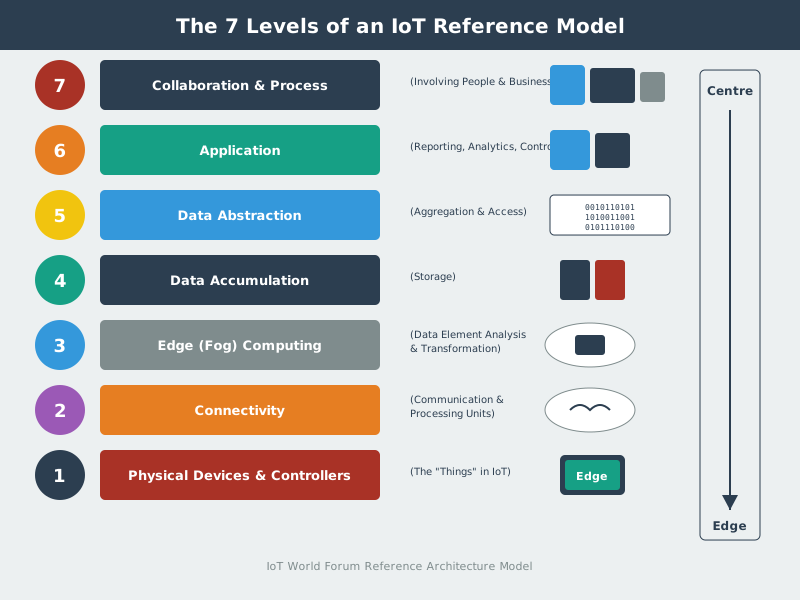
The Cisco 7-Level IoT Reference Model provides a structured framework for IoT network design decisions, organizing device connectivity, edge processing, data management, and business applications into distinct layers.
NoteVisual: IoT Protocol Stack Overview
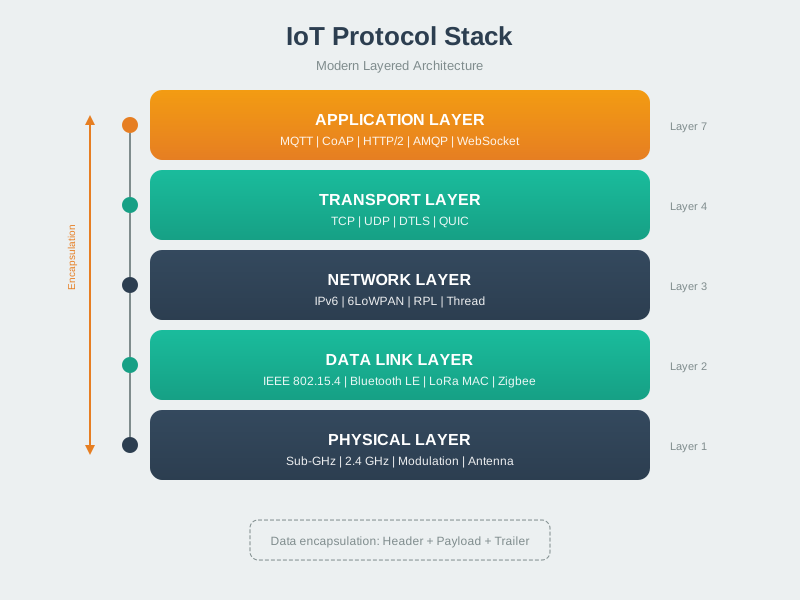
This protocol stack visualization illustrates how different IoT protocols map across network layers, helping designers select appropriate protocols for specific device capabilities and network requirements.
NoteVisual: Mesh Network Topology
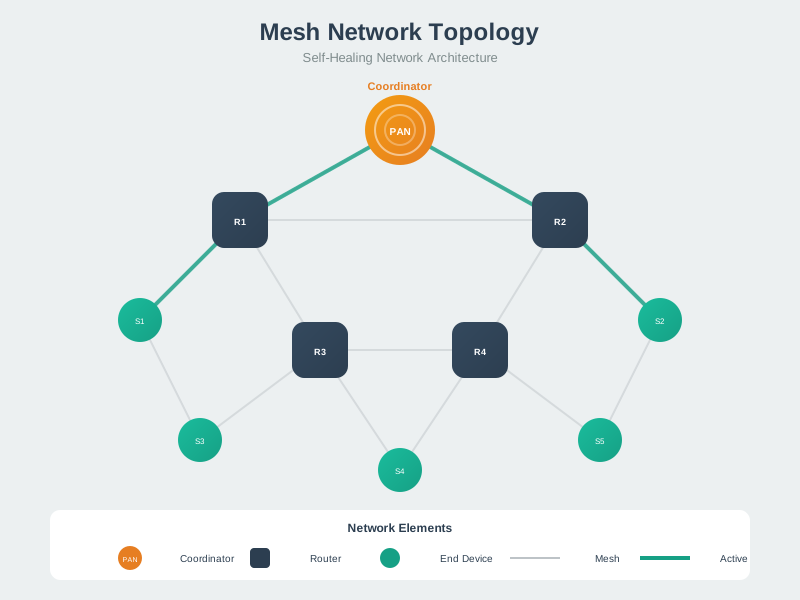
Mesh topology provides redundant communication paths critical for industrial IoT and smart building applications where network reliability is essential.
789.8 Summary
Designing an IoT network requires careful consideration across multiple dimensions:
TipKey Takeaways
- No Universal Solution: Each IoT deployment requires custom design based on specific requirements
- Layered Decision Making: Use the 7-Level IoT Reference Model to organize design decisions
- Device-First Thinking: Device capabilities and constraints drive connectivity choices
- Data Characteristics Matter: Volume, velocity, and value of data influence protocol selection
- Plan for Scale: Addressing schemes and topology must accommodate growth
- Document Everything: Logical and physical topologies are essential for deployment and maintenance
- Think End-to-End: Design must consider all layers from devices to applications
- Redundancy for Critical Systems: High-availability requirements demand redundant infrastructure
Design Process: 1. Understand devices (capabilities, power, placement) 2. Characterize data (volume, frequency, latency) 3. Select appropriate protocols for each layer 4. Design addressing scheme for scale 5. Plan physical and logical topologies 6. Specify infrastructure requirements 7. Implement redundancy where needed 8. Document all design decisions
The complexity of IoT network design reflects the heterogeneous nature of IoT devices and applications. Successful deployments balance technical constraints, business requirements, and future scalability.
789.9 What’s Next?
Continue to Network Topologies to explore how different network structures (star, mesh, tree) impact IoT system scalability, reliability, and management.