99 IoT History: Lessons from Technology Paradigm Shifts
99.1 Learning Objectives
By the end of this chapter, you will be able to:
- Recognize paradigm blindness: Understand why experts miss technology shifts
- Apply historical lessons: Evaluate IoT opportunities using historical patterns
- Avoid the Innovator’s Dilemma: Frame IoT proposals to address skepticism
- Identify emerging use cases: Recognize that today’s “silly” applications may become essential
IoT Overview Series: - IoT Introduction - Getting started with IoT and the Five Verbs - Device Evolution - Embedded vs Connected vs IoT products - IoT Systems Evolution - Computing evolution enabling IoT - Industry 4.0 and Classification - Industrial IoT and device classification
Strategic Perspectives: - Application Domains - Industry-specific IoT applications - IoT Use Cases - Real-world implementation examples
99.2 Lessons from History: Why Established Players Miss Paradigm Shifts
Understanding IoT’s potential requires learning from history. Every major technology shift has caught established players off guard - and the pattern repeats with striking consistency. The question that seems obvious in retrospect was once dismissed as absurd.
Core Concept: Established experts consistently underestimate paradigm-shifting technologies because they evaluate new innovations using old frameworks. AT&T predicted 900,000 mobile phones by 2000; the actual number exceeded 700 million.
Why It Matters: When evaluating IoT opportunities, the key question is not “Does this solve existing problems better?” but “What new problems can this solve that were previously impossible?” New technologies enable new behaviors that create entirely new markets.
Key Takeaway: Expertise in the current paradigm can blind you to the next one. IoT’s value often emerges from use cases that seem absurd today, just as “walking around with a phone” seemed absurd in 1983.
99.2.1 The Question That Almost Killed Mobile Phones
In the early 1980s, AT&T commissioned McKinsey & Company to forecast the mobile phone market. McKinsey’s analysts, working with AT&T’s best technologists, famously predicted that by the year 2000, the total worldwide market for mobile phones would be… 900,000 units.
The actual number? Over 700 million.
McKinsey was off by a factor of nearly 1,000x.
The fundamental problem? They couldn’t answer a simple question that seemed ridiculous at the time:
“Why would anyone want to walk around with a phone?”
This wasn’t a failure of analysis - it was a failure of imagination. The analysts correctly understood the technology. They correctly understood the costs. What they couldn’t see was that human behavior would fundamentally change once the technology became available.
99.2.2 The British Post Office’s Telephone Verdict
The skepticism toward new communication paradigms extends even further back. When the telephone was first demonstrated in Britain, Sir William Preece, Chief Engineer of the British Post Office, famously declared:
“The Americans have need of the telephone, but we do not. We have plenty of messenger boys.”
This wasn’t ignorance - it was expertise applied to the wrong paradigm. Preece was a brilliant engineer who understood telegraphy perfectly. His error was evaluating a paradigm-shifting technology through the lens of the paradigm it would replace.
99.2.3 From Telephony to IoT: The Communication Evolution
The evolution from telephony to IoT reveals a pattern of expanding connectivity that established players consistently underestimate:
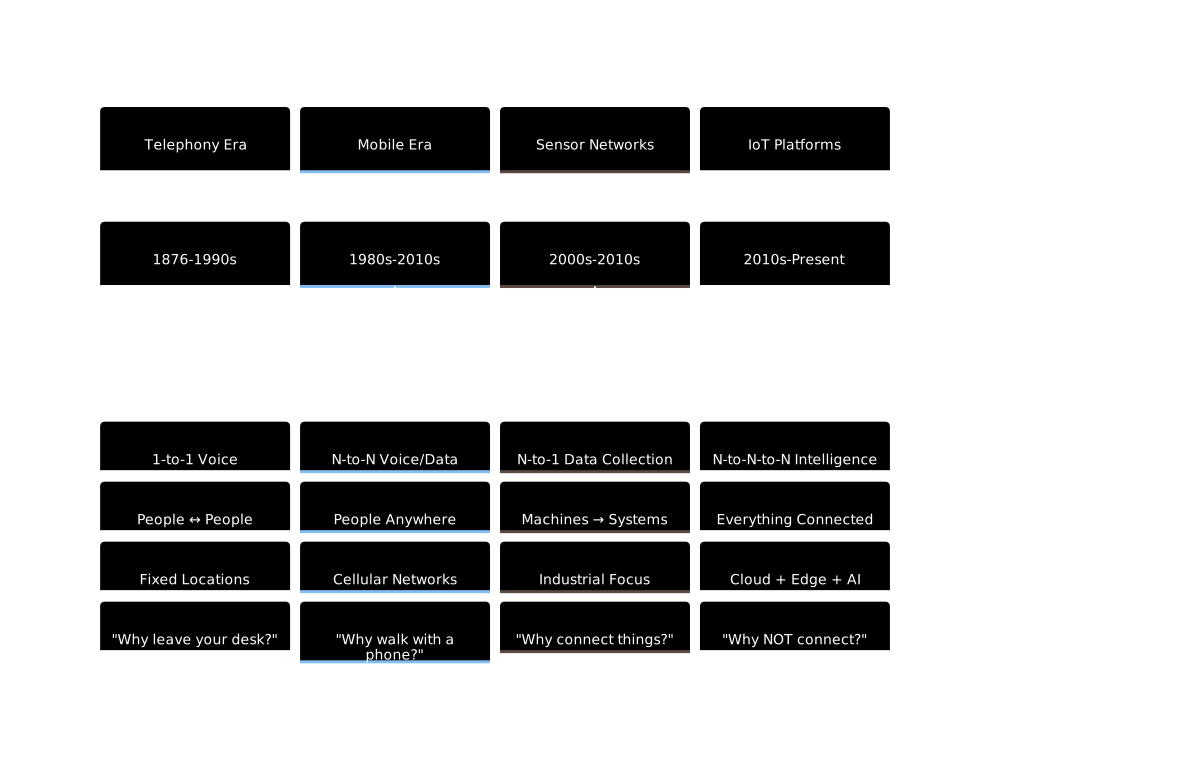
The Pattern of Dismissal:
| Era | Dismissive Question | Reality That Emerged |
|---|---|---|
| Telephone (1876) | “We have messenger boys” | Instant voice communication became essential infrastructure |
| Mobile (1983) | “Why walk with a phone?” | 5+ billion people carry phones everywhere, all the time |
| Internet (1995) | “It’s just for academics” | Global commerce, communication, and culture transformed |
| Smartphones (2007) | “Who needs email on a phone?” | Smartphones became primary computing devices for billions |
| IoT (2015+) | “Why connect a light bulb?” | Connected devices outnumber people 10-to-1 |
99.2.4 Why Experts Miss Paradigm Shifts

Clayton Christensen’s “Innovator’s Dilemma” explains why successful companies fail to adopt disruptive technologies:
1. Expertise Becomes a Liability - AT&T’s deep knowledge of landline infrastructure made wireless seem inferior - Telecom engineers optimized for voice quality, not mobility - Their expertise in the old paradigm blinded them to the new one
2. Customers Don’t Ask for Disruption - In 1983, no AT&T customer was asking for a mobile phone - Customers rarely ask for paradigm-shifting products - they ask for better versions of what they already have - “Faster horses, not automobiles”
3. The Math Doesn’t Work (Initially) - Early mobile phones: $4,000, poor quality, 30-minute battery - Early IoT sensors: expensive, unreliable, no clear ROI - Incumbents correctly calculate that the new technology is inferior - for existing use cases
4. New Use Cases Emerge Unexpectedly - Mobile phones enabled SMS (unexpected killer app) - Smartphones enabled ride-sharing, social media, mobile payments - IoT is enabling predictive maintenance, precision agriculture, remote healthcare
The Lesson for IoT Professionals:
When evaluating IoT applications, ask not “Does this solve existing problems better?” but rather “What new problems can this solve that were previously impossible?”
The connected light bulb seems silly when compared to a regular light bulb. It becomes revolutionary when it enables: - Automated circadian lighting that improves sleep quality - Occupancy-based energy savings across commercial buildings - Emergency lighting that guides evacuation routes - Health monitoring through light usage patterns for elderly care
99.2.5 Applying History’s Lessons to IoT
Just as “Why walk with a phone?” seemed reasonable in 1983, today’s skeptics ask:
- “Why does a refrigerator need Wi-Fi?” -> Automated grocery ordering, food waste reduction, energy optimization
- “Why connect a light bulb?” -> Circadian health, security, energy savings, accessibility
- “Why put sensors in concrete?” -> Structural health monitoring, predictive maintenance, safety
- “Why track cows with GPS?” -> Precision grazing, health monitoring, theft prevention, optimal breeding
Pattern Recognition:
The IoT applications that seem frivolous today may become essential infrastructure tomorrow. History teaches us that:
- Connectivity changes behavior in ways we cannot predict
- New use cases emerge that the technology’s inventors never imagined
- The “silly” applications often lead to the serious ones (gaming -> graphics cards -> AI)
- Established players who dismiss new paradigms often become disrupted by them
For IoT Students and Practitioners:
When you encounter an IoT application that seems pointless, pause and ask: - What new behaviors might this enable? - What data could this generate that doesn’t exist today? - Who might benefit in ways the current market doesn’t serve? - What happens when this becomes 10x cheaper and 10x smaller?
The next “walking around with a phone” moment is happening right now in IoT. The question is: can you see it?
99.2.6 Historical Context: Key Takeaways
| Historical Lesson | IoT Application |
|---|---|
| “We have messenger boys” | Don’t evaluate IoT by what it replaces - evaluate by what it enables |
| McKinsey’s 1000x error | Adoption forecasts consistently underestimate paradigm shifts |
| Expertise as liability | Deep knowledge of current systems can blind you to new possibilities |
| Behavior changes with technology | Connected devices will change how people interact with the physical world |
| New use cases emerge | The killer app for IoT may not exist yet - just like SMS didn’t exist in 1983 |
Scenario: Your company manufactures traditional industrial pumps. A junior engineer proposes adding IoT sensors to monitor vibration, temperature, and flow rate. The VP of Sales dismisses the idea: “Our customers want reliable pumps, not gadgets. They’ve never asked for this.”
Questions to Consider:
- Which historical pattern does the VP’s response mirror?
- Answer: This mirrors both “We have messenger boys” (evaluating new technology by old paradigm standards) and “No customer asked for a mobile phone” (customers don’t ask for paradigm shifts).
- What new use cases might emerge that aren’t obvious today?
- Answer: Predictive maintenance (pump signals failure before it happens), usage-based billing (pay per gallon pumped), performance optimization (adjust pump settings based on conditions), fleet management (monitor hundreds of pumps remotely), warranty validation (prove operating conditions were within spec).
- What would happen if a competitor added these sensors first?
- Answer: They could offer predictive maintenance contracts, reduce customer downtime by 25-40%, build data moats that enable continuous improvement, and potentially shift from selling pumps to selling “pumping-as-a-service.”
- How might you reframe the proposal to address the VP’s concerns?
- Answer: Frame IoT not as a “gadget” but as a reliability enhancement - the sensors don’t replace pump quality, they protect the customer’s investment by predicting failures and optimizing performance. Start with a pilot program to generate data on actual benefits.
The History Lesson Applied: AT&T’s landline expertise made them dismiss mobile. Your pump expertise could make you dismiss IoT. The question isn’t whether your current customers are asking for IoT - it’s whether your future customers (or your competitors’ customers) will expect it.
99.3 Summary
In this chapter, you learned:
- Paradigm blindness causes experts to consistently underestimate new technologies
- McKinsey’s 1000x error on mobile phones exemplifies how even careful analysis fails when evaluating paradigm shifts
- Expertise can be a liability when it leads to evaluating new technologies by old standards
- New use cases emerge that technology creators never imagined
- The Innovator’s Dilemma explains why successful companies fail to adopt disruptive technologies
- Reframing IoT proposals helps overcome organizational resistance
99.4 What’s Next?
Continue to IoT Systems Evolution to understand how computing evolution and Moore’s Law enabled the IoT revolution.