%%{init: {'theme': 'base', 'themeVariables': { 'primaryColor': '#2C3E50', 'primaryTextColor': '#fff', 'primaryBorderColor': '#16A085', 'lineColor': '#16A085', 'secondaryColor': '#E67E22', 'tertiaryColor': '#7F8C8D'}}}%%
graph TB
    subgraph Rescue["Rescue Team Equipment"]
        R1["Team Alpha<br/>Portable Node"]
        R2["Team Beta<br/>Portable Node"]
        R3["Team Gamma<br/>Portable Node"]
    end

    subgraph Drones["Aerial Relay Network"]
        D1["Drone 1<br/>High Altitude"]
        D2["Drone 2<br/>High Altitude"]
    end

    subgraph Victims["Victim Signals"]
        V1["Smartphone<br/>Distress Signal"]
        V2["Wearable<br/>Vital Signs"]
    end

    subgraph Command["Command Center"]
        CC["Mobile<br/>Command Post"]
    end

    V1 --> R1
    V2 --> R2
    R1 --> D1
    R2 --> D1
    R3 --> D2
    D1 --> CC
    D2 --> CC

    style V1 fill:#E74C3C,color:#fff
    style V2 fill:#E74C3C,color:#fff
    style R1 fill:#16A085,color:#fff
    style R2 fill:#16A085,color:#fff
    style R3 fill:#16A085,color:#fff
    style D1 fill:#E67E22,color:#fff
    style D2 fill:#E67E22,color:#fff
    style CC fill:#2C3E50,color:#fff
237 Multi-Hop Ad Hoc: Real-World Applications
237.1 Learning Objectives
By the end of this chapter, you will be able to:
- Analyze Real-World Deployments: Examine multi-hop IoT systems in disaster rescue, agriculture, and archaeology
- Design Relay Placement: Calculate optimal relay node positions for coverage and hop count constraints
- Compare Network Architectures: Evaluate ad hoc vs infrastructure networks for specific use cases
- Plan Deployment Strategies: Create cost-effective multi-hop IoT network designs
- Calculate Energy Requirements: Determine node battery capacity and relay burden distribution
237.2 Prerequisites
Before diving into this chapter, you should be familiar with:
- Multi-Hop Core Concepts: Understanding of ad hoc networks, hop count trade-offs, and energy distribution patterns
237.3 Real-World Ad Hoc IoT Deployments
237.3.1 Disaster Rescue Operations
Scenario:
- Earthquake destroys cellular infrastructure
- Rescue teams carry portable IoT nodes
- Victims’ smartphones/wearables transmit distress signals
- Drones provide aerial relay nodes
- Network self-organizes as teams move through rubble
- Real-time victim location and vital signs relayed to command center
Requirements:
- Rapid deployment (no time for infrastructure setup)
- Resilience to node failures
- Support for mobile nodes
- Low power consumption (battery-operated)
237.3.2 Agricultural Monitoring Network
%%{init: {'theme': 'base', 'themeVariables': { 'primaryColor': '#2C3E50', 'primaryTextColor': '#fff', 'primaryBorderColor': '#16A085', 'lineColor': '#16A085', 'secondaryColor': '#E67E22', 'tertiaryColor': '#7F8C8D', 'fontSize': '11px'}}}%%
graph TB
    subgraph Zone1["Field Zone A (Corn)"]
        S1["Soil Sensor<br/>Moisture: 45%"]
        S2["Soil Sensor<br/>Moisture: 38%"]
    end

    subgraph Zone2["Field Zone B (Wheat)"]
        S3["Soil Sensor<br/>Temp: 22C"]
        S4["Weather Station"]
    end

    subgraph Path["Farm Road Relay Line"]
        R1["Solar Relay 1"]
        R2["Solar Relay 2"]
    end

    subgraph Farm["Farmhouse"]
        GW["Gateway<br/>LoRa + Cellular"]
        Dashboard["Farmer<br/>Dashboard"]
    end

    S1 --> R1
    S2 --> R1
    S3 --> R2
    S4 --> R2
    R1 --> GW
    R2 --> R1
    GW --> Dashboard

    style Zone1 fill:#16A085,stroke:#2C3E50,color:#fff
    style Zone2 fill:#16A085,stroke:#2C3E50,color:#fff
    style Path fill:#E67E22,stroke:#2C3E50,color:#fff
    style Farm fill:#2C3E50,stroke:#16A085,color:#fff
Scenario:
- Large farm with hundreds of hectares
- Sensors deployed across multiple field sections
- No cellular coverage in remote areas
- Sensors form mesh to relay data to farmhouse gateway
- Dynamic routing adapts to:
- Seasonal node deployments
- Battery failures
- Weather-induced link quality changes
- Moving agricultural equipment (temporary obstacles)
Benefits:
- Cost-effective (no infrastructure deployment)
- Scalable (add nodes anywhere)
- Resilient (multiple paths to gateway)
- Flexible topology (adapt to crop rotation)
237.3.3 Archaeological Site Monitoring
%%{init: {'theme': 'base', 'themeVariables': { 'primaryColor': '#2C3E50', 'primaryTextColor': '#fff', 'primaryBorderColor': '#16A085', 'lineColor': '#16A085', 'secondaryColor': '#E67E22', 'tertiaryColor': '#7F8C8D', 'fontSize': '11px'}}}%%
graph TB
    subgraph Site["Excavation Site"]
        direction LR
        Struct["Structural<br/>Strain Gauges"]
        Env["Environment<br/>Temp/Humidity"]
        Sec["Security<br/>Camera Traps"]
    end

    subgraph Solar["Solar Relay Ring"]
        R1["Relay A<br/>Solar + Battery"]
        R2["Relay B<br/>Solar + Battery"]
        R3["Relay C<br/>Solar + Battery"]
    end

    subgraph Station["Research Station"]
        GW["Gateway<br/>Satellite Uplink"]
        Storage["Local<br/>Data Logger"]
    end

    Struct --> R1
    Env --> R1
    Sec --> R2
    R1 --> R3
    R2 --> R3
    R3 --> GW
    GW --> Storage

    style Site fill:#16A085,stroke:#2C3E50,color:#fff
    style Solar fill:#E67E22,stroke:#2C3E50,color:#fff
    style Station fill:#2C3E50,stroke:#16A085,color:#fff
Scenario:
- Remote archaeological site without power/connectivity
- Structural health monitoring of exposed ruins
- Environmental sensors tracking preservation conditions
- Security monitoring for artifact protection
- Nodes battery-powered with solar charging
- Network topology changes as excavation progresses
Challenges:
- Ultra-low power requirements (solar-charged batteries)
- Harsh environmental conditions
- Variable node density as sites expand
- Need for multi-year deployment without maintenance
237.4 Ad Hoc vs Infrastructure Networks
| Feature | Ad Hoc Networks | Infrastructure Networks |
|---|---|---|
| Topology | Dynamic mesh | Fixed star/tree |
| Setup | Self-organizing | Requires planning/installation |
| Cost | Low (no infrastructure) | High (APs, cabling, power) |
| Scalability | Organic growth | Requires infrastructure expansion |
| Reliability | Resilient (multi-path) | Single point of failure (AP) |
| Range | Extended via multi-hop | Limited by AP coverage |
| Routing | Distributed protocols | Centralized (AP-based) |
| Power | Battery-constrained | Infrastructure-powered APs |
| Mobility | High node mobility | Fixed infrastructure |
| Best For | Temporary, remote, mobile | Permanent, high-density, high-bandwidth |
237.5 Smart Agriculture Case Study
Scenario: 500-acre farm in rural Iowa needs soil moisture monitoring across 200 sensor nodes.
Challenge: No cellular coverage, Wi-Fi range limited to 100m, budget constraints prohibit infrastructure.
Solution Architecture:
%%{init: {'theme': 'base', 'themeVariables': { 'primaryColor': '#2C3E50', 'primaryTextColor': '#fff', 'primaryBorderColor': '#16A085', 'lineColor': '#16A085', 'secondaryColor': '#E67E22', 'tertiaryColor': '#7F8C8D'}}}%%
graph TB
    subgraph Field["Field Sensors (200 nodes)"]
        S1[Soil Sensor 1<br/>200m from gateway]
        S2[Soil Sensor 2<br/>400m from gateway]
        S3[Soil Sensor 3<br/>600m from gateway]
    end

    subgraph Relay["Relay Nodes (Strategic)"]
        R1[Relay at 200m]
        R2[Relay at 400m]
    end

    Gateway[Gateway<br/>Farmhouse<br/>LTE Backhaul]
    Cloud[Cloud Platform<br/>Analytics]

    S1 -->|1 hop, direct| Gateway
    S2 -->|2 hops| R1 --> Gateway
    S3 -->|3 hops| R2 --> R1

    Gateway -->|LTE| Cloud

    style S1 fill:#16A085,stroke:#2C3E50,color:#fff
    style S2 fill:#16A085,stroke:#2C3E50,color:#fff
    style S3 fill:#16A085,stroke:#2C3E50,color:#fff
    style R1 fill:#E67E22,stroke:#2C3E50,color:#fff
    style R2 fill:#E67E22,stroke:#2C3E50,color:#fff
    style Gateway fill:#2C3E50,stroke:#16A085,color:#fff
    style Cloud fill:#7F8C8D,stroke:#2C3E50,color:#fff
Implementation Details:
| Component | Specification | Cost | Rationale |
|---|---|---|---|
| Field Sensors | ESP32 + soil moisture probe, 915 MHz LoRa | $25 x 200 = $5,000 | Battery-powered, 2-year life, 2km range per hop |
| Relay Nodes | Solar-powered repeaters, always-on | $150 x 15 = $2,250 | Strategic placement every 200m along field perimeter |
| Gateway | Raspberry Pi + LTE modem + LoRa concentrator | $200 | Aggregates data, cellular backhaul to cloud |
| Monthly Cost | LTE data plan | $30/month | 1 GB sufficient for daily sensor updates |
| Total Investment | $7,450 | vs. $50K+ for cellular module per sensor |
Performance Metrics (6 months operation):
- Average hop count: 2.3 hops per message
- Packet delivery rate: 97.8% (baseline: 95% target)
- Energy efficiency: Sensors last 18 months on 2x AA batteries (90% duty cycle sleep mode)
- Latency: 3.2 seconds average from sensor reading to cloud (acceptable for daily irrigation decisions)
- Network resilience: 2 relay node failures caused zero data loss (automatic rerouting)
Key Lessons:
- Strategic relay placement more important than total relay count - 15 well-placed nodes cover 500 acres
- Heterogeneous network: Different node types (sensor, relay, gateway) optimize cost vs. capability
- Duty cycling critical: Sensors transmit 1 reading per hour, sleep otherwise - battery life extended from 3 months to 18 months
- Packet loss acceptable: Missing 2-3% of readings has no impact on irrigation decisions (daily aggregates used)
237.6 Worked Example: Relay Node Placement for Coverage
NoteWorked Example: Relay Node Placement for Coverage
Scenario: A warehouse needs temperature monitoring across a 300m x 200m floor. Design relay placement to ensure 2-hop maximum path length to gateway.
Given:
- Warehouse dimensions: 300m x 200m
- Gateway location: Corner (0, 0)
- Sensor radio range: 100m (circular coverage)
- Target: All sensors reach gateway in 2 hops or less
- Grid sensor deployment: 50m spacing
Steps:
- Calculate coverage requirements:
- 2-hop coverage from gateway: 100m (hop 1) + 100m (hop 2) = 200m radius
- Farthest point: diagonal corner at sqrt(300^2 + 200^2) = 361m
- 361m > 200m -> Single gateway insufficient for 2-hop coverage
- Determine relay positions:
- Relay needed at ~150m from gateway to extend coverage
- Optimal position: Along diagonal toward far corner
- Relay at (150, 100): Covers nodes from 50m to 250m along diagonal
- Verify coverage with relay:
- Gateway covers: (0,0) to (100,100) direct
- Relay covers: (100,50) to (250,200) via gateway
- Far corner (300, 200): Distance to relay = sqrt(150^2 + 100^2) = 180m (within range for 2 hops via relay)
- Calculate total deployment:
- Grid sensors: (300/50 + 1) x (200/50 + 1) = 7 x 5 = 35 sensors
- Relay nodes: 1 (strategic placement)
- Maximum hops: 2 (gateway <- relay <- far sensor)
Result: One relay at (150, 100) extends gateway coverage to entire warehouse with 2-hop maximum.
Key Insight: Strategic relay placement multiplies coverage area. Placing relays along the diagonal maximizes reach. For a rectangular area, relays at 60-70% of the maximum dimension along the diagonal typically optimize 2-hop coverage. Each additional relay extends coverage by one radio range in the placement direction.
237.7 Worked Example: Hop Count vs Energy Trade-off Analysis
NoteWorked Example: Hop Count vs Energy Trade-off Analysis
Scenario: A vineyard deploys soil moisture sensors that must reach a gateway 800m away. Compare direct single-hop transmission versus multi-hop relay.
Given:
- Distance to gateway: 800m
- Single-hop radio: 1W transmit power, 1km range
- Multi-hop radio: 50mW transmit power, 200m range
- Message size: 100 bytes
- Transmission energy: P x t (power x time)
- Transmission time: 10ms per message at either power level
- Path loss model: Energy proportional to d^2 (power required grows with distance squared)
Steps:
- Calculate single-hop energy:
- Distance: 800m
- Power needed: 1W (to reach 1km, covering 800m with margin)
- Energy per transmission: 1W x 10ms = 10 mJ
- Total network energy: 10 mJ (only source transmits)
- Calculate multi-hop energy:
- Hops needed: 800m / 200m = 4 hops
- Power per hop: 50mW (200m range)
- Energy per hop: 50mW x 10ms = 0.5 mJ
- Total network energy: 4 hops x 0.5 mJ = 2 mJ
- Compare approaches:
- Single-hop: 10 mJ (source only)
- Multi-hop: 2 mJ (distributed across 4 nodes)
- Energy savings: 80% with multi-hop
- Consider relay energy burden:
- Source: 0.5 mJ (transmit own data)
- Relay 1: 0.5 mJ receive + 0.5 mJ transmit = 1 mJ
- Relay 2-3: 1 mJ each
- Source energy: 0.5 mJ vs 10 mJ = 95% savings for source
Result: Multi-hop uses 80% less total network energy and 95% less source energy, at cost of involving 3 additional relay nodes.
Key Insight: Multi-hop dramatically reduces source energy consumption but creates the “funnel effect” - relay nodes near the gateway handle all traffic. Plan for this by placing mains-powered or larger-battery nodes near gateways.
237.8 Visual Reference Gallery
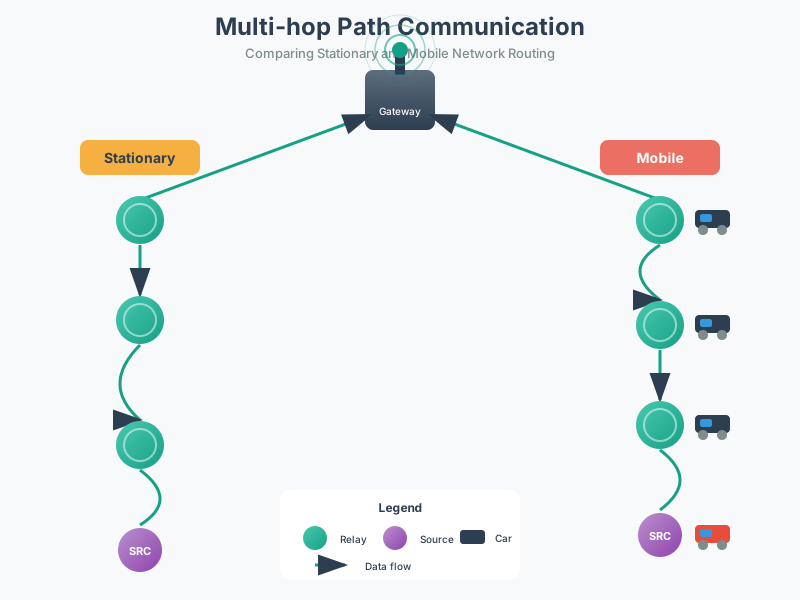
NoteVisual: Multi-Hop Communication Path
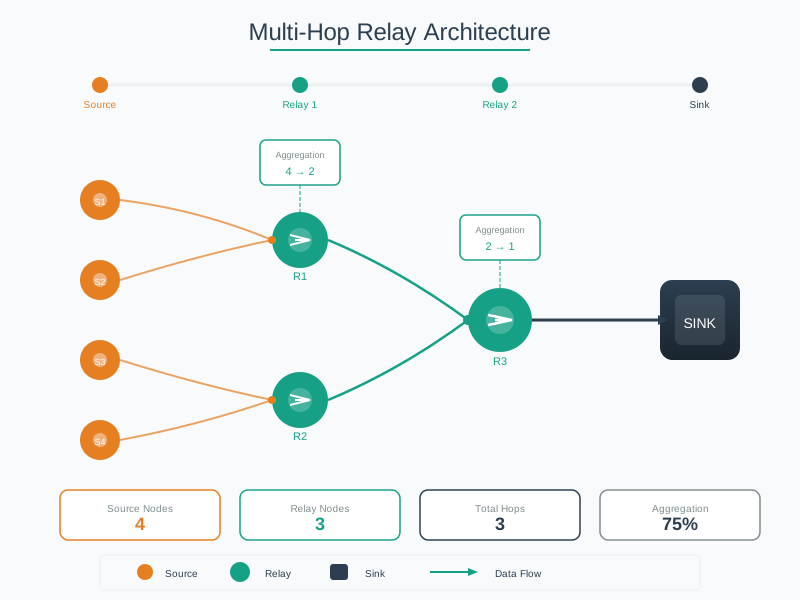
NoteVisual: Relay Node Architecture
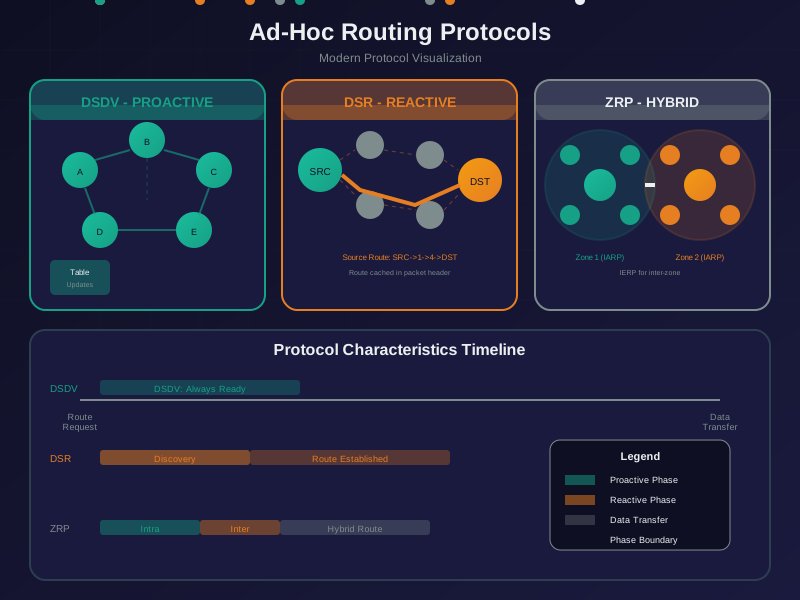
NoteVisual: Ad Hoc Routing Protocols
237.9 Summary
This chapter covered real-world multi-hop IoT applications:
- Disaster Rescue: Self-organizing networks with drone relays for emergency communication when infrastructure is destroyed
- Agricultural Monitoring: Cost-effective sensor meshes covering hundreds of hectares with organic scalability and seasonal adaptability
- Archaeological Sites: Ultra-low power deployments for multi-year monitoring in remote locations without maintenance access
- Network Comparison: Ad hoc networks excel in temporary, remote, and mobile scenarios; infrastructure networks suit permanent high-bandwidth deployments
- Case Study: Smart agriculture deployment showing 200 sensors, 15 relays, $7,450 total cost vs. $50K+ for per-device cellular
- Relay Placement: Strategic positioning along diagonals maximizes 2-hop coverage; 60-70% of maximum dimension is optimal
- Energy Analysis: Multi-hop can save 80% network energy but creates funnel effect requiring heterogeneous battery sizing
237.10 What’s Next
Complete your multi-hop learning with Multi-Hop Assessment for knowledge checks, common pitfalls, and additional worked examples to test your understanding.