%%{init: {'theme': 'base', 'themeVariables': { 'primaryColor': '#2C3E50', 'primaryTextColor': '#fff', 'primaryBorderColor': '#16A085', 'lineColor': '#16A085', 'secondaryColor': '#E67E22', 'tertiaryColor': '#7F8C8D', 'fontSize': '11px'}}}%%
graph TB
    START{Required<br/>Response Time?}

    START -->|"<10ms"| EDGE["EDGE PROCESSING<br/>On-device compute"]
    START -->|"10-100ms"| FOG["FOG PROCESSING<br/>Local gateway/RSU"]
    START -->|">100ms"| CLOUD["CLOUD PROCESSING<br/>Datacenter"]

    subgraph EdgeApps["Edge Applications"]
        E1["Collision avoidance<br/>5-10ms total"]
        E2["Industrial safety<br/>Motor stop <8ms"]
        E3["Robotic control<br/>Real-time loop"]
    end

    subgraph FogApps["Fog Applications"]
        F1["Video analytics<br/>Face recognition"]
        F2["Traffic optimization<br/>Signal timing"]
        F3["AR/VR rendering<br/>Frame prediction"]
    end

    subgraph CloudApps["Cloud Applications"]
        C1["ML model training<br/>Hours/days"]
        C2["Historical analytics<br/>Batch processing"]
        C3["Global aggregation<br/>Cross-region"]
    end

    EDGE --> EdgeApps
    FOG --> FogApps
    CLOUD --> CloudApps

    style EDGE fill:#16A085,stroke:#2C3E50,color:#fff
    style FOG fill:#E67E22,stroke:#2C3E50,color:#fff
    style CLOUD fill:#2C3E50,stroke:#16A085,color:#fff
355 Fog Optimization: Use Cases and Privacy
355.1 Learning Objectives
By the end of this chapter, you will be able to:
- Design Privacy-Preserving Architectures: Apply data minimization, anonymization, and differential privacy techniques at the fog layer
- Implement GigaSight Patterns: Apply hierarchical video analytics architecture patterns for bandwidth reduction and real-time processing
- Plan Factory Deployments: Design fog architectures for industrial predictive maintenance with appropriate tier responsibilities
- Architect Vehicle Systems: Structure edge computing for autonomous vehicles balancing safety-critical latency with system reliability
355.2 Prerequisites
Before diving into this chapter, you should be familiar with:
- Fog Energy and Latency Trade-offs: Understanding of energy-latency optimization provides context for use case design decisions
- Fog Resource Allocation: Knowledge of resource allocation strategies informs tier responsibility assignments
- Privacy and Security Foundations: Familiarity with privacy concepts enables understanding of fog-based privacy preservation
TipFor Beginners: Learning from Real-World Fog Deployments
The best way to understand fog computing is through real examples. This chapter presents four case studies:
- GigaSight - How to process thousands of video cameras without sending everything to the cloud
- Privacy Architecture - How to analyze sensitive data without exposing it
- Smart Factory - How to predict machine failures in milliseconds
- Autonomous Vehicles - How to make split-second driving decisions
Each case study shows the same pattern: put time-critical and data-heavy processing close to the source, send only summaries to the cloud.
| Use Case | Key Challenge | Fog Solution |
|---|---|---|
| Video Analytics | Terabytes of data daily | Process locally, send events |
| Privacy | Sensitive personal data | Anonymize at fog before cloud |
| Factory | Millisecond failure detection | Edge sensors + fog ML |
| Vehicles | Life-critical decisions | On-board processing + RSU coordination |
355.3 Edge Computing Architecture: GigaSight Framework
GigaSight represents an exemplary edge computing framework designed for large-scale video analytics, illustrating practical fog computing architecture patterns.
355.3.1 Architecture Overview
Problem: Real-time video processing from thousands of cameras generates petabytes of data with latency requirements incompatible with cloud-only processing.
Solution: Hierarchical edge computing architecture distributing processing across three tiers.
355.3.2 Three-Tier Architecture
Tier 1: Camera Edge Devices - Smart cameras with embedded processors - Perform basic video preprocessing - Motion detection and frame extraction - H.264/H.265 video compression
Tier 2: Edge Servers (Cloudlets) - Deployed near camera clusters (e.g., building, floor, or area) - GPU-accelerated video analytics - Object detection and tracking - Face recognition and classification - Event extraction
Tier 3: Cloud Data Center - Long-term video storage - Cross-location analytics - Model training and updates - Dashboard and user interfaces

355.3.3 Processing Pipeline
- Capture: Cameras capture video streams
- Filter: Motion detection filters static periods
- Extract: Key frames and events extracted
- Analyze: Edge servers run ML models (YOLO, CNNs)
- Index: Metadata and events indexed
- Store: Relevant clips and metadata stored locally
- Forward: Summaries and alerts sent to cloud
- Query: Users query metadata, retrieve specific clips
355.3.4 Benefits Demonstrated
Latency: Real-time alerts (sub-second) vs. cloud (several seconds)
Bandwidth: 99% reduction through local processing
Privacy: Video stays local; only metadata and specific events sent to cloud
Scalability: Thousands of cameras supported through distributed edge servers
355.4 Privacy-Preserving Architecture
Fog computing enables privacy-preserving architectures that process sensitive data locally while still providing useful insights and services.

355.4.1 Privacy Challenges in IoT
Personal Data Exposure: - Video surveillance - Health monitoring - Location tracking - Behavioral patterns
Cloud Privacy Risks: - Data breaches - Unauthorized access - Third-party sharing - Government surveillance
355.4.2 Fog-Based Privacy Preservation
Local Processing Principle: “Process data where it’s collected; send only necessary insights”
Techniques:
Data Minimization: - Extract only required features - Discard raw sensitive data - Aggregate individual data
Example: Smart home: Count people in room (1 number) instead of sending video stream
Anonymization: - Remove personally identifiable information - Blur faces in video - Generalize location (area vs. precise GPS)
Differential Privacy: - Add noise to data before transmission - Provide statistical guarantees on privacy - Enable aggregate analytics while protecting individuals
Encryption: - End-to-end encryption for necessary transmissions - Homomorphic encryption for cloud processing of encrypted data - Secure multi-party computation
355.4.3 Architecture Pattern
- Edge Devices: Collect raw sensitive data
- Fog Nodes:
- Extract privacy-safe features
- Anonymize or aggregate
- Encrypt if transmission needed
- Cloud:
- Receives only privacy-preserved data
- Performs authorized analytics
- Returns results to fog/devices
Example: Healthcare Monitoring - Wearable: Collects heart rate, location, activity - Fog (smartphone): Detects anomalies, triggers alerts - Cloud: Receives only: “Anomaly detected at approximate location X” - Privacy preserved: Raw health data never leaves personal fog node
355.5 Use Case 1: Smart Factory Predictive Maintenance
355.5.1 Scenario
Manufacturing facility with hundreds of machines, each instrumented with vibration, temperature, and acoustic sensors generating data at 1kHz sampling rate.
355.5.2 Requirements
- Real-time anomaly detection (<100ms)
- Predictive failure alerts (hours to days advance warning)
- Minimal network load
- Continued operation during internet outages
355.5.3 Fog Architecture
Edge Tier: Machine Controllers - Collect sensor data at 1kHz - Basic filtering and feature extraction - Detect critical threshold violations (immediate shutdown)
Fog Tier: Factory Edge Servers - Deployed per production line - Run ML models for anomaly detection - Analyze vibration patterns, thermal signatures - Predict component failures - Store recent data (rolling 24-hour window) - Generate maintenance work orders
Cloud Tier: Enterprise Data Center - Aggregate data from all factories - Train improved ML models - Long-term trend analysis - Supply chain and inventory optimization - Dashboards for management
355.5.4 Benefits
Latency: Immediate shutdown on critical failures; real-time anomaly alerts Bandwidth: 99.9% reduction (1kHz data -> event summaries) Reliability: Continues operating during internet outages Value: Reduced downtime, optimized maintenance, extended equipment life
355.6 Use Case 2: Autonomous Vehicle Edge Computing
355.6.1 Scenario
Connected autonomous vehicles requiring instant decision-making with sensing, communication, and coordination.
355.6.2 Requirements
- Ultra-low latency (<10ms for critical decisions)
- High reliability (safety-critical)
- Massive sensor data (cameras, LIDAR, radar)
- Vehicle-to-vehicle (V2V) communication
- Infrastructure coordination
355.6.3 Fog Architecture
Edge Tier: Vehicle On-Board Computing - Powerful edge servers in vehicle - Real-time sensor fusion - Immediate driving decisions (steering, braking, acceleration) - Trajectory planning - Collision avoidance
Fog Tier: Roadside Units (RSUs) - Deployed along roads at intersections - Coordinate multiple vehicles - Provide local traffic information - Extend sensor range (communicate what’s around corner) - Handle V2V message relay
Fog Tier: Mobile Edge Computing (MEC) at Base Stations - Cellular network edge - Regional traffic management - HD map updates - Software updates - Non-critical cloud services
Cloud Tier: Central Data Centers - Fleet management - Route optimization - Long-term learning - Software development - Regulatory compliance
355.6.4 Processing Example
Collision Avoidance Scenario: 1. Vehicle sensors detect potential collision (5ms) 2. On-board edge processing decides evasive action (3ms) 3. Action executed (braking/steering) (2ms) 4. Total: 10ms (Cloud round-trip would be 200ms+ - collision already occurred)
Cooperative Perception: 1. RSU combines sensor data from multiple vehicles 2. Shares augmented awareness (blind spot information) 3. Vehicles receive enhanced situational awareness 4. Better decisions through cooperation
355.6.5 Benefits
Safety: Life-critical response times achieved Bandwidth: Terabytes/day of sensor data processed locally Reliability: Critical functions independent of cloud connectivity Scalability: Millions of vehicles supported through distributed architecture
NoteAlternative View: Latency-Critical Decision Tree for Fog Placement
This variant shows how latency requirements drive the decision to process at edge, fog, or cloud, using real-world timing constraints.
NoteAlternative View: Fog Resource Optimization Trade-offs
This variant shows the multi-dimensional optimization problem fog computing must solve, balancing competing constraints.
%%{init: {'theme': 'base', 'themeVariables': { 'primaryColor': '#2C3E50', 'primaryTextColor': '#fff', 'primaryBorderColor': '#16A085', 'lineColor': '#E67E22', 'secondaryColor': '#E67E22', 'tertiaryColor': '#7F8C8D', 'fontSize': '11px'}}}%%
graph TB
    subgraph Triangle["OPTIMIZATION CONSTRAINTS"]
        LAT["LATENCY<br/>Local = Fast<br/>Cloud = Slow<br/>Pull toward Edge"]

        BW["BANDWIDTH<br/>Raw data expensive<br/>Aggregated cheap<br/>Pull toward Edge"]

        COST["COMPUTE COST<br/>Edge = Expensive/unit<br/>Cloud = Cheap/unit<br/>Pull toward Cloud"]
    end

    FOG["FOG LAYER<br/>Optimal Balance<br/>• Process time-critical<br/>• Aggregate bandwidth<br/>• Defer to cloud<br/>for scale"]

    LAT --> FOG
    BW --> FOG
    COST --> FOG

    subgraph Examples["Optimization Examples"]
        EX1["Video: 80% bandwidth<br/>reduction at fog"]
        EX2["Control: 90% latency<br/>reduction at fog"]
        EX3["ML: 60% compute<br/>cost savings at cloud"]
    end

    FOG --> Examples

    style FOG fill:#E67E22,stroke:#2C3E50,color:#fff
    style LAT fill:#16A085,stroke:#2C3E50,color:#fff
    style BW fill:#16A085,stroke:#2C3E50,color:#fff
    style COST fill:#2C3E50,stroke:#16A085,color:#fff
355.7 Visual Reference Gallery
NoteFog Computing Architecture
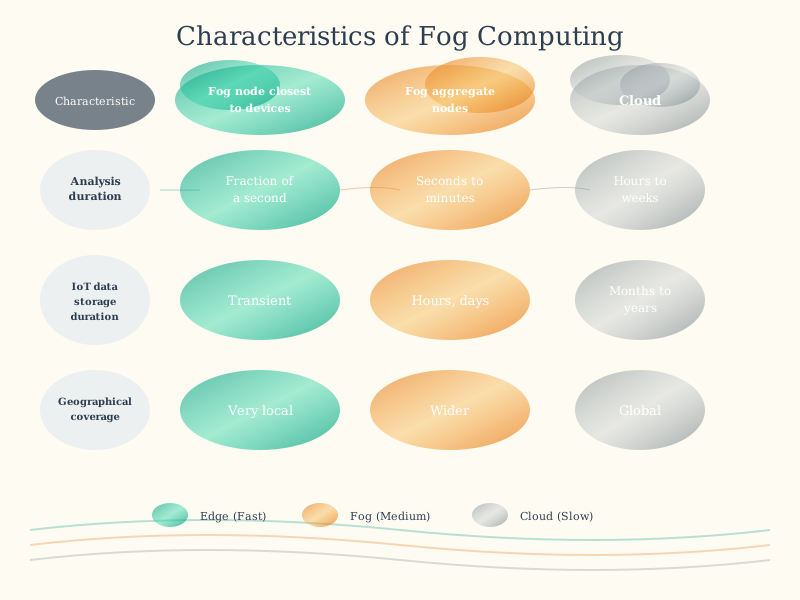
Key characteristics of fog computing that differentiate it from traditional cloud architectures.
NoteEdge-Cloud Continuum
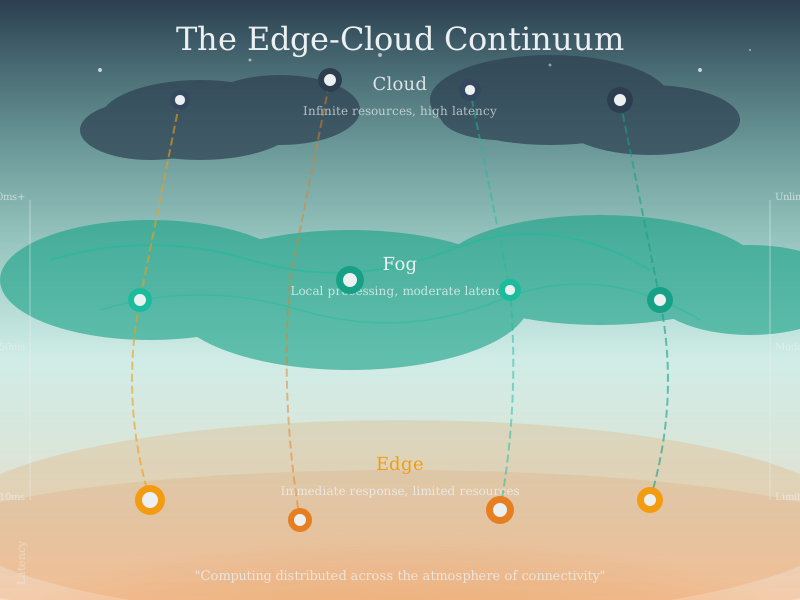
The computing continuum showing how workloads distribute across edge, fog, and cloud tiers.
NoteTask Offloading Patterns
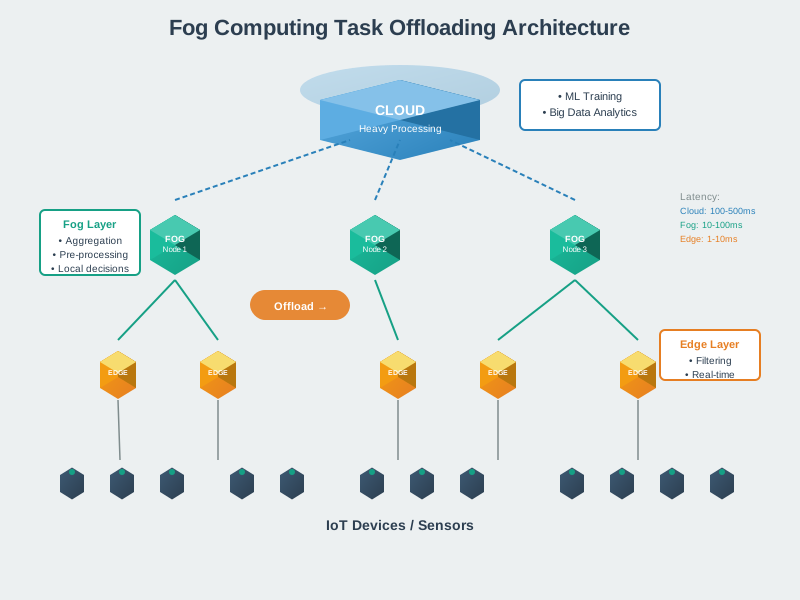
Decision framework for offloading computation between edge, fog, and cloud resources.
355.8 Summary
This chapter covered fog computing use cases and privacy-preserving architectures:
- GigaSight Framework: Three-tier video analytics architecture demonstrates 99% bandwidth reduction through edge filtering (motion detection, compression), fog-tier GPU inference (object detection, face recognition), and selective cloud forwarding (metadata, events only)
- Privacy-Preserving Design: Fog enables local data minimization, anonymization, differential privacy, and encryption before cloud transmission—keeping raw sensitive data from leaving personal fog nodes
- Smart Factory Pattern: Industrial predictive maintenance uses edge sensors (1kHz data collection), fog servers (ML anomaly detection), and cloud (model training) to achieve <100ms failure detection while maintaining operation during outages
- Autonomous Vehicle Architecture: Safety-critical decisions require on-vehicle edge processing (<10ms), with RSUs providing cooperative perception and MEC handling regional coordination—cloud reserved for fleet management and learning
- Latency-Driven Design: Processing tier selection follows latency requirements: edge for <10ms (collision avoidance), fog for 10-100ms (video analytics), cloud for >100ms (batch processing)
- Optimization Triangle: Fog computing balances competing constraints of latency (favors edge), bandwidth costs (favors edge aggregation), and compute costs (favors cloud scale)
NoteRelated Chapters
Deep Dives: - Fog Fundamentals - Edge-fog-cloud continuum basics - Fog Production - Complete orchestration platforms - Edge Data Acquisition - Edge processing techniques
Comparisons: - Network Design - Latency and bandwidth planning - Energy-Aware Design - Power optimization strategies
Products: - IoT Use Cases - GigaSight and other fog examples
Learning: - Quizzes Hub - Test fog optimization concepts - Simulations Hub - Task offloading simulators
NotePhantom Figure Gallery
The following AI-generated figures provide alternative visual representations of concepts covered in this chapter. These “phantom figures” offer different artistic interpretations to help reinforce understanding.
355.8.1 Additional Figures

355.9 What’s Next
The next chapter explores Fog Production and Review, covering complete orchestration platforms (Kubernetes/KubeEdge), production deployment strategies, monitoring and management, and real-world fog computing implementations at scale.