%%{init: {'theme': 'base', 'themeVariables': {'primaryColor': '#E8F4F8', 'primaryTextColor': '#2C3E50', 'primaryBorderColor': '#16A085', 'lineColor': '#16A085', 'secondaryColor': '#FEF5E7', 'tertiaryColor': '#FDEBD0'}}}%%
mindmap
  root((Knowledge Gap Categories))
    Networking Fundamentals
      Network Topologies
      IP Addressing & Subnets
      Routing Protocols
      TCP vs UDP
    IoT Protocols
      MQTT QoS Levels
      CoAP vs HTTP
      RPL DODAG
      Protocol Selection
    Wireless Technologies
      RFID vs NFC
      BLE vs Classic Bluetooth
      LoRaWAN Classes
      802.15.4 Standards
    Sensing & Data
      Sensor Calibration
      Multi-Sensor Fusion
      Edge vs Cloud Processing
      Data Storage
    Security & Privacy
      Encryption Methods
      DTLS Handshake
      Threat Modeling
      Privacy by Design
28 Knowledge Categories & Refreshers
28.1 Learning Objectives
By the end of this chapter, you will be able to:
- Identify the five major IoT knowledge categories and their relationships
- Find targeted refreshers for specific knowledge gaps in each domain
- Understand topic prerequisites through the layered architecture view
- Navigate to appropriate quizzes and practice resources for each topic
28.2 Knowledge Categories
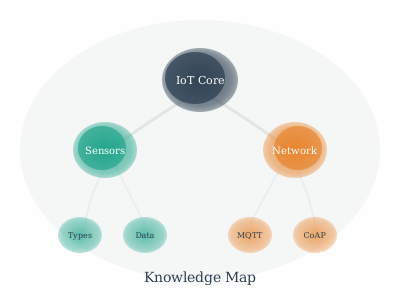
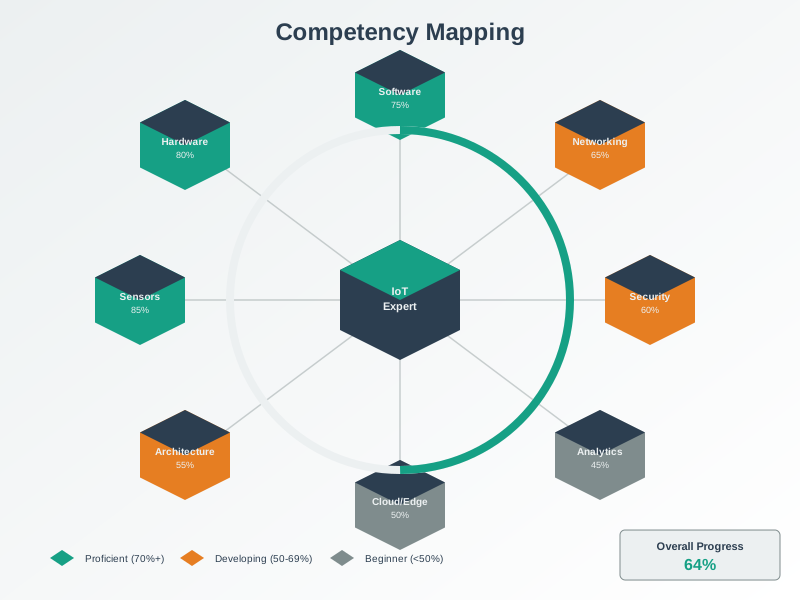

Five major categories of IoT knowledge gaps to track:
28.3 Layered Architecture View
Understanding how knowledge domains build upon each other helps you prioritize your study:
%%{init: {'theme': 'base', 'themeVariables': {'primaryColor': '#2C3E50', 'primaryTextColor': '#fff', 'primaryBorderColor': '#16A085', 'lineColor': '#16A085', 'secondaryColor': '#E67E22', 'tertiaryColor': '#7F8C8D'}}}%%
graph TB
    subgraph TRUST["Trust Layer"]
        SEC["Security & Privacy<br/>Encryption | DTLS | Threats | Privacy"]
    end

    subgraph DATA["Data Layer"]
        SENSE["Sensing & Data<br/>Calibration | Fusion | Edge vs Cloud"]
    end

    subgraph PROTOCOL["Protocol Layer"]
        IOT["IoT Protocols<br/>MQTT QoS | CoAP | RPL DODAG"]
    end

    subgraph PHYSICAL["Physical Layer"]
        NET["Networking<br/>Topologies | IP | Routing"]
        WIRE["Wireless<br/>RFID/NFC | BLE | LoRaWAN"]
    end

    PHYSICAL --> PROTOCOL
    PROTOCOL --> DATA
    DATA --> TRUST
    NET -.-> WIRE

    style TRUST fill:#6B2D5B,stroke:#2C3E50,stroke-width:2px,color:#fff
    style DATA fill:#1B4F72,stroke:#2C3E50,stroke-width:2px,color:#fff
    style PROTOCOL fill:#E67E22,stroke:#2C3E50,stroke-width:2px,color:#fff
    style PHYSICAL fill:#16A085,stroke:#2C3E50,stroke-width:2px
    style SEC fill:#9B59B6,stroke:#2C3E50,stroke-width:1px,color:#fff
    style SENSE fill:#3498DB,stroke:#2C3E50,stroke-width:1px,color:#fff
    style IOT fill:#F39C12,stroke:#2C3E50,stroke-width:1px,color:#fff
    style NET fill:#1ABC9C,stroke:#2C3E50,stroke-width:1px,color:#fff
    style WIRE fill:#1ABC9C,stroke:#2C3E50,stroke-width:1px,color:#fff
28.4 Quick Reference Summary
| Category | Key Topics |
|---|---|
| Networking | Topologies, IP Addressing, Routing Protocols |
| IoT Protocols | MQTT (QoS), CoAP, RPL |
| Wireless | RFID/NFC, Bluetooth/BLE, LPWAN |
| Sensing & Data | Calibration, Data Fusion, Edge vs Cloud |
| Security | Encryption, DTLS, Threat Modeling |
28.5 Spotlight Refreshers
28.5.1 Networking Concepts
NoteDifficulty: Intermediate
Foundational networking knowledge. Allow 10 minutes per topic.
| Topic | Overview | Refresh | Practice |
|---|---|---|---|
| Network Topologies | Star, mesh, tree trade-offs | Topologies Fundamentals | Quiz |
| IP Addressing | Subnets, CIDR, NAT basics | Network Mechanisms | Quiz |
| Routing Protocols | RPL, distance vector, link state | Routing Fundamentals | Quiz |
28.5.2 IoT Protocols
NoteDifficulty: Intermediate
These topics require understanding of networking fundamentals. Allow 10-15 minutes per topic.
| Topic | Overview | Refresh | Practice |
|---|---|---|---|
| MQTT QoS Levels | Compare 0/1/2 trade-offs | MQTT QoS Section | Quiz |
| CoAP vs HTTP | Request-response for constrained devices | CoAP Fundamentals | Quiz |
| RPL DODAG | Graph construction, Trickle timers | RPL Construction | Quiz |
28.5.3 Wireless Technologies
NoteDifficulty: Intermediate
These topics focus on comparison and selection. Allow 10 minutes per topic.
| Topic | Overview | Refresh | Practice |
|---|---|---|---|
| RFID vs NFC | Range, power, use cases | RFID Fundamentals | Quiz |
| BLE vs Classic Bluetooth | Low energy modes, GATT profiles | Bluetooth Fundamentals | Quiz |
| LoRaWAN Classes | A/B/C power and latency trade-offs | LoRaWAN Overview | Quiz |
28.5.4 Sensing & Data
NoteDifficulty: Intermediate
Data-focused topics combining theory and practice. Allow 12-15 minutes per topic.
TipMVU: Sensor Data Understanding
Core Concept: Sensor data has inherent characteristics - accuracy (how close to true value), precision (repeatability), resolution (smallest detectable change), and drift (change over time) - that determine what decisions you can reliably make. Why It Matters: A temperature sensor with 0.01 degree resolution but only 2 degree accuracy gives false precision - understanding these limits prevents bad decisions based on misleading data. Key Takeaway: Always check both accuracy AND resolution in datasheets; calibrate sensors at deployment and periodically thereafter; aggregate noisy readings to improve signal quality.
| Topic | Overview | Refresh | Practice |
|---|---|---|---|
| Sensor Calibration | Drift, noise, and calibration routines | Sensor Interfacing | Quiz |
| Data Fusion | Statistical combination patterns | Multi-Sensor Data Fusion | Simulator |
| Edge vs Cloud | Where to process data | Edge Compute Patterns | Quiz |
| Time-Series Databases | Optimized storage for IoT data | Data Storage | Quiz |
| Lambda Architecture | Batch and stream processing layers | Big Data Overview | Quiz |
28.5.5 Security
NoteDifficulty: Advanced
Security topics require strong foundational knowledge. Allow 15-20 minutes per topic.
TipMVU: IoT Security Fundamentals
Core Concept: IoT security rests on three pillars - confidentiality (only authorized parties read data), integrity (data is not tampered with), and availability (systems remain operational) - known as the CIA triad. Why It Matters: IoT devices often operate unattended in physical environments where attackers can access hardware, intercept wireless signals, or exploit weak default credentials at scale. Key Takeaway: Never trust, always verify - use TLS/DTLS for transport, unique credentials per device, and assume every network request could be malicious.
| Topic | Overview | Refresh | Practice |
|---|---|---|---|
| DTLS Handshake | Securing UDP communication | DTLS Security | Quiz |
| Threat Modeling | STRIDE, attack trees | Threat Modeling | Quiz |
| IoT Encryption | AES, ECC for constrained devices | Encryption Principles | Quiz |
| Privacy by Design | Embedding privacy in system design | Privacy by Design | Quiz |
| CIA Triad | Confidentiality, Integrity, Availability | Security Overview | Quiz |
28.5.6 Architecture & Design
NoteDifficulty: Intermediate
System-level thinking topics. Allow 10-12 minutes per topic.
| Topic | Overview | Refresh | Practice |
|---|---|---|---|
| Edge/Fog/Cloud | Three-tier IoT architecture | Edge-Fog Computing | Videos |
| IoT Reference Models | Standardized architecture frameworks | Reference Models | Chapter |
| WSN Coverage | Optimal sensor placement strategies | WSN Coverage | Quiz |
| M2M vs IoT | Machine-to-machine communication evolution | M2M Fundamentals | Review |
28.5.7 Human Factors
NoteDifficulty: Intermediate
User-centered design topics. Allow 8-10 minutes per topic.
| Topic | Overview | Refresh | Practice |
|---|---|---|---|
| User Research | Understanding user needs and context | Understanding Users | Quiz |
| UX Design | User experience evaluation framework | UX Design | Quiz |
| Device Taxonomy | Connected device categories | Connected Devices | Quiz |
| Interaction Patterns | UI/UX patterns for IoT | Interface Design | Quiz |
28.6 Summary
The five major IoT knowledge categories form the foundation for systematic learning:
- Networking Fundamentals - The foundation layer covering topologies, addressing, and routing
- IoT Protocols - Application-layer protocols like MQTT, CoAP, and RPL
- Wireless Technologies - Physical and link layer technologies from RFID to LoRaWAN
- Sensing & Data - Data acquisition, processing, and storage patterns
- Security & Privacy - Protection mechanisms and compliance frameworks
- Architecture & Design - System-level patterns and reference models
- Human Factors - User-centered design and interaction patterns
Use the spotlight refresher tables to find targeted content for your specific gaps. Each entry provides: - Overview - Quick description of the topic - Refresh - Link to the detailed chapter content - Practice - Quiz or simulation for hands-on reinforcement
28.7 What’s Next
- Use the Progress Tracking tools to assess your current level in each category
- Follow the Gap Closure Process methodology for systematic improvement
- Return to the Knowledge Gaps Hub for the complete overview