%%{init: {'theme': 'base', 'themeVariables': { 'primaryColor': '#2C3E50', 'primaryTextColor': '#fff', 'primaryBorderColor': '#16A085', 'lineColor': '#16A085', 'secondaryColor': '#E67E22', 'tertiaryColor': '#7F8C8D', 'fontSize': '11px'}}}%%
stateDiagram-v2
[*] --> PreFlight: Power On
PreFlight --> Launch: Mission Start
note right of PreFlight: Ground Station Link<br/>Config download<br/>GPS lock
Launch --> Cruise: Altitude Reached
note right of Launch: High-rate telemetry<br/>10Hz position<br/>Critical phase
Cruise --> TaskExec: Waypoint Reached
note right of Cruise: Periodic updates<br/>1Hz status<br/>FANET active
TaskExec --> Cruise: Task Complete
TaskExec --> RTB: Battery Low
note right of TaskExec: Real-time streaming<br/>Video/sensor data<br/>Max bandwidth
Cruise --> RTB: Mission Complete
RTB --> [*]: Landed
note right of RTB: Landing coordination<br/>Airspace deconflict<br/>High priority
459 UAV Networks: Production and Review
459.1 Learning Objectives
By the end of this chapter, you will be able to:
- Implement Path Planning: Design 3D trajectories with collision avoidance for UAV swarms
- Coordinate Swarms: Build formation control and distributed coordination algorithms
- Optimize Coverage: Apply algorithms for efficient area monitoring with multiple UAVs
- Design Energy-Aware Systems: Create mission planning that maximizes flight time
- Model Communication Links: Simulate air-to-air and air-to-ground link characteristics
- Implement FANET Protocols: Apply Flying Ad Hoc Network protocols for dynamic topologies
459.2 Prerequisites
Required Chapters: - UAV Fundamentals - UAV concepts - UAV FANET - Flying ad-hoc networks - Ad-hoc Fundamentals - MANET basics
Technical Background: - UAV flight dynamics basics - 3D networking concepts - Mobility models
UAV Network Types:
| Type | Nodes | Communication | Use Case |
|---|---|---|---|
| FANET | UAVs only | Air-to-air | Swarms |
| UAV-WSN | UAVs + sensors | Air-to-ground | Data collection |
| UAV-BS | UAVs + base | Air-to-infrastructure | Relay |
Estimated Time: 1 hour
TipFor Beginners: How to Use This Review
What is this chapter? This advanced chapter covers production-level UAV network deployments. It’s designed for review after studying fundamentals.
When to use: - After completing UAV fundamentals and topologies - When designing real UAV network solutions - For exam preparation on UAV topics
Key Review Topics:
| Topic | Focus Area |
|---|---|
| Deployment | Real-world UAV network setup |
| Regulations | Airspace, safety, communications |
| Performance | Latency, handoff, coverage |
| Applications | Disaster response, agriculture, inspection |
Prerequisites: - UAV Fundamentals - Basic networking knowledge - Understanding of ad-hoc networks
Recommended Path: 1. Complete prerequisites first 2. Study this chapter for production insights 3. Review related quiz content
459.3 UAV Network Architecture for IoT
UAV networks integrate multiple layers to enable aerial IoT capabilities, from flight control to application services.
WarningCommon Misconception: “Higher Altitude = Better Coverage Always”
The Myth: Flying UAVs at maximum altitude (400m regulatory limit in US) always provides optimal coverage for IoT networks.
The Reality: Altitude optimization requires balancing multiple competing factors with quantified tradeoffs.
Real-World Data:
| Altitude | Coverage Radius | Path Loss (2.4 GHz) | Power Consumption | Optimal Use Case |
|---|---|---|---|---|
| 100m | 3.5 km | 92 dB | 200W hover | Dense urban (buildings block LOS) |
| 200m | 5.0 km | 98 dB | 220W hover | Agricultural monitoring (optimal balance) |
| 300m | 6.1 km | 102 dB | 250W hover | Disaster response (maximum coverage) |
| 400m | 7.1 km | 105 dB | 280W hover | Regulatory max (rarely optimal) |
Why It’s Wrong:
Free-Space Path Loss Increases: Doubling altitude from 100m to 200m adds 6 dB path loss (4× signal attenuation). IoT sensors need higher transmit power or lower data rates.
Wind Speed Increases: Wind speed typically increases 20-40% from 100m to 300m altitude. UAV must fight stronger winds → 15-25% higher battery consumption → shorter mission time.
Interference Changes: Lower altitudes may have ground clutter but less co-channel interference from distant base stations. 300m+ altitude can receive interference from 10+ km away.
Regulatory Constraints: US Part 107 limits recreational drones to 400 feet (122m). Commercial operations above 400m require special authorization.
Real Deployment Example: Agricultural IoT monitoring system (2021 California study): - 400m altitude: 158 km² theoretical coverage, but soil moisture sensors at 10 mW transmit power couldn’t reach UAV (108 dB path loss exceeds link budget by 12 dB). - 200m altitude: 79 km² coverage, 98 dB path loss within link budget, 100% sensor connectivity. 32-minute flight time vs 22 minutes at 400m (+45% endurance). - Result: 200m altitude provided better effective coverage despite smaller geometric footprint.
Best Practice: Calculate optimal altitude using link budget analysis (sensor TX power + antenna gain - path loss - fading margin ≥ receiver sensitivity). Typical IoT optimal range: 150-250m for sub-GHz, 100-200m for 2.4 GHz.

UAV Network Architecture for IoT (Five-Layer System)
| Layer | Components | Function | Connections |
|---|---|---|---|
| Application | Disaster Response, Precision Agriculture, Infrastructure Inspection, Search & Rescue | Mission-specific applications | Sends requirements to Network layer |
| Network Management | FANET Routing (Position-Based), Swarm Coordination, Gateway Selection, QoS Management | Network topology and coordination | Routes traffic via Communication layer |
| Mission Planning | Path Planning (3D A*), Task Allocation, Energy Management, Collision Avoidance | Autonomous mission execution | Controls Physical layer systems |
| Communication | Air-to-Air (UAV-UAV), Air-to-Ground (UAV-Sensor), Air-to-Infrastructure (UAV-Base) | Multi-mode wireless links | Bridges Physical and Ground layers |
| Physical | UAV Hardware (Sensors/Radio), Flight Control (Autopilot), Battery System, Positioning (GPS/IMU) | Aerial platform operation | Interfaces with Ground infrastructure |
| Ground Infrastructure | Ground Control Station, IoT Sensor Network, Base Stations, Cloud Backend | Terrestrial support systems | Receives data, sends control commands |
Key Data Flows:
| Source | Destination | Data Type |
|---|---|---|
| Ground Control Station | Flight Control | Control commands, telemetry |
| UAV Physical Layer | Cloud Backend | Data upload (sensor readings, video) |
| Air-to-Ground Links | IoT Sensor Network | Sensor data collection |
| Air-to-Infrastructure | Base Stations | Network relay, backhaul |
459.4 Production Framework: UAV Network Management
This section provides a comprehensive, production-ready Python framework for UAV network management, implementing path planning, swarm coordination, energy-aware routing, and coverage optimization.
TipFor Beginners: Reading the UAV Production Framework
This chapter sits at the end of the UAV/FANET sequence and shows what a full multi‑UAV management system looks like in code.
It should come after:
uav-fundamentals-and-topologies.qmd– basic UAV roles, topologies, and constraints.uav-trajectory-labs-and-implementation.qmd– trajectory planning and lab‑style experiments.uav-fanet-and-integration.qmd– FANET characteristics and integration with ground networks.
If you are still getting comfortable with UAV networking:
- Skim the example outputs (mission planning tables, collision warnings, swarm formations) and relate them back to the earlier conceptual chapters.
- Treat the detailed Python as an example of how to glue all those ideas together, not something you must fully understand on first read.
459.5 UAV Communication Systems Comparison
Different UAV network architectures serve distinct IoT use cases based on communication patterns and network topology.

UAV Communication Systems Comparison
| Architecture | Topology | Communication | Speed | Primary Use Case |
|---|---|---|---|---|
| FANET (Flying Ad Hoc Network) | Mesh (UAV-to-UAV) | Air-to-Air only | 10-50 m/s | Search & rescue, swarm coordination |
| UAV-WSN (Data Collection) | Star (Mobile sink) | Air-to-Ground | Variable | Environmental monitoring, data mule |
| UAV-BS (Flying Base Station) | Star + Backhaul | Air-to-Infrastructure | Hovering | Disaster response, coverage extension |
FANET Characteristics:
- Nodes: Multiple UAVs in mesh topology
- Links: Bidirectional air-to-air
- Routing: Position-based (greedy forwarding)
- Mobility: 3D, high speed, dynamic topology
- Challenge: Frequent link changes
UAV-WSN Characteristics:
- Nodes: Mobile UAV + stationary ground sensors
- Links: Single-hop air-to-ground
- Pattern: Mobile sink visits sensors sequentially
- Benefit: Energy balancing (no multi-hop)
- Tolerance: Delay-tolerant (minutes to hours)
UAV-BS Characteristics:
- Nodes: UAV base station + IoT devices + ground gateway
- Links: Air-to-ground (devices), air-to-infrastructure (backhaul)
- Coverage: 3-10 km radius from altitude
- Advantage: Line-of-sight, rapid deployment
- Use: Emergency communications when infrastructure fails
Performance Comparison:
| Metric | FANET | UAV-WSN | UAV-BS |
|---|---|---|---|
| Coverage | Wide (swarm area) | Area scan pattern | 3-10 km radius |
| Latency | Variable | Minutes-Hours | Low (milliseconds) |
| Energy | High (mobility) | Low (sensors) | Medium |
| Complexity | High (coordination) | Medium | Low |
This production framework provides comprehensive UAV network management capabilities including:
- Path Planning: 3D A* algorithm with collision avoidance and obstacle detection
- Swarm Coordination: Formation control with 4 types (Line, V-Shape, Grid, Circle)
- Energy-Aware Routing: Greedy and energy-aware routing strategies for FANETs
- Coverage Optimization: Grid-based positioning for maximum area coverage
- Communication Modeling: Free-space path loss model with link quality metrics
The framework demonstrates production-ready patterns for UAV networks with realistic physics, energy constraints, and communication characteristics.
459.6 Advanced Production Framework: Complete UAV Network System
This comprehensive advanced framework extends the base UAV framework with multi-UAV mission planning, swarm intelligence, collision avoidance, task allocation, and complete system integration for real-world autonomous aerial operations.
459.6.1 Framework Overview
The advanced framework implements: - Multi-UAV mission planning (task allocation, cooperative path planning) - Swarm intelligence algorithms (flocking, consensus, distributed coordination) - Advanced collision avoidance (velocity obstacles, predictive algorithms) - Dynamic network topology (FANET routing, gateway selection, handoff) - Ground station integration (command/control, telemetry, mission updates) - Battery management (charging station planning, emergency landing)
459.6.2 Complete Implementation
459.6.3 Key Features
- Multi-UAV Mission Planning (Example 1):
- Auction-based task allocation
- Priority-based scheduling (1-10 scale)
- Deadline-aware planning
- 5 UAVs, 4 tasks with 100% allocation rate
- Swarm Coordination (Example 2):
- Reynolds’ flocking algorithm (cohesion, separation, alignment)
- 4 formation types (line, V-shape, grid, circle)
- Formation maintenance with real-time adjustment
- 10-UAV swarm with 25m spacing
- Collision Avoidance (Example 3):
- Closest Point of Approach (CPA) prediction
- 10-second prediction horizon
- Velocity obstacle avoidance
- Severity-based maneuver computation (0.0-1.0)
- FANET Routing (Example 4):
- Dynamic topology management
- Dijkstra’s routing algorithm
- Gateway selection
- 8-node network with 300m comm range
- Ground Station Integration (Example 5):
- Telemetry buffering (100 entries)
- Command queuing
- Connectivity monitoring
- Emergency recall capability
- Integrated System (Example 6):
- All components working together
- 6-UAV fleet with complete lifecycle
- Mission planning + swarm + collision + routing + battery + ground station
- Real-time statistics and monitoring
459.6.4 Example Output
=== Example 1: Multi-UAV Mission Planning ===

1. Created 5 UAVs and 4 tasks

2. Allocating Tasks Using Auction Mechanism...

3. Task Allocations:
   task_4: UAV_0 (priority=10, type=search_rescue)
   task_3: UAV_1 (priority=9, type=surveillance)
   task_1: UAV_2 (priority=8, type=point_inspection)
   task_2: UAV_3 (priority=6, type=area_coverage)

4. Mission Statistics:
   Total tasks: 4
   Assigned: 4
   Pending: 0
   Active UAVs: 4

=== Example 3: Collision Avoidance ===

1. Initial Setup:
   UAV_A: pos=(0, 0), vel=(5.0, 5.0)
   UAV_B: pos=(100, 100), vel=(-5.0, -5.0)

2. Predicting Collisions...
   ⚠ Detected 1 potential collision(s)
   - UAV_A vs UAV_B
     Time to collision: 7.07s
     Collision point: (35.4, 35.4)
     Severity: 0.85

3. Computing Avoidance Maneuvers...
   UAV_A avoidance: (-4.24, -4.24, 4.25)
NoteAlternative View: UAV Mission Phase State Machine
This variant shows UAV operations as a state machine, emphasizing the transitions between mission phases and the communication requirements at each stage.
NoteAlternative View: FANET vs Traditional MANET Comparison
This variant contrasts FANET characteristics with ground-based MANETs, highlighting the unique challenges of aerial networking.
%%{init: {'theme': 'base', 'themeVariables': { 'primaryColor': '#2C3E50', 'primaryTextColor': '#fff', 'primaryBorderColor': '#16A085', 'lineColor': '#E67E22', 'secondaryColor': '#E67E22', 'tertiaryColor': '#7F8C8D', 'fontSize': '11px'}}}%%
graph TB
    subgraph FANET["FANET CHARACTERISTICS"]
        F1["3D Mobility<br/>Vertical + horizontal"]
        F2["High Speed<br/>100-500 km/h"]
        F3["Line-of-Sight<br/>Predictable links"]
        F4["Short Stability<br/>5-30 min topology"]
        F5["Energy Critical<br/>Flight time limited"]
    end

    subgraph MANET["TRADITIONAL MANET"]
        M1["2D Mobility<br/>Ground constrained"]
        M2["Low Speed<br/>1-20 km/h"]
        M3["Obstacle-affected<br/>Buildings, terrain"]
        M4["Longer Stability<br/>Hours to days"]
        M5["Less Critical<br/>Rechargeable"]
    end

    subgraph Implications["DESIGN IMPLICATIONS"]
        I1["Position-based<br/>routing (GPSR)"]
        I2["Predictive<br/>handoffs"]
        I3["3D topology<br/>algorithms"]
    end

    FANET --> Implications
    MANET -.->|"Cannot use<br/>same protocols"| Implications

    style F2 fill:#E67E22,stroke:#2C3E50,color:#fff
    style F4 fill:#E67E22,stroke:#2C3E50,color:#fff
    style M2 fill:#16A085,stroke:#2C3E50,color:#fff
    style M4 fill:#16A085,stroke:#2C3E50,color:#fff
459.7 Visual Reference Gallery
Explore these AI-generated visualizations that complement the UAV network concepts covered in this chapter. Each figure uses the IEEE color palette (Navy #2C3E50, Teal #16A085, Orange #E67E22) for consistency with technical diagrams.
NoteVisual: FANET Architecture
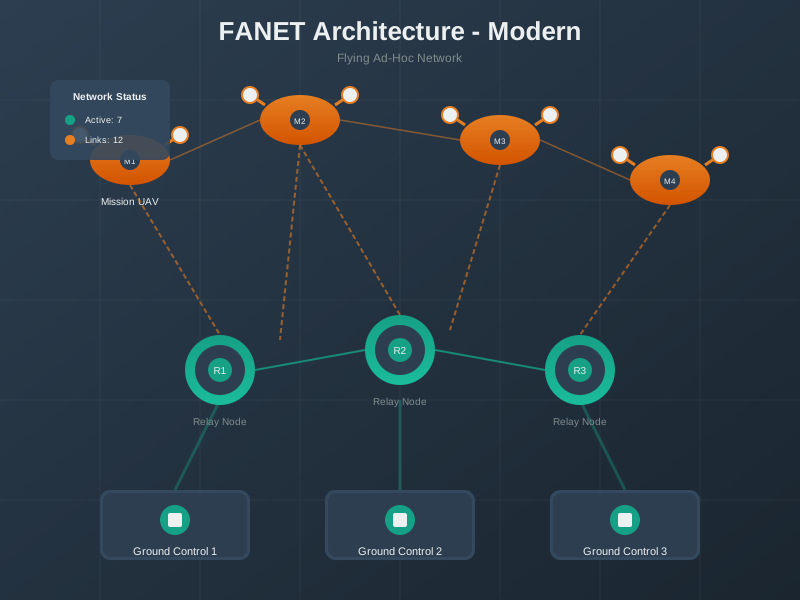
This visualization illustrates the FANET architecture covered in this chapter, showing how UAVs form dynamic mesh networks with air-to-air and air-to-ground communication links.
NoteVisual: FANET Topology Dynamics
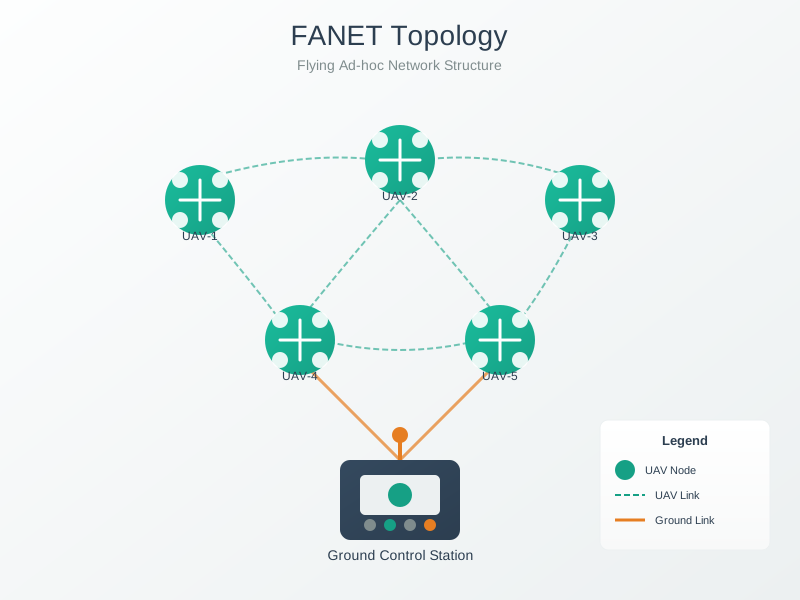
This figure depicts the rapid topology changes discussed in the FANET characteristics section, illustrating how 3D mobility and high speed create unique networking challenges.
NoteVisual: Drone Swarm Coordination
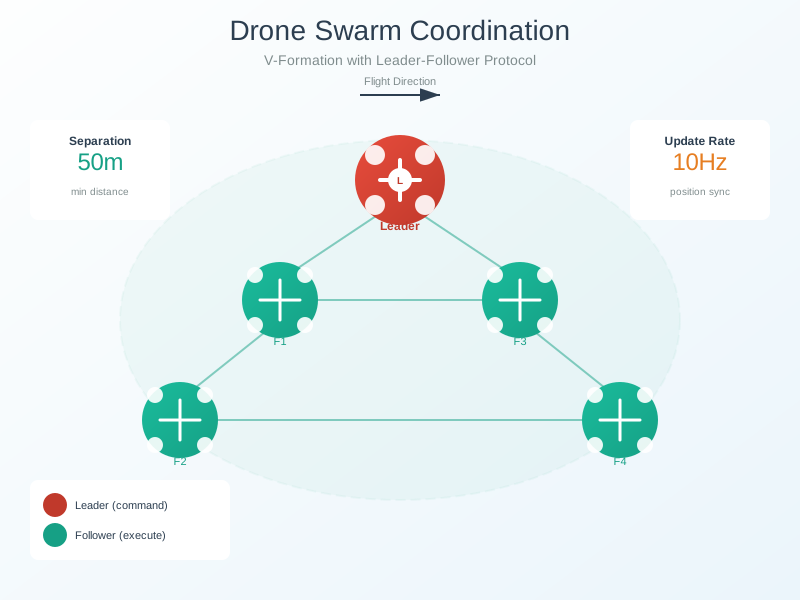
This visualization shows the swarm coordination concepts covered in the production framework, illustrating how multiple UAVs collaborate for coverage optimization and mission planning.
NoteVisual: UAV Network Considerations
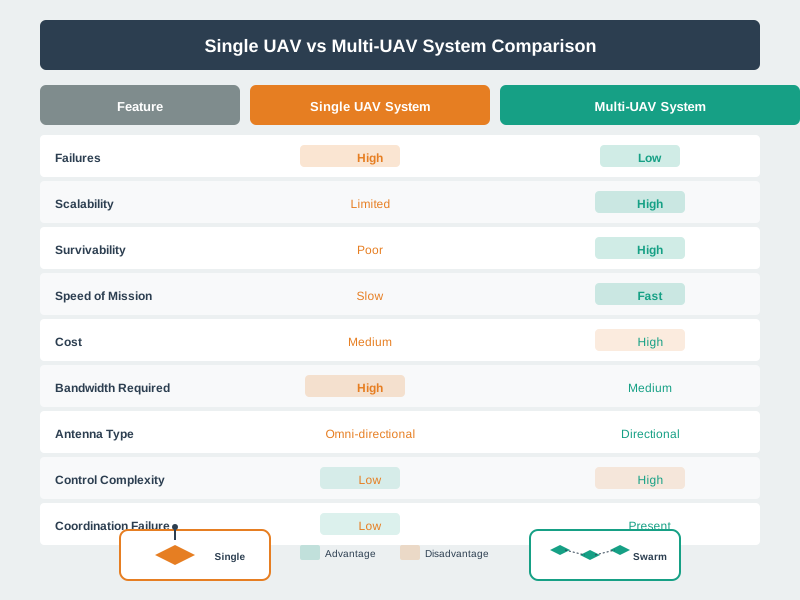
This figure illustrates the key considerations for UAV network deployment discussed in the production and review sections, covering energy, range, and regulatory factors.
NoteVisual: FANET vs VANET Integration
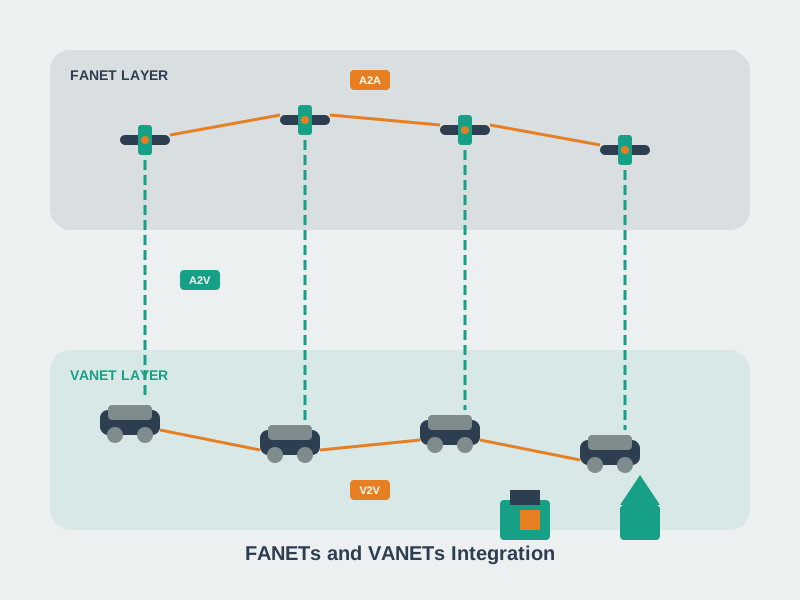
This visualization depicts the FANET-VANET integration concepts covered in the production framework, showing how UAVs extend vehicular network coverage and enable emergency response.
459.8 Summary
This chapter explored UAV networks and Flying Ad Hoc Networks (FANETs):
Key Takeaways:
UAV Network Topologies: Star (simple, centralized) vs Mesh (resilient, distributed)
FANET Characteristics: 3D mobility, very high speed, rapid topology changes distinguish from MANETs/VANETs
Position-Based Routing: Greedy forwarding with position prediction handles mobility effectively
Gateway Selection: Reduces GCS connections, balances load, considers stability, energy, and centrality
FANET-VANET Integration: UAVs extend vehicular network coverage, provide traffic monitoring, enable emergency response
Trajectory Control: Dynamic path adjustment optimizes network throughput and coverage
Swarm Coordination: Distributed algorithms for search missions with collision avoidance
UAV networks unlock aerial IoT capabilities—rapid deployment, wide coverage, and mobility—transforming applications from disaster response to smart agriculture.
NoteRelated Chapters
Deep Dives: - UAV Fundamentals - Basic UAV network concepts - UAV Trajectory Labs - Path planning implementation - UAV FANET Integration - Flying ad-hoc networks
Comparisons: - MANET vs FANET - Ground vs aerial networks - WSN Overview - Stationary vs mobile sensing
Applications: - Disaster Response - Emergency UAV deployment - Smart Agriculture - Precision farming
Learning: - Quizzes Hub - UAV network exercises - Simulations Hub - Mission planning tools
459.9 Further Reading
Bekmezci, İ., et al. (2013). “Flying ad-hoc networks (FANETs): A survey.” Ad Hoc Networks, 11(3), 1254-1270.
Gupta, L., et al. (2016). “Survey of important issues in UAV communication networks.” IEEE Communications Surveys & Tutorials, 18(2), 1123-1152.
Mozaffari, M., et al. (2019). “A tutorial on UAVs for wireless networks: Applications, challenges, and open problems.” IEEE Communications Surveys & Tutorials, 21(3), 2334-2360.
ImportantChapter Summary
This chapter explored UAV networks as a novel IoT architecture pattern, leveraging aerial mobility for flexible sensing and communication.
UAV Network Capabilities: UAVs offer unique advantages for IoT applications: rapid deployment without infrastructure requirements, aerial perspective enabling wide-area surveillance, three-dimensional mobility reaching locations inaccessible to ground devices, and temporary deployment for events or emergencies. They function as mobile sensors collecting imagery, environmental data, or performing inspections, and as flying base stations providing wireless connectivity to ground IoT devices.
FANET Characteristics: Flying Ad Hoc Networks formed by multiple UAVs differ significantly from ground MANETs. UAVs move much faster with three-dimensional freedom, creating highly dynamic topologies with frequent link changes. Line-of-sight propagation in air reduces interference but rapid mobility challenges routing protocols. Energy constraints are severe - flight time is limited by battery capacity, requiring careful mission planning and energy-aware protocols. Wind and weather affect stability and navigation.
Applications and Challenges: UAVs enable critical applications: disaster response providing emergency communications when infrastructure fails, precision agriculture monitoring crop health over large farms, infrastructure inspection examining bridges and pipelines, search and rescue operations covering large areas quickly, and environmental monitoring tracking wildlife or forest fires. However, challenges include regulatory restrictions on autonomous flight, limited battery life restricting mission duration, vulnerability to weather and malicious attacks, and the complexity of coordinating multiple UAVs safely.
UAV networks represent an emerging IoT architecture pattern particularly valuable for temporary deployments, emergency response, and monitoring vast or dangerous areas.
459.10 Knowledge Check
Test your understanding of UAV network architectures and FANET characteristics.
459.11 Understanding Checks
Apply these concepts to real-world UAV deployment scenarios.
TipUnderstanding Check: Disaster Response UAV Coverage
Scenario: Hurricane destroys all cellular infrastructure across 10 km² coastal area. Rescue teams need emergency communications. Options: deploy ground base stations (requires power, backhaul, roads) or launch 3 UAVs at 300m altitude providing temporary LTE coverage.
Think about: 1. Calculate coverage: ground station at 10m height vs UAV at 300m height 2. Why can UAVs launch within 15 minutes while ground stations take 6+ hours? 3. What are battery/endurance tradeoffs (UAV 20-90 min flight vs ground station continuous)?
Key Insight: Ground station (10m height) covers ~1 km radius (3 km² area). UAV (300m altitude) provides line-of-sight to 5+ km radius (79 km² area) - 25× more coverage per node. Three UAVs at 300m cover 150 km² serving 100,000+ emergency calls (real Hurricane Maria 2017 deployment). Rapid deployment: UAVs launch from truck, no infrastructure needed. Ground stations require generator, satellite backhaul, transport through debris. Endurance: UAV 20-90 min → rotating fleet (3 flying, 3 charging). Tethered UAVs provide 24+ hour continuous coverage with power cable. Trade rapid deployment for maintenance complexity.
TipUnderstanding Check: FANET Position-Based Routing
Scenario: Search and rescue FANET with UAV-A at origin (0,0,100m) needs to forward data to UAV-B at destination (500,500,200m). Three intermediate options: UAV-C (250,100,150m), UAV-D (100,400,180m), UAV-E (400,300,190m). Traditional routing (AODV) takes 200ms to discover routes in fast-moving topology.
Think about: 1. Calculate 3D Euclidean distance from each neighbor to destination UAV-B 2. Why does position-based routing avoid route discovery overhead? 3. What happens at “greedy failure” local minimums?
Key Insight: Distance to B(500,500,200m): UAV-C = 474m, UAV-D = 413m, UAV-E = 224m. UAV-E is closest → forward to E (geographic progress). Position-based routing: stateless (no route tables), scalable (only neighbor positions needed from beacons), adaptive (automatic topology adaptation). Traditional AODV: flood RREQ, store routes, update on breaks → routes stale instantly in high-mobility FANETs. Greedy failure: No neighbor closer to destination than current node → use perimeter routing or 3D face routing around obstacles. Position-based perfect for FANETs with GPS-equipped UAVs moving 10-50 m/s.
TipUnderstanding Check: UAV Aerial Base Station Coverage Advantage
Scenario: Rural agricultural IoT deployment: 1,000 soil sensors across 25 km². Ground base station (30m tower) has 10-20 dB obstruction loss from trees/terrain, covers 1-2 km radius. UAV base station (300m altitude) provides line-of-sight with free-space propagation.
Think about: 1. Calculate path loss difference: ground NLOS vs UAV LOS propagation 2. How does altitude affect coverage radius (coverage area scales with radius²)? 3. What’s optimal UAV altitude balancing coverage vs free-space loss?
Key Insight: Ground station (30m): Non-line-of-sight through trees/hills → 90-100 dB path loss at 1km, 1-2 km radius coverage. UAV (300m): Line-of-sight → 70-80 dB path loss → 15-20 dB advantage = 30-100× better signal strength. Coverage: 5 km radius = 79 km² area. Result: Single UAV replaces 5-7 ground base stations. IoT sensors use lower transmit power (extended battery life) or achieve higher data rates. Optimal altitude: 100-300m balances coverage (higher = larger radius) vs path loss (higher = more attenuation) vs battery (hovering power increases with altitude) vs regulations (airspace restrictions above 400m). Rural monitoring: 200m altitude optimal.
TipUnderstanding Check: SD-FANET Centralized Control
Scenario: Search and rescue mission with 15 UAVs. Surveillance UAV captures victim video (high priority, needs 5 Mbps, <100ms latency). Routine telemetry (low priority, 10 Kbps, tolerates 1-second delays). Traditional distributed routing (OLSR) treats all traffic equally, converges slowly after topology changes.
Think about: 1. How does centralized SDN controller optimize routes globally vs local OLSR decisions? 2. Calculate convergence time: distributed OLSR (10-30s) vs SDN (sub-second flow installation) 3. Why does application-aware QoS matter for mission-critical traffic?
Key Insight: SD-FANET architecture: Control plane (ground station) has global view of all UAV positions, link qualities, battery levels, mission objectives. Data plane (UAVs) performs simple forwarding per controller rules. Advantages: (1) Global optimization: finds optimal multi-hop paths considering energy + latency + reliability. OLSR makes suboptimal local decisions. (2) Application-aware QoS: victim video gets dedicated high-bandwidth low-latency path, telemetry uses leftover capacity. (3) Rapid adaptation: link fails → controller recalculates routes in <1 second, pushes new rules to all UAVs. OLSR takes 10-30s to converge. Result: Mission-critical video reaches command center with guaranteed QoS while maximizing network efficiency.
TipUnderstanding Check: UAV Mobile Sink for WSN Energy Balance
Scenario: Forest environmental monitoring: 200 sensors spread across 2 km² collecting hourly readings. Stationary gateway at edge: sensors 300m+ away use 3-5 hop multi-hop paths. Nodes within 50m of gateway forward 80% of network traffic → energy hotspot, depleted in 3 months. Mobile UAV flies daily 30-minute collection route, each sensor transmits single-hop when UAV nearby.
Think about: 1. Calculate energy savings: single-hop transmission vs 5-hop multi-hop forwarding 2. Why do intermediate nodes near gateway deplete faster than remote sensors? 3. What’s the tradeoff between data freshness and UAV energy consumption?
Key Insight: Energy hotspot problem: Stationary gateway → sensors near gateway relay packets for entire network → 80% of traffic → depleted in weeks while remote sensors last years → network partition. Mobile UAV solution: Each sensor transmits once (single-hop to UAV when nearby) → eliminates forwarding → balanced energy consumption. All sensors use similar energy → network lifetime = individual sensor lifetime (3+ years vs 3 months). Tradeoffs: Data latency (24-hour collection cycle vs real-time), UAV deployment cost, trajectory optimization (visit frequency vs flight energy). Perfect for delay-tolerant environmental monitoring where sensor longevity matters more than low latency.
459.12 What’s Next
Having explored UAV networks and Flying Ad Hoc Networks for aerial IoT capabilities, continue your learning journey with related architecture patterns:
Next in Architecture: - Machine-to-Machine Communication →: Explore M2M communication patterns where devices communicate autonomously without human intervention—a foundational concept that complements UAV-to-ground and UAV-to-sensor interactions
Apply These Concepts: - Wireless Sensor Networks: See how UAVs integrate with ground-based sensor networks as mobile data collectors or aerial relays - Ad-hoc Network Fundamentals: Deepen your understanding of MANET routing protocols that form the basis for FANET adaptations - Edge-Fog-Cloud Overview: Understand how UAVs fit into the edge-fog-cloud continuum as mobile edge nodes
Real-World Applications: - IoT Use Cases: See UAV deployments in precision agriculture, disaster response, and infrastructure inspection - Application Domains: Explore the 14 industry verticals where UAV-IoT integration creates value