%% fig-alt: "Diagram showing three types of mobile WSNs: Underwater (acoustic communication, 3D space, current-induced mobility), Terrestrial (RF communication, ground-based platforms), and Aerial (line-of-sight, wide coverage, limited battery)."
%%{init: {'theme': 'base', 'themeVariables': {'primaryColor': '#2C3E50', 'secondaryColor': '#16A085', 'tertiaryColor': '#E67E22'}}}%%
graph TD
    Types[Mobile WSN<br/>Types]

    Types --> UW[Underwater<br/>MWSNs]
    Types --> Terr[Terrestrial<br/>MWSNs]
    Types --> Aerial[Aerial<br/>MWSNs]

    UW --> UW_Char[Acoustic comm<br/>3D deployment<br/>Current mobility]
    Terr --> Terr_Char[RF communication<br/>Ground platforms<br/>Road networks]
    Aerial --> Aerial_Char[Line-of-sight<br/>Wide coverage<br/>Limited battery]

    UW_Char --> UW_Apps[Ocean monitoring<br/>Marine tracking<br/>Underwater surveillance]
    Terr_Char --> Terr_Apps[Wildlife tracking<br/>Smart cities<br/>Agriculture]
    Aerial_Char --> Aerial_Apps[Disaster response<br/>Traffic monitoring<br/>Crop surveillance]

    style Types fill:#16A085,stroke:#2C3E50,color:#fff
    style UW fill:#2C3E50,stroke:#16A085,color:#fff
    style Terr fill:#2C3E50,stroke:#16A085,color:#fff
    style Aerial fill:#2C3E50,stroke:#16A085,color:#fff
423 MWSN Types and Mobile Entities
423.1 Learning Objectives
By the end of this chapter, you will be able to:
- Compare MWSN Environments: Differentiate underwater, terrestrial, and aerial mobile sensor networks
- Select Appropriate Platforms: Match mobility platforms to application requirements
- Design Human-Centric Sensing: Leverage smartphones and wearables for participatory sensing
- Plan Vehicle-Based Networks: Utilize cars, buses, and public transit for urban sensing
- Deploy Robotic Sensing: Design autonomous robot networks for hazardous or precision applications
423.2 Prerequisites
Before diving into this chapter, you should be familiar with:
- MWSN Components: Understanding mobile sensor nodes, mobile sinks, and data MULEs
- Mobile WSN Fundamentals: Knowledge of MWSN architecture and mobility benefits
- UAV Networks: Basics of aerial sensor platforms
TipFor Beginners: Where Mobile Sensors Operate
Mobile sensor networks operate in three main environments:
Underwater - Think submarines and ocean monitoring
- Sound travels farther than radio underwater (acoustic communication)
- Sensors drift with currents or swim (AUVs)
- Applications: Ocean temperature, marine life tracking, oil spill detection
On Land (Terrestrial) - Think cars, robots, and animals
- Standard radio communication (Wi-Fi, cellular, Bluetooth)
- Sensors on wheels, legs, or carried by animals/humans
- Applications: Traffic monitoring, wildlife tracking, agriculture
In the Air (Aerial) - Think drones and weather balloons
- Line-of-sight radio communication
- Powered flight (drones) or passive drift (balloons)
- Applications: Disaster response, crop surveillance, search and rescue
Daily Life Entities as Sensors:
| Entity | Sensors Available | Coverage Pattern |
|---|---|---|
| Smartphones | GPS, accelerometer, camera, microphone | Unpredictable (human movement) |
| Cars | GPS, cameras, accelerometers, OBD-II | Road networks |
| Buses | GPS, passenger counters | Fixed routes, predictable |
| Robots | Customizable sensor suite | Programmable paths |
423.3 Types of Mobile WSNs
423.4 Underwater Mobile WSNs (UW-MWSNs)
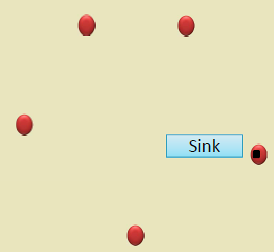
Underwater sensor networks monitor aquatic environments using acoustic communication. Nodes are often subject to water currents and may be mobile by design or drift.
Characteristics:
- Acoustic communication (much slower than RF)
- 3D deployment space
- Node mobility due to water currents
- Long propagation delays
- Limited bandwidth
Applications:
- Ocean monitoring (temperature, salinity, pollution)
- Marine life tracking (whale migration, fish populations)
- Underwater surveillance and security
- Offshore oil/gas infrastructure monitoring
- Tsunami and seismic activity detection
423.4.1 Integration with Autonomous Underwater Vehicles (AUVs)
- AUVs serve as mobile sinks or data MULEs
- Collect data from stationary underwater sensors
- Perform coordinated sensing missions
- Surface to upload data via satellite
%% fig-alt: "Diagram showing underwater MWSN with static sensors, drifting sensors affected by currents, AUV mobile sink collecting data via acoustic communication, surfacing to satellite uplink, and cloud analysis."
%%{init: {'theme': 'base', 'themeVariables': { 'primaryColor': '#2C3E50', 'primaryTextColor': '#fff', 'primaryBorderColor': '#16A085', 'lineColor': '#16A085', 'secondaryColor': '#E67E22', 'tertiaryColor': '#7F8C8D', 'fontSize': '16px'}}}%%
graph TB
    subgraph "Underwater Environment"
        S1[Static<br/>Sensor] ~~~|Water Current| S2[Drifting<br/>Sensor]
        S3[Static<br/>Sensor] ~~~|Acoustic<br/>Comm| S2

        AUV[AUV<br/>Mobile Sink]
        AUV -.Collects Data.-> S1
        AUV -.Collects Data.-> S2
        AUV -.Collects Data.-> S3
    end

    AUV -->|Surface| Sat[Satellite<br/>Uplink]
    Sat --> Cloud[Cloud<br/>Analysis]

    style S1 fill:#2C3E50,stroke:#16A085,color:#fff
    style S2 fill:#16A085,stroke:#2C3E50,color:#fff
    style S3 fill:#2C3E50,stroke:#16A085,color:#fff
    style AUV fill:#E67E22,stroke:#16A085,color:#fff
    style Sat fill:#7F8C8D,stroke:#16A085,color:#fff
    style Cloud fill:#2C3E50,stroke:#16A085,color:#fff
423.5 Terrestrial Mobile WSNs
Ground-based mobile sensor networks deployed over land surfaces, often integrated with mobile robots or vehicles.
Mobility Platforms:
- Wheeled robots
- Tracked vehicles
- Animal-borne sensors
- Human-carried sensors (smartphones)
Applications:
- Wildlife tracking and conservation
- Precision agriculture (autonomous tractors)
- Search and rescue operations
- Military surveillance and reconnaissance
- Environmental monitoring (pollution, radiation)
- Smart city infrastructure monitoring
423.5.1 Integration with Unmanned Aerial Vehicles (UAVs)
- UAVs provide aerial perspective
- Act as mobile sinks for ground sensors
- Relay data to distant base stations
- Provide temporary connectivity in partitioned networks
423.6 Aerial Mobile WSNs
Sensor nodes deployed on flying platforms, typically UAVs (drones).
Characteristics:
- High mobility and flexibility
- Wide coverage area
- Line-of-sight communication
- Limited battery life
- Weather-dependent operation
Applications:
- Disaster response and damage assessment
- Traffic monitoring
- Crowd monitoring and public safety
- Agricultural surveillance
- Wildlife census
- Border patrol and security
UAV Network Coordination:
Multiple UAVs can form flying ad-hoc networks (FANETs) for coordinated sensing missions, with dynamic topology management as drones move and communicate.
423.7 Mobile Entities in Daily Life
Mobile entities from our daily lives can serve as opportunistic sensor platforms and data collectors. Each entity type has unique characteristics that influence its suitability for different WSN applications.
%% fig-alt: "Diagram showing three categories of mobile entities in daily life: Humans (smartphones/wearables with unpredictable paths), Vehicles (cars/buses with road network coverage), and Mobile Robots (autonomous platforms with controllable movement)."
%%{init: {'theme': 'base', 'themeVariables': {'primaryColor': '#2C3E50', 'secondaryColor': '#16A085', 'tertiaryColor': '#E67E22'}}}%%
graph TD
    Entities[Mobile Entities<br/>in Daily Life]

    Entities --> Humans[Humans<br/>Smartphones/Wearables]
    Entities --> Vehicles[Vehicles<br/>Cars/Buses/Trams]
    Entities --> Robots[Mobile Robots<br/>Autonomous Platforms]

    Humans --> H_Char[Unpredictable paths<br/>High sensor diversity<br/>Participatory sensing]
    Vehicles --> V_Char[Road network coverage<br/>Predictable routes<br/>Infrastructure access]
    Robots --> R_Char[Controllable movement<br/>Mission-driven<br/>Hazardous environments]

    H_Char --> H_Apps[Health tracking<br/>Noise mapping<br/>Social sensing]
    V_Char --> V_Apps[Traffic monitoring<br/>Air quality<br/>Road condition]
    R_Char --> R_Apps[Industrial inspection<br/>Search & rescue<br/>Agriculture]

    style Entities fill:#16A085,stroke:#2C3E50,color:#fff
    style Humans fill:#2C3E50,stroke:#16A085,color:#fff
    style Vehicles fill:#2C3E50,stroke:#16A085,color:#fff
    style Robots fill:#2C3E50,stroke:#16A085,color:#fff
    style H_Char fill:#E67E22,stroke:#16A085,color:#fff
    style V_Char fill:#E67E22,stroke:#16A085,color:#fff
    style R_Char fill:#E67E22,stroke:#16A085,color:#fff
    style H_Apps fill:#7F8C8D,stroke:#16A085,color:#fff
    style V_Apps fill:#7F8C8D,stroke:#16A085,color:#fff
    style R_Apps fill:#7F8C8D,stroke:#16A085,color:#fff
423.8 Humans as Mobile Sensors
Humans carrying smartphones or wearable devices represent the most ubiquitous form of mobile sensor platform.
Characteristics:
- Unpredictable mobility patterns
- Social mobility models (home, work, social gatherings)
- High sensor diversity (accelerometer, GPS, camera, microphone, etc.)
- Participatory nature (humans can annotate data)
Data Collection Modes:
- Continuous background sensing: Always-on monitoring (step counting, location)
- Event-triggered sensing: Automatic capture (fall detection, loud noise)
- User-initiated sensing: Active participation (photo capture, surveys)
- Opportunistic sensing: Data collection when near infrastructure
Example Applications:
- Noise mapping: Smartphones measure ambient noise levels across city
- Air quality: Wearables with pollution sensors track personal exposure
- Traffic monitoring: GPS traces reveal congestion patterns
- Health tracking: Accelerometers detect activity levels, sleep patterns
NoteReal-World Example: Aclima/Google Street View Air Quality
Google Street View cars equipped with air quality sensors measured pollution across San Francisco. Covering the city with stationary sensors would require 10,000+ nodes ($5M+). Mobile sensors on 15 Street View cars achieved citywide coverage for <$500K, demonstrating how mobile sensing trades temporal resolution for spatial coverage.
423.9 Vehicles as Mobile Sensors
Vehicles (cars, buses, trams) equipped with sensors provide wide spatial coverage along road networks.
Capabilities:
- GPS for location tracking
- Cameras for traffic and road conditions
- Environmental sensors (temperature, air quality)
- Accelerometers for road quality assessment
- Communication via cellular or DSRC
Applications:
- Traffic monitoring and congestion detection
- Parking availability sensing
- Road condition monitoring (potholes)
- Air quality mapping
- Smart city infrastructure
Data Transmission Options:
- Upload to Roadside Units (RSUs) when passing
- Cellular network upload
- Vehicular ad hoc network (VANET) communication
Advantage of Public Transit:
Buses and trams follow predictable routes, providing:
- Consistent temporal sampling along routes
- Reliable coverage of urban corridors
- Known schedules for latency estimation
- Lower per-vehicle instrumentation cost
423.10 Mobile Robots
Autonomous or semi-autonomous robots with controllable mobility.
Advantages:
- Predictable and controllable movement
- Can execute precise missions
- No human safety concerns in hazardous areas
- Coordinated multi-robot operations
Applications:
- Industrial inspection (warehouses, factories)
- Agricultural monitoring (crop health)
- Hazardous environment monitoring (nuclear, chemical)
- Search and rescue
- Planetary exploration
Robot Types:
| Type | Mobility | Environment | Example Application |
|---|---|---|---|
| Wheeled | Fast, efficient | Flat surfaces | Warehouse inventory |
| Tracked | Rough terrain | Outdoor/rubble | Search and rescue |
| Legged | Stairs, obstacles | Indoor/complex | Building inspection |
| Aerial (drone) | 3D movement | Any | Crop surveillance |
| Aquatic | Water | Lakes/ocean | Environmental monitoring |
423.11 Knowledge Check
423.12 Summary
This chapter covered the types of mobile wireless sensor networks and mobile entities:
- Underwater MWSNs: Acoustic communication, 3D deployment, current-induced mobility, AUV integration for ocean and marine monitoring
- Terrestrial MWSNs: Ground-based platforms (robots, vehicles, animals) for wildlife tracking, agriculture, and smart cities
- Aerial MWSNs: UAV-based networks with wide coverage but limited battery life for disaster response and surveillance
- Human-Centric Sensing: Smartphones and wearables providing unpredictable but ubiquitous coverage with rich sensor diversity
- Vehicle-Based Sensing: Cars and buses covering road networks with predictable (transit) or opportunistic (personal) patterns
- Robotic Sensing: Controllable autonomous platforms for hazardous environments and precision applications
423.13 What’s Next
Return to the WSN Stationary vs Mobile Overview for a complete summary, or continue to WSN Human-Centric Networks and DTN for deeper exploration of participatory sensing and delay-tolerant networking protocols.