102 IoT Perspectives and Definitions
102.1 Learning Objectives
By the end of this chapter, you will be able to:
- Recognize diverse IoT perspectives: Understand how different stakeholders view IoT
- Apply formal definitions: Use academic and industry definitions to classify IoT systems
- Navigate the IoT ecosystem: Understand the complete taxonomy of IoT components
- Appreciate multidisciplinary nature: Recognize why cross-functional collaboration is essential in IoT
IoT Overview Series: - IoT Introduction - Getting started with IoT and the Five Verbs - IoT Requirements and Characteristics - Minimum requirements and ideal characteristics - Device Evolution - Embedded vs Connected vs IoT products - IoT History and Paradigm Shifts - Lessons from technology evolution
Deep Dive Chapters: - IoT Architectures - Detailed architecture patterns - Privacy and Security - Security perspectives in depth
102.2 Different Perspectives of the IoT
The Internet of Things (IoT) is a concept that is often perceived differently by various stakeholders. This diversity of perspectives is akin to the story of the blind men and the elephant, where each person perceives only a part of the whole. Similarly, IoT can be understood from multiple viewpoints, each shedding light on its unique attributes and applications.
102.2.1 Key Perspectives
- Security Perspective:
- Viewed through the lens of data protection and privacy, IoT security focuses on safeguarding connected devices and networks from unauthorized access, breaches, and cyber threats. This includes secure device authentication, encryption, and robust security protocols.
- Do-It-Yourself (DIY) Perspective:
- From a maker or hobbyist’s point of view, IoT is about creativity and customization. It enables individuals to design and build their own IoT solutions, like automating homes or creating wearable devices, using affordable components and open-source platforms.
- Sensors and Circuits Perspective:
- Engineers and hardware developers see IoT as a network of physical sensors, actuators, and circuits that gather data and perform tasks. This view emphasizes the technical foundation and hardware innovations that make IoT possible.
- Architecture Perspective:
- For system architects, IoT is about designing scalable and efficient infrastructures that support data flow, connectivity, and integration between devices, cloud systems, and users. This includes protocols, middleware, and data management strategies.
- Data Analytics Perspective:
- Data scientists perceive IoT as a rich source of data streams that can be analyzed for insights, predictions, and decision-making. This perspective emphasizes machine learning, AI, and data visualization tools.
The parable in the figure below reinforces why stakeholders often disagree about priorities - each role touches a different slice of the overall system, much like the blind researchers studying an elephant.
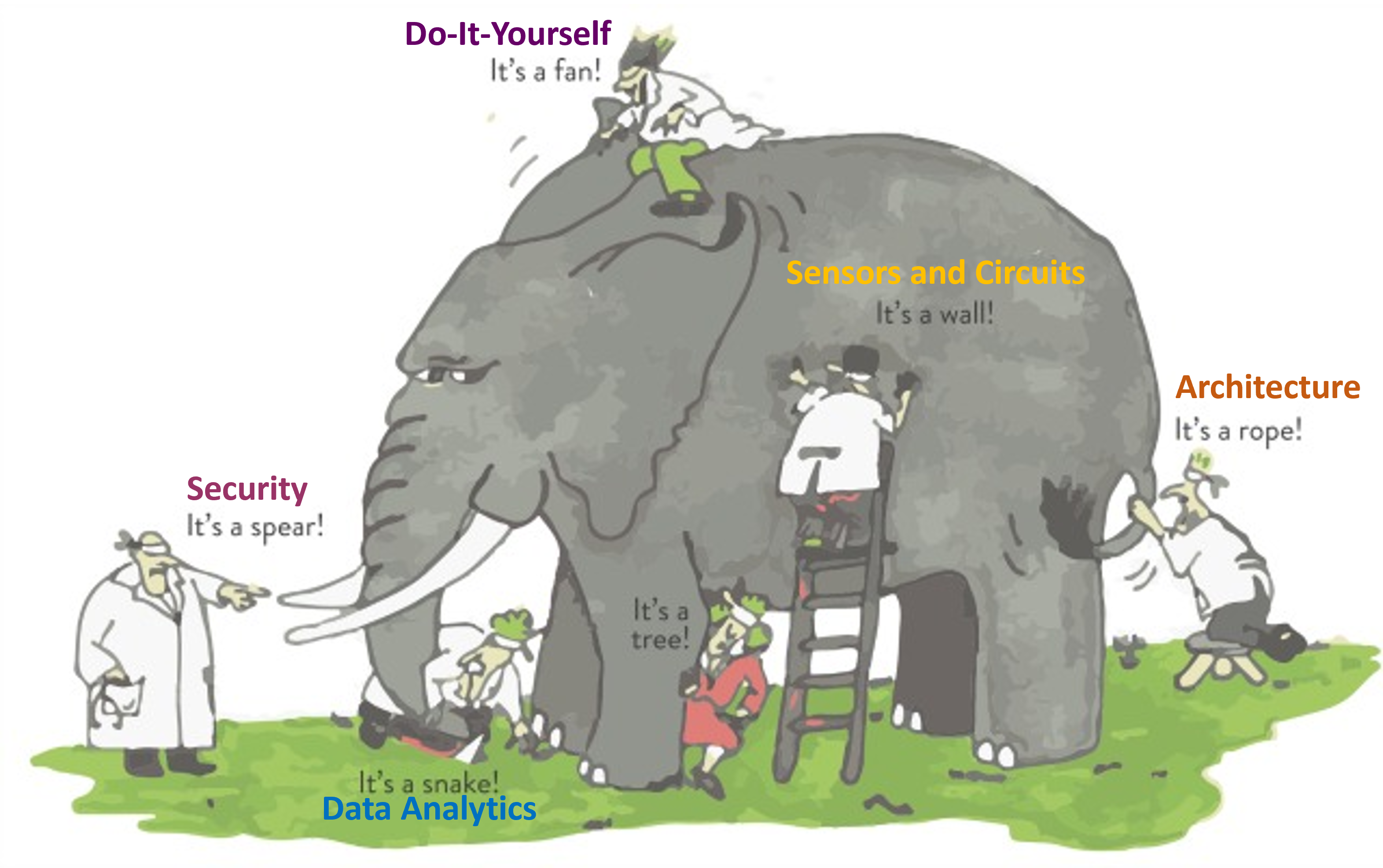
IoT’s multidisciplinary nature ensures that no single perspective can capture its full essence. Understanding these diverse viewpoints helps in creating holistic and inclusive IoT solutions for varied applications and challenges.
102.2.2 IoT System Components Taxonomy
The following taxonomy provides a complete overview of the IoT ecosystem across all layers:
| Layer | Category | Technologies/Examples |
|---|---|---|
| Hardware | Sensors | Temperature, Motion, Pressure, Light, GPS, Humidity |
| Actuators | Motors, Relays, Valves, LEDs, Speakers, Displays | |
| Microcontrollers | Arduino, ESP32, Raspberry Pi, ARM Cortex | |
| Power Systems | Battery, Solar, Mains, Energy Harvest | |
| Software | Firmware | RTOS, Embedded C, MicroPython |
| Edge Apps | Gateway Logic, Local Analytics, Protocol Bridge | |
| Cloud Services | Data Storage, ML/AI, APIs, Dashboards | |
| User Apps | Mobile Apps, Web Portals, Voice Control | |
| Network | PAN | Bluetooth, Zigbee, Z-Wave, Thread |
| LAN | Wi-Fi, Ethernet | |
| WAN | 4G/5G, NB-IoT, LTE-M | |
| LPWAN | LoRaWAN, Sigfox, RPMA | |
| Data | Collection | Sampling, Streaming, Event-Driven |
| Storage | Time-Series DB, NoSQL, Data Lake | |
| Analytics | Real-Time, Batch, ML/AI, Predictive | |
| Action | Alerts, Automation, Visualization, Reporting | |
| Security | Device | Secure Boot, Attestation, TPM |
| Network | TLS/SSL, VPN, Firewall | |
| Data | Encryption, Access Control, Privacy | |
| Application | Authentication, Authorization, API Security |
102.3 Defining Internet of Things (IoT)
The Internet of Things (IoT) represents a paradigm where physical objects are endowed with digital identities, enabling them to operate in interconnected smart environments. IoT leverages intelligent interfaces to facilitate communication within social, environmental, and user contexts. Below are two foundational perspectives on IoT definitions:
102.3.1 Academic Definitions
- Identity and Contextual Interaction:
- “Things have identities and virtual personalities operating in smart spaces using intelligent interfaces to connect and communicate within social, environmental, and user contexts.”
- Key concepts: Identities, Virtual personalities, Social, environment, user contexts
- Conceptual Breakdown:
- “The semantic origin of the expression is composed by two words and concepts: Internet and Thing, where Internet can be defined as the world-wide network of interconnected computer networks, based on a standard communication protocol, the Internet suite (TCP/IP), while Thing is an object not precisely identifiable. Therefore, semantically, Internet of Things means a world-wide network of interconnected objects uniquely addressable, based on standard communication protocols.”
- Key concepts: Identifiable unique Things, Network connectivity
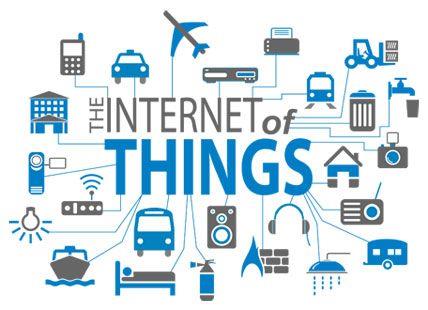
This academic visualization captures a key insight: virtually any physical object can become an IoT device. The diversity shown here includes:
- Transportation: Aircraft, buses, ships, cars
- Buildings: Smart homes, offices, factories
- Appliances: Refrigerators, washing machines, beds
- Personal devices: Phones, cameras, headphones, speakers
- Infrastructure: Trash bins, street lights, utility meters
The connecting lines illustrate that IoT value emerges not from individual smart devices, but from the network effects when thousands of diverse devices share data and coordinate actions.
Source: University of Edinburgh - Principles and Design of IoT Systems
102.3.2 Practical Definition Framework
For practitioners, the most operationally useful definition provides clear, verifiable criteria:
Minimum Requirements Definition: Thing + Computation + Internet
This framework enables: - Product classification (is this smart toaster IoT?) - Requirements validation (missing internet connectivity = not IoT) - Evolution tracking (embedded -> connected -> IoT progression)
| Definition Approach | Strengths | Limitations |
|---|---|---|
| Academic (Identity/Context) | Captures intelligence and context | Operationally vague |
| Semantic (Network/Unique ID) | Emphasizes networking | Misses intelligence |
| Practical (Thing+Compute+Internet) | Clear, verifiable criteria | May oversimplify |
Best Practice: Use the practical definition for product development and the academic definitions for conceptual understanding and research.
102.3.3 Why Multiple Definitions Matter
Understanding diverse IoT perspectives is not merely academic - it’s essential for project success:
Cross-Functional Challenges: - Security engineer vs Hardware engineer: Security demands encryption overhead; hardware wants minimal power consumption - Data scientist vs Network engineer: Analytics wants high-frequency data; network wants minimal bandwidth - UX designer vs System architect: Users want seamless experience; architecture requires complexity
Resolution Strategy: 1. Acknowledge that each perspective is valid and necessary 2. Identify conflicts early in design phase 3. Make explicit trade-offs with stakeholder buy-in 4. Document decisions for future reference
Example: A medical wearable team resolved their security/battery conflict by implementing lightweight encryption (ChaCha20) instead of heavyweight AES-256, achieving 90% of the security with 50% of the power consumption.
102.4 Summary
In this chapter, you learned:
- Five stakeholder perspectives shape IoT understanding: Security, DIY, Hardware, Architecture, and Data Analytics
- IoT is inherently multidisciplinary - no single perspective captures the complete picture
- Formal definitions range from academic (identity, context) to practical (Thing + Compute + Internet)
- The IoT taxonomy spans Hardware, Software, Network, Data, and Security layers
- Cross-functional collaboration is essential for IoT project success
102.5 What’s Next?
Continue to Device Evolution to understand the spectrum from embedded systems to connected products to true IoT devices.