248 DSDV Evaluation: Trade-offs and Worked Examples
248.1 Learning Objectives
By the end of this chapter, you will be able to:
- Evaluate DSDV Limitations: Identify scenarios where DSDV is unsuitable for IoT deployments
- Calculate Overhead: Assess the bandwidth and energy cost of maintaining proactive routing tables
- Compare Proactive vs Reactive: Differentiate DSDV from reactive protocols like DSR and AODV
- Apply Decision Frameworks: Select appropriate routing protocols based on network characteristics
- Analyze Real Scenarios: Work through detailed examples of DSDV deployment trade-offs
248.2 Prerequisites
Before diving into this chapter, you should be familiar with:
- DSDV Fundamentals: Understanding routing tables, sequence numbers, and route selection
- DSDV Protocol Operation: Update mechanisms and topology change handling
- Ad Hoc Routing: Reactive (DSR): On-demand routing for comparison
248.3 DSDV Limitations for IoT
248.3.1 When to Use DSDV
Good Fit: - Network relatively static - Most nodes communicate frequently - Network size is moderate (<50-100 nodes) - Power budget allows continuous operation - Latency-sensitive applications (routes pre-computed)
Poor Fit: - Battery-powered sensors - Sparse communication patterns - Large networks (>100 nodes) - High mobility environments - Duty-cycled sleep schedules
248.4 Proactive vs Reactive Trade-offs
248.5 Worked Examples
248.5.1 Example 1: Route Selection with Competing Paths
Scenario: A smart factory uses DSDV routing for real-time machine monitoring. Node M (machine sensor) needs to send an alert to Node G (gateway). Node M has received two route advertisements from different neighbors:
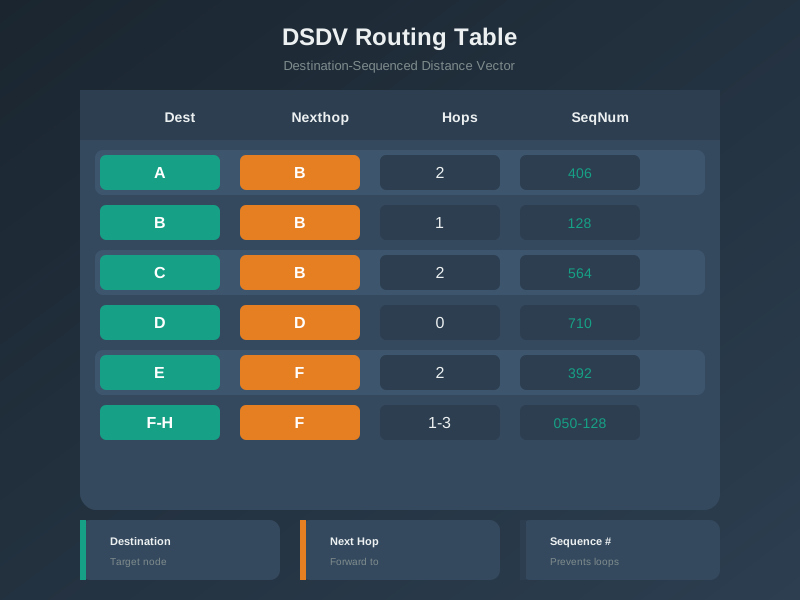
Given: - Route 1 (via Node A): Destination G, Next Hop A, 3 hops, Sequence Number 156 - Route 2 (via Node B): Destination G, Next Hop B, 2 hops, Sequence Number 152 - Node M needs to select the best route and update its routing table
Steps:
Compare sequence numbers first (DSDV’s primary criterion):
- Route 1: seq = 156
- Route 2: seq = 152
- Route 1 has higher sequence number (156 > 152)
Apply DSDV selection rule:
- Higher sequence number = fresher route information
- Route 1 (seq=156) reflects more recent network topology
- Route 2 (seq=152) is 4 update cycles old and may include stale links
Do NOT compare hop counts (sequences differ):
- Even though Route 2 is shorter (2 hops vs. 3 hops)
- Hop count is only compared when sequence numbers are equal
Install Route 1 in routing table:
+-------------+-----------+-------+--------+
| Destination | Next Hop  | Hops  | Seq #  |
+-------------+-----------+-------+--------+
| Node G      | Node A    | 3     | 156    |
+-------------+-----------+-------+--------+
Result: Node M selects Route 1 (via A, 3 hops, seq=156) despite Route 2 being shorter. The sequence number 156 guarantees this route reflects the current network state.
Key Insight: DSDV’s “freshness first” rule prevents routing loops caused by stale information. A longer but current route is always safer than a shorter but outdated route.
248.5.2 Example 2: Overhead Calculation for IoT Deployment
Scenario: An industrial IoT deployment manager needs to evaluate whether DSDV is suitable for a sensor network monitoring a chemical plant.
Given: - Network size: 80 sensor nodes - DSDV update interval: 15 seconds - Routing table entry size: 12 bytes (destination, next-hop, hops, seq#) - Wireless link capacity: 250 kbps (typical 802.15.4) - Each node has routes to all other nodes: 79 entries - Maximum acceptable control overhead: 15% of link capacity
Steps:
- Calculate routing table size per node:
- Entries: 79 (routes to all other nodes)
- Size per entry: 12 bytes
- Total table size: 79 x 12 = 948 bytes
- Calculate update frequency per node:
- Update interval: 15 seconds
- Updates per minute: 60/15 = 4 updates/minute
- Updates per hour: 4 x 60 = 240 updates/hour
- Calculate network-wide broadcast overhead:
- Each node broadcasts 948 bytes every 15 seconds
- Per node per minute: 948 x 4 = 3,792 bytes/minute
- Network total: 80 nodes x 3,792 = 303,360 bytes/minute
- Converting to bits: 303,360 x 8 = 2,426,880 bits/minute
- Per second: 2,426,880 / 60 = 40,448 bps
- Calculate overhead percentage:
- Link capacity: 250,000 bps
- Control overhead: 40,448 bps
- Percentage: 40,448 / 250,000 = 16.2%
- Compare to threshold:
- Calculated: 16.2%
- Acceptable: 15%
- DSDV exceeds acceptable overhead by 1.2%
Result: DSDV routing overhead is 16.2% of link capacity, exceeding the 15% threshold. Options include: (1) increase update interval to 20 seconds (reduces overhead to 12.1%), (2) use incremental updates instead of full table broadcasts, or (3) switch to reactive routing if traffic is sparse.
Key Insight: DSDV overhead scales as O(N^2) - both table size and number of broadcasting nodes grow with N. For networks exceeding 50-100 nodes, carefully calculate overhead.
248.5.3 Example 3: Energy-Aware Route Selection
Scenario: A precision agriculture deployment uses 45 soil sensors across a 20-hectare vineyard. After 6 months of operation, several central relay nodes have critically low batteries.
Given: - 45 sensor nodes, 3 gateway nodes - Current routing: DSDV with pure hop-count metric - Node battery status after 6 months: - 12 nodes: >80% battery (peripheral sensors) - 18 nodes: 50-80% battery (moderate traffic) - 12 nodes: 20-50% battery (busy relay nodes) - 3 nodes: <20% battery (critical central relays: N7, N12, N23) - Critical relay node N12 forwards 40% of all network traffic - Path A (current): Sensor S - N5 - N12 - Gateway (3 hops, N12 at 15% battery) - Path B (alternate): Sensor S - N8 - N15 - N22 - Gateway (4 hops, minimum battery 65%)
Steps:
- Calculate current path energy distribution:
- Path A (3 hops): N5, N12, Gateway
- N12 energy/day: 2,880 packets x 1.2mJ = 3.46J
- N12 also relays for 40% of network: Total drain ~15J/day
- Estimate remaining lifetime on Path A:
- N12 battery: 15% of 2000mAh = 3,888J (at 3.6V)
- Remaining days: 3,888J / 15J = 259 days before N12 dies
- N12 dying partitions network into 3 isolated segments!
- Design energy-aware routing metric:
- Modified metric: cost = hop_count x (1 / remaining_battery^2)
- Path A cost: 3 x (1/0.15^2) = 3 x 44.4 = 133.3
- Path B cost: 4 x (1/0.65^2) = 4 x 2.37 = 9.5
- Path B is 14x cheaper despite being 1 hop longer!
- Project network lifetime improvement:
- Without energy-aware routing: N12 dies in 259 days
- With energy-aware routing: Offload N12 traffic to Path B
- N12 new drain: 9J/day (60% of original) - 432 days remaining
Result: Energy-aware DSDV extends network lifetime from 259 days to 432+ days (67% improvement) by routing traffic away from battery-critical nodes.
Key Insight: Standard DSDV’s hop-count metric optimizes for latency, not lifetime. Incorporating residual energy into the routing metric dramatically improves lifetime.
248.5.4 Example 4: Convergence Time After Major Topology Change
Scenario: A smart city traffic monitoring network uses DSDV routing among 60 intersection nodes. A construction project disables 5 adjacent nodes (N15-N19) simultaneously.
Given: - 60 intersection nodes in grid topology - DSDV update interval: 15 seconds (periodic full dump) - Triggered update delay: 200ms (incremental on topology change) - Network diameter: 8 hops (longest shortest path) - Nodes disabled: N15, N16, N17, N18, N19 (contiguous block) - Routes affected: 23 nodes had paths through disabled region - Packet processing time: 5ms per routing table entry - Wireless propagation: ~1ms per hop
Steps:
- Calculate triggered update propagation:
- t=0ms: N15-N19 go offline
- t=100ms: Neighboring nodes detect missing HELLO
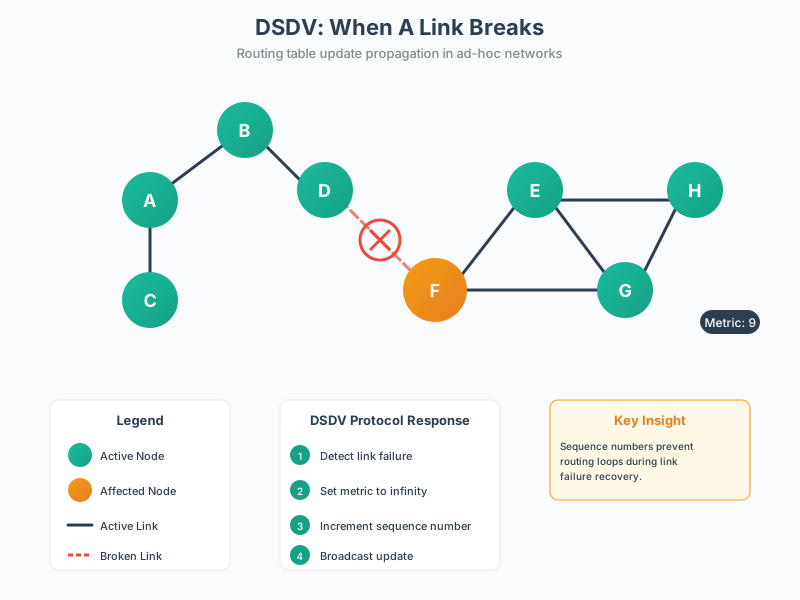
- t=200ms: Neighbors generate triggered updates with infinity metric
- First wave of route invalidation:
- t=200ms: N10 broadcasts:
<N15, infinity, seq+1>, ... - Processing time at each recipient: 5 entries x 5ms = 25ms
- Propagation to next hop: 1ms
- t=226ms: 8 second-tier neighbors receive invalidation
- t=200ms: N10 broadcasts:
- Calculate full convergence time:
- Maximum distance from disabled zone to affected node: 6 hops
- Per-hop delay: 25ms processing + 1ms propagation = 26ms
- Invalidation complete: t = 200ms + (6 x 26ms) = 356ms
- Calculate new route discovery time:
- New routes propagate from edge nodes toward center
- Maximum propagation: 4 hops from alternate route source
- New routes installed: t = 356ms + (4 x 26ms) = 460ms
- Consider periodic update alignment:
- Worst case: Must wait for next periodic cycle (15 seconds)
- Worst-case convergence: 15.2 seconds
- Calculate packet loss during convergence:
- Traffic rate: 10 packets/second through affected routes
- Best case (460ms): ~5 packets lost
- Worst case (15.2s): 152 packets lost
Result: DSDV converges in 460ms best-case (triggered updates) or 15.2 seconds worst-case (periodic updates).
Key Insight: For critical infrastructure, reduce periodic update interval (e.g., 5 seconds) and implement reliable triggered updates.
248.6 Knowledge Check
Scenario: You’re deploying a fleet of 50 delivery drones that must coordinate routes in real-time to avoid collisions. Drones communicate within 200m range and move at 10 m/s. Communication is frequent (every 2 seconds).
Think about: 1. Should you use DSDV (proactive) or DSR (reactive) routing for this network? 2. What are the energy and latency trade-offs? 3. How does mobility affect your routing protocol choice?
Key Insight: DSDV is well-suited for this scenario despite its overhead. Why? (1) Frequent communication (every 2s) means reactive route discovery would occur almost continuously. (2) Low latency requirement - collision avoidance requires <100ms response time. DSDV provides instant forwarding. (3) Mains-powered or frequently-recharged drones can afford the energy overhead.
248.7 Common Misconceptions
248.8 Visual Reference Gallery
248.9 Summary
This chapter covered DSDV evaluation, trade-offs, and practical application:
- Key Limitations: High overhead (O(n^2)), power consumption, scalability issues, and wasted effort maintaining unused routes
- Optimal Use Cases: Static networks with frequent communication, moderate size (<50-100 nodes), adequate power budgets, and latency-sensitive applications
- Overhead Calculation: Control traffic grows quadratically with network size; calculate before deploying
- Energy-Aware Extensions: Incorporating battery levels into routing metrics can extend network lifetime by 67%+
- Convergence Analysis: Best-case convergence uses triggered updates (sub-second); worst-case waits for periodic interval
- Protocol Selection: Choose DSDV for frequent, latency-critical traffic; choose reactive (DSR) for sparse, energy-constrained deployments
Deep Dives: - DSDV Fundamentals - Routing tables and sequence numbers - DSDV Protocol Operation - Update mechanisms and topology changes - Ad Hoc Routing: Reactive (DSR) - On-demand routing for sparse traffic
Comparisons: - Ad Hoc Routing: Hybrid (ZRP) - Combining proactive and reactive approaches - Routing Fundamentals - Distance-vector vs link-state routing - RPL Fundamentals - Proactive routing for low-power networks
Implementation: - Ad-hoc Production and Review - Production frameworks and multi-path routing - Ad-hoc Labs and Quiz - Protocol simulation exercises
248.10 What’s Next
The next chapter explores Ad Hoc Routing: Reactive (DSR), covering on-demand route discovery, route caching strategies, and how reactive protocols reduce overhead for sparse communication patterns while tolerating initial discovery delays.