%% fig-alt: "NFC security architecture showing three layers: Physical (4-10cm range, 13.56MHz), Protocol (ISO 14443, NDEF), and Application (AES-128, mutual auth, tokenization). Threats include eavesdropping (1-2m), relay attacks (100m+), and cloning. Mitigations: secure element, challenge-response, and encryption."
%%{init: {'theme': 'base', 'themeVariables': { 'primaryColor': '#2C3E50', 'primaryTextColor': '#fff', 'primaryBorderColor': '#16A085', 'lineColor': '#16A085', 'secondaryColor': '#E67E22', 'tertiaryColor': '#7F8C8D', 'noteTextColor': '#2C3E50', 'noteBkgColor': '#D5DBDB'}}}%%

graph TB
    subgraph Physical["Physical Layer"]
        Range["Range: 4-10cm<br/>Frequency: 13.56MHz"]
        Threat1["Eavesdrop: 1-2m<br/>with loop antenna"]
    end

    subgraph Protocol["Protocol Layer"]
        ISO["ISO 14443A/B<br/>ISO 15693"]
        NDEF["NDEF Messages<br/>Tag Types 1-5"]
        Threat2["Relay Attack<br/>100m+ range"]
    end

    subgraph Application["Application Security"]
        Crypto["AES-128 Encryption<br/>Mutual Auth"]
        SE["Secure Element<br/>DESFire EV3"]
        Token["Tokenization<br/>One-time use"]
        Threat3["Cloning<br/>without keys"]
    end

    Range --> ISO
    ISO --> NDEF
    NDEF --> Crypto
    Crypto --> SE
    SE --> Token

    Threat1 -.->|Mitigated by| Crypto
    Threat2 -.->|Mitigated by| SE
    Threat3 -.->|Prevented by| Token

    style Physical fill:#2C3E50,stroke:#16A085,stroke-width:2px,color:#fff
    style Protocol fill:#16A085,stroke:#2C3E50,stroke-width:2px,color:#fff
    style Application fill:#E67E22,stroke:#2C3E50,stroke-width:2px,color:#fff
    style Threat1 fill:#C0392B,stroke:#922B21,stroke-width:2px,color:#fff
    style Threat2 fill:#C0392B,stroke:#922B21,stroke-width:2px,color:#fff
    style Threat3 fill:#C0392B,stroke:#922B21,stroke-width:2px,color:#fff
891 NFC Security and Comparisons
891.1 Learning Objectives
By the end of this chapter, you will be able to:
- Identify NFC Security Risks: Analyze eavesdropping, relay attacks, cloning, and malicious tag threats
- Implement Security Mitigations: Apply tokenization, encryption, and mutual authentication for NFC
- Compare NFC with Alternatives: Evaluate NFC vs Bluetooth, RFID, and QR codes for different use cases
- Understand EMV Contactless Security: Explain payment card security mechanisms and tokenization
- Design Secure NFC Applications: Apply best practices for access control, payments, and data exchange
- Evaluate Privacy Implications: Assess tracking risks and privacy-preserving NFC implementations
TipFor Beginners: How to Use This Chapter
What is this chapter? NFC security considerations and comparisons with similar technologies (RFID, BLE).
When to use: - After understanding NFC fundamentals - When designing secure NFC applications - To compare short-range communication options
Security Concerns:
| Threat | Mitigation |
|---|---|
| Eavesdropping | Short range limits exposure |
| Data Tampering | Cryptographic signatures |
| Relay Attacks | Distance bounding protocols |
| Cloning | Secure elements, authentication |
Technology Comparison:
| Technology | Range | Security | Use Case |
|---|---|---|---|
| NFC | ~10cm | High (proximity) | Payments |
| RFID | Up to 10m | Varies | Asset tracking |
| BLE | ~100m | Medium | Wearables |
Recommended Path: 1. Complete NFC Fundamentals 2. Study security aspects here 3. Review NFC Comprehensive Review
891.2 Prerequisites
Before diving into this chapter, you should be familiar with:
- NFC Fundamentals: Understanding NFC operating modes, NDEF structure, and basic NFC capabilities is essential for evaluating security risks and implementing mitigations
- NFC Hands-on and Applications: Practical experience with NFC tag programming and real-world applications provides context for the security vulnerabilities discussed in this chapter
- Networking Basics: Knowledge of wireless communication security concepts (encryption, authentication) helps understand NFC-specific security mechanisms
- Basic cryptography concepts: Familiarity with encryption, tokenization, and authentication principles is helpful for understanding EMV contactless security and mutual authentication
NoteRelated Chapters
Deep Dives: - NFC Fundamentals - Core NFC concepts and operating modes - NFC Hands-on - Practical NFC implementation
Comparisons: - RFID Security - Security in the parent technology - Bluetooth Security - BLE security comparison - 6LoWPAN Security - Network-layer security
Technology Alternatives: - Bluetooth Fundamentals - BLE for longer range - RFID Fundamentals - RFID frequency bands - QR Codes - Visual alternative
Security Context: - IoT Security Overview - Broader security landscape - Encryption Architecture - Cryptographic foundations - Privacy Introduction - Privacy considerations
Products:
Learning: - Quizzes Hub - Test security knowledge - NFC Comprehensive Review - Complete NFC overview
NoteCross-Hub Connections
Interactive Tools: - Simulations Hub - Network security simulators and protocol analyzers - Videos Hub - NFC security demonstrations and attack scenarios
Assessment: - Quizzes Hub - Test your NFC security knowledge with scenario-based questions - Knowledge Gaps Hub - Common misconceptions about proximity-based security
Navigation: - Knowledge Map - Explore connections between NFC security and broader IoT security landscape
WarningCommon Misconception: “NFC is Secure Because of Short Range”
The Myth: Many developers believe NFC is inherently secure because its 4-10cm range makes eavesdropping impossible.
The Reality: While short range reduces attack surface, NFC remains vulnerable:
Eavesdropping Range (ISO 14443A, 13.56MHz): - Reader-to-tag: Attackers can eavesdrop up to 1-2 meters away using sensitive loop antennas (10-20× normal range) - Tag-to-reader: Lower power signal limits eavesdropping to 20-40cm (still 4-10× nominal range) - Relay attacks: Can extend effective range to hundreds of meters using two relay devices
Real-World Attack Data: - Proxmark3: Open-source hardware ($300) can read/clone many NFC tags from 15-20cm - NFCGate relay attack: Demonstrated in 2019, extends range via smartphone relay with <300ms latency - Credit card skimming: Attackers capture EMV contactless payment data through clothing/bags at 10-15cm
Why This Matters: - Payment systems: EMV contactless uses tokenization and cryptograms (not relying on proximity alone) - Access control: MIFARE Classic (widely deployed) has broken cryptography—cloneable regardless of range - Smart tags: Unencrypted NDEF data readable by any device within extended eavesdropping range
Quantified Impact: - MIFARE Classic vulnerability: ~1 billion tags deployed worldwide with broken CRYPTO1 cipher (crackable in seconds) - EMV tokenization benefit: Captured payment data is single-use—useless even if intercepted - DESFire adoption: Only 15-20% of existing NFC deployments use modern AES-128 secure elements
Best Practices: 1. Never rely on proximity alone for security—always use cryptographic authentication 2. Encrypt sensitive data at application layer (AES-128 minimum) 3. Use secure elements (DESFire EV3, JCOP4) with mutual authentication 4. Implement tokenization for payment/credential systems 5. Add user confirmation for high-value transactions (biometric/PIN)
The Fix: Treat NFC as a transport mechanism, not a security mechanism. Security comes from cryptography, not physics.
891.3 Security Considerations
WarningNFC Security Risks
While NFC’s short range provides inherent security, risks exist:
- Eavesdropping: Attackers capture communication (requires proximity)
- Data corruption: Intentional or accidental tag modification
- Relay attacks: Extend NFC range using relay devices
- Cloning: Copy tag data to create duplicate
- Malicious tags: Tags programmed to exploit vulnerabilities
NoteAlternative View: NFC Attack Vectors and Mitigations Timeline
This timeline view shows when different attacks can occur during an NFC transaction and the corresponding defenses at each stage.
%%{init: {'theme': 'base', 'themeVariables': { 'primaryColor': '#2C3E50', 'primaryTextColor': '#fff', 'primaryBorderColor': '#16A085', 'lineColor': '#16A085', 'secondaryColor': '#E67E22', 'tertiaryColor': '#7F8C8D', 'noteTextColor': '#2C3E50', 'noteBkgColor': '#D5DBDB'}}}%%
timeline
    title NFC Transaction Security Timeline
    section Discovery
        Tag Detected : Eavesdropping risk (1-2m)
                     : Mitigation - Minimize broadcast time
    section Authentication
        Challenge-Response : Relay attack window
                          : Mitigation - Distance bounding, timing checks
    section Data Transfer
        Encrypted Payload : Cloning attempt
                         : Mitigation - Per-transaction tokens
    section Completion
        Transaction Logged : Replay attack
                          : Mitigation - Monotonic counter, nonce
Key Insight: Each phase of an NFC transaction has different vulnerabilities. Layered defenses (timing, cryptography, tokens, counters) provide defense-in-depth rather than relying on any single mechanism.
891.3.1 Security Best Practices
For Payment Systems:
✅ Tokenization: Never transmit actual card numbers ✅ EMV standards: Follow EMVCo specifications ✅ User authentication: Require biometric or PIN ✅ Transaction limits: Cap contactless payment amounts ✅ Secure element: Use hardware-based key storage
For Access Control:
✅ Encryption: AES-128 minimum for sensitive data ✅ Mutual authentication: Reader and tag both verify identity ✅ Unique keys: Per-tag encryption keys ✅ Audit logging: Track all access attempts ✅ Expiration: Time-limited access credentials
For Smart Tags:
✅ Lock tags: Make read-only after deployment ✅ Signature verification: Cryptographically sign critical data ✅ HTTPS only: Use secure URLs in NDEF records ✅ Sanitize input: Validate data read from unknown tags ✅ User confirmation: Require user approval for sensitive actions
Example: Secure NDEF Signature
// Sign NDEF message
NdefRecord signature = NdefRecord.createMime(
    "application/vnd.bluetooth.signature",
    signData(payload, privateKey)
);

NdefMessage secureMessage = new NdefMessage(
    new NdefRecord[] {dataRecord, signature}
);
%% fig-alt: "EMV contactless payment flow showing mutual authentication between card and terminal. Steps: 1) Reader initiates, 2) Card sends tokenized PAN, 3) Terminal requests cryptogram, 4) Card generates ARQC with transaction counter, 5) Backend validates and approves. Includes secure element storing permanent keys and dynamic data generation."
%%{init: {'theme': 'base', 'themeVariables': { 'primaryColor': '#2C3E50', 'primaryTextColor': '#fff', 'primaryBorderColor': '#16A085', 'lineColor': '#16A085', 'secondaryColor': '#E67E22', 'tertiaryColor': '#7F8C8D', 'noteTextColor': '#2C3E50', 'noteBkgColor': '#D5DBDB'}}}%%
sequenceDiagram
participant Terminal as NFC Reader<br/>(Terminal)
participant Card as Contactless Card<br/>(Secure Element)
participant Backend as Payment Network<br/>(Issuer)
Terminal->>Card: 1. Initiate Transaction
activate Card
Card->>Terminal: 2. Tokenized PAN<br/>(not real card number)
Terminal->>Card: 3. Request Cryptogram
Card->>Card: 4. Generate ARQC<br/>(transaction counter++)
Card->>Terminal: 5. ARQC + Counter
deactivate Card
activate Terminal
Terminal->>Backend: 6. Authorization Request<br/>(ARQC + Token)
activate Backend
Backend->>Backend: 7. Validate Cryptogram<br/>Check Counter
Backend->>Terminal: 8. Approve/Decline<br/>(ARPC)
deactivate Backend
Terminal->>Card: 9. Complete Transaction
deactivate Terminal
Note over Card: Secure Element:<br/>Master Key (never leaves card)<br/>Counter (prevents replay)<br/>Crypto Engine (AES/DES)
Note over Terminal,Backend: Token usable once<br/>Cryptogram unique per transaction<br/>Replay attacks prevented
891.4 NFC vs Alternatives
| Feature | NFC | Bluetooth LE | QR Code |
|---|---|---|---|
| Range | 4-10 cm | 10-50 m | Visual (camera) |
| Setup | Instant tap | Pairing required | Scan required |
| Power | Passive tags | Active only | None |
| Security | Good (proximity) | Medium | Low (visible) |
| Data Rate | 424 Kbps | 1-2 Mbps | N/A |
| Use Case | Payments, access | Sensors, audio | Marketing, ticketing |
| Cost | Tags: $0.20-$5 | Modules: $2-$10 | Free |
When to Use NFC:
✅ Need: Secure, instant, proximity-based interaction ✅ Range: Intentional touch-to-connect preferred ✅ Devices: Smartphones or NFC-enabled readers ✅ Use Cases: Payments, pairing, access, smart tags
When NOT to Use NFC:
❌ Long range needed → Use Bluetooth LE or Wi-Fi ❌ Continuous data streaming → Use Bluetooth ❌ Visual/printed medium → Use QR codes (cheaper) ❌ Outdoor asset tracking → Use UHF RFID or GPS
%% fig-alt: "Technology selection decision tree for short-range IoT. Start: Need wireless communication? If passive/battery-free: NFC (payments, access) or UHF RFID (logistics). If active power: Range >1m → BLE (sensors, wearables), Range <10cm → NFC (pairing, tags). If visual/printed → QR code (marketing, tickets)."
%%{init: {'theme': 'base', 'themeVariables': { 'primaryColor': '#2C3E50', 'primaryTextColor': '#fff', 'primaryBorderColor': '#16A085', 'lineColor': '#16A085', 'secondaryColor': '#E67E22', 'tertiaryColor': '#7F8C8D', 'noteTextColor': '#2C3E50', 'noteBkgColor': '#D5DBDB'}}}%%

graph TD
    Start["Need Short-Range<br/>Communication?"]

    Power{"Power<br/>Available?"}
    Range{"Range<br/>Requirement?"}
    Security{"Security<br/>Critical?"}
    Visual{"Visual<br/>Medium?"}

    NFC_Payment["✅ NFC<br/>Payments, Access"]
    NFC_Pairing["✅ NFC<br/>Quick Pairing"]
    BLE["✅ Bluetooth LE<br/>Sensors, Wearables"]
    RFID["✅ UHF RFID<br/>Logistics, Tracking"]
    QR["✅ QR Code<br/>Marketing, Tickets"]
    NFC_Tags["✅ NFC Tags<br/>Smart Posters"]

    Start --> Power

    Power -->|"No<br/>(Passive)"| Security
    Security -->|"Yes"| NFC_Payment
    Security -->|"No"| RFID

    Power -->|"Yes<br/>(Active)"| Range
    Range -->|"< 10cm"| NFC_Pairing
    Range -->|"> 1m"| BLE
    Range -->|"Visual"| Visual

    Visual -->|"Printed"| QR
    Visual -->|"Embedded"| NFC_Tags

    style Start fill:#2C3E50,stroke:#16A085,stroke-width:3px,color:#fff
    style NFC_Payment fill:#16A085,stroke:#2C3E50,stroke-width:2px,color:#fff
    style NFC_Pairing fill:#16A085,stroke:#2C3E50,stroke-width:2px,color:#fff
    style NFC_Tags fill:#16A085,stroke:#2C3E50,stroke-width:2px,color:#fff
    style BLE fill:#E67E22,stroke:#2C3E50,stroke-width:2px,color:#fff
    style RFID fill:#E67E22,stroke:#2C3E50,stroke-width:2px,color:#fff
    style QR fill:#E67E22,stroke:#2C3E50,stroke-width:2px,color:#fff
891.5 Videos
NoteNFC Introduction
TipUnderstanding Check: Secure Access Control System
Scenario: You’re deploying access control for a 200-employee office building with 12 secure doors. Employees tap their badge to unlock doors. Security requirements: employee identity must be verified cryptographically, no cloning allowed, audit log of all access attempts. Badge must work for 5 years without battery. Budget: $25,000 for readers + badges.
Think about: 1. Should you use basic RFID badges or NFC badges with secure elements? What’s the cost trade-off? 2. How do you prevent someone from cloning a valid badge?
Key Insight: Use NFC badges with MIFARE DESFire EV3 secure element ($3/badge vs $0.50 for basic RFID). The $2.50 premium per badge ($500 total for 200 employees) is negligible compared to the security risk. DESFire provides AES-128 mutual authentication—the reader proves its identity to the badge AND the badge proves its identity to the reader using challenge-response. Even if an attacker reads the badge data, they can’t replay it without the cryptographic key stored in the secure element.
Reader cost: 12 readers × $400 each = $4,800 (with Ethernet and tamper detection). Total: $4,800 readers + $600 badges = $5,400 vs $15,000+ for biometric systems or $30,000+ for full security turnstiles.
Basic RFID ($0.50/badge, $100 total) broadcasts static ID that’s trivially cloned with $50 Proxmark device—unacceptable for office security. The $500 premium for NFC DESFire prevents unauthorized access worth potentially millions in IP theft or physical security breaches.
Verify Your Understanding: - Why can’t someone clone a DESFire badge even if they capture all communication? - How does a relay attack work, and why doesn’t short range alone stop it?
891.6 Visual Reference Gallery
NoteVisual: NFC Communication Modes and Security
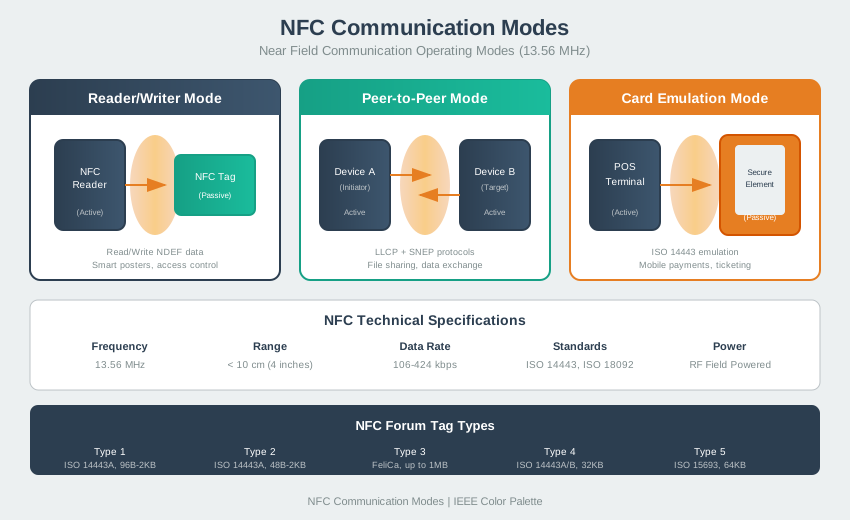
Active vs passive describes how the RF field is generated and the power model. Security depends primarily on authentication and cryptography (secure elements, mutual authentication, tokenization), not on whether a device is “active.”
NoteVisual: NFC Technology Overview
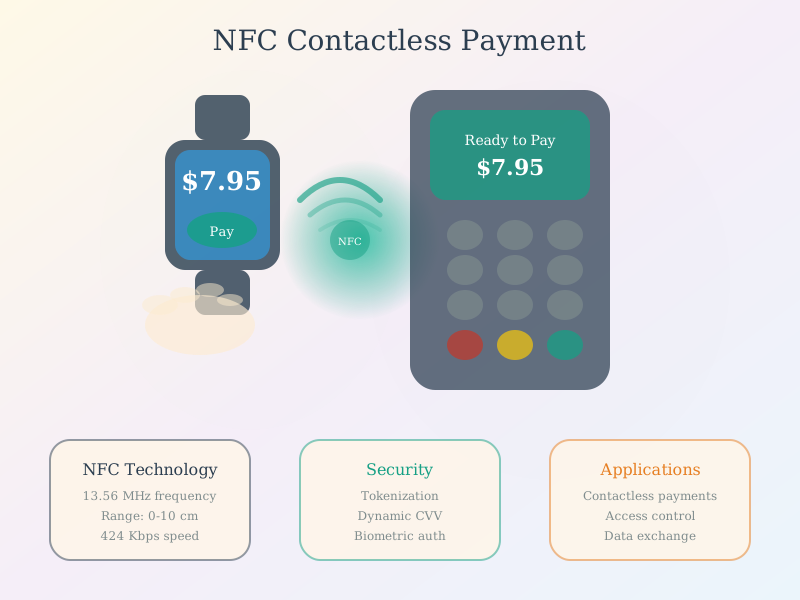
NFC operates at 13.56 MHz with a deliberate short range (typically 4–10 cm) that helps reduce accidental reads and encourages intentional “tap” interactions. Proximity raises the bar for many attacks, but it is not a substitute for cryptographic authentication.
NoteVisual: NFC Data Exchange Protocol
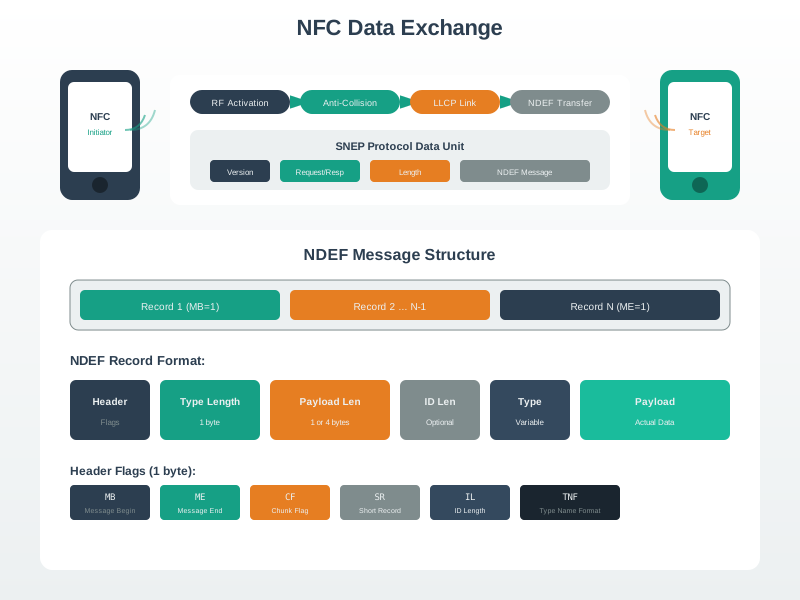
NDEF provides the standardized format for NFC data exchange. Understanding the protocol structure helps implement secure data transfer with proper validation and error handling.
891.7 Summary
NFC security depends on cryptography, not proximity. While the short range reduces the attack surface, eavesdropping can be possible at meter-scale distances with specialized equipment, and relay attacks can extend range in real time. Secure deployments use:
- Secure Elements (DESFire EV3, JCOP4) with AES-128 mutual authentication
- Tokenization for payments (EMV contactless) - captured data is single-use
- Challenge-Response Protocols - prevents replay and cloning attacks
- Application-Layer Encryption - never rely on physical layer alone
- User Confirmation - biometric/PIN for high-value transactions
The $2.50/badge premium for secure NFC vs basic RFID ($500 total for 200 employees) is negligible compared to security breach costs. MIFARE Classic (broken CRYPTO1 cipher) remains widely deployed in legacy systems, leaving many installations vulnerable to practical cloning/key-recovery attacks.
891.8 Knowledge Check
891.9 What’s Next
In the next chapter, NFC Comprehensive Review, we’ll synthesize all NFC concepts with quiz questions, protocol comparisons, and deployment case studies.
Key Takeaways: - MIFARE DESFire with AES-128 mutual authentication prevents badge cloning even if attacker captures communication - $2.50/badge premium ($500 total) for secure NFC vs basic RFID is negligible compared to security breach costs - NFC access control costs $5,400 vs $15,000+ for biometric or $30,000+ for turnstiles - Relay attacks extend NFC range in real time; mitigations include user confirmation, tight timeouts, and distance-bounding (where supported) - Passive NFC badges last 5+ years without batteries (powered by reader’s RF field)