%%{init: {'theme': 'base', 'themeVariables': { 'primaryColor': '#2C3E50', 'primaryTextColor': '#fff', 'primaryBorderColor': '#16A085', 'lineColor': '#16A085', 'secondaryColor': '#E67E22', 'tertiaryColor': '#fff'}}}%%
flowchart TD
    Start[App requests:<br/>AtHome status] --> SP[Sensing Planner]

    SP --> Eval[Evaluate options]

    Eval --> O1[Option 1: Direct GPS<br/>Cost: 100mW<br/>Accuracy: 100%]
    Eval --> O2[Option 2: Wi-Fi SSID<br/>Cost: 20mW<br/>Accuracy: 90%]
    Eval --> O3[Option 3: Infer from<br/>cached Driving=False<br/>Cost: 0mW<br/>Accuracy: 85%]

    O1 --> Best{Select cheapest<br/>above threshold}
    O2 --> Best
    O3 --> Best

    Best --> Choose[Choose O3:<br/>Infer from cache]
    Choose --> Verify{Confidence<br/>> threshold?}
    Verify -->|Yes| Return[Return inferred value]
    Verify -->|No| Fallback[Fall back to Wi-Fi O2]

    style Choose fill:#16A085,stroke:#2C3E50,color:#fff
    style Return fill:#16A085,stroke:#2C3E50,color:#fff
    style O1 fill:#E67E22,stroke:#2C3E50,color:#fff
1611 Code Offloading and Heterogeneous Computing
1611.1 Code Offloading and Heterogeneous Computing
This section provides a stable anchor for cross-references to code offloading and heterogeneous computing across the book.
1611.2 Learning Objectives
By the end of this chapter, you will be able to:
- Understand Code Offloading Decisions: Explain when to process locally versus offload to cloud based on energy profiles
- Calculate Offloading Energy Costs: Compute transmission energy for Wi-Fi vs cellular networks
- Apply MAUI Framework: Use the MAUI decision framework to make context-aware offloading decisions
- Leverage Heterogeneous Cores: Match computational tasks to appropriate processors (CPU, GPU, DSP, NPU)
- Design Energy-Preserving Sensing Plans: Find the cheapest sequence of operations to determine context
1611.3 Prerequisites
Before diving into this chapter, you should be familiar with:
- ACE System and Shared Context Sensing: Understanding caching and inference for context-aware systems
- IoT Reference Models: Knowledge of edge, fog, and cloud computing architectures
1611.4 Energy-Preserving Sensing Plans
Sensing Planner finds the best sequence of proxy attributes to sense, considering: - Direct sensing cost - Inference possibilities from cached attributes - Confidence of inference rules - Overall energy minimization
Example: To determine “InOffice”, options are: 1. Sense directly (80mW) 2. If “Running=True” cached, infer “InOffice=False” (0mW) 3. If “AtHome=True” cached, infer “InOffice=False” (0mW)
Choose the cheapest option!
1611.5 Code Offloading Decisions
%%{init: {'theme': 'base', 'themeVariables': { 'primaryColor': '#2C3E50', 'primaryTextColor': '#fff', 'primaryBorderColor': '#16A085', 'lineColor': '#16A085', 'secondaryColor': '#E67E22', 'tertiaryColor': '#fff'}}}%%
flowchart TD
    Task[Compute Task] --> Profile[MAUI Profiler]

    Profile --> Local[Local Execution<br/>Energy Cost]
    Profile --> Remote[Remote Execution<br/>Energy Cost]

    Local --> L1[CPU: 500mW × 2s = 1000mJ]
    Remote --> R1[Network TX: 200mW × 0.5s = 100mJ]
    Remote --> R2[Server: 0mW]
    Remote --> R3[Network RX: 100mW × 0.1s = 10mJ]
    R1 --> RTotal[Total: 110mJ]
    R2 --> RTotal
    R3 --> RTotal

    L1 --> Decision{Compare costs}
    RTotal --> Decision

    Decision --> Choose[Choose Remote<br/>110mJ < 1000mJ<br/>9× energy savings!]

    style Choose fill:#16A085,stroke:#2C3E50,color:#fff
    style L1 fill:#E67E22,stroke:#2C3E50,color:#fff
MAUI (Mobile Assistance Using Infrastructure): Framework that profiles code components in terms of energy to decide whether to run locally or remotely.
Considerations: - Costs related to transfer of code/data - Dynamic decisions based on network constraints - Latency requirements - Local vs remote execution energy
Example: With 3G, offloading may cost more energy due to high network transmission costs. With Wi-Fi, offloading can save significant energy.
WarningCommon Misconception: “Cloud Processing Is Always More Energy Efficient”
The Misconception: “The cloud has powerful servers, so offloading computation always saves energy on my IoT device.”
The Reality: Network transmission energy often exceeds local computation energy, especially on cellular networks. The decision depends on network type, data size, and computation complexity.
Quantified Comparison:
Task: Process 1MB sensor data with ML model (2 seconds computation)
Option 1: Local Processing (ARM Cortex-M4 @ 80 MHz) - CPU power: 50 mW × 2 seconds = 100 mJ - Total energy: 100 mJ
Option 2: Wi-Fi Offloading - Transmit 1MB: 250 mW × 0.5s = 125 mJ - Receive 10KB result: 150 mW × 0.02s = 3 mJ - Idle during compute: 20 mW × 0.1s = 2 mJ - Total energy: 130 mJ (30% worse than local!)
Option 3: LTE Offloading - RRC state transition: 500 mW × 0.5s = 250 mJ (radio ramp-up) - Transmit 1MB: 800 mW × 1.0s = 800 mJ - Receive 10KB: 400 mW × 0.05s = 20 mJ - Tail energy (radio stays on): 200 mW × 5s = 1000 mJ - Total energy: 2070 mJ (20× worse than local!)
When Cloud Wins:
Task: Complex ML inference (60 seconds on local device) - Local: 50 mW × 60s = 3000 mJ - Wi-Fi offload: 130 mJ transmission + negligible remote = 130 mJ total - Energy savings: 23× improvement!
Decision Matrix:
| Network | Data Size | Computation Time | Recommendation |
|---|---|---|---|
| Wi-Fi | <100 KB | <5 sec | Local (transmission overhead dominates) |
| Wi-Fi | <100 KB | >30 sec | Offload (computation dominates) |
| Wi-Fi | >1 MB | >10 sec | Offload (parallel advantage) |
| LTE | Any | <30 sec | Local (tail energy kills savings) |
| LTE | <500 KB | >60 sec | Offload (if battery >50%) |
MAUI’s Context-Aware Approach: - Wi-Fi available + heavy computation → Offload (2-20× savings) - LTE only + light computation → Local (avoid 10-15× penalty) - Battery <20% → Always local (conserve energy) - Latency critical → Offload if Wi-Fi, local if LTE
Key Insight: The 5-10 second LTE “tail energy” (radio staying on after transmission) often consumes more energy than the entire local computation. Context-aware offloading decisions must consider network type, not just raw transmission costs.
1611.6 Local Computation: Heterogeneous Cores
%%{init: {'theme': 'base', 'themeVariables': { 'primaryColor': '#2C3E50', 'primaryTextColor': '#fff', 'primaryBorderColor': '#16A085', 'lineColor': '#16A085', 'secondaryColor': '#E67E22', 'tertiaryColor': '#fff'}}}%%
flowchart LR
    Task[IoT Task] --> Scheduler[Task Scheduler]

    Scheduler --> CPU[CPU Core<br/>General Purpose<br/>2000 mW<br/>Fast & Flexible]
    Scheduler --> DSP[DSP Core<br/>Signal Processing<br/>500 mW<br/>Efficient for audio]
    Scheduler --> GPU[GPU Core<br/>Parallel Processing<br/>3000 mW<br/>Image processing]
    Scheduler --> NPU[NPU Core<br/>ML Inference<br/>200 mW<br/>AI acceleration]

    CPU --> Ex1[Control flow,<br/>networking]
    DSP --> Ex2[Audio filtering,<br/>voice detection]
    GPU --> Ex3[Image recognition,<br/>video processing]
    NPU --> Ex4[Neural networks,<br/>sensor fusion]

    style NPU fill:#16A085,stroke:#2C3E50,color:#fff
    style DSP fill:#16A085,stroke:#2C3E50,color:#fff
    style GPU fill:#E67E22,stroke:#2C3E50,color:#fff
    style CPU fill:#E67E22,stroke:#2C3E50,color:#fff
Modern Mobile SoCs include heterogeneous cores: - CPU: General purpose, control flow - GPU: Massively parallel, graphics and compute - DSP: Low-power signal processing, audio/sensor data - NPU: Neural network acceleration, ML inference
Benefits: - Increase performance and power efficiency - Selected tasks shift to more efficient cores - Dynamic voltage/frequency scaling per core
Example - Keyword Spotting: - Optimized GPU is >6x faster than cloud - Optimized GPU is >21x faster than sequential CPU - Optimized GPU with batching outperforms cloud energy-wise
1611.7 Knowledge Check: Heterogeneous Computing
1611.8 Code Offloading Energy Analysis Worksheet
NoteWork Through: Code Offloading Energy Analysis
Scenario: Image processing on wearable device - local vs cloud decision
1611.8.1 Step 1: Local Processing Energy
| Component | Power | Duration | Energy |
|---|---|---|---|
| Image Capture | 80 mA @ 3.7V = 296 mW | 100 ms | 29.6 mJ |
| CPU Processing | 200 mA @ 3.7V = 740 mW | 3000 ms | 2,220 mJ |
| Total Local | - | - | 2,249.6 mJ |
1611.8.2 Step 2: Cloud Offloading Energy (Wi-Fi)
| Component | Power | Duration | Energy |
|---|---|---|---|
| Image Capture | 80 mA @ 3.7V = 296 mW | 100 ms | 29.6 mJ |
| Wi-Fi TX (upload 50KB) | 250 mA @ 3.7V = 925 mW | 400 ms | 370 mJ |
| Wi-Fi RX (download 5KB) | 150 mA @ 3.7V = 555 mW | 50 ms | 27.75 mJ |
| Idle Wait (remote processing) | 15 mA @ 3.7V = 55.5 mW | 500 ms | 27.75 mJ |
| Total Cloud (Wi-Fi) | - | - | 455.1 mJ |
Wi-Fi Decision: Offload (saves 1,794 mJ = 80% energy reduction)
1611.8.3 Step 3: Cloud Offloading Energy (LTE)
| Component | Power | Duration | Energy |
|---|---|---|---|
| Image Capture | 80 mA @ 3.7V = 296 mW | 100 ms | 29.6 mJ |
| LTE TX (upload 50KB) | 500 mA @ 3.7V = 1,850 mW | 800 ms | 1,480 mJ |
| LTE RX (download 5KB) | 300 mA @ 3.7V = 1,110 mW | 100 ms | 111 mJ |
| RRC State Overhead | 200 mA @ 3.7V = 740 mW | 2000 ms | 1,480 mJ |
| Total Cloud (LTE) | - | - | 3,100.6 mJ |
LTE Decision: Process locally (saves 851 mJ vs LTE offloading)
1611.8.4 Step 4: MAUI Decision Framework
Decision = {
  if (Wi-Fi available AND energy_cloud_wifi < energy_local):
    return "OFFLOAD_WIFI"
  elif (energy_local < energy_cloud_cellular):
    return "PROCESS_LOCAL"
  elif (battery > 50% AND latency_critical):
    return "OFFLOAD_CELLULAR"
  else:
    return "PROCESS_LOCAL"
}
1611.8.5 Step 5: Context-Aware Adaptation
| Context | Network | Battery | Decision | Energy | Rationale |
|---|---|---|---|---|---|
| At Home | Wi-Fi | 80% | Offload | 455 mJ | Wi-Fi cheap, fast |
| Outdoors | LTE | 80% | Local | 2,250 mJ | LTE expensive |
| Outdoors | LTE | 15% | Local | 2,250 mJ | Battery critical |
| At Office | Wi-Fi | 15% | Offload | 455 mJ | Save battery with Wi-Fi |
Your Turn: Calculate offloading decisions for your application!
1611.9 Sensor Fusion Energy Optimization Worksheet
NoteWork Through: Sensor Fusion Energy Optimization
Scenario: Location tracking using GPS vs Wi-Fi/accelerometer inference
1611.9.1 Step 1: Direct GPS Sensing
| State | Current | Duration | Energy per Hour |
|---|---|---|---|
| GPS Active | 45 mA | 30 sec | 0.375 mAh |
| Processing | 20 mA | 2 sec | 0.011 mAh |
| BLE TX | 15 mA | 1 sec | 0.004 mAh |
| Sleep | 10 µA | 27 sec | 0.000075 mAh |
Per measurement (60s cycle): 0.390 mAh Per hour (60 measurements): 23.4 mAh 200mAh battery life: 8.5 hours
1611.9.2 Step 2: ACE Inference Strategy
Use cached GPS + accelerometer for motion detection
| Scenario | Method | Current | Duration | Frequency |
|---|---|---|---|---|
| Stationary | Cached GPS | 10 µA | 60 sec | 59 min/hour |
| Moving (inferred) | Accel check | 0.5 mA | 0.5 sec | 59 times/hour |
| Verify Location | GPS | 45 mA | 30 sec | 1 time/hour |
Energy per hour:
E_stationary = 59 × (10µA × 60s) / 3600 = 0.0098 mAh
E_accel_check = 59 × (0.5mA × 0.5s) / 3600 = 0.0041 mAh
E_gps_verify = 1 × (45mA × 30s + 20mA × 2s) / 3600 = 0.386 mAh
E_total = 0.40 mAh per hour
200mAh battery life: 500 hours = 20.8 days
Energy savings: 58.5× improvement over continuous GPS!
1611.9.3 Step 3: Association Rules for Inference
ACE learns these rules from history:
| Rule | Support | Confidence | Inference |
|---|---|---|---|
| Accel_Still=True → AtHome=True | 25% | 85% | Skip GPS if still |
| Wi-Fi_SSID=Home → AtHome=True | 30% | 95% | Use Wi-Fi instead of GPS |
| Time=Night AND Still → Sleeping=True | 15% | 90% | 10× reduce all sampling |
Optimized energy with rules: - 85% of requests served from cache/inference (0.01 mAh) - 15% require GPS sensing (0.39 mAh) - Average: 0.085 mAh per request - Battery life: 2,352 hours = 98 days!
1611.9.4 Step 4: Battery-Aware Adaptation
| Battery Level | Strategy | GPS Frequency | Avg Current |
|---|---|---|---|
| 100-50% | Normal | Every 5 min | 0.40 mA |
| 50-20% | Conservative | Every 15 min | 0.15 mA |
| 20-15% | Emergency | Every 30 min | 0.08 mA |
| <15% | Critical | Every 60 min | 0.04 mA |
Your Turn: Design inference rules for your sensor fusion application!
1611.10 Visual Reference Gallery
NoteMAUI Offloading Framework
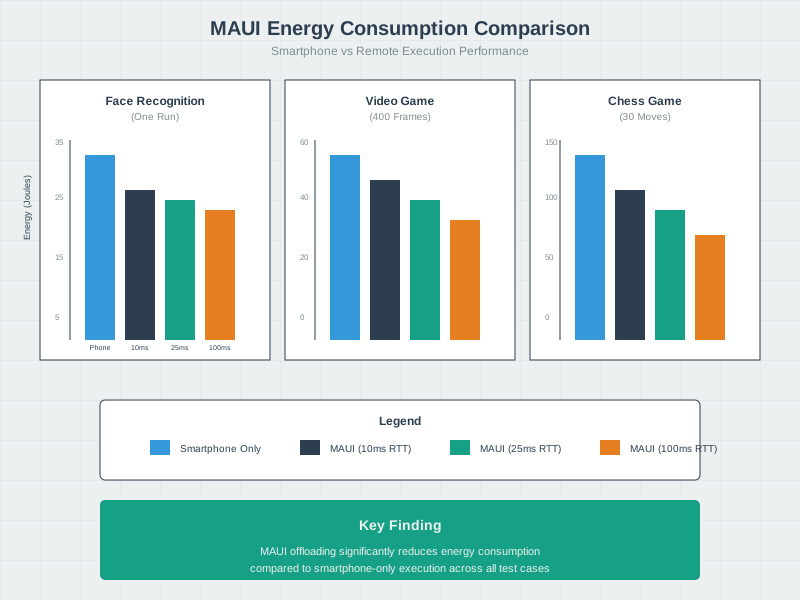
Intelligent offloading frameworks like MAUI reduce energy by delegating computation-heavy tasks to the cloud when network conditions are favorable.
NoteLEO Low-Energy Offloading
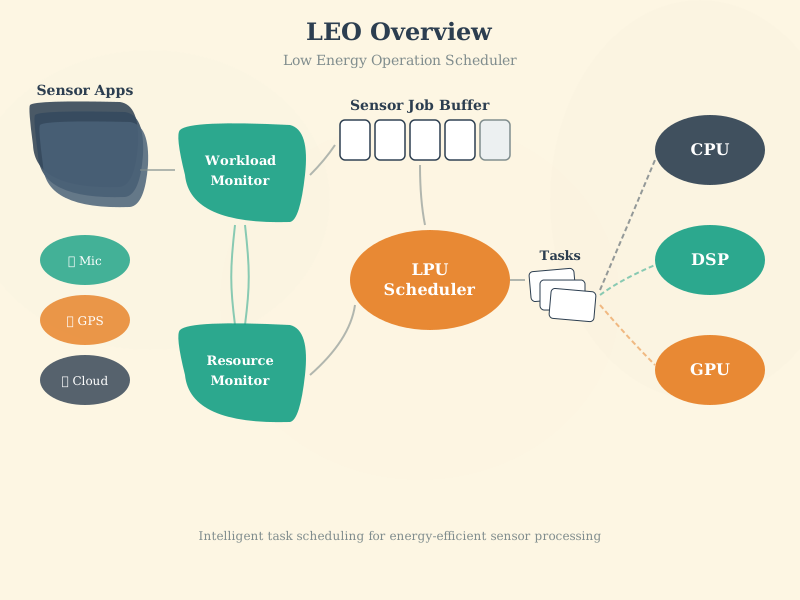
LEO (Low Energy Offloading) extends MAUI with dynamic adaptation. This visualization shows how the energy profiler monitors real-time consumption, the decision engine evaluates offload candidates, and the adaptive partitioner splits computation to minimize total energy under latency constraints.
NoteLocal Computation Performance
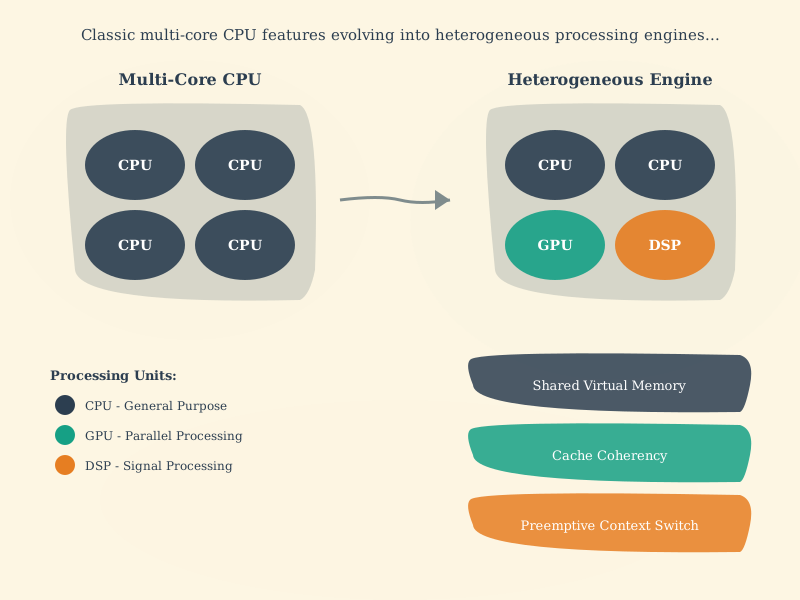
Local GPU processing can outperform cloud offloading for many IoT workloads, achieving 21× speedup over sequential CPU while avoiding network transmission energy costs.
1611.11 Summary
Code offloading and heterogeneous computing are essential for energy-efficient IoT systems:
- Energy-Preserving Sensing Plans: Always choose the cheapest method to obtain context - cache, inference, then direct sensing
- MAUI Framework: Compare local execution energy against network transmission + idle wait + receive energy
- Network-Aware Decisions: Wi-Fi offloading often saves energy; LTE offloading often wastes energy due to tail power
- Heterogeneous Cores: Match tasks to appropriate processors - DSP for audio, GPU for parallel, NPU for ML
- Context-Aware Adaptation: Adjust offloading decisions based on battery level, network type, and latency requirements
The key insight is that offloading decisions are highly context-dependent. Simple rules like “always offload” or “always local” are suboptimal - intelligent systems adapt to current conditions.
1611.12 What’s Next
The next section covers Energy Optimization Worksheets and Assessment, which provides comprehensive calculation worksheets, detailed quizzes, and practical exercises for applying context-aware energy management techniques to real IoT systems.