%%{init: {'theme': 'base', 'themeVariables': {'primaryColor': '#2C3E50', 'primaryTextColor': '#fff', 'primaryBorderColor': '#16A085', 'lineColor': '#16A085', 'secondaryColor': '#E67E22'}}}%%
graph TB
    subgraph Properties["Security Properties"]
        Access[Access Control<br/>Privacy]
        Auth[Authentication]
        Integrity[Data Integrity]
        Confid[Confidentiality]
        Fresh[Data Freshness]
        NonRep[Non-Repudiation]
    end

    subgraph Mechanisms["Encryption Mechanisms"]
        E1[E1: Link Layer<br/>AES-128 Shared Key]
        E2[E2: Device-Gateway<br/>AES-256 Unique Keys]
        E3[E3: Device-Cloud<br/>End-to-End AES-256]
        E4[E4: Gateway-Cloud<br/>TLS/SSL Certificates]
        E5[E5: Key Renewal<br/>RSA Signatures]
    end

    E1 -->|Provides| Access
    E1 -->|Provides| Confid
    E2 -->|Provides| Auth
    E2 -->|Provides| Integrity
    E2 -->|Provides| Fresh
    E3 -->|Provides| Confid
    E4 -->|Provides| Confid
    E4 -->|Provides| Auth
    E5 -->|Provides| Auth
    E5 -->|Provides| NonRep

    style Properties fill:#E6F2FF,stroke:#2C3E50,stroke-width:2px
    style Mechanisms fill:#D4F4DD,stroke:#16A085,stroke-width:2px
1437 Security Properties and Best Practices
1437.1 Learning Objectives
By the end of this chapter, you will be able to:
- Map Security Properties to Encryption Levels: Understand which E1-E5 level provides each security property
- Design Defense-in-Depth Architectures: Combine multiple encryption layers for comprehensive protection
- Evaluate Encryption Tradeoffs: Make informed decisions about symmetric vs asymmetric, per-device vs shared keys
- Apply Best Practices: Implement comprehensive encryption for real-world IoT deployments
1437.2 Security Properties Achieved
The five-level encryption architecture addresses common IoT security requirements:
1437.2.1 Access Control (Privacy)
Mechanism: AES-128 at link layer (E1)
- Only nodes with shared key can access network routing
- Unknown nodes rejected at first hop
- Hardware implementation in radio (no MCU interrupt)
- Preserves energy by not waking MCU for invalid packets
1437.2.2 Authentication
Mechanism: Private keys (E2, E5)
- Each device has unique key pair
- Server stores all device public keys
- Signature verification proves origin
- Prevents spoofing attacks
1437.2.3 Data Integrity
Mechanism: Hash algorithms (E2)
- SHA-256 checksums verify content
- Detects tampering or corruption
- Sequence numbers prevent reordering
- Combined with encryption prevents modification
1437.2.4 Data Confidentiality
Mechanism: Multi-layer encryption (E1-E4)
- E1: Network-level protection
- E2/E3: End-to-end protection
- E4: Transport security
- Defense in depth approach
1437.2.5 Data Freshness
Mechanism: Sequence numbers and timestamps (E2)
- Each packet has unique seed
- Prevents replay attacks
- Gateway filters duplicate packets
- Time-based validity windows
1437.2.6 Non-Repudiation
Mechanism: RSA signatures (E5)
- Legal proof of message origin
- Cannot deny sending signed message
- Important for sensitive sensor data
- Regulatory compliance support
TipLayered Encryption: Defense in Depth
The five-level encryption architecture demonstrates defense in depth—if one layer is compromised, others still provide protection:
- E1 fails (shared key leaked): E2 still protects individual device data
- E2 fails (device key extracted): E1 prevents network access by unauthorized nodes
- E3 fails (cloud encryption broken): E1+E2 protect in-network communications
- E4 fails (TLS vulnerability): E1-E3 still encrypt the underlying data
Best practice: Always implement multiple encryption layers. Single-layer encryption is a single point of failure—one compromise exposes everything.
1437.3 Encryption Tradeoffs
TipTradeoff: Symmetric vs Asymmetric Encryption for IoT
Decision context: When selecting encryption for IoT device communications, data storage, or key exchange mechanisms.
| Factor | Symmetric (AES) | Asymmetric (RSA/ECC) |
|---|---|---|
| Speed | 100-1000x faster | Computationally intensive |
| Key Management | Pre-shared keys required | Public key can be freely distributed |
| Memory Footprint | 256-512 bytes for AES | 2-8 KB for RSA; 512 bytes for ECC |
| Power Consumption | ~10 uJ per operation | ~1000 uJ per RSA operation |
| Forward Secrecy | Not inherent (requires key rotation) | Achievable with ephemeral keys (ECDHE) |
| Authentication | No inherent identity proof | Digital signatures prove identity |
Choose Symmetric Encryption when:
- Processing high-volume data on constrained devices (sensors, actuators)
- Battery life is critical and encryption frequency is high
- Keys can be securely pre-provisioned during manufacturing
- Real-time performance is required (sub-millisecond latency)
Choose Asymmetric Encryption when:
- Establishing initial secure channels between unknown parties
- Key exchange is needed without pre-shared secrets
- Digital signatures are required for non-repudiation
- Device identity verification or certificate-based authentication is needed
Default recommendation: Use hybrid approach - asymmetric encryption (ECC preferred for IoT) for key exchange and authentication, then symmetric encryption (AES-128/256) for bulk data protection.
TipTradeoff: Per-Device Keys vs Shared Network Keys
Decision context: When provisioning encryption keys for an IoT deployment, you must decide between unique keys per device or shared keys across device groups.
| Factor | Per-Device Keys | Shared Network Keys |
|---|---|---|
| Provisioning Complexity | High (unique key per device) | Low (one key for all devices) |
| Compromise Blast Radius | One device only | All devices using that key |
| Key Storage | Scales with device count | Constant regardless of scale |
| Device Authentication | Implicit (key proves identity) | Requires additional identity mechanism |
| Key Rotation | Complex (update each device) | Simpler (update once, propagate) |
| Manufacturing Integration | Requires secure provisioning line | Standard production process |
| Revocation | Granular (revoke single device) | All-or-nothing |
Choose Per-Device Keys when:
- Deployment scale exceeds 100 devices (blast radius becomes significant)
- Device compromise is realistic (public locations, physical access possible)
- Regulatory requirements mandate device-level accountability
- Devices have secure elements or TPMs for key protection
- Long deployment lifespan (10+ years) where some devices will be compromised
Choose Shared Network Keys when:
- Small, controlled deployment (<50 devices in secured facility)
- All devices are physically secured against tampering
- Rapid deployment is prioritized over security granularity
- Budget constraints prevent secure provisioning infrastructure
- Prototyping or proof-of-concept before production security
Default recommendation: Always use per-device keys in production deployments. Modern IoT platforms (AWS IoT, Azure IoT Hub) provide automated per-device key provisioning.
1437.4 Common Pitfalls
WarningCommon Pitfalls in Encryption Architecture
1. Relying on Link Layer Encryption Alone (E1)
- Mistake: Assuming that enabling Zigbee or Wi-Fi encryption (E1) is sufficient
- Why it happens: Link layer encryption is “on by default” giving false sense of security
- Solution: Implement defense-in-depth with multiple layers. In 2017, KRACK demonstrated WPA2 (E1) vulnerabilities could expose traffic
2. Using Shared Network Keys Across All Devices
- Mistake: Deploying the same encryption key to thousands of IoT devices
- Why it happens: Per-device keys seem operationally complex
- Solution: Implement unique per-device keys with automated provisioning. The 2020 Philips Hue vulnerability showed how a single Zigbee key could unlock entire networks
3. Skipping E5 Key Rotation Due to “Perfect Forward Secrecy”
- Mistake: Assuming ECDHE in TLS provides permanent protection without key renewal
- Why it happens: PFS protects past sessions if long-term keys are compromised
- Solution: Implement scheduled key rotation. Best practice: rotate session keys daily, device identity keys annually
1437.5 Worked Example: Smart Home Hub Security Architecture
1437.6 Worked Example: Designing Encryption for a Smart Home Hub
Scenario: You are designing the security architecture for a smart home hub that connects to 50+ devices: smart locks, cameras, thermostats, and sensors. The hub has a Cortex-M4 processor (168 MHz, 256 KB RAM, 1 MB flash), runs on mains power, and connects to a cloud platform via Wi-Fi.
Goal: Design a multi-layer encryption architecture (E1-E5) that protects different data types appropriately.
Data classification:
| Data Type | Sensitivity | Confidentiality | Integrity | Availability |
|---|---|---|---|---|
| Lock commands | Critical | High | Critical | High |
| Camera video | High | High | Medium | Medium |
| Temperature readings | Low | Low | Medium | Low |
| Device state (on/off) | Medium | Medium | Medium | High |
| User credentials | Critical | Critical | Critical | Medium |
| Firmware images | High | Medium | Critical | Low |
Threat model:
| Threat | Attack Vector | Impact | Likelihood |
|---|---|---|---|
| Eavesdropping | Sniff Wi-Fi/Zigbee | Privacy breach, lock codes exposed | High |
| Replay attack | Capture and replay lock command | Unauthorized entry | Medium |
| Man-in-middle | Intercept cloud connection | Command injection | Medium |
| Key extraction | Physical access to hub | Full system compromise | Low |
Layer assignments:
| Layer | Implementation | Protects | Algorithms |
|---|---|---|---|
| E1 (Link) | Zigbee network key | Local device-to-hub | AES-128-CCM (Zigbee 3.0) |
| E2 (Device-Hub) | Per-device keys | Individual device secrets | AES-128-GCM + sequence numbers |
| E3 (Device-Cloud) | Not used | - | Hub terminates all connections |
| E4 (Hub-Cloud) | TLS 1.3 | Cloud communication | ECDHE-P256 + AES-128-GCM |
| E5 (Key Renewal) | Certificate-based | Long-term security | ECDSA-P256, 90-day rotation |
Why E3 is skipped: The hub acts as a trusted gateway. End-to-end encryption from sensors to cloud would require more capable sensors and prevent local automation.
Computational budget analysis:
| Operation | Time (Cortex-M4) | Per-Second Capacity |
|---|---|---|
| AES-128-GCM (128 bytes) | 0.15 ms | 6,600 blocks |
| ECDSA-P256 verify | 25 ms | 40 signatures |
| ECDHE key exchange | 50 ms | 20 key agreements |
| SHA-256 (1 KB) | 0.5 ms | 2,000 hashes |
Optimization decisions:
| Challenge | Solution | Impact |
|---|---|---|
| TLS handshake latency | Session resumption (PSK) | 50ms to 5ms for repeat connections |
| Camera video encryption | AES-CTR (parallelizable) | 30% faster than GCM for video |
| Battery device overhead | Integrity-only option | 50% less computation for sensors |
Lock command security (defense in depth):
# Lock command structure (48 bytes total)
lock_command = {
    "device_id": "lock-001",      # 12 bytes
    "action": "unlock",            # 1 byte
    "sequence": 847291,            # 4 bytes (monotonic)
    "timestamp": 1704825600,       # 4 bytes (Unix time)
    "nonce": "a7b9c2d4e5f6",       # 12 bytes (from challenge)
    "user_id": "user-42",          # 8 bytes
    "hmac": "..."                  # 16 bytes (AES-CMAC)
}

def validate_lock_command(cmd, expected_nonce, last_seq):
    # Check sequence number (replay)
    if cmd.sequence <= last_seq:
        raise ReplayError("Sequence too old")

    # Check timestamp (stale command)
    if abs(time.now() - cmd.timestamp) > 2:
        raise StaleError("Command expired")

    # Check nonce (man-in-middle)
    if cmd.nonce != expected_nonce:
        raise AuthError("Invalid challenge response")

    # Verify HMAC (integrity + authentication)
    if not verify_hmac(cmd, device_key):
        raise AuthError("HMAC verification failed")

    return True
Key hierarchy:
Master Key (in secure element)
+-- Hub Identity Key (ECDSA-P256, permanent)
|   +-- Used for: Device attestation, cloud authentication
+-- Cloud Session Keys (AES-128, derived per connection)
|   +-- Used for: TLS 1.3 traffic protection
+-- Device Group Keys (AES-128, per device type)
|   +-- Used for: Broadcast commands to all locks, all lights
+-- Per-Device Keys (AES-128, unique per device)
    +-- Used for: Individual device commands and responses
Rotation schedule:
| Key Type | Rotation Period | Trigger |
|---|---|---|
| Cloud TLS session | 1 hour | Time-based |
| Device session keys | 24 hours | Time-based |
| Hub identity certificate | 2 years | Certificate expiry |
| Compromised device key | Immediate | Manual revocation |
Key decisions made and why:
| Decision | Choice | Rationale |
|---|---|---|
| E3 (end-to-end) | Not implemented | Hub acts as trusted gateway; avoids sensor complexity |
| Cipher suite | AES-128-GCM | Hardware acceleration available, 128-bit sufficient |
| Lock protection | Sequence + timestamp + nonce | Triple defense against replay |
| Key storage | Secure element for master | Hardware protection prevents extraction |
Quantified security posture:
- Eavesdropping protection: All sensitive data encrypted (E1 + E2 + E4)
- Replay attack window: 2 seconds maximum for lock commands
- Key extraction difficulty: Secure element requires $10K+ attack
- Firmware integrity: ECDSA signature verification on all updates
- Computational overhead: < 5% CPU for typical traffic
1437.7 Summary
This chapter covered security properties and best practices:
- Six Security Properties: Access control, authentication, data integrity, confidentiality, freshness, and non-repudiation each mapped to specific encryption levels (E1-E5)
- Defense in Depth: Multiple encryption layers ensure that compromise of any single layer doesn’t expose the entire system
- Symmetric vs Asymmetric: Use hybrid approach—asymmetric for key exchange, symmetric for bulk data
- Per-Device vs Shared Keys: Always use per-device keys in production to limit blast radius of compromise
- Threat-Model-Driven: Security decisions should be based on actual threat landscape, not checkboxes
1437.8 Knowledge Check
1437.9 What’s Next
You have completed the Encryption Architecture series. Continue your security journey with:
- Cyber Security Methods: Learn how encryption enables identity verification and access control in IoT ecosystems
- IoT Devices and Network Security: Apply encryption within broader IoT security strategies including secure boot and firmware updates
- Threat Modeling and Mitigation: Assess which encryption levels (E1-E5) are necessary for your specific threat landscape
- Zero-Trust Security: Modern security architecture that assumes no trusted zones
NoteRelated Chapters
- Encryption Architecture Overview - Five-layer framework summary
- E1: Link Layer Encryption - Foundation of IoT encryption
- E5: Key Renewal - Long-term key management
- Encryption Principles - Cryptographic fundamentals
1437.10 Visual Reference Gallery
NoteAI-Generated Visual: AES Encryption Process
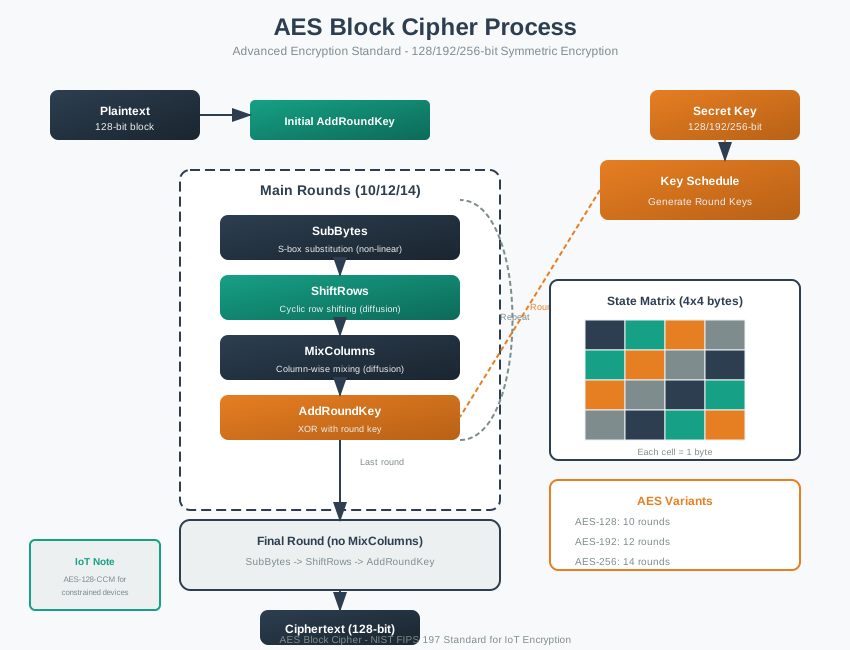
NoteAI-Generated Visual: Asymmetric Encryption Architecture
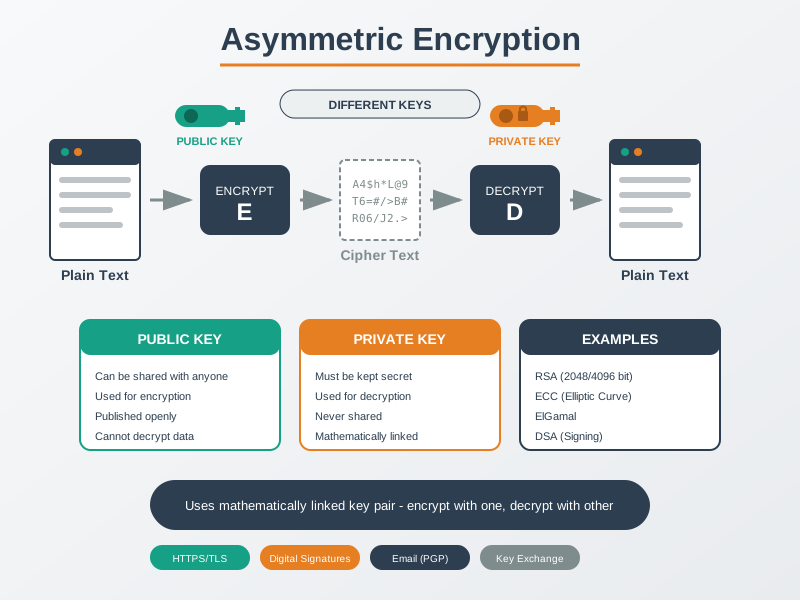
NoteAI-Generated Visual: DTLS Handshake Protocol
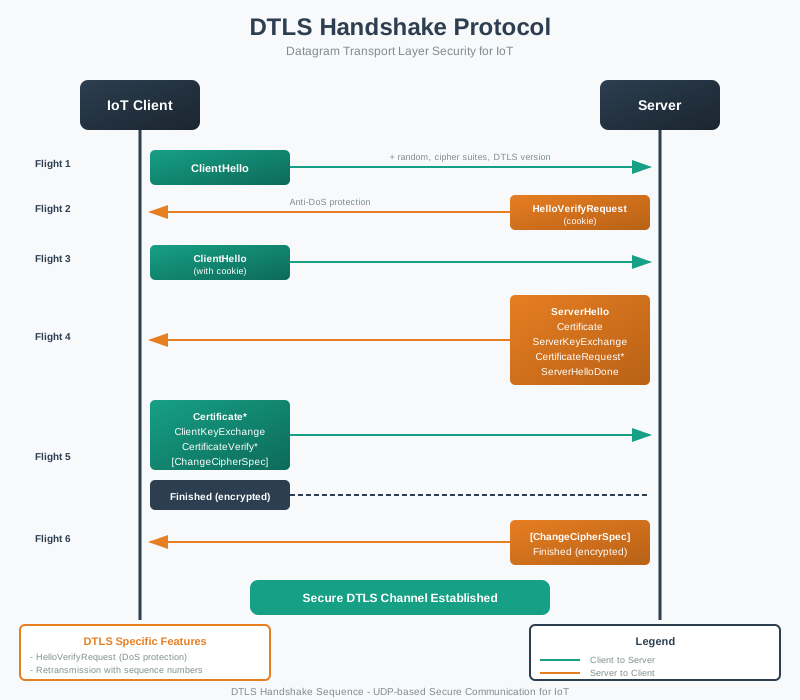
1437.11 Alternative Source Figures
NoteAcademic Resource: Edinburgh IoT Security - Symmetric Encryption Model
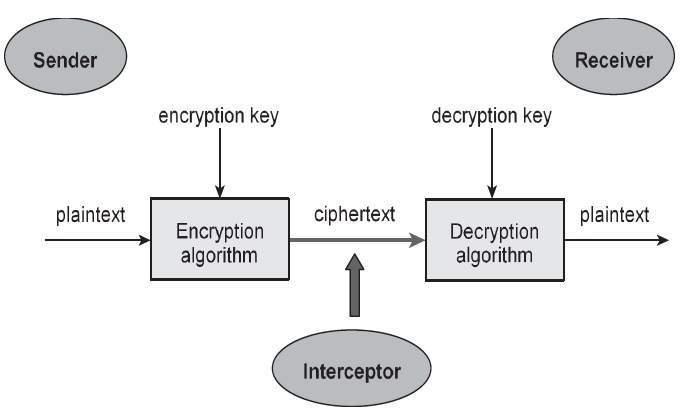
Source: University of Edinburgh - IoT Systems Security Course
NoteAcademic Resource: Edinburgh IoT Security - Asymmetric (Public Key) Encryption
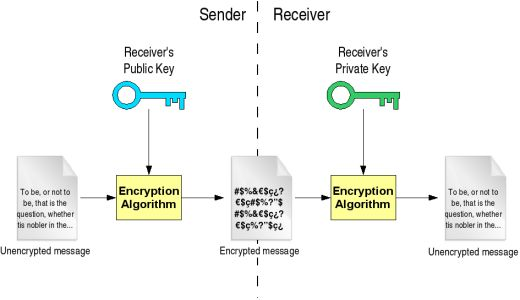
Source: University of Edinburgh - IoT Systems Security Course
NoteOriginal Source Figure: Complete Security Scheme (Alternative View)
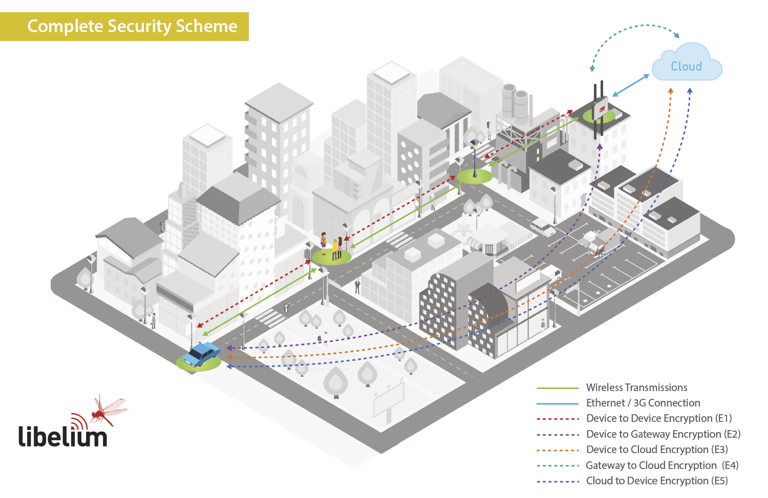
Source: CP IoT System Design Guide, Chapter 6 - Security and Privacy