%%{init: {'theme': 'base', 'themeVariables': { 'primaryColor': '#2C3E50', 'primaryTextColor': '#fff', 'primaryBorderColor': '#16A085', 'lineColor': '#16A085', 'secondaryColor': '#E67E22', 'tertiaryColor': '#7F8C8D', 'clusterBkg': '#f9f9f9', 'clusterBorder': '#2C3E50', 'edgeLabelBackground':'#ffffff'}}}%%
flowchart TB
    Device[IoT Device<br/>Sensor]
    Gateway[Gateway]
    Cloud[Cloud Server]

    Device -->|E1: Link Layer<br/>AES-128 Hardware| Gateway
    Device -->|E2: Device-Gateway<br/>AES-256 Per-Device| Gateway
    Device -.->|E3: Device-Cloud<br/>End-to-End Direct| Cloud
    Gateway -->|E4: Gateway-Cloud<br/>TLS 1.3| Cloud
    Cloud -.->|E5: Key Renewal<br/>RSA-2048| Device

    style Device fill:#16A085,stroke:#2C3E50,color:#fff
    style Gateway fill:#E67E22,stroke:#2C3E50,color:#fff
    style Cloud fill:#2C3E50,stroke:#16A085,color:#fff
1443 Encryption Review: Multi-Layer Architecture (E1-E5)
1443.1 Learning Objectives
By the end of this chapter, you will be able to:
- Implement Multi-Layer Encryption: Build complete E1-E5 encryption stacks for IoT devices
- Configure Link Layer Security: Set up AES-128 encryption for wireless communication
- Apply End-to-End Encryption: Implement device-to-cloud encryption using asymmetric and symmetric keys
- Manage Key Lifecycle: Design secure key generation, distribution, and renewal processes
- Debug Cryptographic Issues: Diagnose authentication failures and encryption mismatches
1443.2 Prerequisites
Required Chapters: - Encryption Fundamentals - Symmetric vs asymmetric basics - Encryption Principles - Core cryptographic concepts
Technical Background: - Basic mathematics (modular arithmetic helpful) - Understanding of binary/hexadecimal - Familiarity with network protocols
Lab Requirements: - OpenSSL installed (for hands-on exercises) - Python with cryptography library (optional) - Access to online crypto tools
Estimated Time: 30 minutes
1443.3 Multi-Layer Encryption Architecture (E1-E5)
IoT systems employ defense-in-depth with five encryption layers protecting data at different points in the communication path.
1443.3.1 Layer-by-Layer Breakdown
| Layer | Path | Algorithm | Purpose | Key Management |
|---|---|---|---|---|
| E1 | Device ↔︎ Gateway | AES-128-CBC | Link protection | Shared network key |
| E2 | Device → Gateway | AES-256-GCM | Per-device isolation | Unique device keys |
| E3 | Device → Cloud | AES-256-GCM | End-to-end confidentiality | Cloud public key |
| E4 | Gateway → Cloud | TLS 1.3 | Transport security | Certificate-based |
| E5 | Cloud → Device | RSA-2048 | Key distribution | Periodic renewal |
1443.4 Layer Selection Guidelines
Not every deployment needs all five layers. Select based on threat model and data sensitivity:
WarningCommon Misconception: “More Encryption Layers = Better Security”
The Myth: Deploying all five encryption layers (E1-E5) simultaneously always provides the best security for every IoT deployment.
Reality Check with Quantified Examples:
Misconception 1: “Always Use All Five Layers” - Smart Agriculture Sensors (10,000 soil moisture sensors, 5-year battery life target): - E1 only (link layer AES-128): 16µJ per transmission - E1+E2+E4 (all layers): 520µJ per transmission (32× more energy) - Impact: Battery life reduced from 5 years to 2.1 years - Reality: Non-sensitive data (soil pH, moisture) doesn’t need E3 end-to-end encryption. E1+E2 provides sufficient protection at 89µJ (3.7 years battery life).
Misconception 2: “E1 Link Layer Encryption Is Sufficient” - Smart Building Network (500 devices sharing WPA2 key): - E1 only: One compromised device exposes all 500 devices’ communications - E1+E2: Compromised device only exposes its own data (0.2% vs 100% exposure) - Reality: 2019 commercial building attack—attacker extracted WPA2 key from one HVAC controller, accessed all 500 devices’ sensor data for 6 months undetected. E2 per-device keys would have contained breach to single device.
Misconception 3: “Encryption Alone Prevents All Attacks” - Medical Infusion Pump (E2 AES-256 encryption without authentication): - Attacker recorded encrypted “inject 5 units” command: 0x6B5A8C92... (valid ciphertext) - Attacker modified single bit: 0x6B5A9C92... (bit-flip attack) - Pump decrypted to “inject 50 units” (lethal overdose) - Impact: 465,000 pumps recalled (FDA 2019), $48M cost - Reality: Encryption (confidentiality) ≠ Authentication (integrity). Need AES-GCM authenticated encryption, adds only 16 bytes (3% overhead) but prevents tampering.
The Right Approach:
Threat-Based Layer Selection: 1. Public Data (weather stations): E1 link layer only—prevents casual sniffing, low cost 2. Private Data (smart home): E1+E2—protects against compromised devices, moderate cost 3. Sensitive Data (medical, financial): E1+E2+E3+E4—end-to-end protection, high cost 4. Critical Infrastructure (power grid): E1+E2+E3+E4+E5—maximum security, premium cost
Real-World Example: Smart City Deployment - Traffic cameras (public data): E1 only → $80/device - Parking sensors (commercial data): E1+E2 → $95/device - Emergency services (sensitive): E1+E2+E4 → $140/device - Police body cameras (legal evidence): E1+E2+E3+E4+E5 → $220/device
Key Insight: Security is a risk management decision, not a “more is better” checklist. Over-engineering encryption wastes 30-40% of battery life and doubles hardware costs for data that doesn’t need that protection level.
1443.5 Lab: Multi-Layer IoT Encryption System
Build a complete multi-layer encryption system for IoT devices.
1443.5.1 Lab Objective
Implement E1-E5 encryption levels with: - Link layer encryption (E1) - Device-to-gateway encryption (E2) - TLS gateway-to-cloud connection (E4) - RSA key renewal (E5)
1443.5.2 Implementation Architecture
┌─────────────────┐         ┌─────────────────┐         ┌─────────────────┐
│   IoT Device    │         │     Gateway     │         │     Cloud       │
│                 │         │                 │         │                 │
│  ┌───────────┐  │   E1    │  ┌───────────┐  │   E4    │  ┌───────────┐  │
│  │ Sensor    │──┼────────▶│  │ Decrypt   │──┼────────▶│  │ Process   │  │
│  │ Data      │  │ AES-128 │  │ E1, E2    │  │ TLS 1.3 │  │ Data      │  │
│  └───────────┘  │         │  └───────────┘  │         │  └───────────┘  │
│                 │         │                 │         │                 │
│  ┌───────────┐  │   E2    │  Device keys    │         │  ┌───────────┐  │
│  │ Encrypt   │──┼────────▶│  stored here    │         │  │ Key       │  │
│  │ Payload   │  │ AES-256 │                 │         │  │ Manager   │  │
│  └───────────┘  │         │                 │         │  └───────────┘  │
│                 │         │                 │         │        │        │
│  ┌───────────┐  │                           │         │        │ E5     │
│  │ RSA Keys  │◀─┼───────────────────────────┼─────────┼────────┘        │
│  │ (E5)      │  │         RSA-2048 Key Renewal        │  RSA-2048      │
│  └───────────┘  │                           │         │                 │
└─────────────────┘         └─────────────────┘         └─────────────────┘
1443.5.3 Core Components
IoTSecurityStack Class: Device-side encryption handling E1 (link layer AES-128), E2 (device-to-gateway AES-256-GCM), and E5 (RSA key renewal)
IoTGateway Class: Gateway-side decryption with device registration, packet processing, and automated key renewal
Security Features: - Replay attack protection via sequence numbers - Integrity verification with SHA-256 checksums - Authenticated encryption with GCM mode
1443.5.4 Implementation Highlights
E1 Layer (Link Protection): - Uses AES-128-CBC with per-packet IVs - Shared network key (like WPA2) - Hardware-accelerated on most radios
E2 Layer (Device Isolation): - Uses AES-256-GCM with authenticated additional data (device ID) - Unique key per device - Prevents cross-device attacks
E5 Layer (Key Renewal): - Employs RSA-2048 with OAEP padding - Secure key distribution from cloud - Maintains forward secrecy
1443.5.5 Packet Structure
┌────────────────────────────────────────────────────────────┐
│                    Encrypted Packet                         │
├──────────────┬──────────┬───────────┬──────────┬───────────┤
│  Device ID   │ Sequence │ Timestamp │ Payload  │ Checksum  │
│   (16 B)     │  (4 B)   │   (8 B)   │ (var)    │  (32 B)   │
├──────────────┴──────────┴───────────┴──────────┴───────────┤
│        E2 Encrypted (AES-256-GCM with auth tag)            │
├────────────────────────────────────────────────────────────┤
│                 E1 Encrypted (AES-128-CBC)                  │
└────────────────────────────────────────────────────────────┘
1443.5.6 Expected Behavior
=== IoT Multi-Layer Encryption System ===

✓ Gateway: Device TEMP_SENSOR_001 registered
✓ Gateway: Device HUMID_SENSOR_002 registered

=== Sending Sensor Data ===

Device 1: Sent 192 byte packet (E1 encrypted over E2)
✓ Gateway received from TEMP_SENSOR_001: temperature 23.5°C

Device 2: Sent 192 byte packet
✓ Gateway received from HUMID_SENSOR_002: humidity 65%

=== Testing Replay Attack ===
Attacker replays Device 1's packet...
✓ Replay attack blocked: Duplicate sequence number detected

=== Key Renewal (E5) ===
✓ Gateway: Generated new AES-256 key for TEMP_SENSOR_001
✓ Device TEMP_SENSOR_001: Key renewed via RSA-2048

Sending with renewed key...
✓ Gateway received with new key: temperature 24.0°C
1443.5.7 Key Takeaways from Lab
- Defense-in-depth: Multiple encryption layers protect against various attack vectors
- Hybrid approach: RSA for key exchange, AES for bulk data encryption
- Forward secrecy: Regular key renewal limits exposure window
- Integrity protection: GCM mode and checksums prevent tampering
1443.6 Diffie-Hellman Key Exchange
A critical component of secure IoT communication is establishing shared secrets without transmitting them. The Diffie-Hellman protocol accomplishes this through elegant mathematics.
%%{init: {'theme': 'base', 'themeVariables': { 'primaryColor': '#2C3E50', 'primaryTextColor': '#fff', 'primaryBorderColor': '#16A085', 'lineColor': '#16A085', 'secondaryColor': '#E67E22', 'tertiaryColor': '#7F8C8D', 'clusterBkg': '#f9f9f9', 'clusterBorder': '#2C3E50', 'edgeLabelBackground':'#ffffff'}}}%%
sequenceDiagram
    participant Alice
    participant Public Channel
    participant Bob

    Note over Alice,Bob: Agree on public parameters: g, p
    Alice->>Alice: Choose secret a
    Alice->>Alice: Compute A = g^a mod p
    Bob->>Bob: Choose secret b
    Bob->>Bob: Compute B = g^b mod p

    Alice->>Public Channel: Send A
    Public Channel->>Bob: Forward A
    Bob->>Public Channel: Send B
    Public Channel->>Alice: Forward B

    Alice->>Alice: Compute K = B^a mod p
    Bob->>Bob: Compute K = A^b mod p

    Note over Alice,Bob: Both now have shared secret K = g^(ab) mod p<br/>Eavesdropper cannot compute K from g, p, A, B

    rect rgb(22, 160, 133)
        Note over Alice,Bob: Secure communication using K as AES key
    end
TipFor Beginners: Understanding Key Exchange
The Problem: How do two devices agree on a secret password when everyone can hear their conversation?
The Magic of Diffie-Hellman: 1. Alice picks a secret number (a = 6) and computes: 5^6 mod 23 = 8 2. Bob picks a secret number (b = 15) and computes: 5^15 mod 23 = 19 3. They exchange 8 and 19 publicly (anyone can see these!) 4. Alice computes: 19^6 mod 23 = 2 5. Bob computes: 8^15 mod 23 = 2
Both get the same secret (2), but an eavesdropper who knows 5, 23, 8, and 19 cannot figure out 2!
Why It Works: Going from secret to public (5^6 → 8) is easy. Going backward (8 → 6) is nearly impossible for large numbers. This is called the “discrete logarithm problem.”
Modern IoT: Uses 2048-bit numbers instead of 23, making the math completely unbreakable.
1443.7 Visual Reference Gallery
NoteVisual: RSA Key Generation and Operations
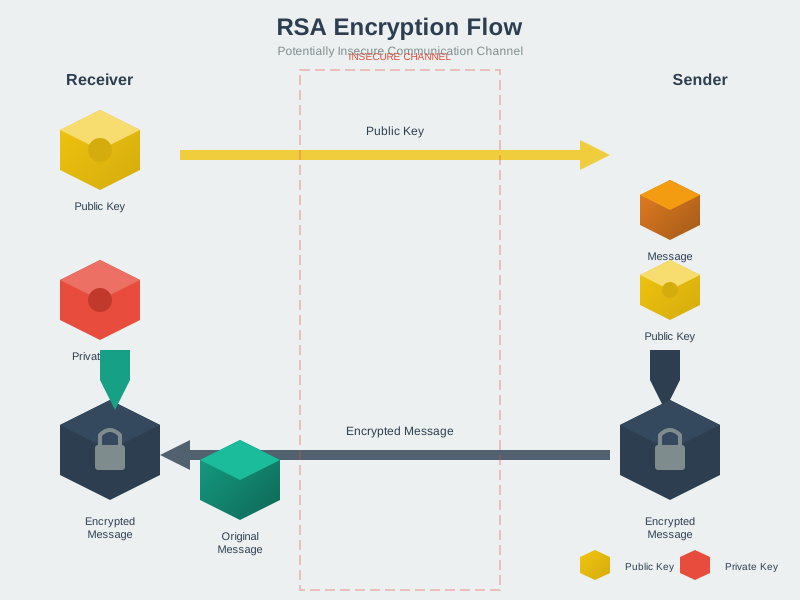
RSA security relies on the computational difficulty of factoring large numbers, providing the mathematical foundation for digital signatures and key exchange in the E5 encryption layer.
NoteVisual: AES Encryption Rounds
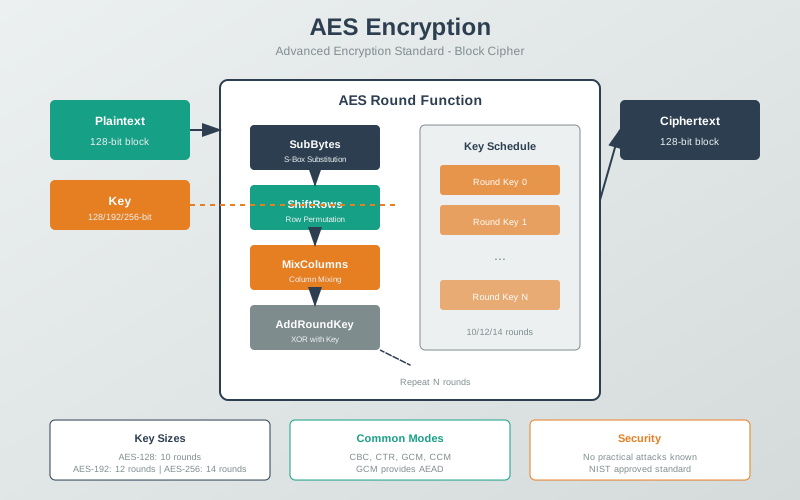
AES operates through multiple rounds of confusion and diffusion, with 128-bit keys using 10 rounds and 256-bit keys using 14 rounds, balancing security strength against computational efficiency for IoT deployment.
NoteVisual: WPA2 Four-Way Handshake
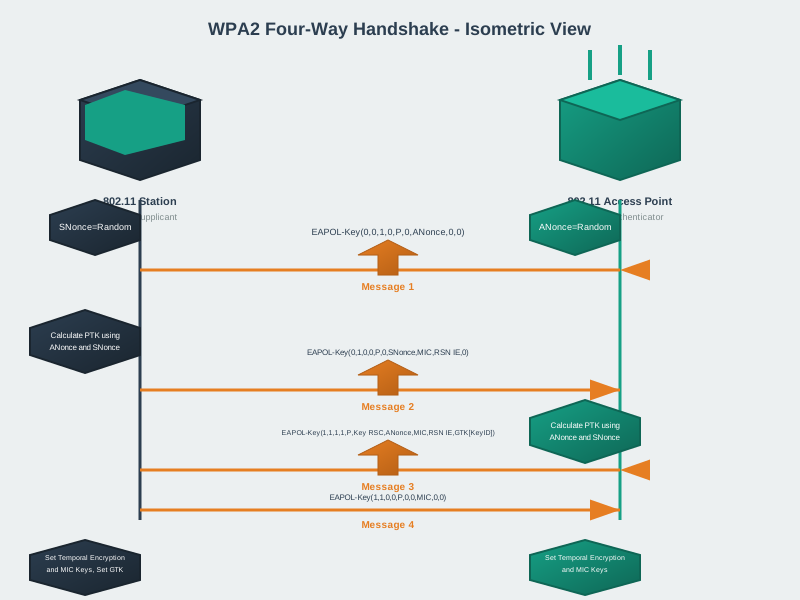
The WPA2 handshake demonstrates practical key agreement, where both parties derive identical encryption keys from exchanged nonces without ever transmitting the actual key over the wireless channel.
1443.8 Summary
Multi-Layer Architecture (E1-E5): - E1: Link layer protection with AES-128 - E2: Device-gateway encryption with integrity - E3: Device-cloud direct encryption - E4: Gateway-cloud TLS connections - E5: Asymmetric key renewal with RSA
Security Properties Achieved: - Privacy through access control - Authentication via digital signatures - Integrity through checksums - Confidentiality via multi-layer encryption - Freshness through sequence numbers - Non-repudiation via RSA signatures
Practical Implementation: - Hybrid approach: asymmetric for key exchange, symmetric for data - Hardware acceleration for link layer (E1) - Defense in depth with multiple layers - Regular key renewal for forward secrecy
NoteKey Concepts
- Five-Layer Encryption Architecture (E1-E5): Link layer, device-gateway, device-cloud, gateway-cloud, and key renewal
- Diffie-Hellman Key Exchange: Secure shared secret establishment over insecure channels using discrete logarithm problem
- Forward Secrecy: Session keys ephemeral and not derivable from long-term keys protecting past communications
- Defense-in-Depth: Multiple overlapping security layers so no single failure compromises the system
1443.9 What’s Next
Now that you understand multi-layer encryption architecture, continue to Understanding Checks where you’ll work through real-world scenario-based exercises covering medical IoT security, OTA firmware updates, smart grid replay attacks, and key management at manufacturing scale.
Continue to Encryption Understanding Checks →
1443.10 See Also
- Encryption Fundamentals Review - Symmetric vs asymmetric basics
- Encryption Architecture - Full E1-E5 layer specification
- Device and Network Security - Network encryption deployment