%%{init: {'theme': 'base', 'themeVariables': { 'primaryColor': '#2C3E50', 'primaryTextColor': '#fff', 'primaryBorderColor': '#16A085', 'lineColor': '#E67E22', 'secondaryColor': '#16A085', 'tertiaryColor': '#E67E22'}}}%%
flowchart LR
    subgraph "Scenario Analysis Framework"
        S1["📊 Identify<br/>Requirements"]
        S2["⚖️ Evaluate<br/>Trade-offs"]
        S3["🎯 Select<br/>Protocol"]
        S4["✅ Validate<br/>Performance"]

        S1 --> S2 --> S3 --> S4
    end

    subgraph "Requirements"
        R1["Reliability"]
        R2["Latency"]
        R3["Power"]
        R4["Security"]
    end

    subgraph "Protocol Options"
        P1["TCP + TLS"]
        P2["UDP + DTLS"]
        P3["UDP + CoAP"]
        P4["UDP"]
    end

    S1 --> R1
    S1 --> R2
    S1 --> R3
    S1 --> R4

    S3 --> P1
    S3 --> P2
    S3 --> P3
    S3 --> P4

    style S1 fill:#E67E22,color:#fff
    style S2 fill:#E67E22,color:#fff
    style S3 fill:#E67E22,color:#fff
    style S4 fill:#E67E22,color:#fff
    style R1 fill:#2C3E50,color:#fff
    style R2 fill:#2C3E50,color:#fff
    style R3 fill:#2C3E50,color:#fff
    style R4 fill:#2C3E50,color:#fff
    style P1 fill:#16A085,color:#fff
    style P2 fill:#16A085,color:#fff
    style P3 fill:#16A085,color:#fff
    style P4 fill:#16A085,color:#fff
751 Transport Selection and Scenarios
751.1 Learning Objectives
By the end of this chapter, you will be able to:
- Apply Selection Frameworks: Use decision trees to choose appropriate transport protocols for IoT scenarios
- Evaluate Trade-offs: Balance reliability, latency, power consumption, and security in protocol selection
- Design for Constraints: Select TCP, UDP, or DTLS based on device capabilities and application requirements
- Analyze Real-World Scenarios: Map common IoT use cases (telemetry, control, streaming) to optimal protocols
- Justify Protocol Choices: Provide technical rationale for transport layer decisions in system designs
- Plan Hybrid Approaches: Combine multiple transport strategies for complex IoT deployments
TipFor Beginners: How to Use This Chapter
What is this chapter? Guidance for selecting transport protocols based on IoT application requirements.
When to use: - When designing IoT systems - To understand protocol trade-offs - For making informed architecture decisions
Selection Criteria:
| Scenario | Recommended |
|---|---|
| Low latency needed | UDP |
| Reliable delivery | TCP |
| Constrained devices | UDP + app-level reliability |
| Secure communication | TLS/DTLS |
Recommended Path: 1. Review Transport Fundamentals 2. Study scenarios here 3. Apply to your project requirements
NoteRelated Chapters
Deep Dives: - Transport Fundamentals - TCP/UDP characteristics and operation - Transport Optimizations - Advanced TCP/UDP tuning - Transport Comprehensive Review - Complete protocol review
Comparisons: - IoT Protocols Overview - Application protocol comparison - CoAP vs MQTT - Transport layer impact
Security: - DTLS and Security - Securing UDP with DTLS
Products:
Learning: - Networking Labs - Hands-on practice - Simulations Hub - Protocol testing tools
751.2 Prerequisites
Before diving into this chapter, you should be familiar with:
- Transport Protocols: Fundamentals: Understanding TCP and UDP characteristics, connection vs connectionless protocols, and DTLS security is essential for making informed protocol selection decisions
- Networking Basics: Knowledge of basic networking concepts including latency, throughput, packet loss, and reliability helps evaluate trade-offs in transport protocol choices
- IoT Protocols Overview: Familiarity with application-layer protocols (CoAP, MQTT) provides context for how transport layer choices affect IoT application behavior
751.3 Transport Protocol Selection for IoT Scenarios
751.3.1 Scenario Analysis
TipAlternative View: Scenario Analysis as Timeline
This variant shows the analysis framework as a time-based process, emphasizing when each step occurs during system design:
%%{init: {'theme': 'base', 'themeVariables': { 'primaryColor': '#2C3E50', 'primaryTextColor': '#fff', 'primaryBorderColor': '#16A085', 'lineColor': '#E67E22', 'secondaryColor': '#16A085'}}}%%
gantt
    title Protocol Selection Process Timeline
    dateFormat X
    axisFormat %s

    section Analysis
    Gather Requirements    :a1, 0, 2
    Document Constraints   :a2, 2, 2

    section Evaluation
    Compare TCP vs UDP     :e1, 4, 2
    Assess Security Needs  :e2, 6, 2
    Calculate Power Budget :e3, 8, 2

    section Selection
    Choose Protocol        :s1, 10, 1
    Select Stack Options   :s2, 11, 1

    section Validation
    Prototype Test         :v1, 12, 3
    Power Measurements     :v2, 15, 2
    Final Approval         :v3, 17, 1
This timeline view helps project managers understand that protocol selection is an iterative process requiring analysis, evaluation, selection, and validation phases.
TipAlternative View: Trade-off Radar Chart Concept
This variant shows how different IoT scenarios prioritize trade-offs differently using a comparative view:
%%{init: {'theme': 'base', 'themeVariables': { 'primaryColor': '#2C3E50', 'primaryTextColor': '#fff', 'primaryBorderColor': '#16A085', 'lineColor': '#E67E22', 'secondaryColor': '#16A085'}}}%%
graph TB
    subgraph TEMP["Temperature Sensor"]
        T1["Reliability: LOW"]
        T2["Latency: MEDIUM"]
        T3["Power: HIGH priority"]
        T4["Security: LOW"]
    end

    subgraph FW["Firmware Update"]
        F1["Reliability: HIGH"]
        F2["Latency: LOW priority"]
        F3["Power: LOW priority"]
        F4["Security: HIGH"]
    end

    subgraph LOCK["Smart Lock"]
        L1["Reliability: HIGH"]
        L2["Latency: HIGH"]
        L3["Power: MEDIUM"]
        L4["Security: CRITICAL"]
    end

    TEMP -->|"Leads to"| UDP["UDP + CoAP NON"]
    FW -->|"Leads to"| TCP["TCP + TLS"]
    LOCK -->|"Leads to"| DTLS["UDP + DTLS + CON"]

    style T1 fill:#16A085,stroke:#2C3E50,color:#fff
    style T2 fill:#16A085,stroke:#2C3E50,color:#fff
    style T3 fill:#E67E22,stroke:#2C3E50,color:#fff
    style T4 fill:#16A085,stroke:#2C3E50,color:#fff
    style F1 fill:#E67E22,stroke:#2C3E50,color:#fff
    style F2 fill:#16A085,stroke:#2C3E50,color:#fff
    style F3 fill:#16A085,stroke:#2C3E50,color:#fff
    style F4 fill:#E67E22,stroke:#2C3E50,color:#fff
    style L1 fill:#E67E22,stroke:#2C3E50,color:#fff
    style L2 fill:#E67E22,stroke:#2C3E50,color:#fff
    style L3 fill:#16A085,stroke:#2C3E50,color:#fff
    style L4 fill:#2C3E50,stroke:#E67E22,color:#fff
    style UDP fill:#16A085,stroke:#2C3E50,color:#fff
    style TCP fill:#2C3E50,stroke:#16A085,color:#fff
    style DTLS fill:#E67E22,stroke:#2C3E50,color:#fff
Orange-highlighted requirements indicate high priority for that scenario, showing how different priority profiles lead to different protocol choices.
751.3.2 Example Scenarios
751.4 Hands-On Lab: Protocol Selection Analysis
751.5 Visual Reference Gallery
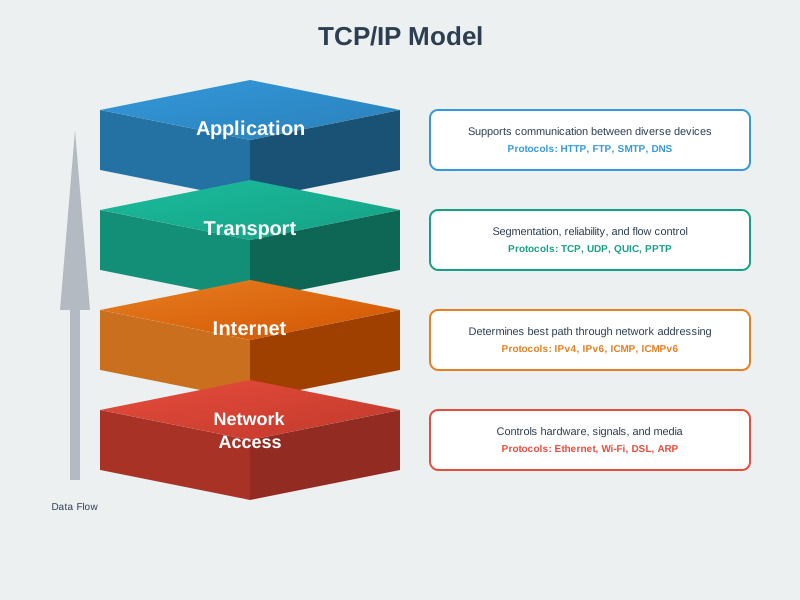
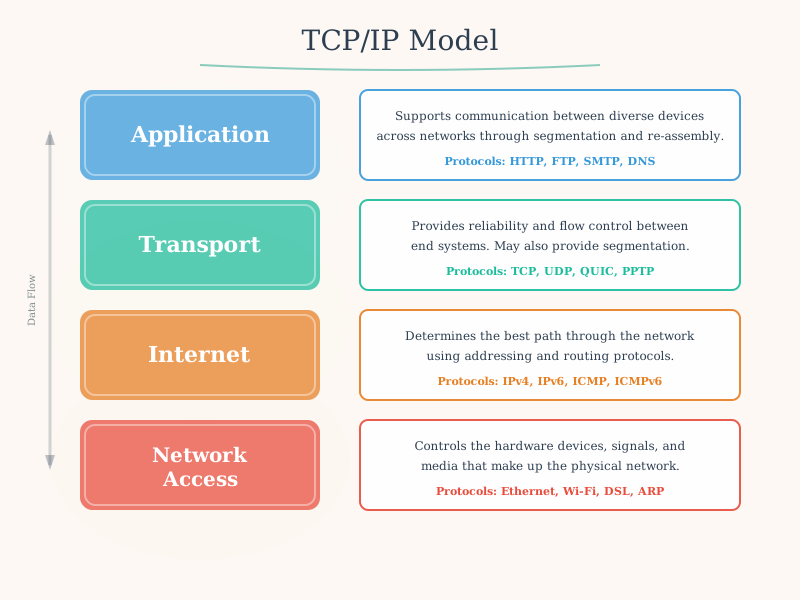
NoteAI-Generated Figure Variants
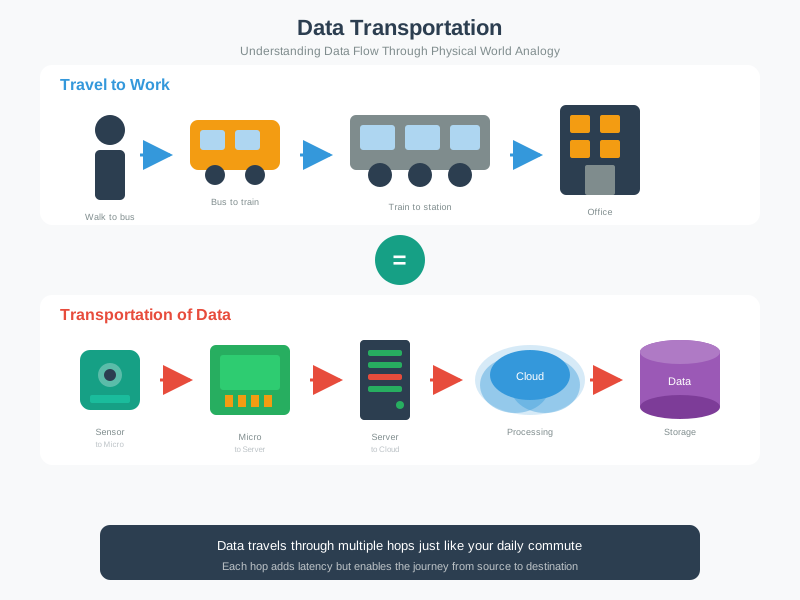
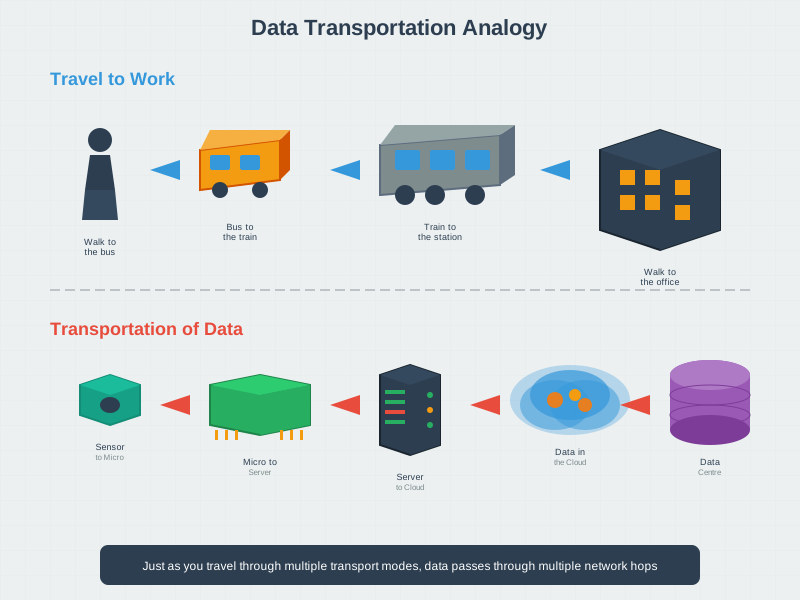
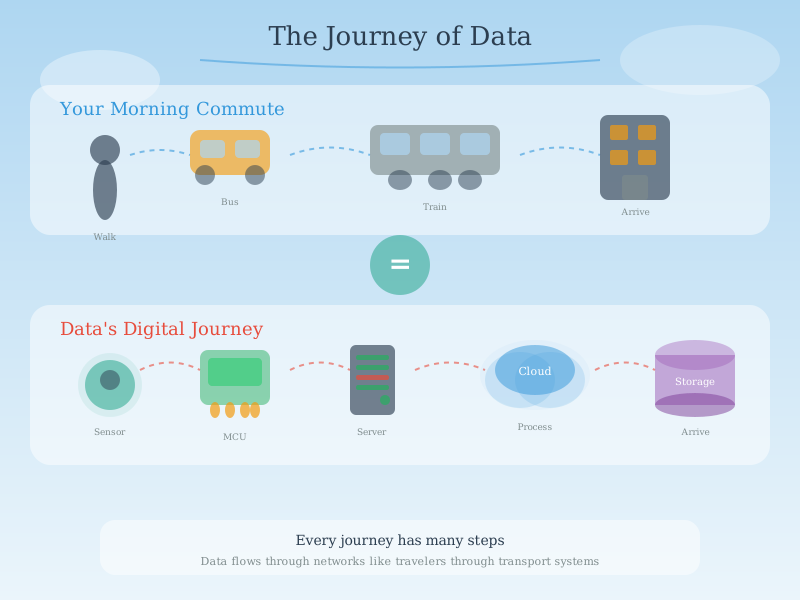
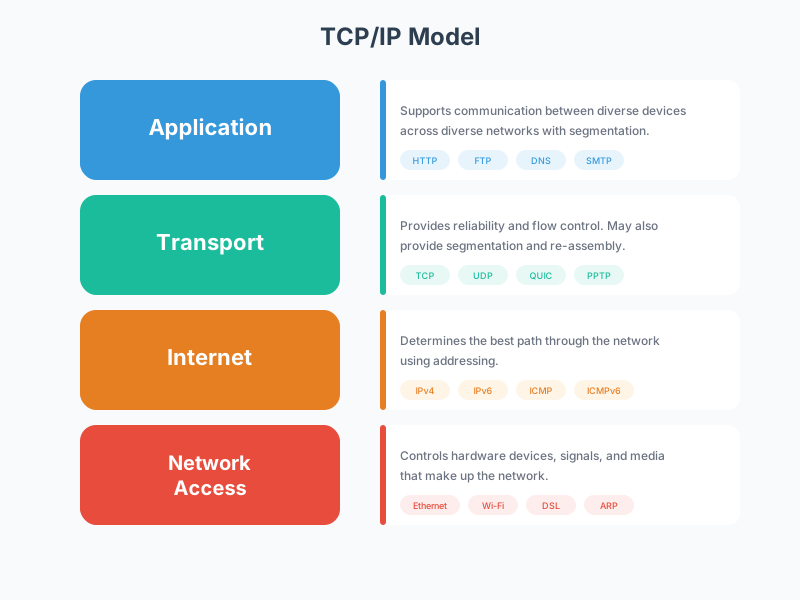
Explore alternative visual representations of key transport protocol selection concepts. These AI-generated figures offer different artistic perspectives while maintaining technical accuracy.
751.6 Protocol Trade-off Analysis
Understanding the key trade-offs between transport protocols helps you make informed decisions for IoT deployments.
WarningTradeoff: Reliable Delivery vs Low Latency
Option A (TCP Reliable Delivery): Guarantees packet delivery through acknowledgments and retransmissions. Adds 1-3 RTT latency (50-300ms on typical IoT networks) for connection setup. Retransmission timeout (RTO) starts at 1 second, doubles on each retry. Total overhead: 244 bytes for single 10-byte sensor reading (handshake + data + teardown).
Option B (UDP Best-Effort): Zero connection latency, immediate transmission. Single packet overhead: 8-byte header + payload = 18 bytes for 10-byte reading. Average latency: 1-5ms on local networks. Packet loss rate depends on network: 0.1-1% on Wi-Fi, 5-30% on lossy wireless sensor networks.
Decision Factors: Choose TCP when data loss is unacceptable (firmware updates, financial transactions, actuator commands) and latency tolerance exceeds 100ms. Choose UDP when fresh data arrives frequently (sensor telemetry every 5-60 seconds) and occasional loss is acceptable. For critical IoT alerts over UDP, add application-layer reliability with CoAP Confirmable messages (2s initial timeout, exponential backoff).
WarningTradeoff: Connection State vs Connectionless Simplicity
Option A (TCP Connection State): Maintains per-connection state: sequence numbers, acknowledgment tracking, congestion window, receive buffer. Memory cost: 280-500 bytes per connection on constrained devices. Connection timeout: 2-4 minutes idle before TCP keepalive triggers. Maximum connections limited by device RAM (e.g., ESP8266: 5-8 concurrent TCP connections).
Option B (UDP Connectionless): Zero connection state, zero memory per “connection.” Each datagram independent: source/destination ports, length, checksum only. Supports unlimited concurrent communication partners. Memory footprint: single 8-byte header structure reused for all transmissions.
Decision Factors: Choose TCP when you need long-lived bidirectional communication (persistent MQTT connections, command channels). Choose UDP when devices communicate with many endpoints (multicast sensor networks), have severe memory constraints (<10KB RAM), or need to support hundreds of simultaneous peers. For battery devices sleeping between transmissions, UDP avoids connection re-establishment overhead on each wake cycle.
751.7 Summary
- Protocol selection frameworks use decision trees based on data loss tolerance, real-time requirements, security needs, and power constraints
- Temperature sensors (battery-powered, periodic data) work best with UDP + CoAP for minimal overhead and maximum battery life
- Firmware updates (critical reliability) require TCP + TLS despite higher overhead due to zero-tolerance for packet loss or corruption
- Smart locks (security-critical, real-time) benefit from UDP + DTLS with CoAP confirmable messages balancing security, reliability, and power efficiency
- Packet overhead calculations reveal UDP uses 24 bytes total vs TCP’s 244 bytes for complete connection lifecycle - 10× difference for single transmission
- Radio-on time directly impacts battery life - UDP 1ms vs TCP full connection 13ms affects daily energy consumption significantly
- Transmission frequency determines protocol impact - infrequent transmissions (every 5 min) minimize protocol overhead importance, frequent transmissions (every 10 sec) make TCP consume 4× more battery than UDP
751.7.1 Real-World Case Study: Smart Agriculture Deployment
Deployment: 500-acre farm with 200 soil moisture sensors
Initial Design (Failed): - Protocol: TCP + MQTT - Battery Life: 4.2 months (target: 12 months) - Operational Cost: $12,000/year battery replacements - Problem: TCP overhead drained batteries in high-loss RF environment (20% packet loss from barn interference)
Redesigned System: - Protocol: UDP + CoAP Confirmable - Battery Life: 18 months (50% above target) - Operational Cost: $2,800/year replacements - Reliability: 98.5% packet delivery (application-layer retry with exponential backoff)
Measured Improvements: - Radio Time: 13ms → 2ms per reading (6.5× reduction) - Retransmissions: TCP storm (5-10 retries) → CoAP selective (1-2 retries) - Battery Cost Savings: $9,200/year (77% reduction) - Network Congestion: 85% → 12% (TCP retransmissions eliminated)
Key Lesson: In high-loss networks, TCP’s reliability mechanisms become the problem—application-layer selective retry (CoAP CON) outperforms TCP’s blind retry-everything approach for periodic telemetry.
751.8 Knowledge Check
TipQuestion 1: Protocol Selection
For a battery-powered sensor sending small updates every hour, which transport is most appropriate?
Options: - A) TCP with keep-alive - B) UDP with application-level acknowledgment - C) WebSocket - D) HTTP/2
NoteAnswer
Correct: B) UDP with application-level acknowledgment
UDP’s lower overhead conserves battery. Application-level ACKs provide reliability without TCP’s connection maintenance overhead during long sleep periods.
TipQuestion 2: Reliability Requirements
When is TCP preferred over UDP in IoT scenarios?
Options: - A) Real-time sensor streaming - B) Command and control messages requiring guaranteed delivery - C) Broadcast announcements - D) Time-sensitive telemetry
NoteAnswer
Correct: B) Command and control messages requiring guaranteed delivery
TCP’s reliable, ordered delivery is essential when commands must be executed exactly once, such as actuator control or configuration updates.
TipQuestion 3: Constrained Networks
What makes CoAP over UDP suitable for constrained IoT networks?
Options: - A) Built-in encryption - B) Smaller message overhead and optional reliability - C) Faster than HTTP - D) Better security than MQTT
NoteAnswer
Correct: B) Smaller message overhead and optional reliability
CoAP uses compact binary headers and offers confirmable (reliable) or non-confirmable (best-effort) messages, letting developers choose the right trade-off.
751.9 What’s Next
Build on your transport protocol selection knowledge:
- Transport Optimizations and Implementation: TCP keep-alive, lightweight stacks, UDP reliability implementation, and DTLS configuration
- CoAP Protocol: Application-layer protocol leveraging UDP for constrained IoT devices
- MQTT Protocol: Publish-subscribe messaging over TCP for IoT applications
- Security Protocols: DTLS and TLS implementation details for secure IoT communication