1554 Network Design and Simulation: Assessment and Resources
The following Python implementation demonstrates a complete framework for IoT network design and simulation, including topology modeling, packet simulation, and performance analysis.
Network Design and Simulation Framework
A network design and simulation framework for IoT enables modeling topologies, analyzing packet flow, and predicting performance before deployment. Key concepts include:
Topology Models: Star, mesh, tree, cluster-tree, and hybrid topologies with node placement, link characteristics (range, bandwidth, latency), and connectivity validation.
Packet Simulation: Discrete-event simulation of packet transmission, collision detection, retry logic, and queuing delays. Models CSMA/CA, time-slotted access, and priority-based scheduling.
Routing Protocols: Implement and compare routing algorithms (shortest-path, flooding, geographic routing, RPL) with metrics for hop count, latency, energy consumption, and reliability.
Performance Analysis: Calculate end-to-end latency, throughput, packet delivery ratio, energy consumption per node, and network lifetime estimates.
Failure Scenarios: Test resilience by simulating node failures, link outages, congestion, and interference. Measure network recovery time and alternative path availability.
Optimization: Iteratively adjust node placement, transmission power, duty cycles, and routing parameters to meet latency/energy/reliability requirements.
For production implementation, use specialized network simulators: ns-3 for detailed protocol simulation, OMNeT++ with INET framework for wireless networks, Cooja for Contiki/Contiki-NG sensor networks, or MATLAB for mathematical network analysis. These tools provide validated PHY/MAC models, extensive protocol libraries, and visualization capabilities.
1554.0.1 Framework Components
1. Network Models: - RadioModel: Path loss, RSSI, transmission range - NetworkNode: Sensors, routers, coordinators, gateways - Link: Connectivity, quality, packet statistics
2. Topology Design: - Star: Central coordinator with peripheral sensors - Mesh: Grid placement for full connectivity - Tree: Hierarchical levels (gateway → routers → sensors)
3. Simulation Engine: - Discrete event simulation with priority queue - Packet routing with hop limits - Energy consumption tracking (TX/RX/idle/sleep) - Link quality and packet loss modeling
4. Performance Metrics: - Packet Delivery Ratio (PDR): Delivered / Total - Average latency: End-to-end packet delay - Throughput: Bits delivered per second - Energy efficiency: Average power consumption
5. Network Analysis: - Network density: Average neighbors per node - Bottleneck identification: High-traffic nodes - Diameter: Maximum path length - Lifetime estimation: Time to first node failure
1554.1 Knowledge Check
Test your understanding of design concepts.
1554.2 Conclusion
Network design and simulation are indispensable tools for successful IoT deployments. By modeling networks in software before physical implementation, designers can:
- Validate performance requirements will be met
- Optimize network parameters and topology
- Identify potential bottlenecks and failure modes
- Reduce deployment risk and cost
- Make data-driven design decisions
The choice of simulation tool depends on project needs: NS-3 for research and large-scale studies, Cooja for WSN and embedded code testing, OMNeT++ for modular protocol development, or commercial tools like OPNET for enterprise deployments.
Effective simulation requires careful attention to model fidelity, realistic traffic patterns, proper statistical analysis, and validation against real-world measurements. Starting with simple models and progressively adding complexity, while documenting assumptions and validating results, leads to trustworthy simulations that accurately predict real deployment performance.
As IoT networks grow in scale and complexity, simulation will only become more critical. The ability to rapidly prototype, test, and optimize networks in software accelerates innovation and reduces the time from concept to successful deployment. Combined with real-world pilot deployments for validation, simulation enables confident design of IoT networks that meet performance, reliability, and efficiency requirements.
1554.3 Key Concepts
Network Topologies: - Star: Central hub with spoked connectivity - Mesh: Full or partial interconnection - Tree: Hierarchical multi-hop structure - Hybrid: Combination approaches (mesh + tree)
Simulation Tools: - NS-3: Large-scale, comprehensive protocol modeling - Cooja: WSN simulation, code-level emulation - OMNeT++: Modular, framework-based simulation - OPNET/Riverbed: Commercial enterprise tools
Key Metrics: - Packet Delivery Ratio (PDR): Successful delivery percentage - Latency: End-to-end packet delay - Throughput: Data rate achieved - Energy consumption: Power usage per operation - Network diameter: Maximum path length - Capacity: Maximum nodes supported
Design Factors: - Radio characteristics: Range, power, data rate - Propagation model: Path loss, obstacles, interference - Topology optimization: Density, coverage, robustness - Routing: Shortest path, reliability, energy-aware - Scalability: Performance as network grows
Validation Approaches: - Sensitivity analysis: Parameter impact - Comparisons with real data - Edge case testing: Failures, interference - Statistical validation: Confidence intervals
1554.4 Chapter Summary
Network design and simulation are indispensable tools for successful IoT deployments. By modeling networks in software before physical implementation, designers validate performance requirements, optimize parameters, identify bottlenecks, reduce risk, and make data-driven decisions.
The choice of simulation tool depends on project needs: NS-3 for research and large-scale studies, Cooja for WSN and embedded code testing, OMNeT++ for modular protocol development, or commercial tools for enterprise deployments. Effective simulation requires careful attention to model fidelity, realistic traffic patterns, proper statistical analysis, and validation against real-world measurements.
1554.5 Network Planning Worksheet
Use this comprehensive worksheet to systematically design and simulate your IoT network before deployment.
1554.5.1 Step 1: Requirements Gathering
| Question | Your Answer | Impact |
|---|---|---|
| Number of devices? | ___ | Scale, cost, simulation complexity |
| Coverage area (m²)? | ___ | AP/gateway count, range requirements |
| Indoor/Outdoor? | ___ | Propagation model, equipment rating |
| Data rate needed? | ___ | Protocol choice, bandwidth planning |
| Latency requirement? | ___ | Architecture, QoS configuration |
| Power availability? | ___ | Battery vs wired, duty cycling |
| Budget per device? | ___ | Technology options, feasibility |
| Reliability (% uptime)? | ___ | Redundancy, mesh vs star |
1554.5.2 Step 2: Protocol Selection Matrix
Based on your requirements, score each option (1-5, where 5 = best fit):
| Factor | Wi-Fi | Zigbee | LoRaWAN | Cellular | Thread | BLE |
|---|---|---|---|---|---|---|
| Meets range? | ||||||
| Meets data rate? | ||||||
| Meets power budget? | ||||||
| Within cost target? | ||||||
| Latency acceptable? | ||||||
| Total Score |
Recommended protocol: ________________ (highest score)
1554.5.3 Step 3: Topology Selection
Based on your requirements, select topology:
| Topology | Pros for Your Application | Cons for Your Application | Score (1-5) |
|---|---|---|---|
| Star | Simple, low latency, centralized control | Hub SPOF, limited range | |
| Mesh | Extended range, self-healing, redundant | Complex routing, higher power | |
| Tree | Hierarchical aggregation, scalable | Parent node failures cascade | |
| Hybrid | Combines strengths, flexible | Most complex, highest cost |
Selected topology: ________________
1554.5.4 Step 4: Coverage Calculation
For indoor Wi-Fi:
Coverage per AP = π × (range)² = π × 25² ≈ 2,000 m²
APs needed = Total area / 2,000
Add 20% for overlap and obstacles
For LoRaWAN outdoor:
Gateway coverage = π × (5km)² ≈ 78 km²
Gateways needed = Total area / 78 km²
Add redundancy factor (1.5× for dual coverage)
Your calculations: - Total area: _____ m² (or _____ km²) - Coverage per gateway/AP: _____ m² - Gateways/APs needed: _____ (with 20% margin) - Estimated cost: _____ gateways × \(___/gateway = **\)_____**
1554.5.5 Step 5: Bill of Materials Template
| Item | Quantity | Unit Cost | Total | Notes |
|---|---|---|---|---|
| End devices | $ | $ | Sensors/actuators | |
| Gateways/APs | $ | $ | From Step 4 calculation | |
| Network server | $/month | $/year | Cloud or self-hosted | |
| Simulation software | $ | $ | NS-3 (free), OPNET, etc. | |
| Test equipment | $ | $ | Packet analyzer, RF tools | |
| Installation | $ | $ | Professional or DIY | |
| Total Initial | \(** | | | **Annual Operational** | | | **\)/year | Subscriptions, cellular |
5-year TCO: Initial + (Annual × 5) = $_____
1554.5.6 Step 6: Simulation Planning
Tool selection:
| Tool | Use Case | Your Need | Selected? |
|---|---|---|---|
| NS-3 | Large-scale research, 100k+ nodes | [ ] | |
| Cooja | WSN firmware testing, <1k nodes | [ ] | |
| OMNeT++ | Modular protocol development | [ ] | |
| Packet Tracer | Education, small networks | [ ] | |
| NetSim | Commercial with IoT modules | [ ] |
Simulation objectives:
Simulation parameters:
| Parameter | Value | Source/Justification |
|---|---|---|
| Propagation model | Log-distance / Two-ray / … | Indoor/outdoor environment |
| Path loss exponent (n) | 2.0-4.0 | Free space=2, indoor=2.5-3, urban=3-4 |
| TX power (dBm) | Device specifications | |
| RX sensitivity (dBm) | Protocol datasheet | |
| Data rate (bps) | Application requirements | |
| Packet size (bytes) | Sensor payload + headers | |
| Traffic pattern | Periodic / Event-driven / Burst | Application behavior |
| Simulation duration (s) | 100-1000+ | Allow network stabilization |
1554.5.7 Step 7: Network Model Configuration
Physical layer:
Propagation: Log-distance with n=_____
TX power: _____ dBm
Sensitivity: _____ dBm
Link budget: TX - Sensitivity = _____ dB
Max range (free space): 10^((Link budget - 40) / (10 × n)) = _____ m
MAC layer: - Access method: CSMA/CA / TDMA / ALOHA - Retry limit: _____ attempts - Backoff: Exponential / Linear - ACK required: Yes / No
Network layer: - Routing: Static / AODV / RPL / Dijkstra - Hop limit: _____ hops max - Route refresh: Every _____ seconds
Application layer: - Protocol: MQTT / CoAP / HTTP / Custom - Traffic: _____ packets/hour per device - Payload: _____ bytes/packet
1554.5.8 Step 8: Deployment Checklist
Pre-Deployment: - [ ] Site survey completed - [ ] Interference assessment done (Wi-Fi analyzer, spectrum scan) - [ ] Power sources identified - [ ] Mounting locations verified - [ ] Network credentials prepared - [ ] Monitoring setup ready - [ ] Simulation completed and validated
Simulation-Specific Tasks: - [ ] Run baseline scenario (ideal conditions) - [ ] Run 30+ iterations with different random seeds - [ ] Parameter sweep (node count: 10, 50, 100, 500) - [ ] Stress test (maximum load, all devices transmitting) - [ ] Failure scenarios (10% node failure, gateway down) - [ ] Statistical analysis (95% confidence intervals) - [ ] Compare with analytical models (Shannon capacity, theoretical PDR)
Deployment: - [ ] Deploy pilot (10-20% of full network) - [ ] Measure pilot performance (PDR, latency, RSSI) - [ ] Compare pilot vs simulation (within 5-10%?) - [ ] Refine simulation model if discrepancy >10% - [ ] Deploy remaining devices in phases - [ ] Document actual vs simulated performance
1554.5.9 Step 9: Performance Validation
Metrics to compare (Simulation vs Real):
| Metric | Simulated | Measured | Δ (%) | Acceptable? |
|---|---|---|---|---|
| PDR | ___% | ___% | <10% Δ OK | |
| Avg latency (ms) | ___ | ___ | <20% Δ OK | |
| Max latency (99th %ile) | ___ | ___ | <30% Δ OK | |
| Throughput (kbps) | ___ | ___ | <15% Δ OK | |
| Energy/packet (mJ) | ___ | ___ | <25% Δ OK | |
| Network lifetime (months) | ___ | ___ | <20% Δ OK |
Validation criteria: - PDR difference <5%: Excellent model accuracy - PDR difference 5-10%: Good, acceptable for design decisions - PDR difference >10%: Refine propagation model, traffic patterns
Common discrepancies and fixes: - Simulated PDR higher → Add interference model, increase path loss exponent - Simulated latency lower → Add queuing delays, MAC contention overhead - Simulated battery life higher → Include routing overhead, idle listening power
1554.5.10 Step 10: Simulation Iteration Log
Track simulation runs to understand parameter sensitivity:
| Run | Nodes | TX Power | Routing | PDR | Latency | Notes |
|---|---|---|---|---|---|---|
| 1 | 50 | 0 dBm | AODV | 85% | 120ms | Baseline - low PDR |
| 2 | 50 | 10 dBm | AODV | 94% | 115ms | Higher TX improved PDR |
| 3 | 50 | 10 dBm | RPL | 96% | 95ms | RPL better than AODV |
| 4 | 100 | 10 dBm | RPL | 91% | 145ms | Scales but higher latency |
| 5 | 100 | 14 dBm | RPL | 97% | 130ms | ✓ Meets requirements |
| … |
Optimal configuration (from simulation): - Nodes: _____ - TX power: _____ dBm - Routing: _____ - Expected PDR: _____% - Expected latency: _____ ms
1554.5.11 Step 11: Failure Scenario Testing
Scenarios to simulate:
| Scenario | Description | PDR Impact | Latency Impact | Recovery Time |
|---|---|---|---|---|
| Single node failure | Random node dies | % → % | _ms → _ms | ___s |
| Gateway failure | Primary gateway down | % → % | _ms → _ms | ___s |
| 10% node failure | Widespread outage | % → % | _ms → _ms | ___s |
| Channel interference | Wi-Fi congestion added | % → % | _ms → _ms | N/A |
| Network partition | Area disconnected | % → % | _ms → _ms | ___s |
Mitigation strategies validated in simulation: - Dual gateways → PDR maintained at % during gateway failure - Mesh routing → Network recovers in _s from 10% node failure - Frequency hopping → Interference resistance improved by __%
1554.5.12 Step 12: Documentation and Handoff
Deliverables from simulation phase:
Handoff to deployment team: - Recommended topology: _________________ - Optimal protocol: _________________ - TX power setting: _____ dBm - Gateway count: _____ - Expected PDR: _____% - Expected latency: _____ ms - Battery lifetime estimate: _____ months
1554.6 Summary
- Network Topology Design: IoT networks employ star topologies for simplicity and low latency, mesh topologies for redundancy and extended range, tree topologies for hierarchical aggregation, or hybrid approaches combining strengths of multiple patterns based on application requirements
- Simulation Tools: NS-3 provides comprehensive protocol modeling for large-scale research (100,000+ nodes), Cooja enables code-level WSN simulation with actual firmware, OMNeT++ offers modular development, while commercial tools like OPNET support enterprise deployments with professional features
- Performance Metrics: Key metrics including Packet Delivery Ratio (PDR), end-to-end latency, throughput, energy consumption, and network lifetime must be quantified through simulation to validate that designs meet application requirements before physical deployment
- Propagation Modeling: Accurate radio propagation models (log-distance path loss, shadowing, multipath) are essential for realistic simulations, with path loss exponents of 2-4 depending on environment (free space vs. indoor vs. urban)
- Routing and Routing Tables: Building routing tables using shortest-path algorithms (Dijkstra) enables packet forwarding, though hop-count metrics may be suboptimal in environments with varying link quality requiring link-quality-aware routing
- Validation and Verification: Comparing simulation results with real deployments validates model accuracy, with differences of 1-2% (e.g., 98.5% measured vs. 99% simulated PDR) confirming simulation fidelity while accounting for real-world variability
- Optimization Strategies: Reducing latency through gateway placement and priority queuing, improving throughput via channel allocation and load balancing, enhancing reliability with redundancy and error correction, and extending battery life through duty cycling and energy-aware routing
Design Deep Dives: - Hardware Prototyping - Physical prototyping - Software Prototyping - Software development - Simulation Tools - Hardware simulation
Network Fundamentals: - Networking Fundamentals - Network basics - Topologies - Network topologies - Routing - Routing protocols
Architecture: - WSN Overview - Sensor networks - Edge Fog Computing - Network tiers
Interactive Tools: - Simulations Hub - Network simulation tools
Learning Hubs: - Quiz Navigator - Design quizzes
1554.7 Visual Reference Gallery
The following AI-generated visualizations provide alternative perspectives on network design and simulation concepts.
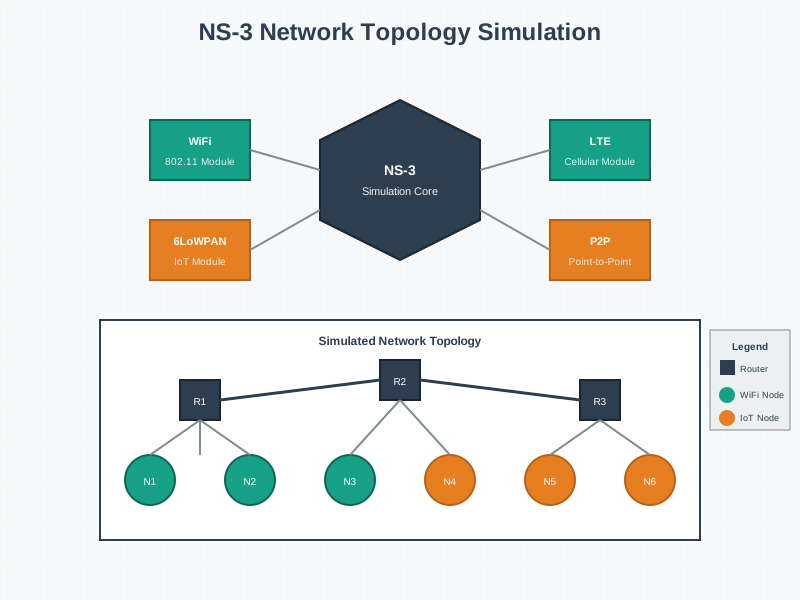
NS-3 provides comprehensive network simulation capabilities, enabling validation of routing protocols, channel models, and network performance before physical deployment.
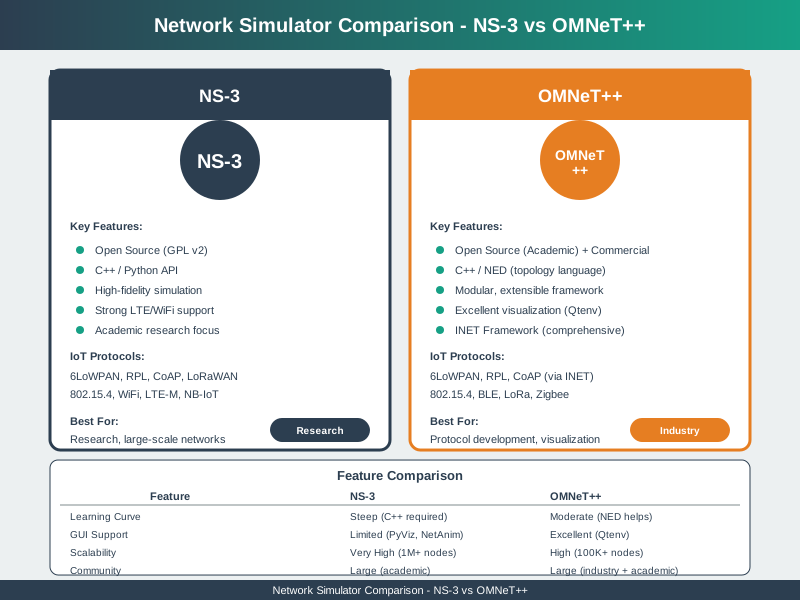
Choosing the right network simulator depends on project requirements, protocol support, scale, and team expertise.
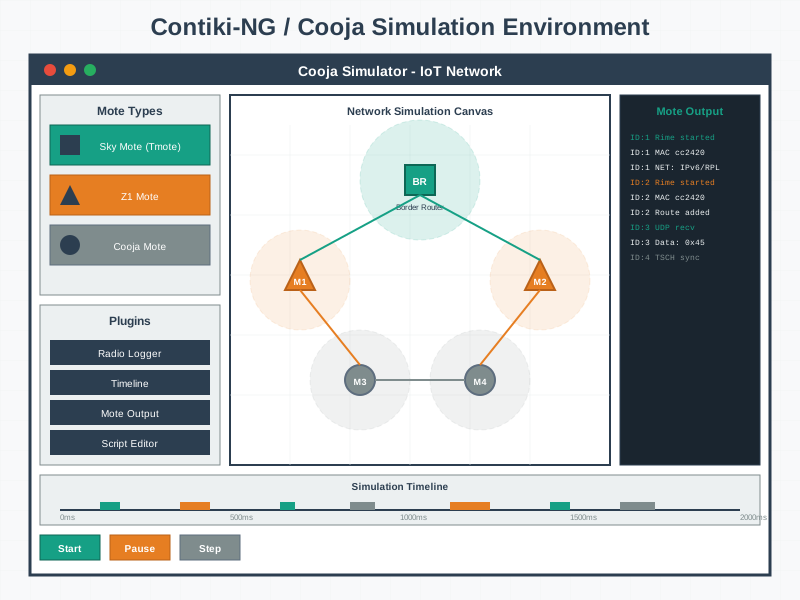
Cooja enables testing actual Contiki firmware on emulated hardware, providing higher fidelity than abstract simulation for wireless sensor networks.
1554.8 What’s Next
The next section covers Network Traffic Analysis, which examines how to capture, monitor, and analyze the actual traffic flowing through your IoT networks. Understanding real traffic patterns complements simulation and enables optimization and troubleshooting of deployed systems.