940 IEEE 802.15.4: Quiz Bank Visual Reference
Overview: Quiz Bank Overview - Learning objectives and study strategy
Quiz Sections: - Part 1 - Comprehensive Review Questions 1-60 - Part 2 - Comprehensive Review Questions 61-120 - Part 3 (Current) - Visual Reference Gallery
Study Materials: - 802.15.4 Fundamentals - Core concepts - 802.15.4 Topic Review - Quick reference
940.1 Visual Reference Gallery
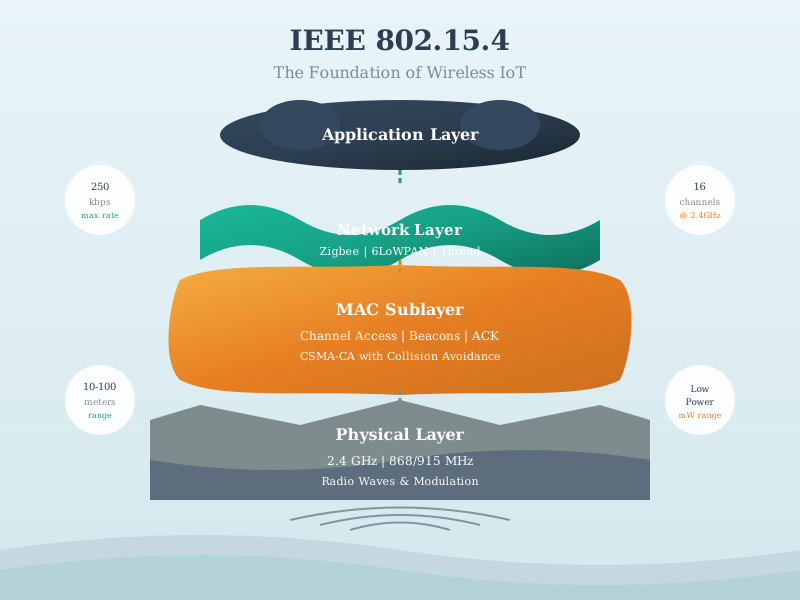
The 802.15.4 standard defines PHY and MAC layers, providing the foundation for higher-layer IoT protocols.
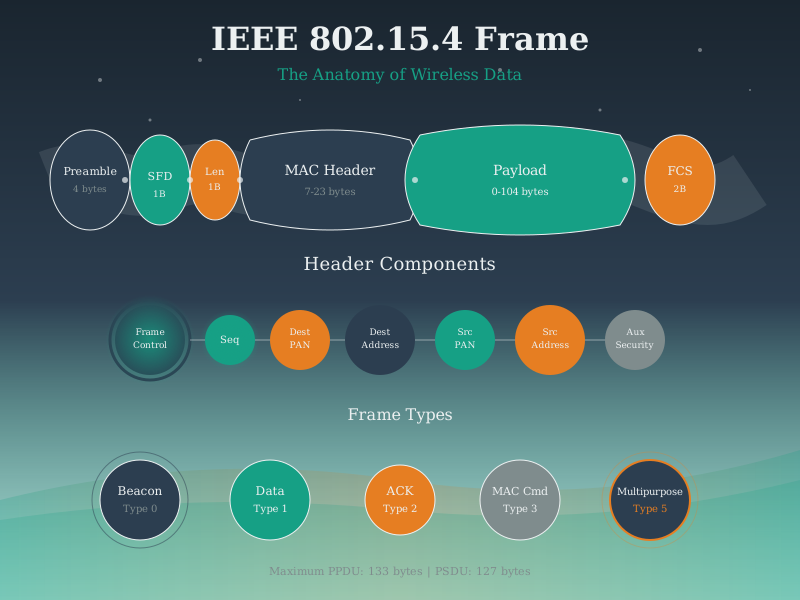
Understanding frame structure is essential for calculating overhead and optimizing payload efficiency in constrained networks.
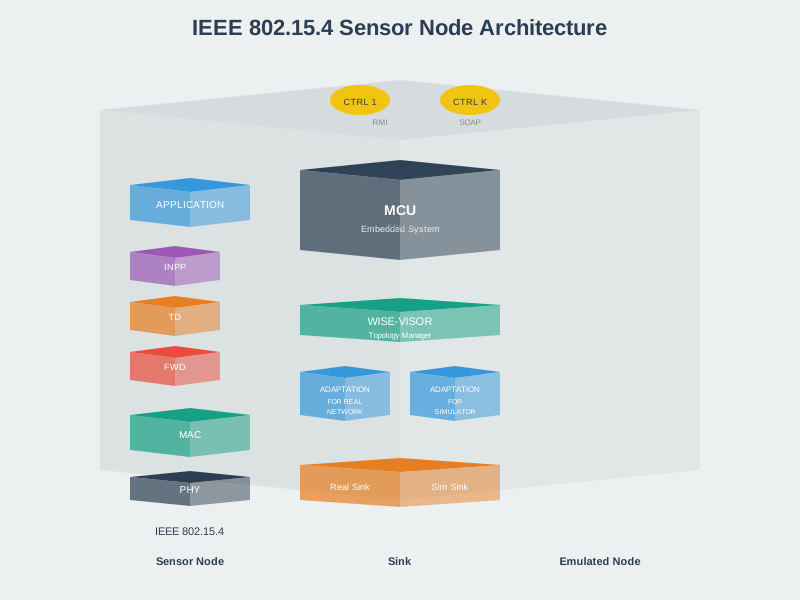
A typical 802.15.4 sensor node achieves multi-year battery life through duty cycling and efficient power management.
940.2 Summary
- Addressing Modes: 802.15.4 supports 64-bit extended and 16-bit short addresses, with short addressing minimizing overhead (6 bytes vs 18 bytes) after device association
- Device Types: FFDs (Full Function Devices) can route and coordinate networks, while RFDs (Reduced Function Devices) are optimized for battery-powered end nodes with minimal RAM requirements
- Tree Addressing (Cskip): Hierarchical address allocation enables distributed address assignment without coordinator involvement, using the Cskip algorithm to calculate address block sizes
- Security Overhead: AES-128 CCM encryption adds approximately 14 bytes (Auxiliary Security Header + MIC), providing replay attack prevention and message integrity crucial for IoT deployments
- Power Efficiency: Ultra-low duty cycles (<1%) achieved through beacon-enabled mode with configurable Superframe Order (SO) and Beacon Order (BO) enable multi-year battery life
- Network Capacity: Addressing configuration (Lm, Cm, Rm parameters) determines maximum network size and device hierarchy depth
- MAC-Layer Reliability: Automatic retransmission with CSMA-CA provides 99.97% delivery probability over lossy wireless links, complementing higher-layer protocols
940.3 What’s Next
Continue to IEEE 802.15.4: Topic Review to consolidate your understanding of 802.15.4 fundamentals, or proceed to RPL Fundamentals and Construction to learn how routing protocols build on 802.15.4 for multi-hop IoT networks.