%%{init: {'theme': 'base', 'themeVariables': {'primaryColor':'#2C3E50','primaryTextColor':'#fff','primaryBorderColor':'#16A085','lineColor':'#16A085','secondaryColor':'#E67E22','tertiaryColor':'#ecf0f1','textColor':'#2C3E50','fontSize':'14px'}}}%%
graph LR
    DEVICE["IoT Device<br/>(LTE-M/NB-IoT Module)"]
    TOWER["Cell Tower<br/>(eNodeB)"]
    CORE["Cellular Core<br/>(EPC/5GC)"]
    INTERNET["Internet/<br/>Cloud Platform"]

    DEVICE <-->|"RF Connection<br/>1-10 km range"| TOWER
    TOWER <--> CORE
    CORE <--> INTERNET

    style DEVICE fill:#E67E22,stroke:#2C3E50,color:#fff
    style TOWER fill:#16A085,stroke:#2C3E50,color:#fff
    style CORE fill:#16A085,stroke:#2C3E50,color:#fff
    style INTERNET fill:#2C3E50,stroke:#16A085,color:#fff
1153 Cellular IoT Overview and Evolution
1153.1 Learning Objectives
By the end of this chapter, you should be able to:
- Understand cellular network evolution (2G/3G/4G/5G) for IoT
- Explain what cellular IoT is and how it differs from traditional cellular
- Identify the key characteristics of cellular IoT technologies
- Compare cellular generations and their IoT suitability
- Understand the 2G/3G sunset timeline and migration requirements
1153.2 Prerequisites
Before diving into this chapter, you should be familiar with:
- Networking Basics: Understanding fundamental networking concepts like IP addressing, TCP/UDP protocols, and client-server architecture is crucial for working with cellular IoT modules and AT commands
- LPWAN Fundamentals: Familiarity with low-power wide-area network principles helps you appreciate how cellular IoT (NB-IoT/LTE-M) compares with unlicensed LPWAN alternatives like LoRaWAN in terms of coverage, power, and cost trade-offs
1153.3 What is Cellular IoT?
NoteKey Takeaway
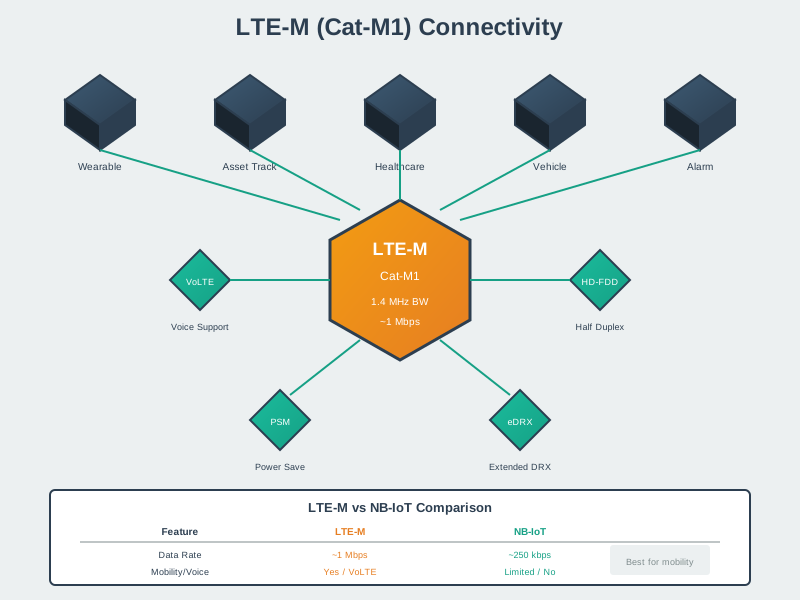
In one sentence: Cellular IoT (NB-IoT and LTE-M) leverages existing mobile network infrastructure to connect distributed IoT devices without requiring gateway deployment, trading higher per-device data costs for zero infrastructure investment.
Remember this: Choose NB-IoT for stationary sensors needing 10+ year battery life and deep indoor coverage; choose LTE-M when devices move or need real-time response and voice capability.
Cellular IoT refers to IoT devices that use cellular networks (mobile networks) for connectivity. These technologies leverage existing cellular infrastructure (cell towers) to provide wide-area coverage for IoT devices.
NoteCross-Hub Connections: Cellular IoT Learning Resources
Enhance your cellular IoT knowledge with these curated learning resources:
Interactive Learning: - Knowledge Map: Visualize how cellular IoT (NB-IoT, LTE-M) connects to LPWAN, networking fundamentals, and IoT protocols in the broader IoT ecosystem - Simulations Hub: Explore cellular coverage simulators and power consumption calculators to understand PSM/eDRX battery life optimization
Assessment & Practice: - Quizzes Hub: Test your understanding with cellular IoT quizzes covering NB-IoT vs LTE-M selection, AT commands, coverage enhancement modes, and SIM technologies - Knowledge Gaps: Address common misconceptions about cellular IoT costs, coverage, and technology selection (LoRaWAN vs cellular trade-offs)
Multimedia Resources: - Videos Hub: Watch demonstrations of NB-IoT/LTE-M module setup, AT command usage, and real-world deployment case studies from smart cities and industrial IoT
Why these connections matter: Cellular IoT sits at the intersection of networking fundamentals, LPWAN technologies, and application protocols. Understanding protocol selection (MQTT vs CoAP over cellular) and comparing cellular with unlicensed LPWAN (LoRaWAN, Sigfox) helps you make informed architecture decisions for cost, coverage, and power trade-offs.
WarningCommon Misconception: “Cellular IoT is Too Expensive for Low-Budget Projects”
The Myth: Many developers assume cellular IoT costs $20-50/device/month, making it prohibitively expensive compared to Wi-Fi or LoRaWAN. This misconception leads to over-engineered LoRaWAN gateway deployments when cellular would be simpler and cheaper.
The Reality: Modern IoT-specific data plans cost $2-5/device/month for NB-IoT, not $20+ consumer cellular plans. The total cost of ownership often favors cellular for distributed deployments.
Real-World Data: San Francisco Smart Parking (2023)
Option A (LoRaWAN - What They Almost Did): - 5,000 parking sensors across 10 km² - 25 gateways needed (200 sensors/gateway) × $600 = $15,000 - Gateway installation: 25 × $200 = $5,000 - Gateway internet: 25 × $50/month = $1,250/month = $15,000/year - Sensor modules: 5,000 × $20 = $100,000 - Year 1 Total: $135,000 | 5-Year Total: $195,000
Option B (NB-IoT - What They Actually Did): - 5,000 parking sensors, zero gateways needed - NB-IoT modules: 5,000 × $12 = $60,000 - Data plans: 5,000 × $3/month = $15,000/year - Infrastructure cost: $0 (used existing AT&T towers) - Installation time: 2 weeks (vs 3 months for LoRaWAN gateways) - Year 1 Total: $75,000 | 5-Year Total: $135,000
Key Insight: Cellular IoT saved $60,000 over 5 years (31% cost reduction) because gateway infrastructure costs ($20,000 initial + $75,000 in connectivity over 5 years) exceeded the premium of cellular data plans. The break-even was 2,000 devices—above this threshold, cellular becomes cheaper than deploying and maintaining LoRaWAN infrastructure.
When the Myth is Actually True: - <100 devices in single building: Wi-Fi is virtually free if Wi-Fi already exists - 1,000+ devices in <1 km²: LoRaWAN wins (1-2 gateways serve all devices) - Countries without IoT data plans: Some regions only offer expensive consumer cellular plans
Lesson: Always calculate 5-year TCO including infrastructure, installation, and maintenance—not just per-device costs. Cellular’s “pay as you go” model eliminates upfront investment and operational complexity, making it cheaper for distributed, medium-scale deployments (100-10,000 devices across >5 km²).
WarningCommon Misconception: “5G Will Replace All LPWAN”
The Misconception: 5G IoT modes will make LoRaWAN and Sigfox obsolete.
Why It’s Wrong: - Different economics: Cellular requires SIM, subscription, licensed spectrum - Power: Even NB-IoT uses more power than LoRa for equivalent range - Coverage: LPWAN can be deployed anywhere; cellular depends on carriers - Cost: $1/month/device cellular vs $0.10/month LPWAN - Latency isn’t always needed (most sensors are fine with minutes delay)
Real-World Example: - Smart agriculture: 10,000 soil sensors across 1,000 acres - Cellular: $10,000/month subscription + coverage gaps - LoRaWAN: One $500 gateway covers entire farm, $0 monthly - Data needs: 1 reading/hour, 10 bytes - cellular overkill
The Correct Understanding: | Factor | Cellular (NB-IoT/LTE-M) | LPWAN (LoRa/Sigfox) | |——–|————————|———————| | Best for | Mobile assets, urban | Fixed assets, rural | | Cost/device/year | $12-60 | $1-10 | | Coverage | Carrier-dependent | Self-deployed | | Power | Days-months | Years | | Bandwidth | Higher | Lower |
Both will coexist. Choose based on mobility, coverage, and cost requirements.
1153.4 Cellular Network Architecture
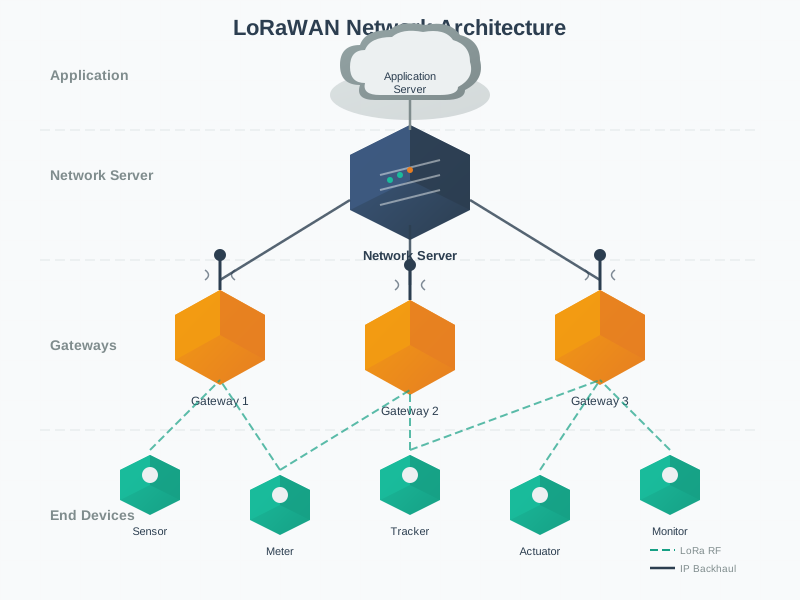
{fig-alt=“Cellular IoT network architecture showing IoT device with LTE-M or NB-IoT module (orange) connecting via RF signal with 1-10km range to cell tower eNodeB (teal), which connects to cellular core network EPC or 5GC (teal), which provides internet connectivity to cloud platforms (navy). Demonstrates direct cellular connectivity without requiring local gateways.”}
NoteAlternative View: Technology Selection Guide
%%{init: {'theme': 'base', 'themeVariables': {'primaryColor': '#2C3E50', 'primaryTextColor': '#fff', 'primaryBorderColor': '#16A085', 'lineColor': '#16A085', 'secondaryColor': '#E67E22', 'tertiaryColor': '#ecf0f1'}}}%%
flowchart TD
    START(["Select Cellular IoT Technology"]) --> Q1{"Need voice<br/>or mobility?"}

    Q1 -->|Yes| LTEM["LTE-M (Cat-M1)<br/>1 Mbps, VoLTE<br/>Mobile asset tracking"]
    Q1 -->|No| Q2{"Data rate<br/>requirement?"}

    Q2 -->|">100 kbps"| Q3{"Battery<br/>constrained?"}
    Q2 -->|"<100 kbps"| NBIOT["NB-IoT (Cat-NB1)<br/>250 kbps, 10+ year battery<br/>Static sensors, meters"]

    Q3 -->|Yes| LTEM
    Q3 -->|No| LTE["LTE Cat-1/4<br/>10-150 Mbps<br/>Cameras, gateways"]

    style LTEM fill:#16A085,stroke:#2C3E50,color:#fff
    style NBIOT fill:#E67E22,stroke:#2C3E50,color:#fff
    style LTE fill:#2C3E50,stroke:#16A085,color:#fff
This decision flowchart helps select between NB-IoT, LTE-M, and standard LTE based on application requirements: mobility, data rate, and power constraints.
1153.5 Cellular IoT Characteristics
- Coverage: Nationwide/global (wherever cellular service exists)
- Range: 1-10+ km per cell tower
- Data Rate: 100 bps to 1+ Gbps (depending on technology)
- Mobility: Excellent (seamless handoff between towers)
- Infrastructure: Uses existing cellular networks (no gateway needed)
- Cost: Subscription/data plans required
NoteAcademic Resource: NPTEL IoT Course (IIT) - IoT World Forum Reference Model
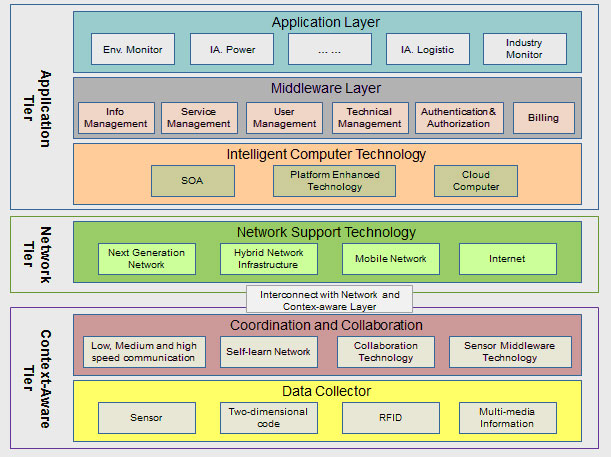
Source: NPTEL Internet of Things Course, IIT Kharagpur - This reference model shows how cellular IoT technologies (NB-IoT, LTE-M) fit into Layer 2 (Connectivity), providing the communication link between physical devices at the edge and higher-level data processing, analytics, and application layers.
1153.6 Cellular Technology Evolution
%%{init: {'theme': 'base', 'themeVariables': {'primaryColor':'#2C3E50','primaryTextColor':'#fff','primaryBorderColor':'#16A085','lineColor':'#16A085','secondaryColor':'#E67E22','tertiaryColor':'#ecf0f1','textColor':'#2C3E50','fontSize':'14px'}}}%%
timeline
    title Evolution of Cellular Technologies for IoT
    section 2G Era
        1991-2010 : GSM/GPRS (2G)
                  : 40-114 kbps
                  : Legacy M2M
    section 3G Era
        2001-2020 : UMTS (3G)
                  : 384 kbps - 42 Mbps
                  : Video tracking
    section 4G Era
        2009-Present : LTE (4G)
                     : 100 Mbps - 1 Gbps
                     : High-bandwidth IoT
        2016-Present : LTE-M (Cat-M1)
                     : 1 Mbps, Mobile IoT
        2016-Present : NB-IoT (Cat-NB1)
                     : 250 kbps, Static sensors
    section 5G Era
        2019-Present : 5G
                     : 10+ Gbps
                     : Autonomous vehicles, Industry 4.0
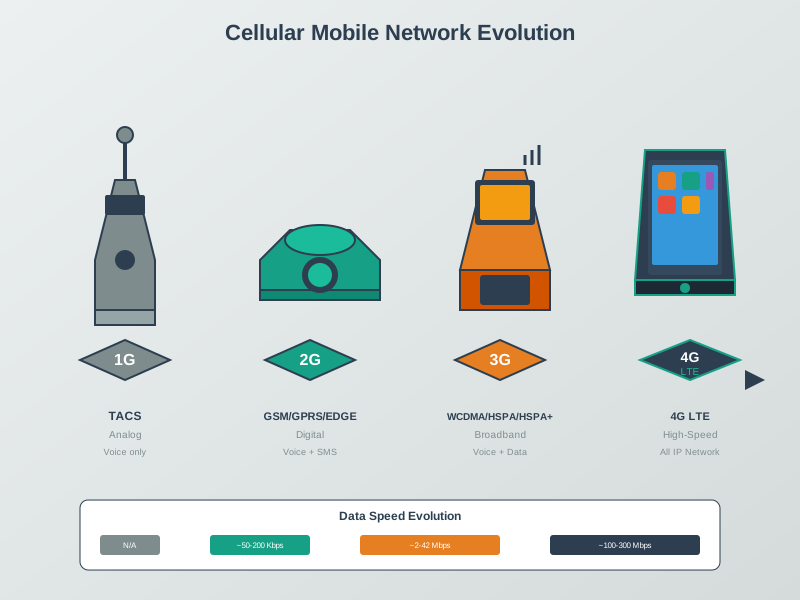
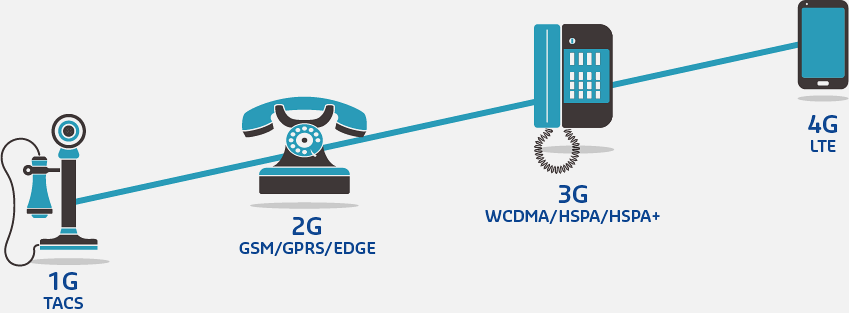
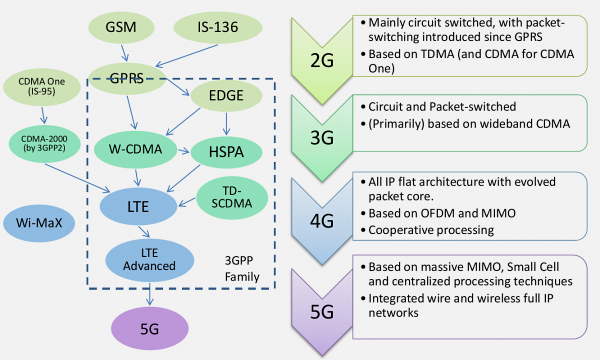
{fig-alt=“Timeline of cellular technology evolution for IoT from 1991 to present. 2G era (1991-2010) introduced GSM/GPRS with 40-114 kbps for legacy M2M. 3G era (2001-2020) brought UMTS with 384 kbps to 42 Mbps for video tracking. 4G era (2009-present) started with LTE at 100 Mbps to 1 Gbps for high-bandwidth IoT, then added LTE-M in 2016 for mobile IoT at 1 Mbps and NB-IoT for static sensors at 250 kbps. 5G era (2019-present) delivers 10+ Gbps for autonomous vehicles and Industry 4.0 applications.”}
NoteHistorical Context: How Cellular IoT Evolved
Original Problem (1990s-2000s): Cellular networks were designed for human voice calls and smartphone data—continuous connections that drain batteries in hours. A typical 2G phone consumes 200-500 mW when connected, completely unsuitable for battery-powered sensors needing 10+ year lifetimes.
2G M2M Era (2000-2010): The first “machine-to-machine” deployments used GSM/GPRS modems (2.5G) for fleet tracking, vending machines, and utility meters. These consumed 1-2W during transmission, required external power, cost $50-100 per module, and data plans ran $10-30/month. Only high-value assets justified the expense.
| Era | Technology | Data Rate | Power (Tx) | Module Cost | Monthly Data | Typical Battery Life |
|---|---|---|---|---|---|---|
| 2G M2M | GSM/GPRS | 64-114 kbps | 1-2W | $50-100 | $10-30 | Days (requires external power) |
| 3G M2M | UMTS/HSPA | 384 kbps-42 Mbps | 1-3W | $40-80 | $10-25 | Hours-Days |
| 4G LTE | LTE Cat-1 | 10 Mbps | 500mW-1W | $20-40 | $5-15 | Days-Weeks |
| 4G IoT | LTE-M (Cat-M1) | 1 Mbps | 100-200mW | $8-15 | $2-10 | Months-Years |
| 4G IoT | NB-IoT (Cat-NB1) | 250 kbps | 20-100mW | $5-12 | $1-5 | 5-15 Years |
| 5G | 5G RedCap | 150 Mbps | 50-200mW | $15-30 | $3-10 | Months-Years |
LTE-M and NB-IoT (2016 - 3GPP Release 13): The breakthrough came when 3GPP designed cellular specifically for IoT with two key innovations: - Power Saving Mode (PSM): Device enters deep sleep (3 µA), wakes only to transmit—achieves 23.99 hours sleep per day - Extended Discontinuous Reception (eDRX): Instead of checking for messages every 1.28 seconds, checks every 10-40 minutes
These changes reduced average power consumption by 100-1000×, enabling coin-cell batteries to last 10+ years.
5G RedCap (2022+ - 3GPP Release 17): “Reduced Capability” 5G bridges the gap between NB-IoT simplicity and full 5G features. RedCap devices support 150 Mbps (vs 250 kbps for NB-IoT) while maintaining reasonable power consumption—ideal for wearables, industrial sensors with video, and smart city applications needing more bandwidth than LPWAN can provide.
Why This Matters: Each generation traded off data rate for power efficiency. NB-IoT achieves 10+ year battery life by sacrificing throughput (250 kbps vs 10 Gbps for 5G). Understanding this evolution helps you select the right cellular technology: - Need mobility + moderate data? → LTE-M (asset tracking, wearables) - Need 10-year battery + low data? → NB-IoT (meters, sensors) - Need higher bandwidth + reasonable power? → 5G RedCap (industrial cameras, AR glasses)
1153.6.1 Cellular Standards Comparison
| Technology | Generation | Data Rate | Power | Coverage | Latency | IoT Use Case |
|---|---|---|---|---|---|---|
| 2G (GSM/GPRS) | 2G | 40-114 kbps | High | Wide | 500-1000 ms | Legacy, M2M |
| 3G (UMTS) | 3G | 384 kbps-42 Mbps | High | Wide | 100-500 ms | Video, tracking |
| 4G (LTE) | 4G | 100 Mbps-1 Gbps | High | Wide | 20-50 ms | High-bandwidth IoT |
| LTE-M (Cat-M1) | 4G | 1 Mbps | Low | Wide | 10-15 ms | Mobile IoT, voice |
| NB-IoT (Cat-NB1) | 4G | 250 kbps | Very Low | Deep | 1.6-10 s | Static sensors |
| 5G | 5G | 10+ Gbps | Variable | Ultra-wide | 1-10 ms | Autonomous, Industry 4.0 |
Important2G/3G Sunset
Many carriers are shutting down 2G and 3G networks globally: - AT&T: 3G shutdown Feb 2022 - Verizon: 3G shutdown Dec 2022 - T-Mobile: 2G shutdown Apr 2023, 3G Jul 2022
For new IoT deployments, use LTE-M, NB-IoT, or 5G.
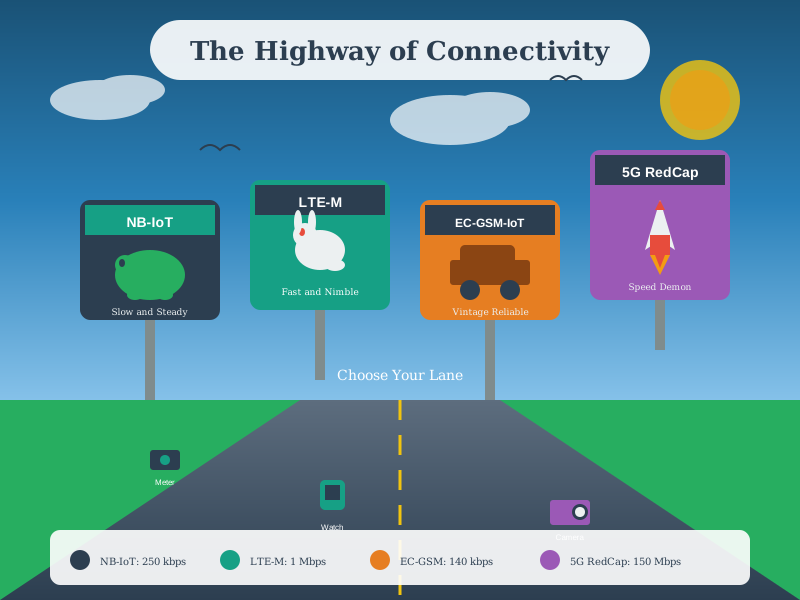
Table: GPRS Technology Summary
| Characteristic | Details |
|---|---|
| Name | General Packet Radio Services (GPRS) or 2.5G |
| Standard protocol is based on | A packet switching data transmission standard |
| Designed for | Mobile network and an extension to GSM (Global System for Mobile Communications) |
| Connection range | Kilometres (depends on terrain) |
| Data rate | 64-114 Kbps |
Table: LTE Technology Summary
| Characteristic | Details |
|---|---|
| Name | LTE |
| Standard protocol is based on | 3G cellular network system |
| Designed for | To increase the data rates available in 3G network technologies. Long Term Evolution (LTE) is designed as a series of 4G standards. LTE architecture eliminates the need for RNC (Radio Network Controller) and uses Evolved Node B (eNB) that adds control and management functionalities to each base station |
| Connection range | Kilometres (depends on terrain) |
| Data rate | 150Mbps (LTE-A with 1Gbps and LTE-A pro with 3Gbps) |
%%{init: {'theme': 'base', 'themeVariables': {'primaryColor':'#2C3E50','primaryTextColor':'#fff','primaryBorderColor':'#16A085','lineColor':'#16A085','secondaryColor':'#E67E22','tertiaryColor':'#ecf0f1','textColor':'#2C3E50','fontSize':'13px'}}}%%
sequenceDiagram
    participant DEV as Mobile IoT Device<br/>(LTE-M)
    participant T1 as Cell Tower 1<br/>(eNodeB-1)
    participant T2 as Cell Tower 2<br/>(eNodeB-2)
    participant CORE as Cellular Core<br/>(MME/SGW)

    Note over DEV,T1: Active Connection
    DEV->>T1: Data transmission<br/>(Tower 1 signal: -85 dBm)
    T1->>CORE: Forward data

    Note over DEV,T1: Device Moving<br/>Signal Weakening
    DEV->>T1: Measurement report<br/>(Tower 1: -95 dBm)<br/>(Tower 2: -90 dBm)
    T1->>CORE: Handover request

    Note over T1,T2: Handover Preparation
    CORE->>T2: Allocate resources
    T2->>CORE: Ready
    CORE->>T1: Handover command

    Note over DEV,T2: Seamless Switch<br/>(10-50 ms)
    T1->>DEV: Switch to Tower 2
    DEV->>T2: Synchronize
    T2->>CORE: Handover complete

    Note over DEV,T2: Connection Maintained<br/>No Data Loss
    DEV->>T2: Continue transmission<br/>(Tower 2: -88 dBm)
    T2->>CORE: Forward data
{fig-alt=“Sequence diagram showing LTE-M handover mechanism for mobile IoT devices. Device actively transmits data to Cell Tower 1 (eNodeB-1) at -85 dBm signal strength. As device moves, signal weakens to -95 dBm while Tower 2 reaches -90 dBm. Device sends measurement report triggering handover request to cellular core (MME/SGW). Core coordinates handover preparation by allocating resources on Tower 2, which confirms readiness. Seamless switch occurs in 10-50ms as Tower 1 commands device to switch, device synchronizes with Tower 2, and handover completes. Connection maintains continuity with no data loss as device continues transmission at -88 dBm on Tower 2. Demonstrates LTE-M full mobility support versus NB-IoT stationary operation.”}
1153.7 Summary
- Cellular IoT leverages existing cellular infrastructure (2G/3G/4G/5G) to provide wide-area connectivity without requiring dedicated gateway deployment
- Key benefits include nationwide/global coverage, zero infrastructure investment, and SIM-based security
- Technology evolution from 2G GPRS (legacy M2M) through LTE-M and NB-IoT to 5G provides migration path balancing legacy support with future-ready capabilities
- 2G/3G sunset requires migration to LTE-M, NB-IoT, or 5G for new deployments as carriers globally phase out legacy networks
- Cost-effectiveness depends on deployment scale and area—cellular often wins for distributed deployments over 100 devices across >5 km²
1153.8 What’s Next
Continue your cellular IoT learning journey:
- Deep comparison: Study NB-IoT vs LTE-M Comparison for detailed technology differences and selection criteria
- Power optimization: Explore Cellular IoT Power Optimization for PSM, eDRX, and signaling strategies
- Deployment planning: Learn Cellular IoT Deployment Planning for coverage analysis and carrier selection
- Global connectivity: Understand eSIM and Global Deployment for multi-carrier and international IoT
- Hands-on practice: Try the LTE-M Interactive Lab for practical experience