1127 NB-IoT Applications and Use Cases
Smart Metering, Asset Tracking, and Smart City Deployments
1127.1 Learning Objectives
By the end of this chapter, you will be able to:
- Design NB-IoT solutions: Select appropriate use cases for smart metering, asset tracking, and monitoring
- Calculate power budgets: Estimate battery life using PSM and eDRX power-saving modes
- Analyze link budgets: Determine coverage feasibility for different deployment scenarios
- Evaluate deployment costs: Compare NB-IoT with alternative technologies for specific applications
1127.2 Application Examples
1127.2.1 Smart Metering
Use case: Smart Water Meters
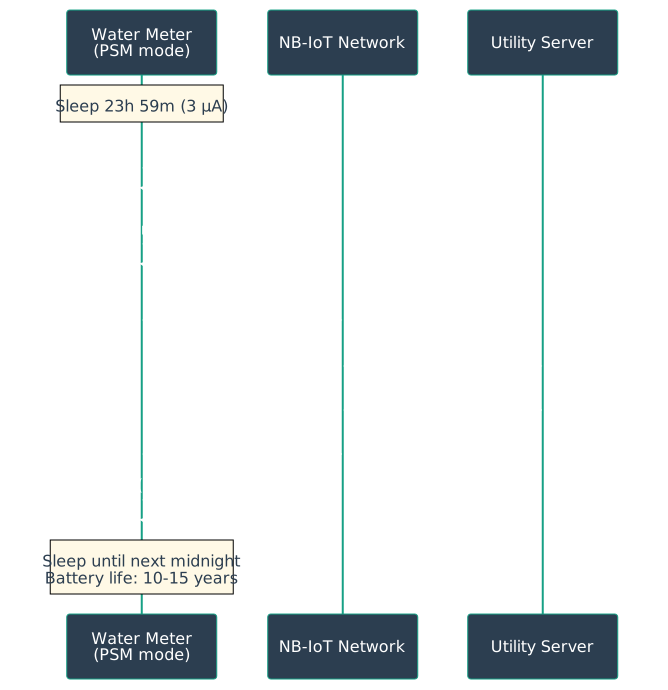
Configuration:
- Message frequency: 1 reading/day (meter value, diagnostics)
- Payload size: 50-100 bytes (meter reading, status, alarms)
- Power mode: PSM with T3412 = 24 hours
- Battery life: 10-15 years with 3.6V, 5 Ah battery
- Coverage: Deep basement penetration critical
Benefits over alternatives:
- No gateway deployment needed (100,000s of meters)
- Guaranteed delivery (utility billing critical)
- Deep penetration (meters often in basements)
- Mobility (some meters on mobile infrastructure)
1127.2.2 Asset Tracking
Use case: Container Tracking
Configuration:
- Stationary: PSM, 1 update/day (battery conservation)
- In-transit: eDRX, 1 update/4-6 hours (reachable for alerts)
- Payload: GPS coordinates (8 bytes) + status (4 bytes) + sensor data
- Battery: 3.6V, 10 Ah -> 3-5 years
NB-IoT advantages:
- Global roaming (operator agreements)
- Mobility support (handoff between cells)
- Higher data rate for bulk uploads
- Firmware updates over-the-air
1127.2.3 Smart City Applications
Use case: Smart Parking
Configuration:
- Event-driven: Send on occupancy change (empty <-> occupied)
- Heartbeat: Every 6 hours if no events (health check)
- Power mode: PSM between events, eDRX if downlink commands needed
- Payload: 10-20 bytes (status, battery, timestamp)
- Battery life: 5-10 years (depends on turnover rate)
Why NB-IoT:
- Existing cellular coverage (no gateway deployment in public spaces)
- Reliable delivery (real-time parking availability)
- Massive capacity (thousands of sensors per cell)
- Carrier-grade security (public infrastructure)
1127.3 Worked Example: Battery Life Calculation for Smart Meter
Scenario: A utility company is deploying NB-IoT smart water meters in residential basements. Each meter needs to send a 50-byte reading once per day and operate for 10+ years on a single 6000 mAh battery.
Given:
- Battery capacity: 6000 mAh (lithium thionyl chloride, 3.6V)
- Payload size: 50 bytes per transmission
- Transmission frequency: 1 message per day
- NB-IoT module specifications:
- Sleep current (PSM): 3 uA
- Active TX current: 220 mA
- Active RX current: 40 mA
- TX duration: 1.5 seconds (including network attach)
- RX duration: 0.5 seconds (ACK)
- Self-discharge rate: 1% per year
Step 1: Calculate daily active energy consumption
TX energy = 220 mA x 1.5 s = 330 mAs = 0.0917 mAh
RX energy = 40 mA x 0.5 s = 20 mAs = 0.0056 mAh
Active total per transmission = 0.0973 mAh
Step 2: Calculate daily sleep energy consumption
Sleep duration = 24 hours - 2 seconds = 23.9994 hours
Sleep energy = 3 uA x 23.9994 hours = 0.072 mAh
Step 3: Calculate total daily energy and theoretical battery life
Daily consumption = 0.0973 mAh + 0.072 mAh = 0.1693 mAh
Theoretical life = 6000 mAh / 0.1693 mAh/day = 35,440 days = 97 years
Step 4: Apply real-world derating factors
Battery self-discharge: 1%/year over 15 years = 15% loss
Temperature derating (basement, 10-20C): 5% capacity reduction
End-of-life threshold (3.0V cutoff): 10% unusable capacity
Effective capacity = 6000 x 0.85 x 0.95 x 0.90 = 4,373 mAh

Practical life = 4,373 mAh / 0.1693 mAh/day = 25,830 days = 70.7 years
Step 5: Account for coverage enhancement repetitions
Basement installation may require CE Mode B (up to 2048 repetitions)
Worst-case TX duration: 1.5s x 4 (repetitions) = 6 seconds
Revised TX energy = 220 mA x 6 s = 0.367 mAh
Revised daily = 0.367 + 0.0056 + 0.072 = 0.445 mAh
Practical life with CE = 4,373 / 0.445 = 9,826 days = 26.9 yearsResult: Even with coverage enhancement for deep basement penetration, the meter achieves 26+ year theoretical battery life, well exceeding the 10-year requirement.
Key insight: PSM (Power Saving Mode) is the critical enabler - without it, sleep current of 15-50 mA would reduce battery life to weeks. The 3 uA PSM sleep current represents a 5000x reduction in idle power consumption.
1127.4 Worked Example: Link Budget for Underground Parking Sensor
Scenario: A smart city wants to deploy occupancy sensors in an underground parking garage (2 levels below ground). Will NB-IoT provide reliable coverage?
Given:
- Base station EIRP: 43 dBm (20W)
- Frequency: 850 MHz (Band 5)
- Distance to base station: 1.5 km
- Penetration losses: Ground level concrete (15 dB), each underground level (12 dB)
- NB-IoT device sensitivity: -141 dBm (CE Mode B)
- Required link margin: 10 dB
Step 1: Calculate free space path loss (FSPL)
FSPL = 20 log10(d) + 20 log10(f) + 32.45
FSPL = 20 log10(1.5 km) + 20 log10(850 MHz) + 32.45
FSPL = 3.52 + 58.59 + 32.45 = 94.56 dB
Step 2: Add building and underground penetration losses
Ground floor penetration: 15 dB
Underground Level 1: 12 dB
Underground Level 2: 12 dB
Total penetration loss = 15 + 12 + 12 = 39 dB
Step 3: Calculate total path loss
Total path loss = FSPL + penetration + shadow fading
Total path loss = 94.56 + 39 + 8 (urban shadow fading)
Total path loss = 141.56 dB
Step 4: Determine received signal strength
RSSI = EIRP - Path Loss + Antenna Gain
RSSI = 43 dBm - 141.56 dB + 0 dBi (sensor antenna)
RSSI = -98.56 dBm
Step 5: Compare to sensitivity and calculate margin
NB-IoT sensitivity (CE Mode B): -141 dBm
Link margin = Sensitivity - RSSI = -141 - (-98.56) = 42.44 dB
Required margin: 10 dB
Available margin: 42.44 dB > 10 dB (Sufficient)Result: NB-IoT provides 42 dB of link margin for the underground parking sensor, well above the 10 dB requirement.
Key insight: NB-IoT’s 164 dB Maximum Coupling Loss (MCL) specification - achieved through repetition coding and narrow bandwidth - provides 20 dB more coverage than standard LTE.
1127.5 Worked Example: Coverage Enhancement Repetitions
Scenario: A building management system deploys environmental sensors inside elevator shafts and mechanical rooms. These locations have severe RF attenuation. How many NB-IoT repetitions are required?
Given:
- Base station EIRP: 46 dBm (typical macro cell)
- Frequency: 700 MHz (Band 28)
- Distance to base station: 800 meters
- Building penetration losses:
- Exterior wall: 15 dB
- Interior concrete walls (2): 10 dB each
- Elevator shaft steel: 25 dB
- NB-IoT module sensitivity (no repetitions): -124 dBm
- Target reliability: 99.9%
- Required link margin: 8 dB
Step 1: Calculate path loss to elevator shaft
Free-space path loss (800m at 700 MHz):
FSPL = 20 x log10(0.8) + 20 x log10(700) + 32.45
FSPL = -1.94 + 56.9 + 32.45 = 87.4 dB

Building penetration:
- Exterior wall: 15 dB
- Interior walls (2x10): 20 dB
- Elevator shaft steel: 25 dB
- Total penetration: 60 dB

Total path loss = 87.4 + 60 = 147.4 dB
Step 2: Calculate repetitions needed
NB-IoT repetition gain:
| Repetitions | Processing Gain | Effective Sensitivity |
|---|---|---|
| 1 (none) | 0 dB | -124 dBm |
| 2 | 3 dB | -127 dBm |
| 4 | 6 dB | -130 dBm |
| 8 | 9 dB | -133 dBm |
| 16 | 12 dB | -136 dBm |
| 32 | 15 dB | -139 dBm |
| 64 | 18 dB | -142 dBm |
| 128 | 21 dB | -145 dBm |
| 256 | 24 dB | -148 dBm |
Step 3: Analyze worst-case scenario
Add worst-case factors:
- Body absorption (technician nearby): 3 dB
- Electrical interference: 5 dB
- Shadow fading (99.9% reliability): 10 dB
Total additional margin needed: 18 dB

For extreme environments, maximum 2048 repetitions -> +33 dB gainResult: For extreme deep indoor deployments, NB-IoT Coverage Enhancement Mode B with maximum repetitions provides connectivity but at cost: 20-minute transmission time and reduced battery life.
Key Insight: NB-IoT’s 164 dB MCL is achieved through repetition coding, but each 3 dB of coverage extension doubles transmission time. For extreme environments (>150 dB path loss), consider in-building DAS or femtocell deployment.
1127.6 Real-World Case Study: Municipal Water Utility
The Challenge: A mid-sized city wants to modernize water metering to detect leaks, eliminate manual meter reading, and enable time-of-use billing.
The NB-IoT Solution:
Hardware per meter:
- NB-IoT module: $8
- Battery (AA lithium): $3
- Installation: $15
- Total per meter: $26
Data transmission pattern:
- Daily consumption report: 200 bytes/day
- Leak alert (if triggered): 150 bytes
- Monthly billing data: 500 bytes
- Average: 6.4 KB/month per meter
Annual operational costs (50,000 meters):
| Cost Component | Per Meter | 50,000 Meters |
|---|---|---|
| Cellular data plan | $2.00/year | $100,000 |
| Network maintenance | $0.50/year | $25,000 |
| Battery replacement (year 12) | $0.25/year amortized | $12,500 |
| Total Annual | $2.75 | $137,500 |
Comparison to manual reading:
| Method | Annual Cost | Notes |
|---|---|---|
| Manual meter reading | $600,000 | $1/read x 12 months x 50,000 |
| NB-IoT automated | $137,500 | Cellular + maintenance |
| Annual Savings | $462,500 | 77% reduction |
Results after 3 years:
- Leak detection: Identified 847 leaks, saving 42 million gallons/year
- Billing accuracy: Reduced disputed bills by 94%
- Operational savings: $1.4 million over 3 years
- No cellular outages: 99.7% uptime (carrier SLA: 99.5%)
- Zero battery failures (ongoing monitoring confirms 12+ year projection)
Key insight: The payback period was 4.2 months. After that, the city saves $462k annually compared to manual reading.
1127.7 Knowledge Check
Question: A smart city deploys 50,000 smart water meters across urban and suburban areas. The meters are installed in basements, underground utility vaults, and building interiors. They need to send 50-byte readings once daily and must operate for 10+ years on battery. Which LPWAN technology is MOST suitable?
Explanation: NB-IoT is optimal for this smart metering deployment:
Why NB-IoT wins:
- Coverage: 164 dB MCL (vs LoRaWAN 157 dB) - critical for basements
- Infrastructure: Zero gateway deployment (uses existing cell towers)
- Reliability: Carrier SLA for billing-grade data
- Scale: Handles 50,000+ devices without custom infrastructure
Why not others:
- LoRaWAN: Would need ~500 gateways for city coverage, basement penetration gaps
- Sigfox: 12-byte payload limit (50 bytes would need multiple messages)
- LTE-M: Overkill for 50-byte daily readings, higher power consumption
1127.8 Summary
- Smart metering is ideal for NB-IoT: daily readings, basement coverage, 10+ year battery life, no gateway infrastructure
- Asset tracking benefits from NB-IoT’s mobility support and global roaming agreements
- Smart city applications (parking, lighting) leverage existing cellular coverage and carrier-grade reliability
- Battery life calculations must account for PSM sleep current, TX duration, CE repetitions, and battery derating
- Link budget analysis confirms NB-IoT’s +20 dB coverage advantage for deep indoor deployments
1127.9 What’s Next
Continue your NB-IoT learning journey with these related topics:
- NB-IoT Power Optimization - Master PSM and eDRX configuration for maximum battery life
- NB-IoT Practical Guide - Learn from common mistakes and real-world deployment pitfalls
- NB-IoT Lab Simulation - Hands-on ESP32 simulation of NB-IoT concepts