%%{init: {'theme': 'base', 'themeVariables': { 'primaryColor': '#2C3E50', 'primaryTextColor': '#fff', 'primaryBorderColor': '#16A085', 'lineColor': '#E67E22', 'secondaryColor': '#16A085', 'tertiaryColor': '#E67E22', 'fontSize': '11px'}}}%%
graph LR
    subgraph TLS["TLS 1.3 (over TCP)<br/>1-RTT Handshake"]
        direction TB
        T1["ClientHello<br/>+ KeyShare"] --> T2["ServerHello<br/>+ KeyShare<br/>+ Encrypted Extensions<br/>+ Certificate<br/>+ Finished"]
        T2 --> T3["Client Finished<br/>+ Application Data"]
        T3 --> T4["Secure Channel<br/>Total: ~100ms"]
    end

    subgraph DTLS["DTLS 1.2 (over UDP)<br/>3-RTT Handshake"]
        direction TB
        D1["ClientHello"] --> D2["HelloVerifyRequest<br/>Cookie"]
        D2 --> D3["ClientHello<br/>+ Cookie"]
        D3 --> D4["ServerHello<br/>+ Certificate<br/>+ ServerKeyExchange"]
        D4 --> D5["ClientKeyExchange<br/>+ ChangeCipherSpec<br/>+ Finished"]
        D5 --> D6["ChangeCipherSpec<br/>+ Finished"]
        D6 --> D7["Secure Channel<br/>Total: ~250ms"]
    end

    WHY["Why Extra Steps?<br/>----------------<br/>DoS Protection<br/>Cookie validates<br/>client IP address<br/>----------------<br/>Packet Loss<br/>UDP may drop<br/>handshake msgs<br/>----------------<br/>Sequencing<br/>No TCP ordering<br/>explicit seq#"]

    TLS -.->|"TCP guarantees<br/>delivery"| WHY
    DTLS -.->|"UDP needs<br/>extra protection"| WHY

    style TLS fill:#16A085,stroke:#2C3E50,color:#fff
    style DTLS fill:#E67E22,stroke:#2C3E50,color:#fff
    style WHY fill:#2C3E50,stroke:#16A085,color:#fff
748 DTLS Handshake Protocols
748.1 Learning Objectives
By the end of this chapter, you will be able to:
- Analyze DTLS 1.2 Handshake: Trace the complete handshake including HelloVerifyRequest for DoS protection
- Compare DTLS Versions: Understand improvements from DTLS 1.2 to DTLS 1.3
- Understand TLS 1.3: Explain how TLS 1.3’s 1-RTT handshake influenced DTLS 1.3
- Evaluate Session Resumption: Analyze 0-RTT resumption benefits and security trade-offs
TipMVU: Minimum Viable Understanding
Core concept: DTLS handshakes establish encrypted sessions over UDP, with the cookie mechanism preventing DoS amplification attacks that plague UDP-based protocols.
Why it matters: The handshake is the most expensive part of DTLS - understanding it helps you optimize battery life and connection latency.
Key takeaway: DTLS 1.3 reduces handshake from 3-RTT to 2-RTT (or 1-RTT for resumption), providing 50% faster connection establishment compared to DTLS 1.2.
748.2 Prerequisites
Before diving into this chapter, you should be familiar with:
- DTLS Fundamentals and Architecture: Understanding why DTLS exists and its basic properties
- Transport Fundamentals: Knowledge of TCP vs UDP transport characteristics
748.3 DTLS 1.2 Handshake
NoteAlternative View: TLS vs DTLS Handshake Comparison
This variant shows the same handshake concept through a side-by-side comparison - useful for understanding why DTLS requires extra round trips and how the cookie mechanism adds overhead for DoS protection.
{fig-alt=“Comparison diagram showing TLS 1.3 with 1-RTT handshake taking ~100ms versus DTLS 1.2 with 3-RTT handshake taking ~250ms. TLS 1.3 sends ClientHello with KeyShare, receives ServerHello bundle, completes with Finished. DTLS 1.2 adds HelloVerifyRequest cookie exchange step for DoS protection because UDP cannot rely on TCP’s delivery guarantees. Center box explains three reasons for extra overhead: DoS protection via cookie validation, packet loss handling since UDP may drop handshake messages, and explicit sequence numbers since TCP ordering not available.”}
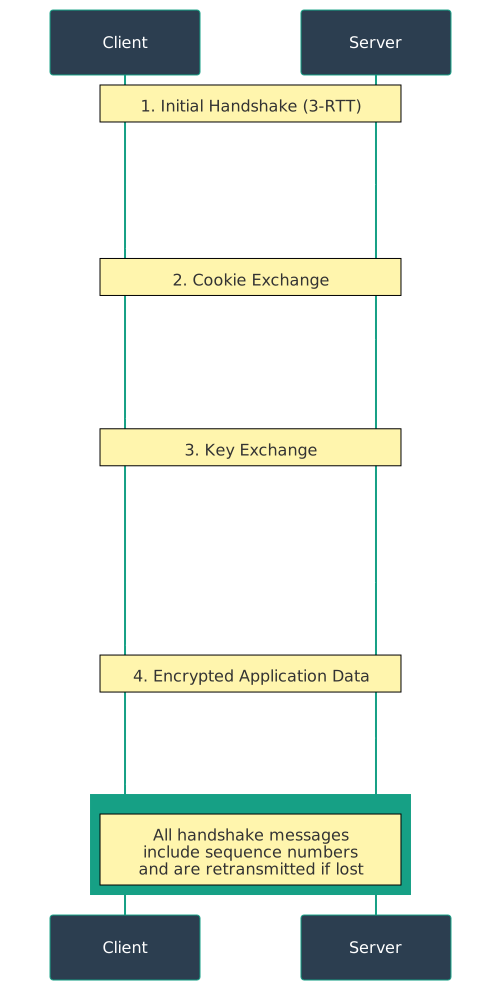
748.3.1 DTLS 1.2 Handshake Steps
DTLS Handshake Steps:
- ClientHello: Client proposes cipher suites
- HelloVerifyRequest: Server sends cookie (DoS protection)
- ClientHello (with cookie): Client proves legitimacy
- Server responds: Certificate, key exchange parameters
- Client key exchange: Client sends key material
- Finished messages: Both sides confirm (encrypted)
- Secure communication: Application data flows encrypted
Overhead: 6-10 round trips (vs 1.5-2 for TLS over TCP)
Why more overhead? - Unreliable transport: Must handle lost handshake packets - Retransmission: DTLS retransmits handshake messages - Cookie mechanism: Extra round trip for DoS protection
748.4 DTLS 1.2 vs DTLS 1.3
DTLS 1.3 (RFC 9147, 2022) improves upon DTLS 1.2:
| Feature | DTLS 1.2 | DTLS 1.3 |
|---|---|---|
| Handshake Latency | 2 round trips | 1 round trip (1-RTT) |
| Cipher Suites | Many (some weak) | Only AEAD (authenticated encryption) |
| Perfect Forward Secrecy | Optional (ECDHE) | Mandatory |
| 0-RTT Resumption | No | Yes (risky, opt-in) |
| Legacy Crypto | RSA, CBC, RC4 | Removed (only modern ciphers) |
| Complexity | Higher | Lower (simplified) |
748.4.1 DTLS 1.3 Handshake (1-RTT)
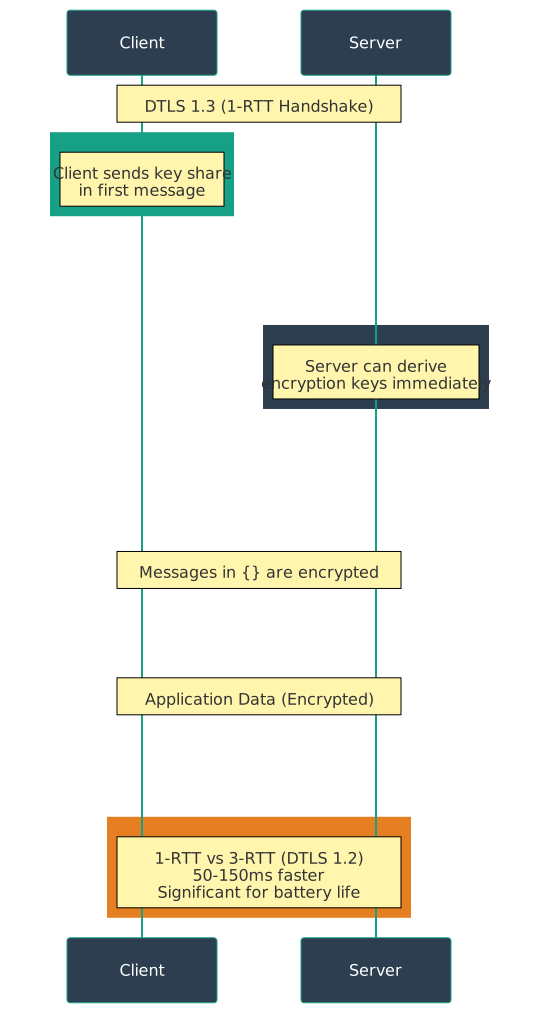
Benefit: DTLS 1.3 shaves off 100-200ms from handshake (critical for mobile IoT).
748.5 TLS 1.3 Handshake: Step-by-Step
TLS 1.3 reduced the handshake from 2 round-trips to 1 (or 0 for resumption). Understanding the TLS 1.3 handshake is essential because DTLS 1.3 follows the same security model.
748.5.1 Full Handshake (1-RTT)
%%{init: {'theme': 'base', 'themeVariables': { 'primaryColor': '#2C3E50', 'primaryTextColor': '#fff', 'primaryBorderColor': '#16A085', 'lineColor': '#E67E22', 'secondaryColor': '#16A085', 'tertiaryColor': '#E67E22'}}}%%
sequenceDiagram
    participant C as Client
    participant S as Server

    Note over C,S: Step 1: ClientHello
    C->>S: ClientHello + KeyShare + Supported Ciphers

    Note over C,S: Step 2: ServerHello
    S->>C: ServerHello + KeyShare + Certificate + Finished

    Note over C,S: Step 3: Client Finished
    C->>S: Finished + [Application Data]

    Note over C,S: Encrypted Communication
    C->>S: Application Data (encrypted)
    S->>C: Application Data (encrypted)
748.5.2 What Happens at Each Step
| Step | Client Action | Server Action | Security Achieved |
|---|---|---|---|
| 1 | Generate ephemeral key pair, send public | - | Forward secrecy initiated |
| 2 | - | Verify client, send cert + key | Server authenticated |
| 3 | Verify server cert, derive session key | Derive session key | Mutual key agreement |
| 4+ | Encrypt with session key | Encrypt with session key | Confidentiality + integrity |
Step-by-Step Breakdown:
- ClientHello (Step 1):
- Client generates ephemeral ECDHE key pair
- Sends public key in
key_shareextension - Lists supported cipher suites (e.g., TLS_AES_256_GCM_SHA384)
- Includes random nonce for freshness
- ServerHello (Step 2):
- Server selects cipher suite
- Generates its own ephemeral key pair
- Derives handshake keys from ECDHE shared secret
- Sends Certificate (encrypted with handshake keys)
- Sends CertificateVerify (signature proving possession of private key)
- Sends Finished (MAC over entire handshake transcript)
- Client Finished (Step 3):
- Client verifies server certificate chain
- Verifies CertificateVerify signature
- Derives session keys
- Sends Finished message
- Can immediately send application data!
- Encrypted Data (Step 4+):
- All subsequent data encrypted with AEAD cipher
- Sequence numbers prevent replay
- Session keys provide forward secrecy
748.5.3 0-RTT Resumption (Pre-Shared Key)
When clients have previously connected and cached session data, they can resume with zero round-trip latency:
%%{init: {'theme': 'base', 'themeVariables': { 'primaryColor': '#2C3E50', 'primaryTextColor': '#fff', 'primaryBorderColor': '#16A085', 'lineColor': '#E67E22', 'secondaryColor': '#16A085', 'tertiaryColor': '#E67E22'}}}%%
sequenceDiagram
    participant C as Client
    participant S as Server

    rect rgb(22, 160, 133)
        Note over C: Client has cached<br/>session ticket (PSK)
    end

    C->>S: ClientHello + PSK + Early Data
    S->>C: ServerHello + Finished

    rect rgb(230, 126, 34)
        Note over C,S: Application data sent<br/>in first message!
    end
0-RTT Benefits: - Latency: Application data sent immediately (no waiting for handshake) - Battery: Fewer packets = less radio-on time - User experience: Faster page loads, quicker sensor responses
Warning0-RTT Security Warning
0-RTT is vulnerable to replay attacks. An attacker can capture the first message and retransmit it, causing the server to process the early data multiple times.
Safe for: - GET requests (idempotent) - Cache lookups - Read-only queries
NOT safe for: - POST/PUT requests - Database writes - Financial transactions - IoT actuator commands (door unlock, motor start)
Mitigation: Servers should mark 0-RTT data as potentially replayed and only process idempotent operations.
748.5.4 TLS 1.3 vs TLS 1.2 Handshake Comparison
%%{init: {'theme': 'base', 'themeVariables': { 'primaryColor': '#2C3E50', 'primaryTextColor': '#fff', 'primaryBorderColor': '#16A085', 'lineColor': '#E67E22', 'secondaryColor': '#16A085', 'tertiaryColor': '#E67E22'}}}%%
flowchart TB
    subgraph TLS12["TLS 1.2 (2-RTT)"]
        A1[ClientHello] --> B1[ServerHello]
        B1 --> C1[Certificate]
        C1 --> D1[ServerKeyExchange]
        D1 --> E1[ServerHelloDone]
        E1 --> F1[ClientKeyExchange]
        F1 --> G1[ChangeCipherSpec]
        G1 --> H1[Finished]
        H1 --> I1[Encrypted Data]
    end

    subgraph TLS13["TLS 1.3 (1-RTT)"]
        A2[ClientHello + KeyShare] --> B2[ServerHello + KeyShare]
        B2 --> C2[Certificate + Finished]
        C2 --> D2[Client Finished]
        D2 --> E2[Encrypted Data]
    end

    TLS12 --> Decision{IoT Device?}
    TLS13 --> Decision
    Decision -->|Yes| Recommend["Prefer TLS 1.3<br/>50% less latency<br/>Mandatory forward secrecy"]

    style A1 fill:#2C3E50,color:#fff
    style A2 fill:#16A085,color:#fff
    style Recommend fill:#E67E22,color:#fff
| Feature | TLS 1.2 | TLS 1.3 |
|---|---|---|
| Round Trips | 2-RTT | 1-RTT (or 0-RTT resumption) |
| Messages | 9+ messages | 3-4 messages |
| Forward Secrecy | Optional (DHE/ECDHE) | Mandatory |
| Cipher Suites | 300+ (many weak) | 5 (all AEAD) |
| RSA Key Exchange | Allowed | Removed |
| CBC Mode | Allowed | Removed |
| Compression | Allowed | Removed (CRIME attack) |
IoT Recommendation: Always use TLS 1.3 (or DTLS 1.3) when available for: - 50% faster handshake (critical for battery life) - Mandatory forward secrecy (protects past sessions if key compromised) - Simplified cipher suite selection (fewer configuration errors)
748.6 Summary
DTLS 1.2 Handshake: - 3-RTT with cookie mechanism for DoS protection - 6-10 messages total - ~250ms on typical networks
DTLS 1.3 Improvements: - 1-RTT handshake (2-RTT with cookie) - Mandatory forward secrecy - AEAD-only ciphers (no weak options) - 0-RTT resumption available (use cautiously)
TLS 1.3 Influence: - DTLS 1.3 mirrors TLS 1.3 security model - Same cipher suites, same key exchange - Adapted for UDP’s unreliability
Battery Impact: - DTLS 1.3 saves 100-200ms per connection - Session resumption reduces overhead by 60% - Critical for battery-powered IoT devices
748.7 What’s Next?
Continue to DTLS Attack Scenarios and Authentication to learn about common attacks against DTLS, defense mechanisms, and how to choose between PSK and certificate-based authentication for your IoT deployment.