363 WSN Common Mistakes and Pitfalls
363.1 Common Mistakes and Pitfalls
Understanding common mistakes in WSN design can save months of troubleshooting and thousands of dollars in deployment costs. Here are the most critical pitfalls and how to avoid them:
The Mistake: Developers choose Wi-Fi (802.11) for WSN deployments because “it’s familiar” and “connects to the internet easily.”
Why It Fails: - Wi-Fi radios consume 200-500 mW transmitting vs. Zigbee’s 10-30 mW (15-50× more power) - Wi-Fi idle listening: 100 mW vs. Zigbee sleep: 0.001 mW (100,000× difference!) - Battery life: Wi-Fi sensors last 2-4 weeks; Zigbee sensors last 2-5 years on the same battery
Real Example: A smart building deployed 200 Wi-Fi temperature sensors. After 3 weeks, batteries started dying. Annual battery replacement cost: $24,000 (200 sensors × $120 labor/replacement × 12 months/3 weeks).
The Fix: - Use Zigbee, Thread, or LoRaWAN for battery-powered sensors (years of battery life) - Reserve Wi-Fi for mains-powered devices (cameras, displays, gateways) - If Wi-Fi is mandatory, use sensors with PoE (Power over Ethernet) or solar panels
Decision Rule: - Battery-powered + multi-year lifetime → Zigbee, Thread, LoRaWAN - Mains-powered + high bandwidth → Wi-Fi - Battery + remote location + low data rate → LoRaWAN
The Mistake: Deploying WSN in a star or multi-hop topology without considering that nodes near the gateway drain batteries 5-10× faster than edge nodes due to relaying traffic.
Why It Fails: - Edge sensor (far from gateway): Transmits only its own data (1 packet/minute) - Intermediate sensor (near gateway): Relays own data + forwards packets from 5-10 other sensors (10 packets/minute) - Relay sensor battery life: 6 months vs. edge sensor’s 3 years - Network failure: When hotspot nodes die, entire network partitions (edge sensors can’t reach gateway)
Real Example: Agricultural WSN with 100 soil sensors in linear rows. Sensors closest to gateway died after 4 months, disconnecting 60 downstream sensors. Farmer lost $15,000 in crop yield due to undetected irrigation failure.
The Fix: 1. Solar-powered cluster heads: Deploy solar/mains-powered relay nodes near gateway to handle hotspot traffic 2. Rotate cluster heads: Protocols like LEACH periodically rotate which nodes serve as relays, balancing energy 3. Energy-aware routing: Route traffic around low-battery nodes to prevent critical failures 4. Plan for replacement: Budget for replacing hotspot batteries 3-5× more frequently than edge nodes
Design Checklist: - [ ] Identified nodes within 2 hops of gateway (hotspot zone) - [ ] Hotspot nodes have solar/mains power OR planned 2-3× battery replacement frequency - [ ] Routing protocol includes energy awareness (e.g., LEACH, not fixed shortest-path) - [ ] Battery monitoring enabled for predictive maintenance alerts
The Mistake: “We need to cover 100 hectares, sensors have 50m range, so we need (100,000 m² / 2,500 m²) = 40 sensors.” This calculation assumes coverage, but ignores connectivity.
Why It Fails: - Coverage: Sensor detects events within its sensing radius (e.g., 10m for temperature) - Connectivity: Sensor can communicate with other sensors within radio range (e.g., 50m for Zigbee) - Reality: Walls, vegetation, terrain, interference reduce radio range by 30-70% - Mesh requirement: Each sensor needs 2-3 neighbors for redundant multi-hop paths
Real Example: Vineyard deployed 50 sensors for 500-hectare coverage (one per 10 hectares) based on LoRa’s “5 km range.” Reality: hills and dense foliage reduced range to 300m. Result: 23 isolated sensors couldn’t reach gateway, requiring 120 additional sensors ($18,000 extra cost).
The Fix: 1. Coverage vs. Connectivity: Calculate density for BOTH requirements, use the higher number 2. Plan for obstacles: Reduce advertised radio range by 50% for indoor/obstructed environments 3. Pilot first: Deploy 5-10 sensors, measure actual range before bulk purchase 4. Redundancy budget: Add 20% extra sensors for mesh connectivity + future failures
Density Formula:
Required Sensors = max(Coverage_Need, Connectivity_Need) × Obstacle_Factor × Redundancy_Factor

Coverage_Need = Monitored_Area / Sensor_Coverage_Area
Connectivity_Need = Monitored_Area / (0.25 × Radio_Range²) [ensures 2+ neighbors]
Obstacle_Factor = 1.5 (indoor), 1.3 (outdoor vegetation), 1.0 (open field)
Redundancy_Factor = 1.2 (20% spares for mesh + failures)
Example: - 100 hectares (1,000,000 m²) - Sensor coverage: 10m radius = 314 m² - Radio range: 100m (outdoor with trees) - Coverage need: 1,000,000 / 314 = 3,185 sensors (too dense!) - Connectivity need: 1,000,000 / (0.25 × 100²) = 400 sensors - With factors: 400 × 1.3 (trees) × 1.2 (redundancy) = 624 sensors
Lesson: Connectivity usually determines density for long-range radios; coverage determines density for short-range radios.
The Mistake: “The datasheet says 3-year battery life, so we’ll replace all batteries in 3 years.”
Why It Fails: - Environmental variation: Temperature extremes, radio interference, and traffic patterns cause 3-10× variation in battery drain - Hotspot effect: Nodes near gateway drain faster (see Mistake #2) - Cascade failures: When one critical node dies, network partitions; 50+ sensors become unreachable - Reactive maintenance: Discovering failures during critical events (e.g., fire season, harvest time) is too late
Real Example: Forest fire detection network with 500 sensors. No battery monitoring. After 2 years, 47 sensors failed silently, creating 3 large coverage gaps. A fire started in a gap and burned 2,000 acres before detection ($4M damage). Post-incident audit showed batteries failed 6-18 months earlier than expected due to extreme heat and high relay traffic.
The Fix: 1. Include battery voltage in sensor telemetry: Add 2 bytes to each packet reporting remaining capacity 2. Cloud dashboard with alerts: Visualize battery levels across network, alert when <20% remains 3. Predictive replacement: Replace batteries when monitoring shows <15% (proactive) vs. waiting for failures (reactive) 4. Staged deployment: Plan initial battery replacement at 60% of expected lifetime, then adjust based on observed data
Implementation Checklist: - [ ] Sensor firmware includes battery ADC reading in every transmission - [ ] Cloud/gateway tracks battery history per node (detect degradation trends) - [ ] Alert thresholds: Warning at 30%, Critical at 15% - [ ] Maintenance routing: Generate lists of sensors needing replacement by geographic zone - [ ] Replacement budget: Plan for 20-30% variance in actual vs. expected battery life
Battery Monitoring Dashboard Example:
Sensor ID | Battery % | Last Reading | Days to Failure | Action Needed
----------------------------------------------------------------------
S045      | 12%       | 2 days ago   | 18 days        | REPLACE NOW
S103      | 18%       | 1 day ago    | 45 days        | Schedule maintenance
S271      | 67%       | 4 hours ago  | 487 days       | OK
S099 | -- | 14 days ago | OFFLINE | INVESTIGATEThe Mistake: Sending high-frequency, high-precision sensor data because “more data is better” without considering energy cost.
Why It Fails: - Transmission dominates energy: Sending 1 byte costs same as 10,000 CPU cycles - Diminishing returns: Temperature every 10 seconds vs. every 10 minutes rarely improves decisions - Battery waste: Transmitting 32-bit floats (4 bytes) vs. 16-bit integers (2 bytes) doubles radio time
Real Example: Smart agriculture WSN transmitted soil moisture every 30 seconds as 4-byte float (0.000-1.000). Battery life: 4 months. After optimization: (1) Sample every 10 minutes (20× reduction), (2) Transmit 1-byte percentage (0-100), (3) Only transmit on >5% change (event-driven). New battery life: 3.2 years (9.6× improvement).
The Fix: 1. Match sampling rate to application: How quickly do conditions change? How fast must you respond? - Temperature: Every 5-15 minutes (thermal mass → slow changes) - Motion detection: Event-driven (transmit only when triggered) - Vibration: 100+ Hz (requires different approach - edge processing) 2. Compress data: Use integers instead of floats (temperature × 10 = 16-bit int, accurate to 0.1°C) 3. Event-driven transmission: Only transmit when value changes >threshold (reduces 90% of transmissions) 4. Data aggregation: Cluster heads combine 5-10 sensor readings into single packet
Energy Calculation:
Scenario: 100 sensors, 3-year target lifetime

Option A: Transmit every 30 seconds, 4-byte float
- Transmissions per sensor: (3 years × 365 days × 24 hours × 3600 seconds / 30) = 3,153,600
- Energy per transmission: 20 mA × 5 ms = 0.028 mAh
- Total energy: 3,153,600 × 0.028 mAh = 88,300 mAh (requires 44× AA batteries!)

Option B: Transmit every 10 minutes on >5% change, 1-byte int, 50% reduction from event filtering
- Transmissions per sensor: (3 years × 365 days × 144 samples/day × 0.5 filter) = 78,840
- Energy per transmission: 20 mA × 3 ms = 0.017 mAh
- Total energy: 78,840 × 0.017 mAh = 1,340 mAh (single 2,000 mAh battery, 33% remaining!)
Optimization Checklist: - [ ] Determined minimum sampling rate for application requirements - [ ] Calculated energy budget (battery capacity / expected lifetime / sensors) - [ ] Implemented event-driven transmission (only transmit on significant change) - [ ] Used smallest data type that meets precision needs (1-2 bytes, not 4-8 bytes) - [ ] Considered local aggregation (1 aggregated packet per 5-10 sensors)
| Mistake | Impact | Quick Fix |
|---|---|---|
| Using Wi-Fi for battery sensors | Battery life: weeks vs. years | Use Zigbee/Thread/LoRaWAN instead |
| Ignoring hotspot problem | Critical nodes fail 5-10× faster | Solar cluster heads + energy-aware routing |
| Underestimating density | Network partitions, coverage gaps | Calculate for connectivity + 50% obstacle factor |
| No battery monitoring | Surprise failures, cascade network loss | Include battery % in telemetry + dashboard alerts |
| Over-engineering data rates | Battery drain 5-10× faster than needed | Event-driven transmission + data compression |
Design Philosophy: WSN success requires obsessive energy conservation. Every design decision—protocol choice, sampling rate, data format, topology—must answer: “How does this affect battery life?” If your deployment requires battery replacement more than once every 2 years per sensor, revisit these mistakes.
363.2 Conclusion
Wireless Sensor Networks form a critical foundation for IoT systems, providing distributed sensing capabilities with autonomous operation and wireless communication. Understanding the characteristics of sensor nodes—including their hardware components, resource constraints, and operational capabilities—is essential for designing effective WSN-based solutions.
The relationship between WSNs and IoT is symbiotic: WSNs provide proven architectures and protocols for resource-constrained sensing, while IoT frameworks offer cloud integration, scalability, and rich application ecosystems. Modern deployments increasingly blend these approaches, using WSN principles for efficient edge sensing while leveraging IoT infrastructure for data management and user interfaces.
Energy management remains the paramount challenge in WSN design, with radio duty cycling serving as one of the most effective conservation techniques. By carefully balancing energy consumption, latency, reliability, and throughput through intelligent duty cycling strategies, WSNs can achieve operational lifetimes spanning months to years on battery power.
As WSN technology continues to evolve with advances in ultra-low-power electronics, energy harvesting, and wireless protocols, these networks will remain indispensable components of the IoT landscape, enabling pervasive sensing across environmental monitoring, industrial control, smart cities, healthcare, and countless other applications.
This chapter introduced Wireless Sensor Networks (WSNs), a foundational IoT architecture for distributed environmental monitoring and tracking applications.
WSN Fundamentals: WSNs consist of numerous small, autonomous sensor nodes deployed in monitored environments to cooperatively gather data. Unlike traditional networks prioritizing performance and QoS, WSNs optimize for energy efficiency and longevity. Nodes typically operate on batteries for months or years without replacement, requiring careful power management at every protocol layer. The distributed, self-organizing nature enables monitoring in challenging environments where infrastructure deployment is impractical.
Network Design Considerations: We examined critical design factors including topology selection (star, mesh, cluster, hybrid), routing protocols, MAC layer coordination, and data aggregation strategies. Topology choice impacts energy consumption, latency, robustness, and scalability. In-network aggregation reduces transmitted data volume by combining sensor readings at intermediate nodes, significantly extending network lifetime while extracting meaningful patterns from raw data.
Applications and Challenges: WSNs enable applications spanning environmental monitoring, industrial sensing, precision agriculture, structural health monitoring, and wildlife tracking. However, resource constraints create challenges: limited processing power restricts on-node computation, battery capacity limits network lifetime, memory constraints affect data buffering, and wireless bandwidth limits data rates. Designers must carefully balance these competing requirements.
Understanding WSN principles provides the foundation for subsequent chapters examining specific WSN capabilities like tracking, coverage, mobility, and routing protocols.
363.3 Visual Reference Gallery
Explore these AI-generated visualizations that complement the wireless sensor network concepts covered in this chapter. Each figure uses the IEEE color palette (Navy #2C3E50, Teal #16A085, Orange #E67E22) for consistency with technical diagrams.
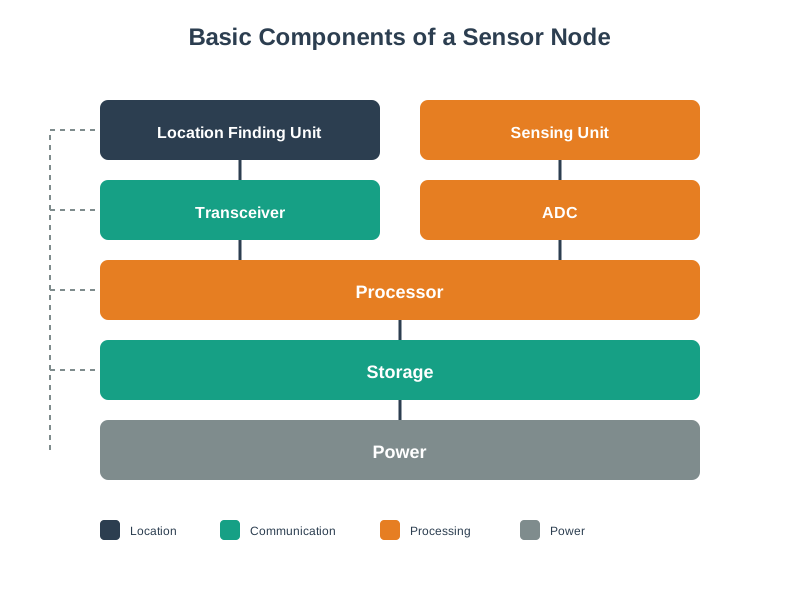
This visualization illustrates the fundamental sensor node architecture introduced in this chapter, showing how the sensing, processing, communication, and power subsystems work together.
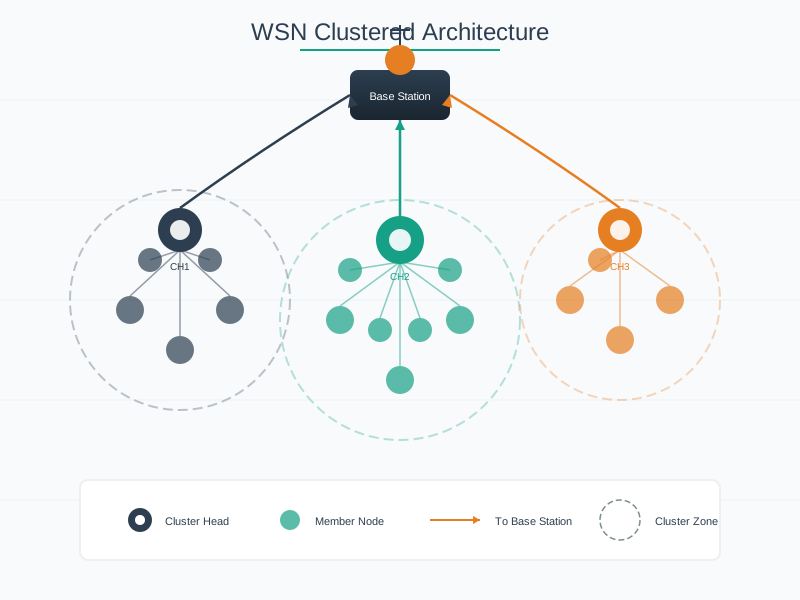
This figure depicts the hierarchical cluster-based WSN organization discussed in the routing section, showing how nodes organize into clusters for efficient data aggregation.
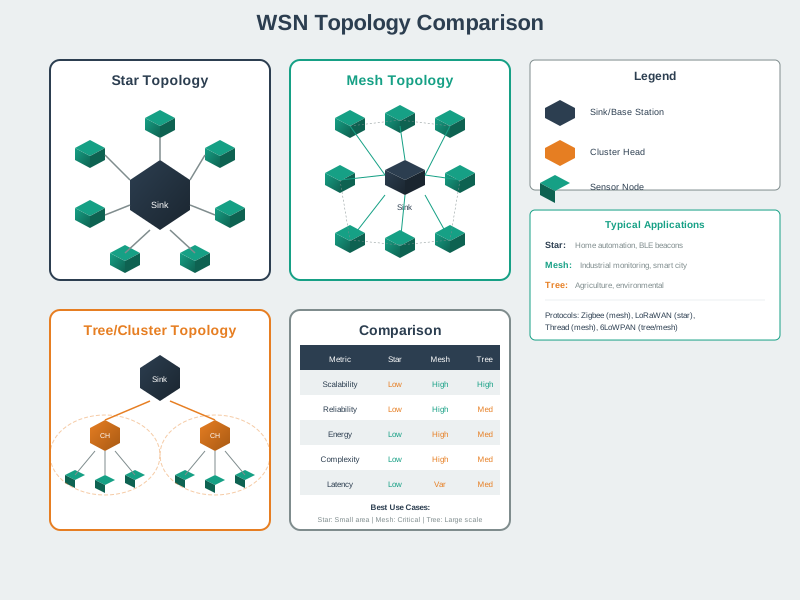
This visualization shows the network topology options covered in this chapter, illustrating star, mesh, and cluster-tree configurations for different application requirements.
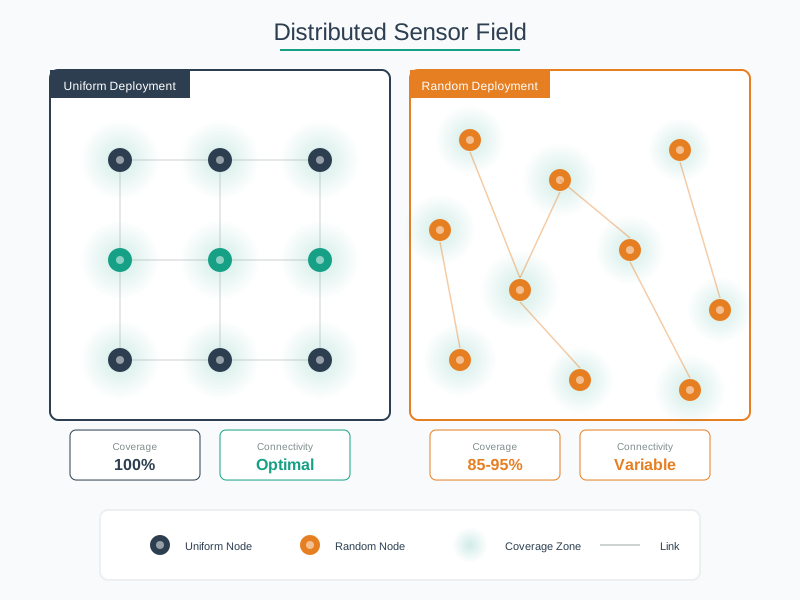
This figure illustrates sensor field deployment strategies discussed in the coverage section, showing how node placement affects monitoring effectiveness.
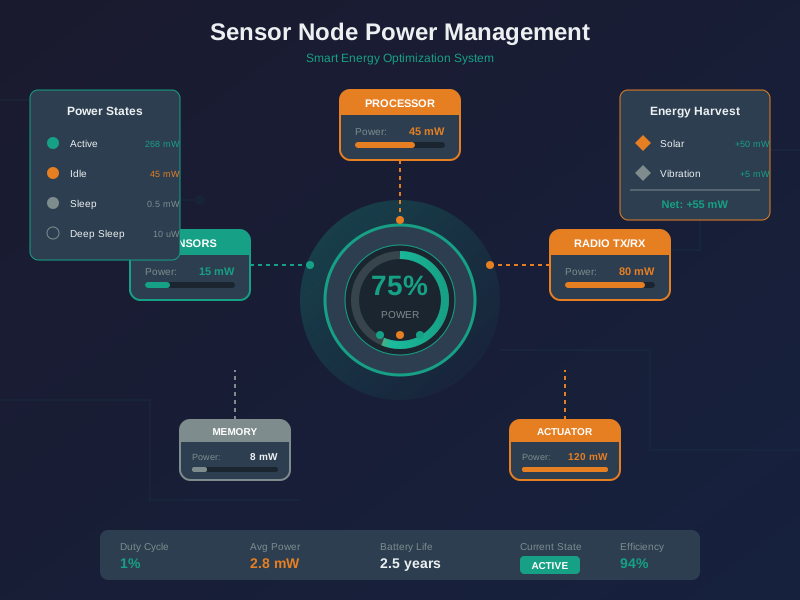
This visualization depicts the energy management concepts central to WSN design, showing how duty cycling and sleep scheduling extend network lifetime.
363.4 Common Pitfalls
The mistake: Deploying WSNs with uniform energy allocation, not accounting for nodes near the sink (base station) depleting batteries 5-10x faster because they relay traffic from distant nodes.
Symptoms:
- Nodes closest to the base station fail first, disconnecting the entire network
- Outer network regions remain functional but isolated
- Network lifetime is 20-30% of theoretical maximum
- Sudden network partition without warning
Why it happens: Teams design assuming uniform energy consumption, forgetting that multi-hop routing concentrates traffic through nodes near the sink. A node 1 hop from the base station relays data from potentially hundreds of nodes further away.
The fix:
# Energy Hole Mitigation Strategies
solutions:
  hardware:
    - Deploy solar-powered cluster heads near sink
    - Use higher-capacity batteries for relay nodes
    - Add redundant sink nodes at network edges

  routing:
    - Energy-aware routing (avoid depleted nodes)
    - Load balancing across multiple paths
    - Mobile sink that moves to distribute load

  topology:
    - Place sink at network center (not edge)
    - Deploy dense relay zone near sink
- Use hierarchical clustering (LEACH, HEED)Prevention: Calculate expected relay load before deployment. Nodes within 2 hops of sink typically handle 50-80% of total network traffic. Budget 3-5x battery capacity for these critical relay nodes, or use energy harvesting (solar, vibration) for cluster heads near the sink.
363.5 Worked Example: WSN Deployment Planning for Forest Environmental Monitoring
Scenario: A conservation organization needs to deploy 100 wireless sensors across a 500-hectare temperate forest to monitor temperature, humidity, soil moisture, and detect early signs of forest fires. The deployment must operate autonomously for 3+ years with minimal maintenance.
Goal: Design a complete WSN deployment plan addressing coverage, connectivity, power management, data collection routing, and environmental challenges.
What we do: Conduct thorough site survey and define operational requirements.
Site Characteristics Identified:
| Factor | Assessment | Impact on Design |
|---|---|---|
| Terrain | Rolling hills, 50m elevation variance | Affects radio propagation, requires terrain-aware placement |
| Vegetation | Dense canopy (80% coverage), seasonal leaf drop | 40-60% signal attenuation in summer, better in winter |
| Wildlife | Deer, bears, rodents present | Enclosure protection needed, elevated mounting |
| Weather | -20C to +40C, heavy rain, snow | Industrial-grade enclosures, temperature-compensated batteries |
| Access | Limited road access, hiking trails only | Solar power preferred, minimize maintenance visits |
Operational Requirements:
- Data collection: Every 15 minutes (fire season: every 5 minutes)
- Latency tolerance: 30 minutes for routine data, 2 minutes for fire alerts
- Battery life target: 3 years minimum (preferably 5+ with solar assist)
- Coverage: 100% of forest interior, 50m sensing radius per node
Why: Site assessment prevents costly deployment failures. The 40-60% signal attenuation from vegetation means we cannot use manufacturer’s “open field” range specifications.
What we do: Calculate sensor density for both sensing coverage and network connectivity.
Coverage Calculation:
Forest area: 500 hectares = 5,000,000 m2
Sensing radius: 50m -> Coverage area per sensor: pi x 50^2 = 7,854 m2
Minimum sensors for coverage: 5,000,000 / 7,854 = 637 sensors

With 30% overlap for redundancy: 637 x 1.3 = 828 sensors
Connectivity Calculation (more critical given terrain):
Radio range (manufacturer spec): 500m (open field, LoRa 868MHz)
Adjusted for vegetation: 500m x 0.5 = 250m effective
Adjusted for hills: 250m x 0.8 = 200m reliable range

Connectivity requirement (2+ neighbors per node):
= Area / (0.25 x Radio_Range^2)
= 5,000,000 / (0.25 x 200^2) = 500 sensors
Final Decision: Deploy 100 sensors as specified, but recognize this provides connectivity (not full coverage). Each sensor monitors ~5 hectares, suitable for fire detection (smoke rises and disperses) but not fine-grained soil analysis.
Network Topology: Cluster-tree with 10 clusters of ~10 nodes each, solar-powered cluster heads.
Why: Coverage vs. connectivity trade-off is critical. With 100 sensors over 500 hectares, we optimize for connectivity and fire detection rather than exhaustive soil monitoring.
What we do: Design strategic placement accounting for terrain, wildlife, and routing efficiency.
Placement Rules:
- Gateway Position: Central clearing at 200m elevation (hilltop with solar exposure)
- Cluster Head Positions: 10 locations on ridgelines for line-of-sight to gateway
- Sensor Node Positions: Valleys and slopes, maximum 200m from cluster head
Terrain-Aware Placement Map:
         North
           |
    [CH2]--[GW]--[CH1]   (Ridge line, 180-220m elevation)
      |     |     |
   [nodes] [nodes] [nodes]   (Slopes, 120-180m)
      |     |     |
    [CH3]  [CH4]  [CH5]   (Mid-ridge, 150m)
      |     |     |
   [nodes] [nodes] [nodes]   (Valleys, 80-120m)
      |     |     |
    [CH6]--[CH7]--[CH8]   (Southern ridge, 160m)
           |
         [CH9]--[CH10]   (Far south stations)
Wildlife Protection:
- Mount sensors 2m above ground on metal poles
- Use steel enclosures (IP67 rated) with tamper-resistant screws
- Cluster heads in locked weatherproof cabinets with solar panels angled away from wildlife access
Why: Ridgeline placement for cluster heads ensures reliable multi-hop paths. Wildlife protection prevents data loss from animal damage - a common failure mode in forest deployments.
What we do: Design power system for 3-5 year autonomous operation.
Energy Budget per Sensor Node:
Daily Operations:
- Sensing (4 sensors @ 5mA x 100ms x 96 readings): 0.048 mAh
- Radio TX (20mA x 50ms x 96 transmissions): 0.027 mAh
- Radio RX (listening window, 15mA x 200ms x 96): 0.08 mAh
- Sleep mode (23.99 hours @ 5uA): 0.12 mAh
- MCU active (processing, 10mA x 500ms x 96): 0.13 mAh

Total daily consumption: 0.405 mAh
Annual consumption: 148 mAh
3-year requirement: 444 mAh
Power Solution:
- Sensor nodes: 2x AA lithium batteries (3,000 mAh total) -> 7.4 years theoretical, 5+ years practical
- Cluster heads: 6x D-cell lithium (19,000 mAh each = 114,000 mAh) + 5W solar panel
- Gateway: 20W solar array + 100Ah deep-cycle battery + cellular backhaul
Seasonal Adjustment:
- Summer (fire season): Increase sampling to 5-minute intervals -> 3x energy
- Winter: Reduce to 30-minute intervals, compensate for reduced solar
- Adaptive duty cycling based on battery voltage readings
Why: Lithium batteries maintain capacity in extreme temperatures (-40C to +60C) unlike alkaline. Solar-assisted cluster heads handle the 5-10x higher energy consumption from traffic relay.
What we do: Implement energy-efficient routing with fire alert prioritization.
Routing Protocol Selection: Modified LEACH with geographic awareness
Normal Operation (Non-Emergency):
1. Sensor nodes wake every 15 minutes
2. Read sensors, check for fire indicators (temp spike, smoke pattern)
3. Transmit to cluster head using TDMA slot (no collisions)
4. Cluster head aggregates 10 readings into 1 packet
5. Cluster head forwards to gateway (1 hop on ridgeline)
6. Gateway uploads via cellular every 30 minutes
Emergency Mode (Fire Detection):
1. Sensor detects: Temperature >45C OR rapid rise >5C/minute
2. Immediate broadcast to cluster head (skip TDMA wait)
3. Cluster head relays with HIGH priority flag
4. Gateway sends immediate cellular alert
5. All sensors in affected cluster switch to 30-second monitoring
6. Adjacent clusters switch to 5-minute monitoring
Data Aggregation at Cluster Heads:
- Temperature: Report min/max/avg (3 values instead of 10)
- Humidity: Report avg only (1 value instead of 10)
- Fire alert: No aggregation - forward immediately with GPS coordinates
Why: TDMA scheduling eliminates collisions (major energy waste). Data aggregation reduces gateway traffic 70% while preserving critical information. Emergency bypass ensures <2 minute alert latency.
What we do: Design for seasonal changes, terrain effects, and failure scenarios.
Seasonal Adaptations:
| Season | Challenge | Mitigation |
|---|---|---|
| Spring | Flooding in valleys | Waterproof enclosures, 2m elevation minimum |
| Summer | Dense foliage, fire risk | Higher TX power (+3dB), 5-min sampling |
| Fall | Leaf drop, storms | Standard operation, check for damaged nodes |
| Winter | Snow accumulation, cold | Solar panel tilt, lithium batteries, reduced sampling |
Terrain-Specific Routing:
- Valley nodes: Always route uphill to ridgeline cluster heads
- Ridgeline nodes: Direct path to gateway when possible
- Backup paths: Each node maintains 2 alternate cluster head options
Failure Recovery:
# Failure detection and recovery
if not heard_from_cluster_head(timeout=1_hour):
    # Primary cluster head failed
    switch_to_backup_cluster_head()
    report_failure_to_gateway()

if not heard_from_any_cluster_head(timeout=4_hours):
    # Isolated - increase TX power and attempt direct gateway contact
    increase_tx_power(max_level)
    attempt_gateway_direct_contact(retry=3)
Wildlife Interference Mitigation:
- Vibration sensor detects tampering -> alert + photo (camera trap mode)
- Mesh redundancy: Any 2 nodes can fail without network partition
- Annual maintenance visit during fall (best access, post-fire-season)
Why: Environmental factors cause 60% of WSN deployment failures. Proactive design for seasonal variation and wildlife interference prevents costly emergency maintenance.
Outcome: Complete WSN deployment plan for 500-hectare forest monitoring with 100 sensors.
Key Decisions Made and Rationale:
| Decision | Choice | Rationale |
|---|---|---|
| Network topology | Cluster-tree (10 clusters) | Balances energy efficiency with reliability |
| Sensor placement | Terrain-aware, ridgeline cluster heads | Maximizes connectivity despite vegetation |
| Power system | Lithium batteries + solar for cluster heads | 5+ year operation without visits |
| Routing protocol | Modified LEACH with emergency bypass | Energy-efficient normal mode, fast fire alerts |
| Sampling rate | Adaptive (5-30 min based on season/alerts) | Conserves energy while meeting fire detection SLA |
| Enclosures | IP67 steel, elevated mounting | Protects against weather and wildlife |
Deployment Timeline:
- Month 1: Site survey, final placement mapping
- Month 2: Gateway and cluster head installation (requires hiking equipment)
- Month 3-4: Sensor node deployment (10 nodes/day with 2-person team)
- Month 5: System testing, calibration, route optimization
- Ongoing: Remote monitoring, annual fall maintenance visit
Expected Performance:
- Network lifetime: 5+ years (cluster heads), 7+ years (sensor nodes)
- Data delivery: 99.5% (mesh redundancy compensates for occasional failures)
- Fire alert latency: <2 minutes (emergency mode)
- Maintenance cost: 1 annual visit x $5,000 = $5,000/year
The mistake: Assuming sensor nodes maintain synchronized clocks without explicit time synchronization protocols, leading to data correlation failures and protocol breakdowns.
Symptoms:
- Sensor readings cannot be correlated (timestamps disagree by seconds or minutes)
- Time-slotted MAC protocols fail (nodes transmit in wrong slots, causing collisions)
- Event detection misses patterns that span multiple sensors
- TDMA schedules drift apart, wasting energy on retransmissions
Why it happens: Cheap crystal oscillators in sensor nodes drift 10-100 ppm (parts per million). At 50 ppm, clocks diverge by 4.3 seconds per day. After a week without resynchronization, nodes can be 30+ seconds apart.
The fix:
# Time Synchronization Approaches
class TimeSyncStrategy:
    """Choose based on accuracy requirement and energy budget"""

    # Reference Broadcast Sync (RBS) - receivers sync to each other
    # Accuracy: ~30 microseconds, Energy: Low (no extra transmissions)
    RBS = "best for loose sync (ms precision)"

    # Flooding Time Sync Protocol (FTSP) - root broadcasts time
    # Accuracy: ~1.5 microseconds, Energy: Medium
    FTSP = "best for tight sync across multi-hop"

    # GPS-based - external reference
    # Accuracy: ~100 nanoseconds, Energy: High (GPS receiver)
    GPS = "best for absolute time, outdoor deployments"

# Resync interval calculation
drift_ppm = 50  # Typical crystal accuracy
required_accuracy_ms = 10  # Application requirement
resync_interval_seconds = (required_accuracy_ms / 1000) / (drift_ppm / 1_000_000)
# Result: 200 seconds (~3 minutes between resyncs)Prevention: Always include time synchronization in WSN design. For event detection requiring <100ms accuracy, resync every 30-60 seconds. For TDMA MAC protocols, resync before each communication cycle. Monitor clock drift in telemetry to detect failing oscillators (drift >200 ppm indicates hardware issue).
Scenario: You’re designing a soil moisture monitoring WSN for a vineyard. Each sensor node must operate for 5 years on 2x AA batteries without replacement.
Given:
- Battery capacity: 2x AA alkaline = 2 × 2,850 mAh = 5,700 mAh (accounting for 85% efficiency at low drain: ~4,845 mAh usable)
- Target lifetime: 5 years = 43,800 hours
- Reporting interval: Every 15 minutes (96 reports/day)
- Sensor: Capacitive soil moisture sensor (3.3V, 5 mA active, 1 µA sleep)
- MCU: STM32L0 (3.3V, 7 mA active, 0.3 µA stop mode)
- Radio: LoRa SX1276 (3.3V, 120 mA TX, 12 mA RX, 0.2 µA sleep)
Step 1: Calculate energy per transmission cycle
| Component | Duration | Current | Energy (mAh) |
|---|---|---|---|
| Wake MCU | 5 ms | 7 mA | 0.000010 |
| Read sensor | 50 ms | 5+7=12 mA | 0.000167 |
| Prepare packet | 10 ms | 7 mA | 0.000019 |
| TX (SF7, 125kHz) | 50 ms | 120 mA | 0.001667 |
| RX window | 100 ms | 12 mA | 0.000333 |
| Total per cycle | 215 ms | - | 0.002196 mAh |
Step 2: Calculate daily energy consumption
- Active cycles: 96/day × 0.002196 mAh = 0.211 mAh/day
- Sleep current: (MCU 0.3 µA + radio 0.2 µA + sensor 1 µA) = 1.5 µA
- Sleep time: 24 hours - (96 × 215 ms) = 23.994 hours
- Sleep energy: 1.5 µA × 23.994 h = 0.036 mAh/day
- Total daily: 0.211 + 0.036 = 0.247 mAh/day
Step 3: Calculate lifetime
- Lifetime = 4,845 mAh ÷ 0.247 mAh/day = 19,615 days = 53.7 years
Step 4: Add safety margin and real-world factors
- Battery self-discharge: -15% capacity over 5 years
- Temperature effects (vineyard heat): -20% capacity
- Retransmissions (5% packet loss): +5% energy
- Adjusted lifetime: 53.7 × 0.85 × 0.80 ÷ 1.05 = 34.7 years
Result: The design exceeds the 5-year requirement by 7x, providing excellent margin for unexpected conditions. You could reduce battery size to 1x AA or increase reporting frequency to every 5 minutes if needed.
Key insight: Radio TX dominates energy (76% of active power), but with aggressive duty cycling (99.975% sleep), even power-hungry LoRa radios enable multi-decade battery life. The key is minimizing time in TX mode through efficient MAC protocols and appropriate spreading factors.
363.6 What’s Next?
Apply your WSN knowledge:
- WSN Routing: Study advanced routing protocols
- WSN Coverage: Optimize sensor coverage
- WSN Tracking: Implement target tracking systems